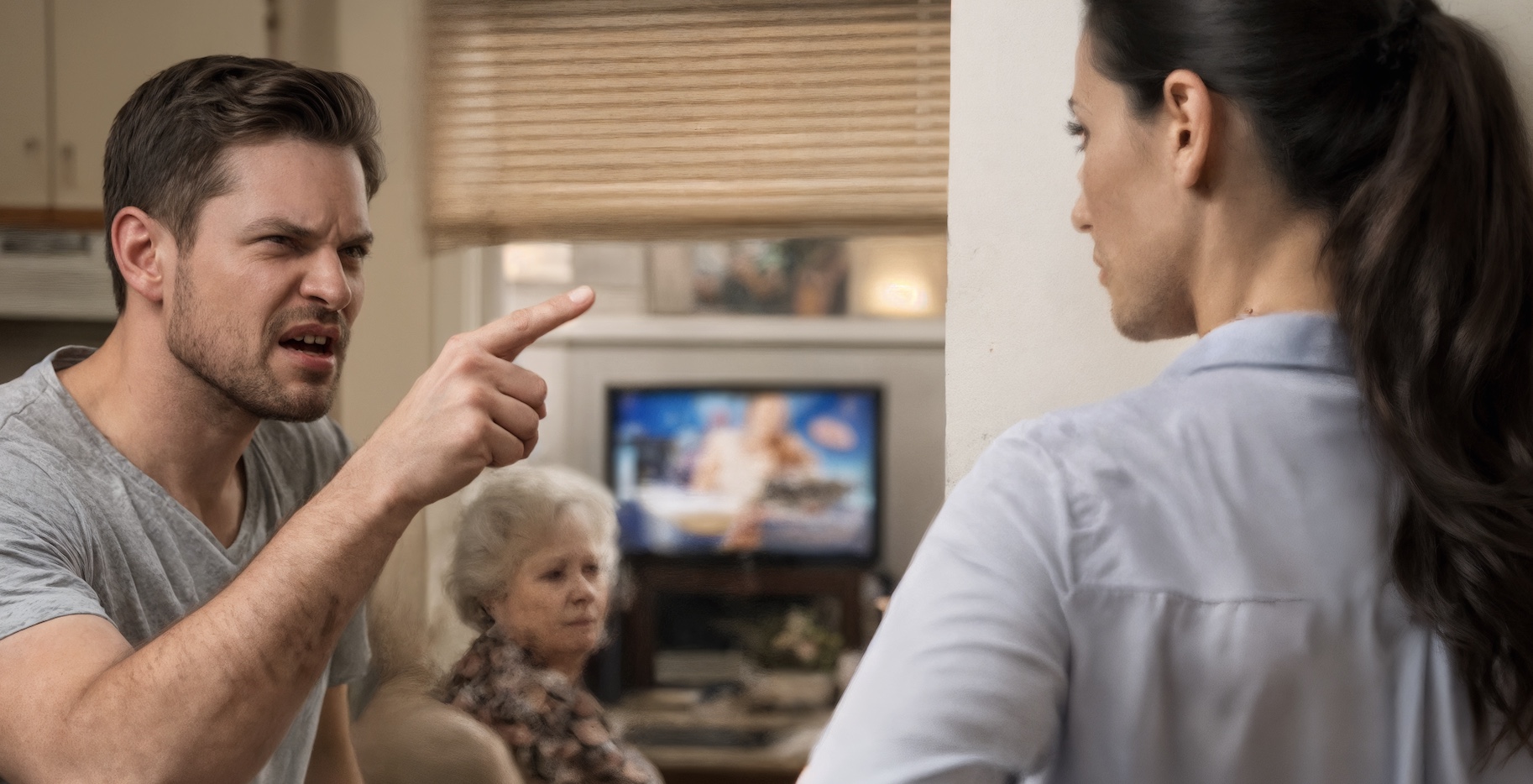
Kirill said it without even lifting his eyes from his phone. He sat in the kitchen in his briefs and a tank top, chewing a sandwich and scrolling his feed as if he’d just casually mentioned that it might rain tomorrow.
“Your career can wait! My mom is coming, and you’re going to stay with her. This isn’t up for discussion!”
I froze at the stove, a small coffee pot clutched in my hands.
My first impulse was to hurl the scalding coffee straight into my husband’s smug face. The second was to turn on my heel and leave—slamming the door hard enough to shake the plaster loose.
“Say that again, please,” I said, forcing my voice to stay even.
“Oh, Lena, don’t be such a child,” he finally looked up, irritation flickering across his face. “My mom’s sick. She can’t be alone. And you’re at the office all day. Look at you—some big boss now, huh?”
Outside, an October drizzle smeared the world in gray.
I stared at him… the man I’d been with for seven years. The man I’d had a child with, shared a bed with, shared debts with, shared plans for the future with. And I didn’t recognize him.
“Kirill, I’m the head of marketing at a company turning over half a billion rubles. I manage eight employees and a twenty-million-ruble project.”
“And?” He shrugged like it meant nothing. “They’ll find another manager. But I’ve only got one mom.”
The pot trembled slightly in my hands. The coffee began to rise.
“And you only have one son too, by the way.”
“Sasha’s in daycare all day—he’s not a problem. But my mom needs constant care.”
I took the pot off the burner and poured coffee into two cups as slowly as I could. I needed time to think.
My mother-in-law, Galina Petrovna, really had broken her leg recently. But “sick and helpless” was an absurd exaggeration.
At sixty-five she had more energy than most forty-year-olds: theater nights, meetups with friends, and an unstoppable habit of poking her nose into our family life every time she visited.
“When is she coming?” I asked.
“Next week. Monday.”
So he’d already decided everything. Talked it through with Mommy, built a plan, and then presented it to me as a done deal—like I was hired help being assigned a new shift.
“And what, you can’t work from home? You’re freelance, aren’t you?”
“Lena, you know a man can’t take care of an old woman. That’s not a man’s job.”
Not a man’s job!
But supporting the family while he’s been “finding himself” in design for the third year straight—that’s apparently a woman’s job. Paying the mortgage, covering daycare, buying groceries—also a woman’s job. And losing my job for his mother? Naturally expected.
“Kirill, what if I refuse?”
He looked at me like I’d asked what would happen if the sun didn’t rise tomorrow.
“Lena, don’t be stupid. My mom gave birth to me, raised me, devoted her whole life to me. And now I’m supposed to abandon her? You’re not a stranger, after all.”
There it was. “Not a stranger.” Meaning I was obligated to sacrifice everything for his mother. And the fact that I had my own life, my own plans, a career I’d built for ten years—that was just background noise.
I sat down across from him and wrapped my hands around the cup. The coffee burned my fingers, but the sting helped me focus.
“Fine,” I said. “Give me a little time to think.”
“What is there to think about?” Kirill was already turning back to his phone. “You’ll write a resignation letter and work your two weeks. End of story!”
And in that moment it clicked. He truly believed I would simply obey. No discussion. No compromise. Because I’m the wife. Because that’s how it’s “supposed” to be. Because Mommy needs it.
“Of course, darling,” I said in a honey-sweet voice. “Everything will be exactly the way you want.”
He didn’t even notice the sarcasm.
At work I couldn’t concentrate on anything. I sat through the daily meeting, nodded along, discussed layouts for a new campaign—while his words kept echoing in my head: “Your career can wait!”
“Lena, are you okay?” my deputy Oksana asked. “You’re pale. Something happened?”
“Just home stuff,” I waved it off.
By the end of the day, a plan had taken shape. Not the noblest plan—but a fair one. If my husband wanted to play a game where my opinion didn’t matter, fine. But I’d be the one writing the rules.
I knocked on the door of Marina Vladimirovna, our CEO. We’d worked together for five years and built real trust.
“Marina Vladimirovna, can I talk to you? Confidentially.”
“Of course, Lena. Sit down. What’s going on?”
I told her everything—my husband, my mother-in-law, the ultimatum. Then I explained what I wanted to do.
“I need unpaid leave. Two months—maybe a little more, maybe less. We’ll say it’s to care for a sick relative. Officially, I stay on the payroll, but I won’t be working.”
“And where’s the catch?” Marina Vladimirovna narrowed her eyes. She was experienced; she could tell I wasn’t being fully transparent.
“If my husband calls or comes here, I need you to tell him I quit. That I resigned voluntarily.”
Marina Vladimirovna was silent for a second—and then she laughed.
“Lena, you’re clever. You’re going to teach your tyrant a lesson?”
“Something like that. I want him to feel what it’s like when someone decides your life for you.”
“And what are you going to do at home—play housewife?”
“No. I’m going to be the most attentive daughter-in-law in the world,” I smiled. “So attentive they’ll get tired of it faster than they expect.”
“Fine,” she said. “Let the men learn a lesson. But with one condition: in two months you’re back. I’ve got a project that can’t run without you.”
“I think it’ll be sooner,” I assured her. “Thank you so much. I won’t forget this.”
I went home light and happy. For the first time in days, I felt like I was in control.
Kirill, as always, was in the kitchen with his phone. Sasha was building a tower of blocks in his room. A peaceful family evening—if you ignored the fact that my small rebellion was about to begin.
“Kir,” I said, dropping my bag onto the table. “I wrote my resignation.”
He lifted his head, and I immediately saw how surprised he was. Apparently he hadn’t expected me to fold so quickly.
“Seriously?” he asked.
“Absolutely. You’re right—family comes first. Your mom is sick, she needs care. And I can always find another job later.”
Kirill broke into a satisfied grin. His plan was working even better than he’d imagined.
“Good job, Lena. I knew you’d understand. Mom will be very happy.”
“Of course she will,” I said. “By the way, when exactly is she arriving?”
“Monday morning. I told you! The train gets in at eight.”
“Perfect. That gives me the weekend to prepare. I want to meet her fully armed.”
“What do you mean, ‘fully armed’?”
“I mean I’m going to learn everything about caring for someone with a fracture—put together a rehab routine, a meal plan. If I’m responsible for her health now, I’m going to do it professionally.”
Kirill nodded, but I caught a flicker of unease in his eyes. He’d probably expected resistance, not enthusiasm like this.
“Lena… you’re really not upset? I just thought you’d… complain more.”
“Why would I?” I shrugged. “You’re the man, the head of the household. If you think this is best, then that’s how it’ll be. I’ll be the best wife and daughter-in-law you’ve ever seen. You’ll see.”
Now he looked genuinely worried. I’d agreed too smoothly—too brightly for someone who’d been arguing just yesterday.
“Lena, are you sick or something?”
“Why would you ask that?” I feigned surprise.
“I don’t know… this is just weird.”
“Kir, you’re the one who wanted me to be a housewife. So I decided to be the perfect one. Your mother will get care she’s never had in her life.”
And that part was true. Galina Petrovna would absolutely get care—care she would remember with a shudder.
Saturday morning, I woke up at six and got to work. My husband was still asleep while I was already making shopping lists and reading up online about caring for older people with fractures.
“Lena, why are you up so early?” Kirill shuffled into the kitchen, hair a mess, wearing his lounge shorts.
“Preparing for your mom’s arrival, darling,” I chirped. “Look what I found!”
I held up a printed article about therapeutic diets for bone fractures.
“Turns out older people need a special menu. Lots of calcium, vitamin D, protein. No sweets, no fatty food, no salty food. And meals must be strictly scheduled—small portions every three hours.”
“Oh, come on,” Kirill yawned. “Mom’s not disabled. Regular food is fine.”
“Kirill!” I snapped. “How can you say that? Your mother is trusting us with her health. I can’t let her down.”
“But why make it so complicated…?”
“No complications,” I cut him off. “If I’m a housewife now, I’m going to do it properly. And I also read about rehabilitation exercises—every day, thirty minutes minimum, or the muscles start wasting away.”
Panic flashed in his eyes.
“Lena, maybe don’t go overboard? Mom came to rest, not to a rehab clinic.”
“To rest?” I widened my eyes. “Kir, she has a fracture! That’s serious. Without proper care there can be complications—blood clots, pneumonia…”
“Where are you even getting all this?”
“Research,” I said proudly. “I read medical articles all night. And I already ordered orthopedic pillows, a massage mat, and a special four-pronged cane.”
Kirill sat down at the table and stared at me.
“Lena, maybe we’re exaggerating?”
“We’re not exaggerating—we’re finally taking your mother’s health seriously,” I lectured. “And by the way, you’ll have to help too.”
“Me? But you said you’d—”
“Darling, I’ll cook, clean, manage her meds. But lifting your mom and helping her to the bathroom—that’s a man’s job. My back is weak; I could injure myself.”
“But you just said you could handle it…”
“And I will. We will—together. Like a real family!”
By Saturday evening, Kirill was visibly on edge. I dashed around the house with the intensity of a factory hero, rearranging furniture to create a “barrier-free environment,” buying half the pharmacy’s supply of supplements for bone strength.
“Lena, stop,” he begged when I moved the armchair in the living room for the third time.
“I can’t stop—your mom arrives tomorrow!” I panted. “By the way, we need to discuss the duty schedule.”
“What duty schedule?”
“Well, someone has to check on her at night. After fractures people get pain, they may need help. We’ll take turns—one hour you, one hour me.”
“Lena, have you lost your mind? What night shifts?”
“Kirill,” I said sternly, “this is your mother. Don’t you care about her well-being?”
He opened his mouth, but I didn’t give him time to argue.
“And I booked her with three doctors next week: an orthopedist, a cardiologist, and an endocrinologist. At her age she needs a full workup.”
“But she didn’t ask for any of that…”
“Whether she asked or not doesn’t matter. We’re responsible for her.”
Sunday, I woke up even earlier and started cooking a “diet borscht” with no sautéing and no salt. Kirill came into the kitchen looking like a storm cloud.
“Listen, Lena… maybe we should rent Mom her own apartment. Or put her in a sanatorium?”
“Kirill!” I threw my hands up. “How can you even say that? Your mother needs family warmth, the care of loved ones. And you want to hand her over to strangers?”
“But all these procedures, schedules…”
“It’s necessary,” I said firmly. “I’m not working anymore—I can devote myself fully to caring for her. By the way, I made a list of things we still need.”
I handed him a sheet: a bedpan, rubber gloves, a blood-pressure monitor, a glucose meter, special underwear, an anti-bedsore mattress…
“An anti-bedsore mattress?” he read aloud. “Lena, she’s not bedridden!”
“Not yet. Prevention is better than treatment.”
By Sunday night, Kirill looked like he wasn’t waiting for his mother—he was waiting for his own funeral.
“Lena… what if we postpone her trip? Say we’re renovating or something…”
“Absolutely not!” I huffed. “That poor woman already packed and bought a ticket. No—we’ll meet her properly. With love and care.”
Kirill let out a doomed sigh.
Galina Petrovna arrived Monday morning with two suitcases and expectations of a quiet vacation at her son’s place. She had no idea she’d walked straight into the arms of the most “caring” daughter-in-law on earth.
“Galina Petrovna, my dear!” I greeted her right in the entryway with open arms. “Finally! We’ve been so worried about your health!”
“Oh, what’s there to worry about, Lena,” she waved it off. “My leg’s almost healed. They’ll take the cast off in a week or two.”
“In a week?!” I gasped. “Mom, you can’t be serious! After the cast comes off, the most important stage begins—rehab. At least a month of recovery, maybe more!”
Kirill stood next to his mother looking like a man on death row.
“Mom… come in, sit down,” he mumbled.
“Do not sit!” I cut in. “You need to lie down. Long trip, stress—it’s terrible for bone tissue.”
I escorted my stunned mother-in-law to the bedroom, where an orthopedic bed I’d ordered the day before already stood waiting.
“What is this?” Galina Petrovna asked, staring at the adjustable medical bed with side rails.
“A special medical bed for injuries of the musculoskeletal system,” I explained. “The angle adjusts, the rails keep you safe. And the mattress is anti-bedsore.”
“Anti-bedsore?” she blanched. “Lena, I’m not bedridden!”
“Not yet,” I agreed darkly. “But at your age complications develop quickly. Better safe than sorry.”
The next days turned into a living nightmare. I had Galina Petrovna up at seven each morning for blood pressure and pulse checks.
“Mom, time to get up—morning exercises!”
“What exercises?” she groaned.
“Therapeutic ones! Without movement, muscles waste away. Breathing drills, joint mobility exercises, foot massage—everything according to medical guidelines.”
At eight: breakfast—plain diet porridge without salt or sugar, plus vitamin boosters.
“Lena, this is impossible to eat,” Galina Petrovna complained.
“But it helps your bones recover,” I replied, unwavering. “And after breakfast—supplements. Don’t forget!”
On the table stood a full battalion of jars and packets: calcium, magnesium, vitamin D3, collagen, chondroitin, omega-3.
“How much is all this costing?” Kirill whispered in horror.
“Health is more important than money!” I said. “And we also need glucosamine and hyaluronic acid—for the joints.”
By the end of the first week, Kirill looked squeezed dry. Night “shifts,” constant pharmacy runs, his mother’s complaints—everything exhausted him more than years of freelancing ever had.
“Lena,” he said Friday evening, “maybe we can loosen the schedule a little? Mom’s tired…”
“Tired?” I snapped. “Rehab isn’t a vacation. If we want your mother healthy, we work. And by the way…”
I pulled out a notebook with calculations.
“We’re running out of money for treatment.”
“Running out?” he blinked. “How?”
“Like this. Special food, supplements, medical equipment, orthopedic supplies—it’s expensive. We spent two hundred thousand in a week.”
“Two hundred thousand?!” Kirill went pale.
“And that’s only the beginning. Tomorrow we need a new round of vitamins, to order a massage chair, to pay for doctor visits. Another hundred thousand at least.”
“Lena, maybe we can skip the massage chair?”
“Kirill!” I gave him a wounded look. “That’s your mother. You want to save money on her health? A massage chair improves circulation and prevents blood clots. Or would you rather deal with a stroke later?”
“But we don’t have that kind of money…”
“Of course we don’t—because I’m not working anymore. We’ll have to spend your savings. But it’s for Mom…”
Kirill buried his face in his hands.
“Lena, maybe you should go back to work after all?”
“How can I?” I said, feigning astonishment. “Your mother needs constant care. Besides, I ‘quit’ because you insisted. They already replaced me.”
“But the money…”
“We’ll find money. Pull out your stash.”
“There isn’t much…”
“How much is ‘not much’?”
“Three hundred thousand,” he admitted reluctantly.
“Perfect,” I said brightly. “That’ll cover about a month. And then we’ll see.”
Galina Petrovna shuffled into the kitchen in her robe, worn out and furious.
“Lena, I can’t eat this grass anymore,” she complained. “And why do I have to swallow pills every two hours?”
“Mom, those aren’t pills—they’re vitamins,” I said patiently. “For recovery. And tomorrow is a very important day: a dietitian and a massage therapist.”
“A dietitian? For what?”
“I think our menu needs professional adjustment.”
Kirill watched us with the expression of a man realizing he’s trapped.
The next Monday, I woke Galina Petrovna at six-thirty for breathing exercises.
“Mom, up we go! Big day today: procedures first, then an osteopath, and in the evening—lymph drainage massage.”
“Lena,” she moaned, “I can’t do this anymore. Every day the same thing. I can’t eat what I want, I can’t sleep when I want…”
“It’s temporary,” I chirped, reaching for the blood-pressure cuff. “In a month or two you’ll be good as new! By the way, the doctor said we need to increase your calcium dose. And add another joint supplement.”
“Another supplement?” Kirill appeared in the doorway, looking terrified.
“High-strength glucosamine. A bit pricey—five thousand per box—but the results are incredible.”
“Lena, I don’t have any money left,” he croaked.
“How can you not? The savings?”
“Spent them. Every last bit.”
“Really?” I widened my eyes. “That was fast. Oh well—then we’ll sell something. Mom’s health comes first!”
That was the moment Galina Petrovna sat up in bed and declared, voice sharp and final:
“That’s it. Enough. I’m not disabled and I’m not dying. It’s a simple fracture that’s almost healed. I’m not eating this tasteless food, I’m not swallowing mountains of supplements, and I’m not getting up at dawn for gymnastics!”
“But Mom—”
“No ‘but’!” she snapped. “Kirill, pack my things. I’m going home. Today.”
“Mom, are you sure?”
“Absolutely. Better to be alone at home than in this madhouse. Lena, thank you for your ‘care,’ but this isn’t care anymore—it’s torture!”
I tried to protest.
“But Mom, rehab isn’t finished yet—”
“Finished, finished!” she waved me off. “I’m buying a ticket for the next train.”
Three hours later Galina Petrovna climbed into a taxi with her suitcases, leaving us alone with the medical bed, the pile of vitamins, and the sense that my plan had worked a little too well.
“That’s it. Finally,” Kirill said, watching his mother disappear.
He sank onto the couch and stared at the floor.
“You know,” he went on quietly, “I realized something. I was a complete idiot. I decided everything for you, forced you to quit, never even asked what you wanted.”
I stayed silent, letting him speak.
“It was your career. Your life. And I treated it like you weren’t a person at all—like you were some kind of… maid. I’m sorry. Please.”
His voice carried real remorse.
“If you want, you can start looking for a new job. I’ll never interfere again. I swear.”
I sat down beside him.
“Kir… I have news for you.”
“What now?” he asked, exhausted.
“I didn’t quit.”
He looked up, confused.
“What do you mean you didn’t quit?”
“I took unpaid leave. And I arranged it so that if you called my office or came in, they’d tell you I resigned.”
He sat there for a few seconds, processing it.
“So you… lied this whole time? You set me up?”
“I set you both up,” I admitted. “I wanted you to feel what it’s like when someone decides everything for you. I wanted to teach you a lesson.”
He stared at me, not blinking.
“So you did all that to my mom on purpose?”
“I didn’t torment her. The diet, the exercises, the supplements—those things really can help after fractures. It’s just that this level of care is usually for very serious cases, not a simple break.”
“And the money—you spent it on purpose too?”
“Of course,” I said. “You told me health is more important than money. So I took your words and made them real.”
Kirill rubbed his face with both hands.
“God… I was such an idiot.”
“You were,” I agreed. “But I think you won’t be again.”
“Lena, I’m sorry. For everything. For not valuing your work. For making decisions for you. I truly understand now—you have a right to your own life.”
“And my career?” I asked.
“And your career,” he nodded. “Grow, thrive—do whatever you want. I’ll be proud, not threatened.”
I wrapped my arms around him.
“You know what’s funniest? Your mom is going to tell all her friends what a devoted daughter-in-law she has. She just might also add that it’s better to stay far away from that kind of devotion.”
Kirill finally smiled.
“So what now?”
“Tomorrow I’m back at the office. I’ve got a twenty-million-ruble project waiting. And at home, we’re going to be a normal family—where decisions are made together.”
“Deal. And… Lena, can I ask you something?”
“What?”
“Can you make a normal dinner? I miss real food.”
I laughed.
“Sure. I’ll even add salt.”
The next morning, I walked into the office feeling like I’d won. The lesson was harsh—but fair. And most importantly, it worked.