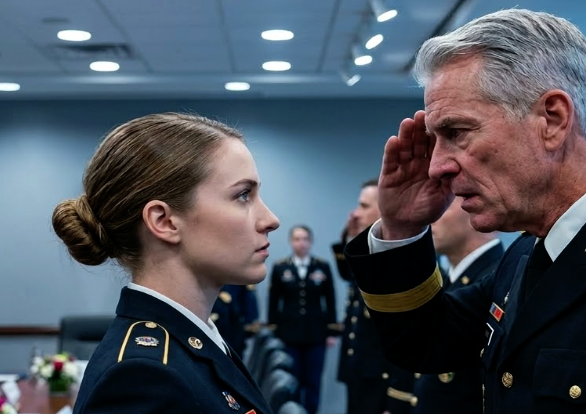
The air inside the briefing room at Peterson Air Force Base didn’t just circulate; it commanded. It was a sterile, pressurized environment where the scent of ozone and floor wax acted as a sensory reminder of the rigid hierarchy governing every soul within its walls. Row upon row of immaculate uniforms sat with spines aligned to the geometry of their chairs, eyes fixed forward. At the head of the mahogany table stood General Raymond McCoy, a man whose presence was defined not by his physical stature, but by the sheer weight of the four stars on his shoulders and the decades of uncompromising authority they represented.
I was his daughter, Lauren. But in this room, biology was an inconvenient footnote. I was a Major presenting a strategic proposal for an orbital satellite relay—a system designed to shave critical seconds off rescue operations in the Syrian corridor. I had lived in the data for months, refining the latency variables until they were flawless. But as I reached the crux of the presentation, my father’s voice cut through the air, cold and sharp as a bayonet.
“Stay seated, Lauren,” he said. The volume wasn’t high, but the authority was absolute. “Sit down. You’re nobody in this theatre.”
A ripple of suppressed laughter—the kind that sounds like dry leaves skittering across pavement—circulated among the senior officers. I stood frozen for a heartbeat, the laser pointer still trembling slightly in my hand. In that moment, I wasn’t a decorated officer; I was the “liability” from Christmas dinners past. I took my seat, the silence of the room pressing against my eardrums. My father didn’t look at me. He looked through me. He didn’t realize that by trying to erase my presence, he had finally completed the training he started when I was five years old. He had taught me how to become a ghost. To understand how I became Ghost 13, you have to understand the house in Alexandria where I grew up. It was a museum of meritocracy. The walls were adorned with commendations, historical sabers, and photographs of my father shaking hands with men whose names were etched into the granite of Washington D.C. In that house, silence wasn’t the absence of noise; it was a tactical requirement.
My mother, Clare, was a woman who moved through the world like she was trying not to disturb the dust. She loved me in whispers, always checking the hallway before offering a word of encouragement. “Don’t contradict him, Lauren,” she would say, her eyes reflecting the pale light of the Virginia suburbs. “Don’t make a scene. Just… be small.”
I learned early that survival meant invisibility. While other children were learning to speak their minds, I was learning to read the micro-expressions of a man who viewed emotion as a structural flaw. When I was accepted into the Air Force Academy, his reaction wasn’t pride; it was a challenge.
“You’ll last a week,” he had said, his knife clinking against the china.
“Then I’ll make it the longest week you’ve ever seen,” I replied.
That was the last time we spoke as kin. From that day forward, I was a competitor in a race he didn’t think I was qualified to run. What he failed to understand was that the very “emotionality” he mocked was actually a heightened state of situational awareness. I wasn’t being “sensitive”; I was collecting data. I was learning to anticipate the strike before the hand even moved.
The transition from a “nobody” analyst to a Tier-1 asset happened in a windowless room beneath a building that wasn’t on any map. It started with a man in a dark suit sitting across from me in the academy library. He didn’t ask for my name; he asked for my philosophy on systems.
“I like systems that operate in the gaps,” I told him.
A week later, I met Director Marla Keane. She was the architect of Ghost Division, a black-budget program that handled the missions the Pentagon couldn’t acknowledge. They didn’t recruit heroes; they recruited solutions.
The Ghost Creed: Invisibility as Utility
In Ghost Division, my identity was stripped away and replaced with a designation: Ghost 13. The number was a reminder that I didn’t need luck, and I didn’t need a legacy. I was trained in “Omega Protocols”—the ability to operate with autonomous authority when conventional command chains were compromised.
The Discipline of Observation: I spent months in sensory deprivation, learning to map digital landscapes by sound alone.
The Zero-Trace Doctrine: Every action had to be invisible. If a target died, it had to look like a heart attack or a glitch in the software.
The Weight of Anonymity: To be a Ghost is to accept that your greatest victories will never be toasted at a gala.
For seven years, I led a double life. By day, I was the “disappointing” analyst at Peterson Base, enduring my father’s public barbs. By night, I was the tactical eye in the sky, guiding SEAL teams through the valley of the shadow of death. The morning after the humiliation at Peterson, the world changed. I received an encrypted burst: Ghost 13. Standby. Extraction at 0400.
I was deployed to a command container near the Iraq-Syria border. The heat was a physical weight, the air tasting of pulverized stone and spent propellant. Colonel Lucas Grant, a SEAL commander who looked like he’d been carved out of the desert itself, was the only one who knew my true designation.
“Welcome back, Ghost,” he said, his voice a low rumble beneath the churn of Blackhawk rotors.
The mission was to recover a stolen satellite drive. My drone feed painted the desert in infrared—a world of heat signatures and hidden threats. As I tracked the target, a fragment of code flashed across my screen that made my blood turn to ice: RM command DC.
RM. Raymond McCoy. My father.
The code suggested that the breach wasn’t external; it was coming from the heart of my father’s office. Either he was being used as a shield, or he was the sword. For a moment, the daughter in me wanted to scream. The Ghost in me simply recalibrated the drone’s flight path.
The SEALS were pinned down by militia fire. I had to make a choice: follow the standard ROE (Rules of Engagement) which would take minutes for approval, or trigger an Omega strike. I chose the latter. Three precision bursts of light on my screen turned the enemy positions into plumes of dust.
“That’s why we call you Ghost,” Grant’s voice crackled in my ear.
I didn’t tell him that the data I had just secured linked my father’s primary aide, Colonel Haskins, to a global trafficking network known as The Drift. My father was the figurehead they were using to bypass security audits. He was too proud to notice the rot sitting at his own desk. Returning stateside, I was greeted by a summons to my father’s retirement gala. It was a room full of “Old Money” and older secrets. My father, now under a cloud of internal investigation he didn’t understand, wanted me there as a prop—a “grounded” daughter to make him look like a family man.
“No uniform, Lauren,” he’d told me over the phone. “Wear something pretty.”
I wore navy silk, the color of a midnight sky. But beneath the lace of my dress, I carried a high-gain microphone and a transmitter. The room was a sea of glittering medals and hollow laughter. I watched my father move through the crowd, his smile a practiced mask.
Then, I saw him. Colonel Haskins. He was huddled in a corner with a defense contractor from Lakestone Systems.
“The Saudis have the files,” Haskins whispered, unaware that my mic was capturing every syllable. “Keep the General in the dark. He’s too busy protecting his ‘legacy’ to notice a ledger shift.”
My pulse didn’t quicken. I had been trained for this. I transmitted the audio directly to Ghost Division. Within minutes, the “Drift” began to unravel. But Haskins was fast. He realized the breach was local. He used my own cloned credentials to frame me for the leak, turning the investigation back onto me. At 0300, my apartment door was kicked in. My father was there, flanked by MPs. He looked at me with disgust so profound it was almost beautiful.
“You betrayed your uniform,” he said. “You used your access to hack the Pentagon. Do you have any idea what you’ve done to my name?”
“I saved your name, Dad,” I said, my wrists in cuffs. “You were just too blind to see who was actually holding the pen.”
He slammed the table in the interrogation room. “You’re a hacker hiding behind a screen! You aren’t a soldier!”
“Better than a General hiding behind medals while his aide sells the country out from under him,” I replied.
He left the room and issued the order: Detain Ghost 13. Use lethal force if necessary. He didn’t know he had just signed a death warrant for his own child. The climax of the war didn’t happen in a desert; it happened in the same briefing room where he’d told me to sit down. I had escaped custody with the help of Colonel Grant and Director Keane. I walked back into that room not as a prisoner, but as an Omega.
The room was filled with the same faces as before, but the atmosphere had shifted. The air was heavy with the scent of a collapsing empire. My father sat at the head, his face a map of exhaustion.
“Status and identifier,” I said, my voice carrying a resonance that silenced the room.
“Lauren, sit down—” he began, the old reflex kicking in.
I didn’t sit. I placed a silver badge on the table. It had no name. Just a number: 13.
“Ghost 13. Clearance Level 5. Omega Protocol,” I stated.
The silence that followed was absolute. It was the sound of a man’s world-view shattering. I played the recording from the gala. I showed the data logs of Haskins mirroring my IP. I showed the proof that my “disappointing” career as an analyst was a cover for the most elite tactical command in the country.
When the recording of Haskins admitting to using the General’s pride as a shield finished playing, the room didn’t move. My father looked like a man who had been struck by lightning but was still standing by force of habit.
“You signed an order to kill me,” I said softly.
“I didn’t know,” he whispered.
“That’s the problem, Dad. You never do.”
I turned and walked out. For the first time, the entire room—Generals, Colonels, and aides—stood. They didn’t stand for my father. They stood for the Ghost. Ten years have passed since that day. The “Drift” was dismantled, Haskins is serving a life sentence, and my father is in a forced retirement that feels more like a long, quiet penance. We meet sometimes at a café in Colorado. He still struggles with the language of equality, but he’s trying.
I am now the Deputy Operations Lead for Ghost Division. I spend my days training the next generation of solutions. Yesterday, I saw a young cadet named Emily. She was crying behind the hangars because her father told her that flying wasn’t for girls. I walked up to her, not as a superior officer, but as someone who knew the weight of that silence.
“Your father may give you your name, Emily,” I told her, resting a firm hand on her shoulder. “But you’re the one who decides how high it can fly.”
I watched her jet lift off an hour later, a silver needle sewing the clouds together. The wind caught my hair, and for a fleeting second, I heard the echo of that briefing room: Sit down, Lauren.
I smiled. The sky has no chairs. And the truth about ghosts is that once they stop hiding, they don’t just disappear. They become the wind that carries everyone else higher.