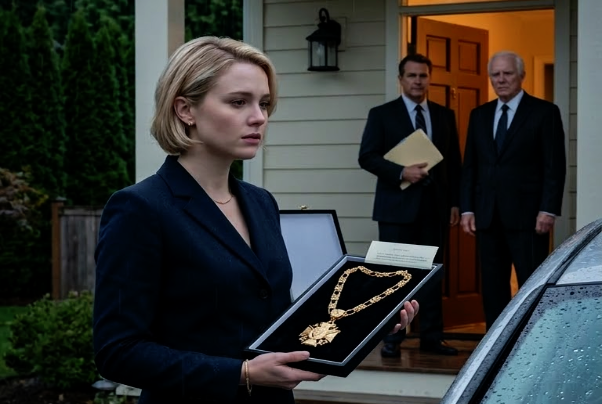
The rain in Auburn, Washington, does not merely fall; it occupies. It is a persistent, gray presence that seeps into the wood of old houses and the silences between people. I stood in my father’s garage, a space that once smelled of promise and mechanical precision—of motor oil, sawdust, and the sharp tang of metal. But that morning, the atmosphere had shifted. The silence was no longer the comfortable quiet of a workshop; it was the hollow ring of a crime scene.
My eyes drifted to the far corner shelf, where a metal box had sat for years. It was a repository of my decade in the Air Force—medals, commendations, and letters that recorded a life I had lived in the shadows of cargo bays and the heat of sandstorms. The box was gone. In its place was a clean, dust-free rectangle, a mocking geometry of absence. Beside it lay a note written in bright pink glitter pen, the ink shimmering with a jarring, adolescent cheerfulness: “Don’t worry, I’ll make good use of them. Love, Sabrina.”
My sister, Sabrina, had always viewed the world through the lens of immediate gratification. To her, history was a burden and objects were merely liquid assets. I felt something inside me crack—not with the loud snap of anger, but with the quiet, terminal groan of a foundation giving way. I realized then that I had spent years practicing “endurance” under the guise of family loyalty. But as I stared at that empty shelf, I understood a fundamental truth: Endurance isn’t love; it is a slow, dignified surrender. A week later, in my apartment in Seattle, the digital world delivered the second blow. A notification appeared on my screen: “Recommended for you: Authentic Air Force medal set.” I clicked the link, and there it was. My life, listed for $250 by a seller named “Bina Sunrise.”
The price tag was perhaps the most profound insult. Ten years of service, of missions that had no names, of friends who never came home, had been appraised by my own sister at the cost of a wedding photographer’s deposit. When I called her, she didn’t even offer the grace of a lie.
“They were just sitting there collecting dust, Rhonda,” she laughed, her voice bright and careless. “I needed the cash. I’ll buy you a new set—they’re just things.”
She didn’t understand that these were not “things.” Each medal carried a digital fingerprint, a serial number linked to federal records. Specifically, the medal from the humanitarian mission—coded HUM Z2QF—was tied to Operation Dawnlight, a restricted Syrian operation. It was an item that, by federal law, was never supposed to leave my custody, let alone be trafficked on a public marketplace.
I reached out to my father, hoping for a tether of shared values. His response was a masterclass in the generational obsession with “keeping the peace” at the cost of the truth. “Let it go, Rhonda,” he texted. “It’s just stuff. Don’t ruin your sister’s big day over old junk.”
But the “stuff” had already triggered a silent alarm. Somewhere in the labyrinth of the Office of Special Investigations (OSI), a logistics officer had flagged the serial number. The machinery of the state was already turning, cold and indifferent to family dynamics. Two days later, the “peace” my father so desperately craved was shattered. I received a frantic call from him, his voice raw with a panic I had never heard.
“The feds are here, Rhonda! They’re at the house! They’re taking Sabrina in handcuffs! What have you done?”
I stood by my window, watching the Seattle rain hammer against the glass. “I didn’t do anything, Dad,” I said quietly. “Sabrina did.”
The investigation escalated with terrifying speed. Within hours, I was summoned to D.C. by Lt. Cole Marcus Hail of the OSI. The transition from a Boeing conference room to a sterile interrogation suite at the Pentagon annex was surreal. Marcus was a man of sharp angles and sharper questions. He didn’t care about my sister’s wedding or my father’s stroke; he cared about the “breach.”
The irony was palpable: while I was being grilled by federal agents, my sister was busy becoming a digital martyr. She released a video that went viral within hours. With smeared mascara and a trembling lip, she told the world about her “heartless” soldier sister who had called the government on her own family over “trinkets.”
The public backlash was a tidal wave. I was called a “military robot,” a “betrayer of blood,” and a “monster.” It was a classic example of modern narrative warfare: the one who screams the loudest is often mistaken for the one who tells the truth. But Marcus Hail gave me a piece of advice that would become my mantra: “The noise will pass, but integrity leaves a mark. Make sure yours stands for something.” As I began consulting for the newly formed Lost Honors Recovery Initiative, I realized that Sabrina’s theft was not an isolated incident of sibling greed. It was a symptom of a much larger, darker “pipeline.”
Marcus and I spent weeks auditing marketplace data. We discovered a sophisticated network of traffickers who targeted the families of veterans. They looked for “weak spots”—siblings or children who viewed military honors as “junk” and were looking for a quick payout.
Examples of the “Pipeline” in Action:
The Tacoma Case: A nephew sold his grandmother’s Purple Heart to an “estate liquidator” who was actually a broker for offshore collectors. The grandmother, a WWII nurse, collapsed from the shock when she found the empty velvet box.
The Portland Handoff: A collection of restricted commendations was funneled through an antique shop that specialized in “military history,” which served as a front for a multi-state trafficking ring.
The Digital Mules: Younger relatives were paid in cryptocurrency to list “estate finds” on various platforms, creating layers of anonymity that made it nearly impossible for the OSI to trace the original source.
We tracked my own medals to a shop called Stonemill Antiques in Virginia. When we walked in, the dealer didn’t see two government officials; he saw two obstacles to his profit margin.
“You want to punish someone?” the dealer sneered, his eyes flicking to the security camera he had conveniently disabled. “Punish the families who bring their junk here. I’m just the middleman.”
It was there that I saw him—a man I would come to know as “Mills.” He was the handler, the one who convinced people like Sabrina that they weren’t thieves, they were just “entrepreneurs.” He recognized me instantly, thanks to my sister’s viral video.
“You’re the sister,” he said with a cold, calculated smile. “Tell your family to stop talking online. It draws the wrong kind of attention.” The investigation led us back to where it all began: my father’s house in Auburn. We arrived at 3:00 AM, the atmosphere thick with the smell of old carpet and unspoken regrets. My father, still recovering from a minor stroke, met us at the door with a bitterness that felt like a physical weight.
“You’re not taking anything else from this house,” he growled.
But the garage told a different story. Another empty space had appeared on the shelf. My father’s own records—letters from commanders and unit logs—had been touched. We found more restricted items hidden in a tool chest, ready to be “liquidated.”
“I didn’t know what they were,” my father whispered, his pride finally fracturing. “I didn’t know they meant… this.”
This was the moment of reckoning. My father had spent his life raising me to be “tough,” which to him meant being quiet. He had raised Sabrina to be “happy,” which to her meant having whatever she wanted. He realized, too late, that by demanding my silence, he had given Sabrina permission to destroy me. We set a trap for Mills at a quiet parking lot outside a chain hotel. Sabrina, now terrified and facing federal charges, was our bait. She was the “mule” who was supposed to deliver my signed apology and a retraction of the charges in exchange for the return of the medals.
As I sat in the car beside her, watching her hands shake, I didn’t feel triumph. I felt a profound sadness for the woman she had become. She wasn’t a criminal mastermind; she was a hollow person who had been filled with the greed of others.
When Mills appeared, the exchange was quick and clinical. He dropped the bag containing my medals, but not before he made a final, spiteful gesture. He let the case hit the asphalt, the lid cracking with a sickening sound. The medals scattered across the wet pavement, small flashes of silver and gold under the flickering streetlights.
I knelt and gathered them, one by one. I didn’t scream. I didn’t cry. I simply reclaimed what was mine. A year after the hearing at the Pentagon, the “noise” had finally settled. Sabrina was barred from federal work and fined heavily, but the real punishment was the silence. She had lost her audience. Without the drama, she was forced to look at the life she had built on the wreckage of others.
I remained in D.C. as the National Director of the Lost Honors Recovery Initiative. My office overlooked the Potomac, and on my desk sat the cracked metal box, still bearing its red evidence tag. It was a reminder that accountability isn’t paperwork; it’s character.
My father eventually sent me a letter. It wasn’t an apology in the traditional sense—men like him don’t apologize with words—but it was a bridge.
“Rhonda, I was wrong. Not about the world, but about you. You didn’t break the family. We broke you, and you still stood up. —Dad”
As I look back on that rainy morning in the garage, I realize that the $250 price tag was the best thing that ever happened to me. It forced me to stop “enduring” and start living. It taught me that home isn’t a place you return to; it’s a principle you carry within you.
The “stuff” was never just stuff. It was the physical evidence of a life lived with purpose. And while the case may be cracked, the honor inside is, for the first time, entirely mine.