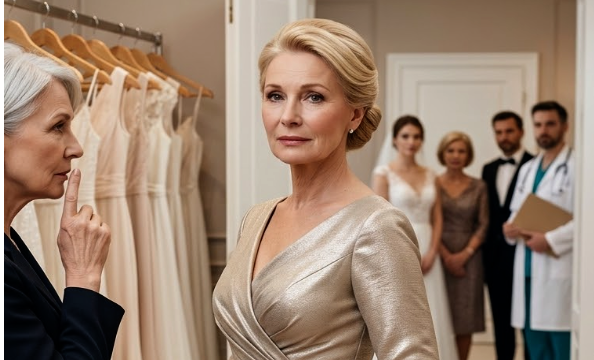
The bell above the door of Whitmore’s Boutique chimed with a delicate, silver resonance, a sound that had greeted the elite women of Greenwich, Connecticut, for four decades. The air inside was an olfactory tapestry of lavender sachets, expensive silk, and the faint, metallic scent of high-end tailoring. It was June, the height of the wedding season, and I was there for the final fitting of my champagne gold gown—the dress I would wear to see my only daughter, Rachel, marry Derek Pierce.
Rebecca Williams, the boutique’s owner, was a woman of iron-clad composure. She had fitted my own wedding dress in 1983, a year of puff sleeves and boundless optimism. But as she emerged from a forest of tulle and organza today, her normally steady hands were trembling. Her face, usually a mask of professional serenity, was pale, her lips pressed into a thin, bloodless line.
“Catherine,” she whispered, her voice barely audible over the soft jazz playing in the background. “We need to talk. Now.”
Before I could ask if there was a flaw in the silk or a delay with the hem, she reached past me, locked the front door, and flipped the sign to Closed. The sudden silence of the shop felt heavy, subterranean. She took my elbow with a grip that was almost painful and guided me toward the VIP suite—a soundproofed room hidden behind a velvet curtain and a display of hand-painted Italian scarves.
“Stay here,” she breathed, her eyes darting to the wall that shared a boundary with the neighboring high-end cafe’s private terrace. “Don’t say a word. Just… listen.”
She killed the lights. I was plunged into a golden-hued darkness, the only illumination being the thin sliver of light beneath the door. At first, there was only the hum of the air conditioning. Then, voices filtered through the vents—muffled, yet distinct.
“The power of attorney amendment is on page seven,” a man’s voice said. It was smooth, curated, and instantly recognizable. It was Derek, my future son-in-law. “She’ll sign it Saturday night after the first dance. The champagne will be flowing, the emotion will be high. She won’t even read the fine print.”
My heart hammered against my ribs like a trapped bird.
“Are you sure this is the only way?” This was Rachel. Her voice was small, hesitant, stripped of the confidence I had spent thirty years instilling in her.
“Rachel, look at the documentation,” Derek replied, his tone shifting to one of practiced empathy. “She’s slipping. We’ve discussed this.”
A third voice joined them—clinical, measured, and terrifyingly familiar. “I’ve documented five distinct incidents of cognitive decline over the last ninety days. Confusion regarding dates, repeating herself in board meetings, and that episode with the client’s name in April. Once the power of attorney activates, I’ll file the competency assessment. We can initiate the asset transfer to Cascade Holdings within seventy-two hours.”
It was Dr. James Caldwell. Our family neurologist. The man who had sat by my husband Thomas’s bed as he passed, the man I had trusted with my own health for five years.
“The Thomas Morrison Memorial Trust holds fifteen million,” Derek continued, the sound of a pen scratching against paper audible through the vent. “The moment she’s declared legally incompetent, you become the sole trustee. Combined with the company’s current valuation and the planned merger… we’re looking at forty-seven million total. It’s for her own protection, Rachel. Evergreen Manor is the best facility in the country. She’ll be safe there.”
“Evergreen?” Rachel whispered. “That’s… that’s a locked ward, Derek.”
“For her safety,” he repeated.
In the dark of the VIP room, I bit my lip until I tasted the copper tang of blood. They weren’t just planning a wedding; they were planning a funeral for my life. Rebecca’s hand found mine in the dark, squeezing tight. We sat there in the shadows until the voices faded, the scrape of chairs signaling the end of their macabre business meeting.
When Rebecca finally turned the light back on, her eyes were swimming with tears. “I’m so sorry, Catherine. They were here last week, too. I didn’t want to believe it, but I had to tell you.”
I looked at the garment bag containing my champagne gold dress. It hung there like a ghost of the woman I was supposed to be—the happy mother of the bride, blissful and blind.
“Thank you, Rebecca,” I said, my voice sounding like it belonged to someone else. “I’ll take the dress now.” As I drove away from the boutique, the lush greenery of Greenwich seemed to blur into a monotonous smear of color. I wasn’t just grieving a betrayal; I was dissecting a masterpiece of manipulation.
Thomas had died in 2009, leaving me with a grieving daughter and a consulting firm, Morrison Strategic, that was $800,000 in debt. I had spent fifteen years in the trenches, working eighty-hour weeks, reclaiming our legacy. I had raised Rachel to be my successor, giving her a front-row seat to the grit required to build an empire. By 2019, we were a $25 million powerhouse.
Then came Derek Pierce in January 2022.
He arrived with a Yale MBA and a smile that seemed to promise stability. He was charming, efficient, and quickly became indispensable. I saw the way he looked at Rachel, and I thought I was seeing love. In reality, I was seeing an acquisition strategy.
The gaslighting had been surgical. It began in November during a Q3 projection meeting. I had been mid-sentence when Rachel interrupted, a look of faux-concern on her face. “Mom, you already said that two minutes ago.” I had checked my notes, confused. I didn’t think I had. Derek had placed a hand on my shoulder, his voice a soothing balm. “Maybe it’s just the stress, Catherine. Why don’t you take the weekend off?”
By March, I was second-guessing my own shadow. I was checking my calendar three times a day, writing down every conversation, wondering if the “cognitive decline” they hinted at was a delayed reaction to the trauma of losing Thomas. I had walked into Dr. Caldwell’s office for “routine” checkups, unaware that he was the architect of my medical demise, likely bought and paid for by Derek.
But now, the fog had lifted. I didn’t have dementia. I had a predator in my house.
I pulled into the drive of the Morrison Estate, the Victorian home Thomas and I had bought in 1995. It was a house built on the foundation of honest work. I sat in the driveway and looked at the oak tree Thomas had planted the year Rachel was born.
“I will not let them take it,” I whispered to the empty car. “I will not let them take anything.” I had forty-eight hours until the wedding. Forty-eight hours to save $47 million and my own freedom.
My first call was to Sarah Goldman, my corporate attorney and a woman who had survived three decades in the shark-infested waters of Manhattan law. We met at her office in a glass tower in Stamford at 8:00 PM.
“This is an emergency health proxy amendment,” Sarah said, her reading glasses perched on the bridge of her nose as she scanned the photo Rebecca had managed to snap of the document. “Section 4.3 is the kill switch. It’s written as a symbolic transfer of thirty percent of voting rights to the ‘Acting CEO’—Rachel—to ‘streamline operations.’ But page seven links that transfer directly to a certification of cognitive impairment. If you sign this at the reception, and Caldwell files his report Monday morning, you are legally a ward of the state by Wednesday.”
“Can we stop it?” I asked.
“We can’t just stop it, Catherine. We have to trap them. If we file a lawsuit now, they’ll liquidate what they can and disappear. We need a definitive strike.”
She handed me a card. David Reyes. Private Investigations. Financial Fraud Specialist.
“He’s an ex-FBI,” Sarah said. “If Derek Pierce has a skeleton in his closet, David will find the entire graveyard.”
I met David at a nondescript diner on Route 1 at midnight. He was a man of few words and silver hair, with eyes that seemed to see through walls. I told him everything. When I mentioned Thomas, he paused, his pen hovering over his notebook.
“Thomas Morrison?” he asked. “The man who testified in the 2008 Ponzi investigation?”
“Yes,” I said. “That was my husband.”
David set his pen down. “Your husband saved my career, Catherine. He was the only one with the guts to provide the documentation we needed. I’ve been looking for a way to pay back that debt for fifteen years. Consider me hired.” By Friday afternoon, less than twenty-four hours before the ceremony, David Reyes arrived at my study with a leather briefcase. Inside were three folders: Red, Blue, and Black.
“Folder One: The Red Folder,” David began. He slid a photograph across the desk. It showed Derek Pierce shaking hands with a man in a dark suit on a street corner in Queens. “That’s Dmitri Vulov. He’s an enforcer for a Russian gambling syndicate. Derek isn’t just a CFO; he’s a high-stakes degenerate. He owes them $2.5 million. The deadline is June 30th. If he doesn’t pay, he’s a dead man. This isn’t just about greed, Catherine. This is about survival.”
My stomach churned. My daughter was marrying a man who was using her inheritance as a life raft.
“Folder Two: The Blue Folder,” David continued. “Corporate sabotage. Over the last eighteen months, Derek has been systematically devaluing Morrison Strategic. He’s been leaking client lists to your top competitor, Stratton Advisory, for kickbacks. He’s been intentionally missing deadlines on major contracts. He’s reduced the company’s book value by $7 million so that the ‘merger’ he’s planning with Cascade Holdings—a shell company he controls—looks like a necessary bailout.”
“And the Black Folder?” I asked, my voice trembling.
“Dr. James Caldwell,” David said, his voice turning cold. “He’s a predator. I found three other cases in the last six years. Margaret Hastings, Howard Bennett, Patricia Donovan. All wealthy, all elderly, all declared incompetent by Caldwell. Their estates were liquidated by ‘trusted’ family members who then paid Caldwell ‘consulting fees’ ranging from $40,000 to $75,000. Margaret and Howard are dead. Patricia is in a nursing home in New Jersey, but she’s still lucid. And she’s furious.”
I looked at the evidence. The bank transfers, the offshore accounts, the forged medical records. It was a trifecta of evil: a gambling addict, a corporate traitor, and a medical mercenary.
“What about Rachel?” I asked, the question I was most afraid to hear the answer to.
“I tracked a conversation she had with Derek in the kitchen last night,” David said, sliding a digital recorder across the desk.
I pressed play.
“Derek, I can’t do this,” Rachel’s voice sobbed. “She’s my mother. We’re taking her house. We’re putting her in a home.”
“We’re saving her, Rachel,” Derek’s voice was like ice. “The doctor said she’s a danger to herself. Do you want her to burn the house down with her inside? Sign the papers, or I’m leaving. I can’t watch you let her destroy herself.”
Silence followed. Then, the sound of Rachel weeping.
She wasn’t a mastermind. She was a victim of the most cruel form of psychological warfare. He had used her love for me and her fear of loss to turn her into his accomplice. The wedding day arrived with a cruel, mocking brilliance. The sun sparked off the ripples of the Long Island Sound, and the Lake View Country Club was a sea of white lilies and expensive cologne.
I walked Rachel down the aisle. Her hand was ice-cold in mine, and her eyes were hollow, hidden behind a veil of delicate lace. Derek stood at the altar, looking every bit the Yale-educated savior.
The ceremony was a blur of lies. When the officiant asked who gave this woman to be married, I said, “I do,” and felt the weight of the recording in my clutch purse.
The reception began at 7:00 PM. The string quartet played “At Last” as the newlyweds took the floor. Derek leaned in, whispering into Rachel’s ear, likely reminding her of the “gift” they needed me to sign.
At 8:30 PM, the MC tapped the microphone. “And now, a few words from the Mother of the Bride.”
I walked to the podium. The room fell silent. 180 of the most influential people in Connecticut sat before me, including Dr. Caldwell and several board members of Morrison Strategic. In the back, David Reyes and four plain-clothes officers stood by the exits.
“Marriage is built on trust,” I began, my voice amplified by the speakers, echoing off the silk-lined walls of the tent. “It is a partnership of souls. My husband Thomas understood that. He built a legacy not of money, but of integrity.”
I looked directly at Derek. His smile was beginning to falter.
“I spent this week thinking about legacies. And I discovered that some people prefer to build their fortunes on the ruins of others.”
I clicked a remote in my hand. The large projector screen behind me, which was supposed to show a slideshow of Rachel’s childhood photos, flickered to life.
Instead of a toddler in a sandbox, the screen displayed a bank statement. A wire transfer of $75,000 from Cascade Holdings to Dr. James Caldwell.
Gasps rippled through the room. Caldwell stood up, his face turning a sickly shade of grey.
“This,” I said, my voice rising, “is the price of a dementia diagnosis. $75,000 to buy a doctor’s soul.”
I clicked the remote again. The screen showed the “Red Folder” photo—Derek and the Russian enforcer.
“And this is Derek Pierce, our CFO, meeting with a known gambling syndicate to discuss how he would use the Morrison Trust to pay off a $2.5 million debt.”
The tent erupted. Derek lunged for the podium, but two of David’s men intercepted him, pinning him against a table of crystal glassware.
“Mom!” Rachel screamed, her hands over her mouth.
“Wait, Rachel,” I said, clicking the remote one last time.
The screen showed page seven of the power of attorney. I had highlighted the “Kill Clause” in bright, neon red.
“This was the wedding gift Derek had planned for me. A one-way ticket to a locked ward at Evergreen Manor so he could liquidate Thomas’s legacy and flee to the Caymans.”
I looked at the board members. “The emergency injunction was filed an hour ago. Every account associated with Derek Pierce and Cascade Holdings is frozen. Every leaked client list has been traced back to Derek’s personal server.”
The lead officer stepped forward, his badge gleaming under the chandeliers. “Derek Pierce, Dr. James Caldwell—you’re under arrest for conspiracy, wire fraud, and elder financial abuse.”
As they were led away in handcuffs, the room was a cacophony of shock. Derek was shouting, his mask of Ivy League polish finally shattered. Caldwell walked in a slumped, defeated silence.
I walked over to Rachel, who had collapsed into her chair, her white dress spread around her like a broken wing.
“I didn’t know, Mom,” she sobbed. “He told me you were sick. He told me it was the only way to save you.”
I knelt beside her, ignoring the stares of the 180 guests. “I know he did, sweetheart. And that is why we are going to fix this. Together.” It has been one year since the wedding that ended in handcuffs.
Derek Pierce is currently serving a twelve-year sentence in federal prison. Dr. Caldwell’s medical license was revoked, and he followed Derek into the system shortly after, his career ending in a prison cell surrounded by the ghosts of the people he had defrauded.
Morrison Strategic is thriving. We reclaimed the clients Derek tried to steal, and our reputation for integrity has never been higher. I am still the CEO, but I am no longer a workaholic. I’ve learned that a company is just a collection of papers; a family is a collection of moments.
Rachel moved to Boston. She needed distance from the ghosts of Greenwich. She’s working as a senior analyst at a firm there—one where no one knows her last name. She goes to therapy twice a week. We talk every Sunday.
Last night, she called me.
“Mom,” she said, her voice sounding stronger than it had in years. “I went to the park today. I saw an oak tree. It reminded me of Dad. I think… I think I’m ready to come home for a visit.”
I looked out my window at the oak tree Thomas had planted. It was summer again. The leaves were a deep, vibrant green, reaching toward the sky, resilient and unshakable.
“The door is always open, Rachel,” I said. “I’ll have your room ready.”
I hung up the phone and looked at the champagne gold dress, still hanging in the back of my closet. I had never worn it again. Perhaps I never would. But every time I saw it, I was reminded of a boutique owner who whispered a single word that saved my life.
Hide. Because sometimes, you have to disappear into the shadows to finally see the light.