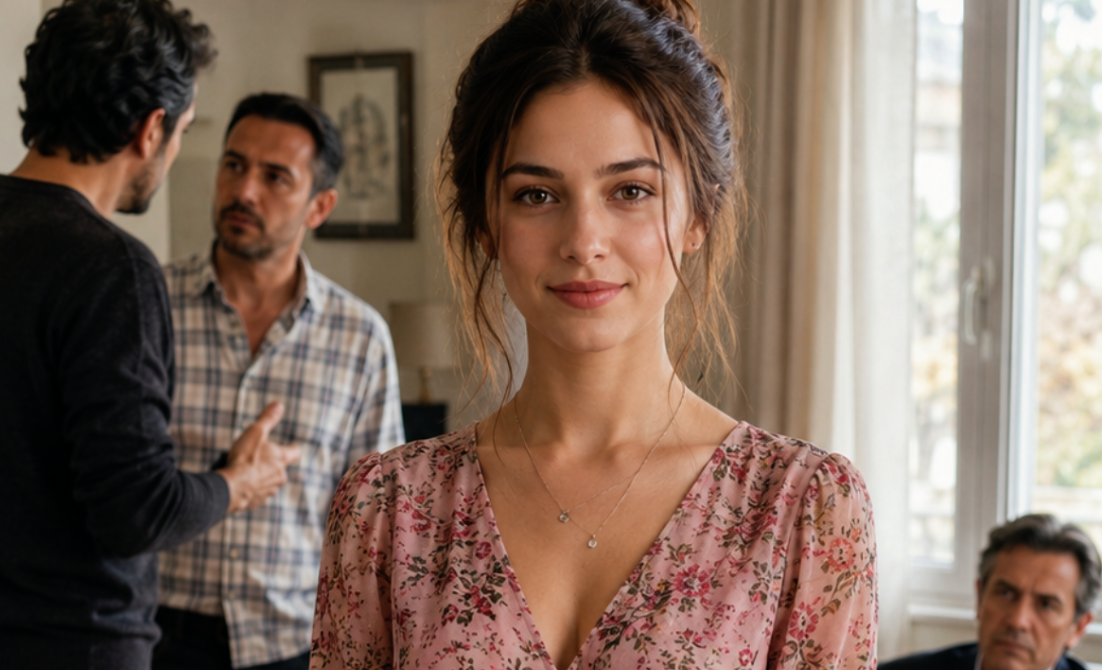
Sunday morning promised nothing except an attempt to scrub the baking tray after yesterday’s chicken. Alina, a forty-eight-year-old woman with a spine of steel forged in battles with the housing and utilities system, stood at the sink. The water roared, drowning out thoughts about eternal matters — namely, the fact that dishwashing liquid had gone up by another thirty rubles, yet foamed as if it had been diluted with the tears of state employees.
Vitalik shuffled into the kitchen in his slippers. He looked tragic, like Lieutenant Rzhevsky after being told there would be no champagne. He sat down at the table, pushed the sugar bowl aside, and sighed heavily while staring out the window, where the gray November landscape perfectly matched his emotional state.
“Alina,” he began in a voice full of universal sorrow. “We need to talk. I can’t go on like this. I’m suffocating.”
Alina turned off the water.
“He’s suffocating,” she thought, wiping her hands on a waffle towel. “Of course he is. If you eat half a kilo of boiled pork all by yourself at night, your diaphragm will rise and shortness of breath will appear. I told him not to eat fatty food before bed.”
“What do you mean, suffocating, Vital?” she asked aloud, sitting down opposite him. “Should I open the window? Or is it heartburn again?”
“You reduce everything to the mundane!” Vitalik threw up his hands theatrically. “I’m talking about the soul, about the cosmos, about our relationship! The spark is gone, do you understand? We’ve become strangers, neighbors in a communal apartment. I feel my creative potential withering in this… in this routine!”
Alina narrowed her eyes. Vitalik’s “creative potential” consisted of reinstalling Windows for a neighbor once every six months in exchange for a bottle of cognac and writing angry comments online about geopolitics. The rest of the time, he worked as a sales manager for plastic windows, though they sold poorly because, according to Vitalik, people these days had become poor and did not understand their own happiness.
“Cut to the chase, Vital, as Maupassant used to say,” Alina hurried him along. “Are you leaving or what?”
“I’m leaving!” he announced solemnly. “I’ve met a woman. She is different. She hears me. If you want to know, she is a muse!”
“Well, a muse is a muse,” Alina nodded calmly.
Inside, nothing twitched or broke. On the contrary, she felt a strange sense of relief, as if she had taken off tight shoes after a long corporate party.
“Will you pack your things now, or will your muse send movers?”
Vitalik was taken aback. He had expected tears, smashed plates, screams of, “Who are you leaving me for?” He had prepared a speech about how “we will remain friends” and “it’s not you, it’s me.” But here she was — dry, practical, businesslike.
“You’re not even upset?” he asked, offended.
“Vital, I’m almost fifty. I only get upset when utility prices go up or when my favorite cheese disappears from the store. You’re a grown boy. You made your decision, so go. The suitcase is on the mezzanine. Get it yourself; my back hurts.”
The next two hours passed under the banner of the great migration of peoples. Vitalik dashed around the apartment, gathering his possessions. Alina sat in an armchair with a crossword puzzle, but she kept a sharp eye on the trajectory of his movements.
“I’m taking this laptop. I need it for work!” he declared, pressing the old Asus to his chest.
“Take it,” Alina waved generously. “It overheats like an iron anyway and doesn’t hold a charge.”
“And the coffee maker!” Vitalik had already gotten carried away. “I’m not human without coffee in the mornings.”
“The coffee maker?” Alina raised an eyebrow. “Vital, we bought it when you were unemployed for three months, remember? With my bonus. But fine, take it. Let your muse make you cappuccino. Just don’t forget the filters; they’re in the top drawer. I know you creative types — next thing you know, you’ll be straining coffee through a handkerchief.”
Vitalik puffed as he stuffed sweaters and jeans into the suitcase. He also tried to grab the tool set, but that was when Alina rose to defend her property with her full chest.
“Put the drill back.”
“Why? I hung the shelf!”
“You hung it, but I bought it. And by the way, the shelf is crooked. I’ll have to redo it. The tools stay in the family. Meaning with me.”
When the bags were packed, Vitalik, sweaty and disheveled, looked around the apartment. He clearly wanted to say something epic in farewell, but the only thing that came to mind was “thanks for the borscht,” which somehow felt too small for the moment.
“Well, I’m going,” he muttered. “I won’t call a taxi. Too expensive. I’ll take the car. There are a lot of things.”
Alina, who was peacefully finishing her cold tea at that moment, choked.
“Which car, excuse me?”
“Well, ours! The Toyota. What’s the big deal? I have to drive across the whole city to Lenka’s… I mean, to my new place of residence. And you have the metro right nearby. Besides, why does a woman need a crossover? You never feel the dimensions anyway.”
With a confident movement, Vitalik took the keys to the silver RAV4 from the hook. He could already see himself: free, proud, behind the wheel of a foreign car, rushing into a new life where he would be valued, loved, and not forced to take out the trash.
Alina slowly placed her cup on the table. The ring of porcelain in the silence sounded like a gong before the start of a deadly battle. She stood up, adjusted her house robe, and walked almost right up to her former beloved.
“Vitalik, my joy,” she began affectionately, but there was such coldness in her eyes that goosebumps ran down Vitalik’s back. “Let’s recall the chronology of events. What year did we get married?”
“In eighteen,” he answered uncertainly. “Why?”
“In eighteen, correct. In November. And when did I buy the car?”
Vitalik wrinkled his forehead. He was bad at remembering dates, but he remembered perfectly how proudly he had sat in the passenger seat when they drove out of the dealership.
“Well… also in autumn.”
“In August, Vitalik. August of 2018. Three months before we went to the registry office and got those little blue stamps. And the loan, let me remind you, I paid off with the money from selling my grandmother’s dacha while you were trying to find yourself in network marketing and sell some miracle supplements made from dried grasshoppers.”
“But we’re family!” Vitalik protested. “I drove it! I changed the oil!”
“You changed the oil with my money, and you drove it because I was kind. I was. Until this moment.”
“Alina, this is petty!” he squealed, realizing that the ground — or rather, the wheels — was disappearing from under his feet. “You want to leave a man without transportation? With suitcases on the street?”
“I want to restore justice,” she cut him off. “If it’s divorce, then it’s divorce. Property will be divided by law. What was acquired through hard labor during the marriage is there, in the suitcase: your shirts, the coffee maker, and that barbecue set we never once opened. But the car, my dear, is premarital property.”
She extended her hand, palm up. The gesture was imperative and tolerated no objection.
“The keys.”
Vitalik hesitated. The beautiful picture of his arrival at his new lover’s place was collapsing in his head. It was one thing to roll up in a shiny crossover, casually toss the keys onto the nightstand, and say, “Here, I brought the essentials.” It was quite another to tumble out of an Economy taxi with plaid bags like a refugee and whine that his ex-wife was a witch.
“Alin, at least let me take my things there! I’ll bring it back tomorrow! Honest word!”
“I know your ‘honest word,’” Alina smirked. “Tomorrow you’ll fix the shelf, tomorrow you’ll find a job. No, thank you. What’s dead is dead. Keys to base.”
Vitalik, red as an overripe tomato, threw the keys onto the small cabinet.
“Choke on your piece of metal!” he shouted. “I always knew you were mercenary! Things matter more to you than people!”
“Not things, Vitalik — assets,” she corrected him in a mentoring tone. “And not more than people — more reliably. The car has never betrayed me, never whined about a creative crisis, and never left me for another driver because his gasoline tasted better.”
He grabbed the suitcases and, stumbling, dragged them toward the door. One suitcase wheel squeaked pitifully and fell off. Vitalik cursed, tucked the bag under his arm, and spilled out onto the stairwell.
“And don’t you dare set foot here again!” he shouted from the elevator, though there was absolutely no logic in that statement.
Alina locked the door with two turns. The lock clicked. Silence settled over the apartment. Blessed, thick silence.
She walked over to the window. Down below, near the entrance, Vitalik was trying to call a taxi. Judging by his gestures, the prices in the app were “outrageous,” and the waiting time was eternal. He kicked the suitcase, then took out his phone and apparently began calling his muse, complaining about the cruelty of the world.
Alina picked up the car keys and turned them over in her hand. The pleasant weight of the key fob warmed her palm.
“I should go to the car wash,” she thought. “And change the air freshener inside. Everything smells like his cologne.”
She threw on a jacket, put on comfortable sneakers, and went out into the yard. The wind was cold but fresh. Vitalik was already gone — apparently, he had left in some kind of Logan.
Alina got into her RAV4. The seat had been pushed too far back — adjusted for her husband’s long legs. With a familiar motion, she moved it forward and adjusted the rearview mirror. In the reflection, a woman looked back at her: not young, but well-groomed, with an ironic sparkle in her eyes and a calm smile. A woman who knew exactly how much a kilogram of beef cost, how to pay taxes through an app, and why property should never be registered under husbands who are still “finding themselves.”
She turned the ignition key. The engine responded with a smooth, satisfied purr.
“Well then, my little swallow,” Alina said aloud, stroking the steering wheel. “Shall we go get some pastries? I’ve earned a Napoleon today. And champagne. And perhaps new seat covers.”
She turned on the radio. They were singing something cheerful about everything being all right. Alina switched on the turn signal and smoothly drove out of the courtyard.
Ahead lay a free evening. And a free life. And a full tank of gas, which, unlike certain men, always takes you where you need to go.