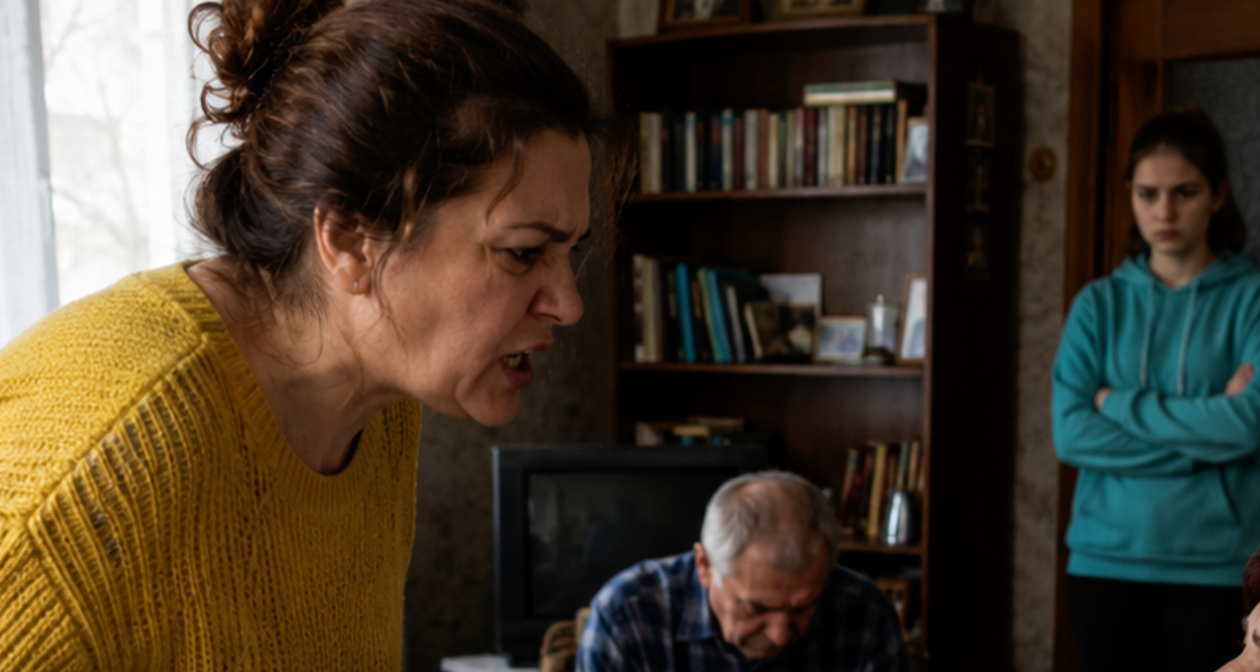
“Then please your husband properly so he doesn’t throw you out! And we’ll divide our apartment between Kristina and Matvey. What do you need square meters for?”
Nina Ivanovna, my mother, calmly set the silver cake server aside. The metallic sound rang sharply in the silence hanging over the table. A greasy crumb of buttercream fell from the knife onto the snow-white lace tablecloth.
I stared at my slice of Napoleon cake. My breath caught at once, and it became hard to swallow. The spacious living room smelled of dinner, my mother’s heavy perfume, and old curtains. An ordinary Sunday family lunch had turned into a trial in a single minute.
“So what do you mean… divide it?” I raised my eyes, feeling my cheeks begin to burn. “The apartment is registered in the names of all five of us. Each of us owns one-fifth. You and Dad are giving your shares to the younger ones. I understand that. But what does my part have to do with it?”
Mother sighed heavily. She brushed an invisible speck from the sleeve of her blouse and looked at me with mild irritation. The way people look at a clueless cashier who is scanning items too slowly.
“Sonia, let’s not start one of your scenes,” she grimaced. “Your father and I are moving to the village. We’ve already bought a house. We’re leaving this Stalin-era apartment to the children. Kristina is marrying Vadim in six months; they need somewhere to live. Matvey is finishing university. We’ve decided that you’ll go to the notary and sign away your share in their favor. They’ll sell the apartment and split the money in half. They need it more. And you’re already settled. Ilya has his own two-room apartment.”
I slowly looked around at my relatives. My father, Nikolai Petrovich, was very intently studying the patterns on his plate, carefully avoiding looking in my direction. Twenty-three-year-old Kristina loudly sipped her tea and buried herself in her phone screen, pretending that her messages were now the most important thing in the world. And Matvey, who had recently turned twenty-one, was sprawled in his chair, lazily picking at his sponge cake with a fork.
I am twenty-eight. And only now, it seemed, did I understand: to them, I had always been just a convenient background figure. The eldest daughter who got into university on a state-funded place by herself, bought her own winter boots with money from her first part-time job, and paid for her own modest wedding.
“Mom, actually, I was planning to use my share myself,” I said, trying to keep my voice steady. Under the table, my fingers dug into the edge of a napkin. “Ilya and I want to take out a mortgage on a small commercial space. To rent it out. Extra income wouldn’t hurt us, especially if we have children.”
“What nonsense have you come up with now?” Mother slapped her palm on the table, making the cups clink nervously. “Carrying our family money in your beak to some strange man!”
“Ilya is not some strange man. He is my husband.”
“A husband today, gone tomorrow!” Kristina cut in without even lifting her eyes from the screen. “Sonia, are you seriously going to ruin your own sister’s life over a few kopecks? Vadik and I are renting right now. The washing machine there hums so loudly the neighbors bang on the radiators, and drafts blow in from every crack. Do you really begrudge us that much?”
“Seriously, sis, don’t be greedy,” Matvey supported her in his deep voice. “You’ve got a man with an apartment. Sit tight.”
I looked at my father.
“Dad. Do you also think this is fair?”
Father nervously rubbed his neck and muttered somewhere toward the sugar bowl:
“Sonia… well, your mother is right. Why quarrel? Give in to them. You’re the eldest.”
The hurt was so dense that for a second my ears felt blocked. As if someone had hit me with a dusty sack, and I had not even had time to raise my hands.
“And what if something happens between Ilya and me?” I asked, looking straight into my mother’s eyes. “What if life doesn’t work out? Where do I go? You’ll all be left with housing and money, and I’ll go sit on a bench outside the building with one suitcase?”
That was when she said that exact phrase. That I needed to behave well and please my husband so he wouldn’t throw me out.
I carefully pushed back my chair. It scraped loudly across the old parquet floor. I stood up without touching the cake.
“Finish your tea yourselves,” I said, heading toward the hallway.
“Sonia, stop! Where are you going? We need to go to the MFC on Thursday!” Mother shouted after me.
“Don’t wait for me,” I took my wool coat from the hanger. “I’m not gifting my share to anyone. We’ll sell the whole apartment, and I’ll take what belongs to me according to the documents.”
I slammed the door behind me. The stairwell smelled of an old building. The click of the lock sounded like a full stop.
For the next three days, my phone burned hot. Mother wrote huge messages about how ungrateful I was, how they hadn’t slept at night when I was sick as a child, and how I was ready to betray my own blood for square meters. Matvey recorded a voice message calling me mercenary. Kristina simply sent pictures with quotes about greed.
I did not answer anything. I just went to work in my logistics department, mechanically filled out spreadsheets, and in the evenings sat in the kitchen watching the kettle boil.
Ilya behaved perfectly. He did not pester me with questions. He simply brewed strong thyme tea, placed a mug in front of me, and stroked my shoulders.
“Sonia,” he said on Wednesday evening, sitting down across from me. His work T-shirt smelled of the workshop and the street. “Let’s do this. If they want to be offended, that’s their right. But this is your property. Legally. You’re not stealing anything from them. Tomorrow we’ll take a day off and go see a lawyer.”
On Thursday, I decided to stop by my parents’ apartment. I still had seasonal clothes there, a couple of boxes of books, and my old humidifier. I simply wanted to collect my junk while no one was home so I wouldn’t have to run into anyone.
The key turned in the lock as usual. The hallway smelled of paint and takeout food. Voices came from my former room.
I looked through the half-open door and froze on the threshold.
My bed was gone. The wardrobe stood wide open, empty. And in the middle of the room, right on the bare linoleum, sat Kristina and her Vadim. They were eating pizza straight from the box and measuring the distance from the wall to the window with a tape measure.
“Oh, look who showed up,” Kristina lazily licked sauce from her finger. “We’re figuring out where to put Vadik’s computer desk. Your clothes are in the hallway, in the plaid bags. We moved the books to the balcony; they were very dusty. Take everything quickly, we keep tripping over it.”
I looked at the three huge bags huddled pitifully in the corner of the hallway. Inside them, crumpled any which way, were my cashmere sweaters, my winter jacket, and other small things. They had not even warned me. They had simply cleared out the room as if I had never existed there. Casually. Between a slice of pizza and measuring a wall.
“Clearing the territory?” my voice came out unexpectedly hoarse.
“Why drag it out?” Vadim stood up, brushing off his jeans. “Kris and I are moving our things in this weekend. We have to pay rent soon. Why waste money if there’s an empty room here? You don’t live here.”
I did not make a scene. Silently, I dragged the bags out onto the landing and called the elevator. All the way home, I watched the gray buildings drifting past, and inside me everything seemed to burn out completely.
The next day, Ilya and I went to a lawyer, and then to the post office.
A week and a half later, Mother called me herself. The phone was practically vibrating with her outrage.
“What did you send us?! What official notice is this?!”
“Under Article 250 of the Civil Code, Nina Ivanovna,” I answered calmly, shifting documents on my desk. “You have the preemptive right to buy. I am selling my one-fifth share. If you do not pay me its value within a month, I will put it on the open market. To third parties.”
“What third parties?!” Mother shrieked. “Are you out of your mind?! You’re going to drag strangers into our apartment?!”
“The apartment is almost in the center, and the layout is excellent. People will tear that share right out of my hands. I’ve already found an agent.”
I was not lying. Through his acquaintances, Ilya had found a realtor — a sharp, loud woman of about fifty named Oksana, who specialized in complicated share transactions.
On Saturday, I arrived at the apartment with Oksana for a “viewing.”
My parents and Matvey were home. When we entered, Oksana, without removing her massive boots, immediately stomped across the parquet into the hallway, her heels clacking loudly. She gave off a thick smell of something tart and sharp.
“Well, well, well,” she boomed, waving her notebook through the air. “A twenty-meter room… Excellent. We’ll put up a plasterboard partition here. I actually have clients right now. A family from a neighboring country, seven children, looking for registration. Noisy people, but they pay on time. We’ll have to hang a schedule in the kitchen for who cooks when. The bathroom will also have to be used by the hour.”
Father’s face changed, and he grabbed the doorframe. Mother stood with her mouth open, looking from me to that monumental woman.
“You… you have no right!” Nina Ivanovna forced out.
“She does, sweetheart, she absolutely does,” Oksana winked at her, clicking her ballpoint pen. “It’s her property. She can sell it to whoever she wants. Well then, expect neighbors in a month. Prepare shelves for them in the refrigerator.”
It worked instantly. The prospect of sharing the amenities and kitchen with a huge strange family brought my relatives to their senses at once. They finally understood that I was not bluffing and that I was no longer going to collect my things from old boxes.
They agreed to put the whole apartment up for sale.
The deal took place a month and a half later in a spacious bank office. The air conditioner hummed, and the muffled clicking of keyboards came from the hallway. The buyers — a pleasant couple with a small child — carefully read through the lines of the contract.
My family sat on the leather sofa by the wall. Kristina nervously twisted the strap of her bag, Matvey kept bouncing his leg without stopping. Mother pressed her lips together and stared out the window. None of them even greeted me.
When the bank employee began preparing the payment orders, Nina Ivanovna suddenly came to life, approached the desk, and said in the sweetest tone:
“Miss, why don’t we put the whole amount into my account? We’re family. I’ll transfer everyone what they need afterward myself. Why make things complicated with all these different papers?”
Ilya, standing behind my chair, gave a mocking snort.
“No,” I placed a printout with my bank details in front of the employee. “The money will be distributed strictly in proportion to the shares. My part goes to this account. If not, I am not signing the contract right now, and we all leave.”
Mother jerked as if she had been shocked. Red blotches spread across her face, and her lips twisted. But she did not dare argue — the buyers had already begun exchanging displeased glances.
Twenty minutes later, a notification came to my phone. A large sum had landed in my account. I looked at those numbers but felt neither joy nor triumph. Only emptiness. I signed the final documents, stood up, and headed for the exit.
“May you be happy, my dear daughter,” Mother hissed behind my back with undisguised venom. “Choke on those papers.”
I did not turn around.
A year has passed. During that time, Ilya and I invested the money we received as the down payment for a spacious commercial space on the ground floor of a new residential complex. We renovated it into a bright, pleasant space, and now I rent it out to a children’s creative studio. The passive income covers the payments, and we have even started saving for expansion.
We do not communicate with my relatives. At all. I know through mutual acquaintances that the money Kristina and Vadim got from the sale of the share was not enough for a decent apartment, so they took on a heavy mortgage for a tiny studio on the very outskirts. Matvey blew his part on a used foreign car, drove it out onto the road unsuccessfully, and turned it into a pile of scrap metal two months later. Now he is renting again. And my parents settled in their village after all, regularly complaining to the neighbors about their greedy eldest daughter.
Sometimes, while brewing tea in my kitchen, I remember that dry piece of Napoleon cake and the sound of the silver cake server against the table. The hurt no longer burns. It no longer makes me feel sick. It has simply become useful life experience.
They say you have to know how to find compromises with family. But I understood one thing: if a compromise means erasing you and throwing you away in garbage bags for someone else’s convenience, then you need to leave that kind of family. And you must take what is legally yours.