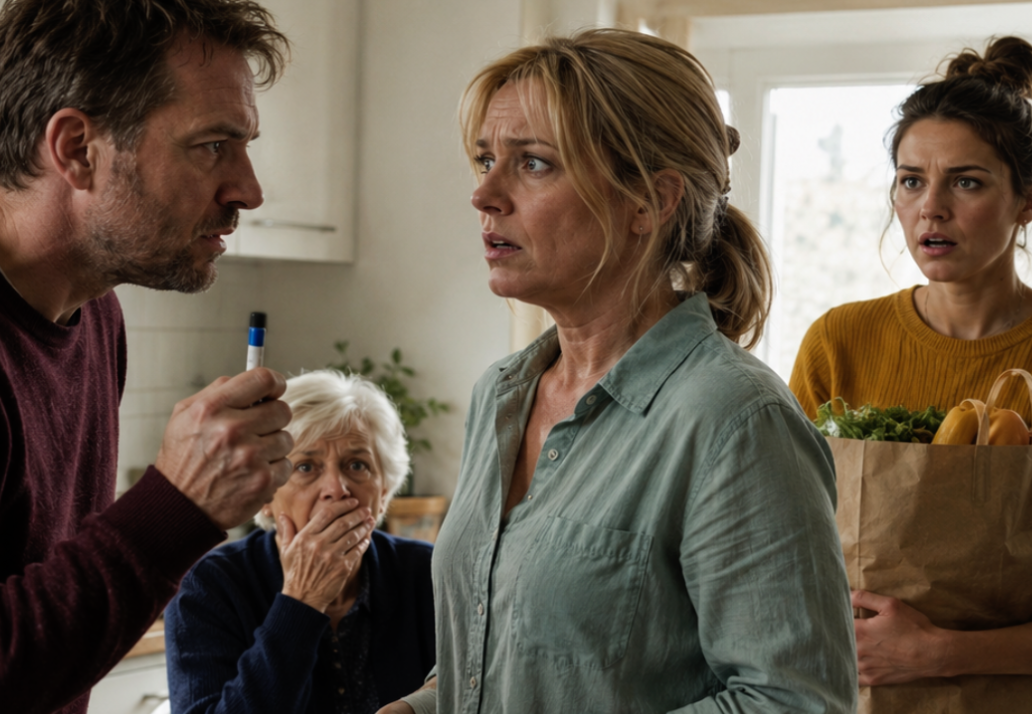
— My mother is not going to wait in the entryway while you sit here counting your money, — Konstantin said angrily.
— My mother is not going to wait in the entryway while you sit here counting your money, — Konstantin said angrily, placing a thin folder with a blue clip on the kitchen table.
Zlata was standing by the sink with wet hands. Salmon hissed on the stove, parchment crackled quietly in the oven, and the salad had already released its juices and looked as though it, too, had been dragged into the family scandal and now regretted ever being born.
— Did you bring a notary or a funeral crew? — Zlata asked calmly, wiping her hands on a towel. — That folder looks so ceremonial even the fish has started doubting its future.
— Don’t be sarcastic, — Konstantin said, flushing in blotches like a man who had already been told how a husband should behave but had not been given instructions on how not to look like a schoolboy at the blackboard while doing it.
From the hallway came Vera Mikhailovna’s voice:
— Kostenka, we’ve taken off our shoes! Only your doormat, Zlata dear, is absolutely useless. Even the sand on it is asking for retirement.
Taisiya came in after her, carrying a supermarket bag as if she had brought humanitarian aid to a starving household. Inside, a bottle of cheap sparkling wine clinked, along with a packet of cookies and two bananas that looked like witnesses for the prosecution.
— So, are you celebrating? — Taisiya asked with a smile that contained artificial sweetener and a little rat poison. — Kostya said you got a bonus. We decided not to let your joy suffer from loneliness.
— How sweet, — Zlata replied evenly. — Do we now schedule joy by appointment, or does it arrive through the intercom?
Vera Mikhailovna walked into the kitchen and immediately sat at the head of the table, although there was no head to this table: it was an ordinary extendable table from a furniture store, which had survived a move, two renovations, and five years of family pretending. Her mother-in-law removed her scarf, smoothed down her gray hair, and looked around with the eyes of an owner. She knew how to look at other people’s belongings in such a way that the belongings began to feel guilty.
— I don’t understand, Zlata, — Vera Mikhailovna said with offended solemnity, — why you always greet relatives as if you’re the district police officer. We haven’t come with a search warrant.
— Not yet, — Zlata said. — But the folder on the table suggests you prepared for one.
Konstantin sharply pulled the folder toward himself.
— There’s nothing terrible in there, — he said dully. — We just need to discuss things normally. Without theatrics.
— The show has already started, — Zlata noted. — And the tickets, as I understand it, were bought with my bonus?
Five years ago, Konstantin had seemed to her like a quiet and reliable man. Back then, in a cafeteria after someone’s anniversary celebration, he had stood by the window with a plastic cup of tea and talked not about himself, but about machines at the factory, about how metal behaves in freezing weather, and about his mother, who had “carried the whole family all her life.” At that time Zlata was past forty-seven. She had no divorce behind her, but she did have experience with lonely dinners, a sore back from carrying bags, and an apartment bought before marriage, paid off down to the last ruble. Her daughter Katya was already living separately, raising a son, calling rarely but always for a reason. Zlata did not want grand love with thunder and white curtains; she wanted a calm man who would not start a revolution over an unwashed cup.
Konstantin did not start revolutions. He simply kept silent when his mother began her little artillery barrage. In the first months Zlata had even valued that silence: she thought he was a peaceful man. Later she realized it was not peace, but a convenient crack between two women where he hid his head.
At first Vera Mikhailovna came on holidays. Then she was “just passing by.” Then she had “an appointment at the clinic with a good doctor.” Then “Tasya needs to go to courses, and there’s a transfer near your place.” Eventually Zlata’s apartment became their family railway station without ticket office or schedule.
Taisiya could open the refrigerator and say:
— Oh, you’re out of cheese? Surprising. With that salary, one could keep the house in European condition.
Vera Mikhailovna could walk into the bedroom, run her finger along the windowsill, and sigh:
— Dust, Zlata dear, is not dirt. It is an indicator of one’s attitude toward one’s husband.
Zlata endured it. Women after fifty know how to endure so virtuously they could teach it at a conservatory: the introduction — “it’s nothing serious,” the first movement — “she is elderly, after all,” the finale — “but Kostya is a good man.” But patience, like a cheap tea bag, on the third use no longer gives flavor, only murky water.
That evening Zlata came home from work tired, but almost happy. They had finished the project ahead of schedule, the director had shaken her hand, the bonus had arrived on her card, and in the elevator she had even smiled at her reflection: well, girl, you made it, you didn’t fall apart. She bought fish, greens, cheese, and a bottle of wine that the saleswoman called “respectable,” though on the price tag it held itself up not through dignity, but through sheer insolence. She had wanted to talk to her husband about a trip to Kislovodsk: more and more often she wanted air, mineral water, and people who did not discuss someone else’s property over dinner.
But Konstantin did not come in alone. With him came Vera Mikhailovna, Taisiya, and the folder.
— Sit down, — Zlata said dryly, taking out extra plates. — Since the celebration has arrived in an expanded cast.
— Don’t make the face of a cemetery director, — Taisiya said mockingly, settling closer to the salad. — We actually come in peace.
— Your peace always marches in formation, — Zlata replied. — And for some reason always toward me.
— Tasya, be quiet, — Vera Mikhailovna said sternly, but with pleasure, because her daughter had said exactly what needed to be said. — Zlata, let’s do without barbs. We are adults. You are at an age when it is time to think not only about your career. A career is here today, and tomorrow a new female boss comes in, and that’s it, hello, unemployment line.
— Thank you for the forecast, — Zlata said. — I was just thinking what was missing from the fish. Turns out it was a funeral service for my job.
Konstantin sat beside his mother. Zlata noticed it instantly. Before, he used to sit between her and the guests, like a poorly trained peacekeeper. Today he sat with his own. That meant the conversation had been prepared in advance.
— Zlata, — Konstantin began, trying to speak softly, though someone else’s will creaked in his voice, — Mom and I thought…
— That already sounds frightening, — Zlata said. — When you think with your mother, my weekends usually disappear afterward.
— Don’t interrupt, — Konstantin said, striking the folder with his fingers. — This is about the future. A normal, calm future. We are spouses. We live together. I invested in the renovation, paid utilities, bought groceries.
— You did, — Zlata nodded. — And you personally ate them too, not through a proxy.
Taisiya snorted, but immediately put on a serious face so her mother would not notice the betrayal.
— Exactly, — Vera Mikhailovna picked up, missing the mockery. — A man in the house should not feel like a suitcase under the bed. Here today, thrown out tomorrow.
— A suitcase at least keeps quiet when appropriate, — Zlata said. — But go on.
Konstantin pulled a printout from the folder. On the top line Zlata saw the words “draft agreement.” Her heart gave an unpleasant thud, but she did not show it.
— We are not demanding, — Konstantin said, immediately betraying himself with the word “we.” — We are simply suggesting that everything be formalized fairly. A share. Not half, if that is so hard for you. A third would be possible. So that I am not left hanging in uncertainty.
— What uncertainty? — Zlata asked quietly. — You lived here for five years. You had keys, a wardrobe, a favorite cracked mug, and the habit of leaving socks under the radiator. What exactly was hanging over you?
— A lack of respect, — Vera Mikhailovna interfered, leaning forward. — You keep emphasizing: my apartment, my salary, my decision. And who is my son? A piece of interior decoration? A man is not a ficus.
— A ficus, by the way, drinks water silently and does not blackmail anyone with its leaves, — Zlata said. — But you are right, the comparison is not in Kostya’s favor.
— Do you hear that? — Vera Mikhailovna turned to her son with triumphant horror. — She is humiliating you in front of me.
— I hear it, — Konstantin said, and there was something in his voice that Zlata had never heard before: the irritated confidence of a weak man who had been given a choir behind his back. — Zlata, enough. You became impossible after your promotion. One cannot talk to you. You immediately think everyone wants to rob you.
— And what do you want? — Zlata asked, looking at the printout. — To congratulate me on my bonus? Wish me good health? Perhaps help wash the dishes so the country doesn’t collapse?
Taisiya threw the cookies onto the table.
— We want fairness, — she said sharply. — Mom lives on a pension, Kostya’s salary is ridiculous, my work is unstable. And you sit in your fortress pretending to be decent. That is not how family lives.
— Family does not arrive with a draft agreement without warning, — Zlata said. — Family does not count someone else’s bonus as its own harvest.
— Someone else’s? — Konstantin smirked. — So my money is shared, but yours is someone else’s?
— Your money went wherever you decided, — Zlata said. — I never asked how much you transferred to your mother. Even when our washing machine coughed like a consumptive old man and you said it could wait.
Vera Mikhailovna raised her chin.
— I am his mother. A son must help his mother.
— He must, — Zlata agreed. — But a wife is not obliged to pay for your habit of treating someone else’s refrigerator as ancestral property.
Taisiya abruptly stood up.
— You are a boor, — she said, her voice trembling. — Just a boor with a diploma and a bonus. You think that because you are a manager, you can crush people?
— I am not crushing anyone, — Zlata replied. — I am removing myself from the role of ATM with dinner function.
Konstantin slammed his palm on the table. A glass jumped, wine splashed onto the tablecloth.
— Enough! — he shouted. — You will apologize to my mother now.
Zlata looked at the stain. It spread slowly, burgundy, like a seal on a verdict. She had bought the tablecloth last year on sale because Katya had burned the previous one with a candle when she visited with her grandson. Back then they had laughed. Now Zlata suddenly felt that laughter had long been walking through her house on tiptoe.
— I will not apologize, — she said.
— Zlata, — Konstantin said, getting up. — Don’t push it.
— Push it to what? — Zlata asked. — The truth? It is already here, sitting in a scarf and eating my salad.
Vera Mikhailovna turned pale, but her eyes were burning.
— Kostya, — she said in an icy voice. — If you swallow this now, you can stop calling yourself a man.
— Wonderful, — Zlata said. — Now we have a masculinity test by the oven. All that’s missing is a commission from the building management company.
Konstantin stepped toward his wife and grabbed her wrist. Not hard, but enough to make it clear: he had finally decided not to keep silent and had chosen the stupidest way to do it.
— Come to the room, — he said through his teeth. — We’ll talk without an audience.
Zlata slowly looked at his hand.
— Remove your hand, Konstantin, — she said quietly. — Don’t add an ugly scene to stupidity.
— Or what? — Taisiya asked, coming closer. — Will you call the police? Say your relatives are hurting your feelings? The whole courtyard will laugh.
— Tasenka, — Zlata said, not taking her eyes off her husband, — the courtyard has been laughing for a long time. You just think it is laughing at the neighbors.
Konstantin let her go. Red finger marks remained on her wrist. Vera Mikhailovna saw them and looked away for a second: not out of shame, but out of annoyance that her son had done it in front of witnesses.
And then Zlata noticed something else. Under the paperclip on the printout lay a copy of the property ownership certificate. Her copy. The very one she kept in a folder in the top drawer of the dresser. The drawer was in the bedroom; it contained documents, old photographs of Katya, the purchase agreement, and medical records. Konstantin knew where the folder was. But the sheet had been photographed on a phone: the edge of her flowered blanket was visible.
— Where did this come from? — Zlata asked, picking up the sheet with two fingers.
Konstantin froze.
— I took it, — he said after a pause. — For consultation. Nothing serious.
— You were rummaging through my documents? — Zlata asked very calmly.
— Ours, — Vera Mikhailovna corrected. — Family documents.
— Vera Mikhailovna, — Zlata turned to her, — I also have compression stockings and a note from my gastroenterologist in that dresser. Should we count those as family property too? I can give everyone a page; you can read it before bed.
Suddenly Taisiya, unable to hold back, said too much:
— Don’t act as if you keep the Kremlin safe in there. Mom simply photographed it while you were at work. Kostya gave her the key, that’s all.
Silence fell. Even the oven clicked so cautiously, as if afraid it would be next.
Konstantin turned to his sister.
— Are you an idiot? — he breathed.
— What? — Taisiya became confused. — She would have found out anyway.
Zlata sat down. Her legs had suddenly gone weak. Not from fear. From clarity. They had not simply asked. They had already entered her apartment without her. Opened her dresser. Photographed her documents. Discussed how to “formalize things fairly.” Her home, for which she had paid every meter, carried bags of plaster, chosen tiles, listened at night to the neighbor sneezing behind the wall — had turned into a passage room for people who called themselves family.
— The key, — Zlata said.
— What key? — Konstantin asked.
— All keys. Now.
— Zlata, don’t start, — he said wearily, already understanding that everything had gone off their plan.
— No, I am just finishing, — Zlata replied. — Keys on the table. Yours, spare ones, your mother’s, secret ones, holiday ones, whatever exists. Then the three of you leave.
Vera Mikhailovna rose slowly, like an actress in the third act.
— You are throwing out your husband’s mother after she wished you well?
— If that is good, — Zlata said, — then evil in your family must come with a bow.
— Kostya! — Vera Mikhailovna raised her voice. — Do you hear that? She is throwing us out. She is putting your mother out at night!
— It is eight in the evening, — Zlata noted. — Buses are running, taxis exist, and your dramatic flair is free, so there is no need to conserve it.
Taisiya stepped toward Zlata and grabbed her sleeve.
— Who do you think you are? — she hissed. — You think because you bought an apartment, you are a queen? Mom gave her life to Kostya. And you arrived all ready-made, with square meters, and pretend to be independent.
Zlata pulled her sleeve free.
— I did not arrive ready-made, Taisiya. I arrived with three jobs, a mortgage, a bad lower back, and a daughter who needed winter boots. Ready-made is when, at twenty-nine, you explain to others how to live while sitting on your mother’s neck and calling it self-discovery.
Taisiya raised her hand, either for a slap or a gesture, but Vera Mikhailovna caught it.
— Don’t dirty yourself, — the mother-in-law said loudly. — That is exactly what she wants.
— Of course, — Zlata said. — My secret dream is a fight by the salad. In childhood everyone wanted to become astronauts, and I knew right away: I would fend off my sister-in-law near the sink.
Konstantin took out his keys and threw them on the table.
— Take them, — he said with hatred. — Just don’t think you’ve won. You will be left alone, Zlata. With your job, your money, your little papers. And in the evenings you will listen to the refrigerator.
— At least the refrigerator doesn’t bring its mother with a contract, — Zlata said.
— Let’s go, — Vera Mikhailovna told her son with contemptuous pity. — Let her live. Women who, after fifty, confuse freedom with loneliness later call their exes very loudly. Only then it’s too late.
Zlata opened the front door.
— Don’t forget the bag with the bananas, — she said. — They are the only ones here who are not guilty of anything.
Taisiya grabbed the bag, Vera Mikhailovna swept out majestically, and Konstantin paused on the threshold.
— I’ll come back for my things, — Konstantin said dully.
— By prior phone call, — Zlata replied. — And not alone. I’ll invite my neighbor Nina Petrovna. She is a former accountant; she has the kind of look that makes even cockroaches confess to shortages.
The door closed. Zlata leaned her back against it and suddenly heard her own breathing. Not beautiful, not cinematic: hoarse, uneven, with a rasp. The kitchen smelled of fish, wine, and shame that was not hers, yet somehow lay on her floor.
She removed the printouts from the table and put them into a bag. Then she photographed the red marks on her wrist. Not because she was about to file a report immediately, but because a woman after fifty already knows: the memory of the heart is unreliable. Today it hurts, tomorrow you begin justifying things. A photograph does not justify. It simply shows.
Zlata did not sleep that night. At two in the morning Katya called. Her daughter spoke in a whisper, probably because her son was sleeping nearby.
— Mom, are you alive? — Katya asked anxiously. — Taisiya wrote me some disgusting nonsense. That you threw Kostya out and drove Vera Mikhailovna into an attack.
— Her attack was conversational, — Zlata replied. — Her heart was working like a minibus engine.
— Mom, don’t joke, — Katya said sharply. — What happened?
Zlata told her. Without embellishment. About the folder, the key, the documents, the hand on her wrist. On the other end there was a long silence.
— I’m coming tomorrow, — Katya said firmly. — And we’ll change the lock. And go to a lawyer. And you will not say “well, he didn’t mean harm.” Got it? I know you. First you’re granite, and then you start feeling sorry for everyone, including an iron if it overheated.
— I am not made of iron, — Zlata said quietly.
— Exactly, — Katya replied. — So don’t let anyone stroke you against the grain. Mom, the apartment is yours. Bought before marriage, mortgage paid off before marriage?
— Yes, — Zlata said. — I have the documents.
— Then let them go discuss masculine dignity at the multifunctional center, — Katya said. — They’ll get a ticket there: “Window number six, complaints against reality.”
In the morning Katya arrived with her husband Sergey and her son Misha. Misha immediately asked where Grandpa Kostya was, and Zlata answered:
— He went to Grandma’s.
— Forever? — Misha asked, studying her face.
— I don’t know yet, — Zlata said honestly.
— Did he take my scooter? — Misha clarified practically.
— The scooter remains with its lawful owner, — Sergey said, kneeling by the door with a box containing the new lock. — Now that’s what I call family law.
Katya walked through the apartment, checking the dresser, documents, closets. She did not fuss, but her face was adult and angry. Zlata looked at her daughter and thought how strangely time works: yesterday you buy your child boots to grow into, and today that child buys you a lock and tells you not to answer the phone after eleven.
On Monday Zlata went to a lawyer. The small office on the first floor of an apartment building smelled of coffee, paper, and other people’s divorces. The lawyer, a dry woman with short hair, listened carefully and said:
— An apartment purchased before marriage and fully paid for before the marriage registration is not subject to division as jointly acquired property. If the spouse proves substantial investments that significantly increased the value of the housing, he may try to claim compensation. Wallpaper and a new faucet are not the construction of a palace.
— And if they photographed documents without me? — Zlata asked.
— Unpleasant, — the lawyer said. — But the main thing now is safety and order. Have you changed the lock?
— Yes.
— Good. Is there much jointly owned property?
— The car is his, the apartment is mine. Each of us has our own account. Most household appliances are mine.
— No children together?
— No.
— Then the divorce can be formalized through the registry office if he agrees. If he resists, through court. Do not argue in the kitchen. In our country, the kitchen is generally a dangerous institution: marriages, loans, and accusatory speeches are born there.
For the first time in two days, Zlata smiled.
Konstantin called three days later. His voice was rumpled, like a shirt after a business trip.
— We need to talk, — Konstantin said with restraint.
— Talk, — Zlata replied, putting the phone on speaker. Katya sat beside her, silently peeling a mandarin as if skinning an enemy of the people.
— Not over the phone, — Konstantin said. — I want to come home.
— Your home is now at Vera Mikhailovna’s, — Zlata said. — My locks have been changed.
— Are you serious? — he asked after a pause. — You changed the locks against your husband?
— Against people who enter my apartment without me, — Zlata replied. — There is a big difference, but your mother probably didn’t explain it to you.
— I didn’t want it to turn out like this, — Konstantin said. — Mom went too far. Tasya too. But you could have avoided humiliating us.
— Kostya, — Zlata said wearily, — the humiliating thing is not that I refused to give you part of my home. The humiliating thing is coming to your wife with your mother and sister and asking for property in chorus, like a song at a feast.
— I wasn’t asking you to give it to me, — he said. — I wanted certainty.
— An adult earns certainty through actions, — Zlata said. — Not through someone else’s square meters.
Katya snorted loudly. Konstantin heard it.
— Is Katya there? — he asked irritably. — Of course. So now she is in charge?
— No, — Zlata said. — I am in charge. I simply have a witness to common sense.
— You have become cruel, — Konstantin said. — You used to be normal.
— I used to be convenient, — Zlata said. — You confused the two.
A week later, he came for his things. Zlata invited Nina Petrovna, the neighbor from the sixth floor, a woman in a raspberry-colored tracksuit and with the face of a tax audit. Nina Petrovna brought a stool and sat in the hallway.
— I’ll just sit here, — Nina Petrovna said cheerfully. — My blood pressure is high, but my curiosity is higher.
Konstantin came with Taisiya. Zlata opened the door and said:
— Taisiya does not come in.
— She’ll help, — Konstantin said.
— Let her help the elevator wait, — Zlata replied. — You pack your own things.
Taisiya opened her mouth, but Nina Petrovna raised a finger.
— Young lady, don’t, — the neighbor said kindly and terrifyingly. — I am in a protocol mood today.
Konstantin went into the bedroom. He packed shirts, socks, tools, chargers from unknown devices. At one point he stopped by the bedside table.
— Do you really want a divorce? — he asked quietly, already without his former pressure.
Zlata stood in the doorway.
— Yes.
— Because of one evening?
— No, — Zlata replied. — Because of five years that this evening lit up like a searchlight.
— I didn’t drink, I didn’t beat you, I brought home a salary, — he said bitterly. — What else did you need?
— For you to be beside me when being beside me mattered, — Zlata said. — Not as a body on the couch, but as a person.
He sat on the edge of the bed, squeezing a sweater in his hands.
— Mom says you turned me against my family.
— Kostya, — Zlata said more softly than she had intended, — your family has long been turned against adult life. Everyone there waits for someone else to decide: your mother for her son, your sister for herself, and you so that no one makes noise. I am tired of being your Ministry of Emergency Situations.
He wanted to answer, but from the hallway came Taisiya’s irritated shout:
— Kostya, how much longer? The parking is paid, by the way!
Nina Petrovna immediately said:
— You see, young man, even love for a brother is charged by the minute in your family.
Konstantin took two bags and left. He had no keys anymore. After he left, Zlata sat on the bedroom floor, leaned against the bed, and cried. Not beautifully, without a handkerchief, without music: just a woman who had realized that five years of her life had not been stolen, but had been used very carelessly.
The divorce did go through court after all: at first Konstantin agreed to the registry office, then Vera Mikhailovna “fell ill,” then Taisiya wrote Zlata a long message containing the phrase “you owe my brother a chance,” then Konstantin stopped answering. The lawyer only shrugged:
— A classic. When people cannot hold onto someone with love, they try to hold onto them with procedure.
Konstantin came to the hearing alone. Without his mother. Gaunt, in an old coat that Zlata had once taken to the dry cleaner, pulling his forgotten bolts out of its pockets. The judge asked whether Zlata insisted on the dissolution of the marriage. Zlata said:
— I insist.
Konstantin looked at her as though only now he understood: she was not scaring him, not bargaining, not waiting for him to catch up with flowers by the entrance. She was leaving for real.
— I agree, — he said quietly.
After the hearing he caught up with her near the exit.
— Zlata, — Konstantin said, confused, — Mom asked me to tell you that you can still fix everything.
Zlata stopped.
— Tell Vera Mikhailovna that I am no longer the repair service for your family happiness.
— She is not feeling well, — Konstantin said.
— Let her see a doctor, — Zlata replied. — Not my apartment.
Spring came slowly, with snow in April, mud in the yard, and a notice on the entrance door: “Dear residents, do not feed the pigeons, they dirty the windowsills.” Zlata thought the notice could be expanded: “Do not feed grown people illusions; afterward they dirty your soul.” But she said nothing aloud. She simply bought new curtains, removed from the bedroom the old dresser where the documents had once been kept, and put an armchair there. In the evenings she read, called Katya, and sometimes looked after Misha.
Misha asked directly:
— Grandma, is Grandpa Kostya bad?
— No, — Zlata answered. — He is weak.
— Is that worse? — Misha clarified.
— Sometimes more harmful, — Zlata said. — Bad is at least visible right away.
Six months later Zlata met Taisiya in a supermarket near the grains shelf. Taisiya had lost weight; her face had grown sharper, and her hair was pulled into a tight ponytail. In her cart lay cheap pasta, cat food, and a pack of wet wipes.
— Well, are you satisfied? — Taisiya asked without greeting. — Kostya lives at Mom’s, Mom is on pills, I have two jobs. You ruined people’s lives and walk around buying avocados.
— That is a zucchini, — Zlata said, showing the vegetable. — But I understand. In your family, other people’s things were always called something more promising.
— Funny to you? — Taisiya stepped closer. — You threw him out like old furniture.
— I removed old furniture more carefully, — Zlata said. — At least it didn’t bring relatives to my documents.
Taisiya tightened her grip on the shopping cart handle.
— He loved you.
— Possibly, — Zlata replied. — But love without respect is like a store discount: a bright sign, but inside the product is defective.
— You will be left alone, — Taisiya said, repeating her mother’s phrase, but now without the same confidence.
— Taisiya, — Zlata said tiredly, — loneliness can be in an empty apartment. And it can be at a table where four people discuss you as real estate. The first is cured with a kettle. The second with divorce.
Taisiya turned away. Zlata went to the checkout without feeling victorious. Victory is generally a noisy, youthful word. After fifty, what you want more often is not victory, but for nothing to hurt in the morning and for no one to open your door with their key.
That evening an unfamiliar number called. Zlata had already learned not to flinch, but she still picked up.
— It’s me, — Konstantin said.
— I’m listening, — Zlata replied, looking out the window. In the yard, teenagers were kicking a ball around, and the janitor was scolding them with such passion, as if defending a dissertation on garbage.
— I wanted to apologize, — Konstantin said. — Not to come back. Just… Mom said again today that I should have pressured you harder. And I suddenly realized I’ve lived my whole life as an attachment to her anxiety. Even Tasya is already running away from her to night shifts. And I kept thinking you were to blame.
Zlata was silent. For the first time, he was not speaking in Vera Mikhailovna’s ready-made words, but in his own, uneven ones.
— I should not have given her the key, — Konstantin continued. — I should not have touched your documents. And I should not have grabbed your wrist. It was vile. Back then I thought I was defending my mother. In reality, I was hiding behind her.
— Why are you telling me this? — Zlata asked.
— Because if I don’t say it, I will finally become what she raised me to be, — he said. — A man who talks loudly about dignity but cannot rent a separate apartment without his mother’s advice.
— Have you rented one? — Zlata asked.
— A room, — he answered. — On the outskirts. The neighbor snores like a tractor, but at least no one checks whether I put my shoes in the right place.
Zlata unexpectedly smiled.
— Congratulations, — she said. — Your first independent domestic achievement.
— I’m not asking to meet, — Konstantin said. — You were right to divorce me. In your place, I would have kicked myself out too.
— You would not have kicked yourself out, — Zlata said. — That was the problem.
He laughed quietly. The laugh came out bitter.
— Yes. Probably. Forgive me.
Zlata closed her eyes. Neither her old anger nor the desire to punish him rose inside her. Only fatigue and a strange pity — not even for him, but for the woman she had been: smart, strong, yet for some reason convinced that the strong must endure more than others.
— I accept your apology, — Zlata said. — But the door to the past is closed.
— I understand, — Konstantin replied. — Take care of yourself.
— You too, — she said and ended the call.
The next day Zlata received a new bonus. Smaller than the previous one, but still pleasant. After work she stopped at the store, bought fish, greens, cheese, and a funny mug with the words “Not Today.” At home she put the bag on the table, turned on music, and suddenly realized she was not waiting for footsteps in the hallway. Not waiting for a call from her husband’s mother, not waiting for comments about dust, not waiting for someone else’s claims wrapped in the word “family.”
She cooked dinner for herself alone. Not festive, not demonstrative, without witnesses or judges. She sat by the window, poured tea, and opened the small window vent. From the yard came the smell of wet asphalt, gasoline, someone’s fried potatoes, and spring, which in Russia always arrives like a utility service: late, unevenly, but still arrives.
Zlata raised the mug and quietly said:
— Well, hello.
No one answered her.
And that was the best continuation of the conversation.