For 8 Years, My Husband’s Sister Hadn’t Contributed Money for the Shared Table: I Found a Notebook and Put Containers With My Own Food on the Table
Lilya reached into the pantry for a box of dishes. Galina Semyonovna had asked her to help before her son arrived. Her mother-in-law lived in a two-room apartment on the fifth floor of a five-story brick building, which she and her husband had received from the factory back in the nineties.
The apartment was registered in her name. There was no mortgage — just an old living space with a carpet on the wall and a sideboard full of crystal.
Lilya took down the box, but with it she shifted a stack of notebooks. One slipped out and opened in the middle. Columns of numbers, dates, abbreviations — Galina Semyonovna, a former payroll department accountant, recorded even household expenses as if she were preparing a quarterly report.
Lilya’s eyes automatically skimmed the page: “23.02 — Lyosha + Lilya — 3000, Vika — 0.” Lower down, on another date: “March 8 — L + L — 3500, V — 0.” She turned one page, then another — the same picture for the previous year. Next to Vika’s name, for all eight years, there were either dashes or zeros.
Lilya sat down on the edge of a stool covered in cracked faux leather and continued flipping through the pages. In the column marked “NY-20” it said: “L + L — 4000, V — 0,” and so it went every year.
She took out her phone, photographed several pages, and put the notebook back into the stack. Her fingers trembled slightly, but she forced herself to smile when Galina Semyonovna looked into the room.
Lilya returned home around six. Alexey was already sitting in the kitchen in sweatpants and a stretched-out T-shirt. Lilya silently hung up her down jacket, went into the room, and checked Artyom’s homework.
Their son was ten. He was in fourth grade and loved assembling model airplanes most of all — he glued them together at the table by the window, and at that moment he was fitting a wing to a fuselage. Lilya ruffled his hair and went back to the kitchen.
She sat down opposite her husband and pushed her phone toward him with the photos.
“Look what I found in your mother’s pantry.”
Alexey scrolled through the pictures and frowned.
“Are these her notes about holidays? So what?”
“Do you see the amounts? We contributed for every feast. Your mother’s birthday, New Year, March Eighth — every holiday. Everywhere it’s us. And Vika — zero. Not a kopeck. For eight years, Lyosha.”
Alexey moved the phone aside and rubbed the bridge of his nose.
“Mom said things were hard for Vika. She and her husband always have one problem or another. She’s already stressed enough.”
“We have a mortgage,” Lilya said quietly but firmly. “We both work like dogs. I get up at five in the morning, you at six. We never asked for discounts. Why has your sister been eating and drinking at our expense for eight years?”
“Lilya, it’s a family matter. Don’t start counting pennies.”
“Your mother counted them. She wrote down every thousand. Except Vika’s. So some people are allowed not to pay, and others aren’t? I don’t want this anymore.”
Alexey fell silent, put some papers into a folder, and went into the room. Lilya understood: he didn’t want a scandal. For him, his mother was a person who, after his father died, had been left alone and deserved support.
The next day, Monday, Lilya got up as usual — at five. While the electric kettle was boiling, she washed her face with icy water to wake up, then pulled on her uniform trousers and jacket.
She worked as a cook in a school cafeteria. During her lunch break, Lilya called her husband simply to hear his voice. Alexey answered right away; machines hummed in the background.
“Yes, Lilya?”
“Have you thought about what I showed you?”
“I have,” he paused. “I don’t know what to do. I don’t want to hurt Mom.”
“And it’s okay to hurt me?”
“No, not you,” he sighed. “I just can’t imagine how to discuss it. She kept those notes for herself, not for us.”
“Exactly. For herself. And we paid for everyone. I’m not doing that anymore.”
For two weeks, she said nothing to anyone. She waited. And the invitation was not long in coming — Galina Semyonovna called herself and invited them to her birthday on December fifth. Her mother-in-law’s voice was cheerful, as always when she anticipated gathering the whole family around the table.
“Lilya, come as usual, at three. I’ll set the table. Don’t bring anything, I’ll buy everything myself.”
Before, Lilya would have been happy — no need to carry bags, no need to stand at the stove after work. But now she heard something different in those words: “You’ve already paid your share in money, now just come and don’t draw attention to yourself.” She thanked her and hung up.
On Friday, the day before the celebration, Lilya stopped by the market after her shift. Not the supermarket near home where everything came prepackaged, but the actual market. She bought chicken drumsticks, potatoes, beets, and walnuts.
At home, she turned on the oven and started cooking. Not just food — her own share. She marinated the meat in sour cream with garlic and paprika. She peeled potatoes, cut them into large wedges, and spread them on a baking tray so they would roast with a crust.
She had boiled the beets in advance, grated them, added crushed walnuts and prunes, and dressed everything with vegetable oil and lemon juice. She packed it all into containers and closed the lids tightly. Next to them, she placed a thermos of berry mors.
Artyom came over and peered over her shoulder.
“Mom, why are you cooking food to take with you? Grandma always sets the table.”
“Because Grandma thinks we should pay and Aunt Vika shouldn’t. We’ll eat our own food. Do you mind?”
Artyom shrugged — at ten, children don’t really understand the accounting of family feasts, but he caught his mother’s tone. He was an observant boy in general: when his parents argued, he didn’t interfere, but sat quietly with his model airplanes. Later he might come over and ask, “Mom, did you fight because of money?” Lilya didn’t lie. She answered, “Because of unfairness.” And it seemed he was already beginning to understand what that meant.
On Saturday, before leaving, Alexey saw the cooler bag and frowned. He had just showered after his shift, put on a clean shirt, and was getting ready to drive his family to his mother’s.
“Are you serious?”
“Absolutely.”
“Lilya, this will cause a scandal. Mom will be offended, my sister will get angry. Why do you need this?”
“I don’t need a scandal, Lyosha. I need those eight years to stop being a lie. We’re going. You can join the common table — I won’t say a word to you. But Tyoma and I will eat our own food.”
Alexey put on his jacket and said nothing. Lilya knew he was suffering. He wanted to support his wife and also not offend his mother. But the truth was one thing: for eight years, their family had paid for everything, and now it was time to present the bill.
Galina Semyonovna’s apartment greeted them with the smell of jellied fish and mandarins. In the hallway stood slippers for guests — old, mismatched pairs collected over the years.
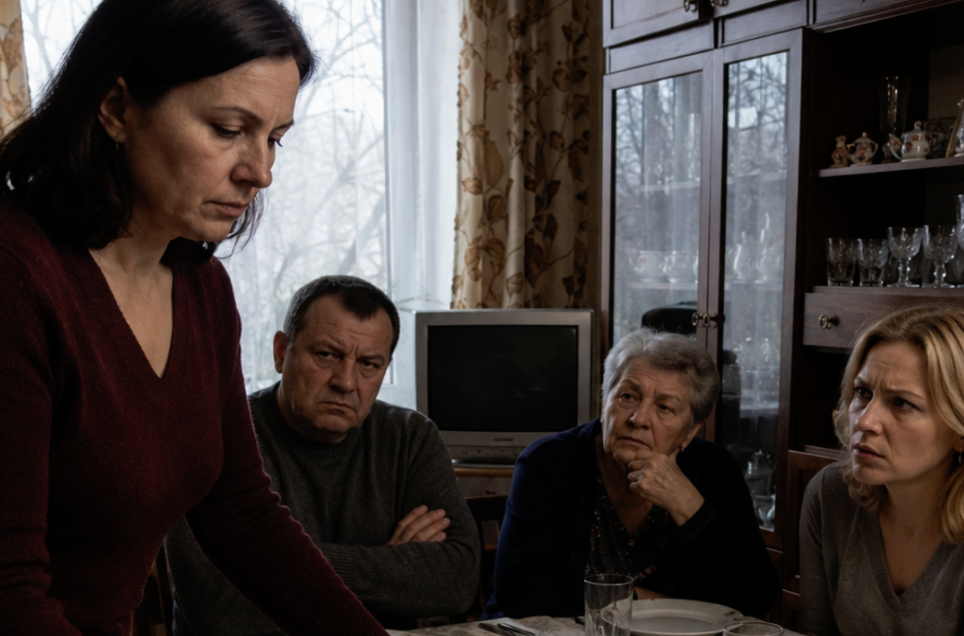
The sideboard shone with crystal bowls that had never once been used but were regularly dusted. In the living room, the guests were already seated: Vika with her husband Valery and their fifth-grade daughter Nastya, as well as Alexey’s cousin-aunt Zinaida Pavlovna, who had come from a neighboring town.
The table was overflowing — Olivier salad, herring under a fur coat, sprat sandwiches, sliced meats, cabbage pies, aspic. At the head of the table, as always, sat Vika — by right of being the beloved daughter. Galina Semyonovna bustled about, moving plates and adjusting napkins.
Lilya took off her down jacket, helped Artyom undress, and walked over to the table. Calmly, she placed the containers in front of herself and her son and opened the lid. The smell of baked chicken and garlic filled the air. Galina Semyonovna, who had been serving the jellied fish onto plates, froze with the spoon in midair.
“What is that?” she asked, looking not at the food but at Lilya.
“Our dinner, Tyoma’s and mine,” Lilya said, spreading out a napkin and taking out forks. “The rest was apparently paid for by Vika — she’s been saving up for eight years, after all.”
The silence became thick. Vika, a plump blonde with bright manicured nails, put down her fork and straightened up. She was thirty-five and had worked now as an administrator in a beauty salon, now as a saleswoman in a jewelry section, and now sat unemployed while her husband drove an rented truck. Today she was fully dressed up — a lurex dress and hoop earrings.
“What do you think you’re doing?”
Lilya looked at her mother-in-law, not at her sister-in-law.
“I found the notebook, Galina Semyonovna. By accident, when I was taking out the box. It says who contributed how much for the holidays. Next to Vika’s name — not a single number. For eight years. You counted everything, I saw it. Why did we pay for her?”
Galina Semyonovna slowly lowered herself onto a chair. She tugged at the edge of the tablecloth.
“Lilya, what are you doing? Things are hard for Vika, she has a daughter. What should I do, not seat my own daughter at the table?”
“Seat her,” Lilya said, cutting off a piece of chicken and putting it on Artyom’s plate. “But why are we paying for her place? We don’t live in our own apartment either — we have the mortgage that Lyosha and I took out a year after the wedding. And nobody ever told us, ‘Lilya, you and Lyosha don’t contribute, eat for free.’ Why has Vika been sitting at the head of the table at our expense for eight years?”
Vika flushed and turned to her mother.
“Mom, you wrote it down?! You said no one would find out, that it was our family business! You promised it would stay between us!”
Galina Semyonovna covered her face with her hands.
“I wrote it down for myself… To know how much I had spent. I didn’t want anyone to know.”
Vika’s husband Valery, who until then had been silently chewing bread, pushed his plate away. He was thin, wearing a knitted vest over a turtleneck, with the face of a man used to long trips and short domestic scandals.
“I didn’t know anything. Vika said we all contributed equally.”
“Equally?” Lilya placed her phone on the table with the screen facing up. “Here, I have photos. I can show you. Eight years, Valera. For eight years, Lyosha and I contributed three or four thousand each time, and your family contributed zero. Do you want to calculate it?”
Valery looked at the screen, then at his wife. Vika bit her lip. Zinaida Pavlovna, the elderly aunt in a down shawl, quietly stood up.
“I’ll go put the kettle on.”
Water started making noise in the kitchen. No one made any toasts. Galina Semyonovna went to the window and adjusted the curtain.
“I didn’t want to offend you, Lilya. It’s just that Vika is my daughter. Sometimes she calls me and cries. I was afraid that if I started demanding money, she would stop coming.”
Lilya sighed. She understood the old woman’s fear of being left without her daughter. She understood because she herself thought every day about how her relationship with Artyom would turn out in twenty years. But understanding did not mean agreeing to pay for that fear out of her family budget.
“Galina Semyonovna, I don’t blame you. You are a mother. But I am a mother too. I have a son growing up, and I don’t want him to think that fairness means some people work themselves to the bone while others sit at the head of the table for free. If Vika can’t contribute, let her say it directly. We would have handled it differently. But this was secret bookkeeping.”
Vika stood up and threw her napkin onto the table. She had always been impulsive — she could slam a door and be offended for a month. Now there were tears in her eyes.
“You know what? If you don’t want to come, don’t come. Nobody’s forcing you.”
“Exactly,” Lilya agreed calmly. “Nobody is forcing us. That’s why today we came for the last time under these conditions. From now on, either the shared table becomes truly shared, or we celebrate holidays at home. The choice is yours.”
“Mom,” Alexey said, “Lilya and I get up by alarm and work ourselves into the ground. Her shift starts at six in the morning. I’m at the factory. We’re not oligarchs. We just don’t complain. And not once did you ask whether things were hard for us.”
Silence hung in the room. Artyom quietly ate his chicken with potatoes, glancing from his mother to his grandmother. Lilya did not take a single crumb from the common table.
“Is this a performance?” Vika crossed her arms over her chest. “Do you want to turn us against each other? Destroy the family?”
“I want fairness,” Lilya replied. “Not a scandal. We’re eating what we paid for. You eat what you paid for. Everything is honest. For eight years, I contributed to the common table without knowing you hadn’t put in a single kopeck. Now I know. So we’re feeding ourselves.”
Galina Semyonovna returned to the table and sat down. Vika demonstratively pulled the bowl of Olivier closer and put a full plate for herself and her daughter. Valery stayed silent — he looked as if he wanted to sink through the floor along with his truck.
Lilya and her son finished their dinner. The containers were empty. She put them back into the cooler bag and zipped it shut. Then she stood up.
“Thank you for the invitation, Galina Semyonovna. We’ll be going. Happy birthday.”
“Lilya, wait,” her mother-in-law grabbed her sleeve. “I don’t want to lose my son and grandson. I’ll change everything.”
“No one is talking about losing anyone. It’s just that now we won’t contribute to the common pot. If you want to get together, let us know, and we’ll bring our own food, like today. Or let’s contribute fairly, including Vika. But secret charity at our expense is over.”
Vika snorted but said nothing. Valera sat red-faced, studying the pattern on the tablecloth. Artyom pulled on his hat. Lilya took her son by the hand and nodded to Alexey. He hesitated for a second, then stood up and followed his wife.
They went out onto the stairwell. Lilya took a deep breath and leaned against the cold wall. Then they went down into the yard and got into their inexpensive foreign car.
At home, after putting Artyom to bed, they sat in the kitchen for a long time.
“You understand that Mom is going to sulk now?” he finally asked.
“I understand. But it’s better for her to sulk than for us to keep paying for someone else’s poverty. Especially in secret.”
A week later, Galina Semyonovna called Alexey on his mobile phone. She said she wanted to see him for no special reason, just for tea. Lilya didn’t object, but she didn’t go herself. Alexey went with Artyom and stayed at his grandmother’s for about two hours. He came back thoughtful.
“Mom suggests a new arrangement. Starting from New Year, everyone contributes equally for groceries, and she writes everything down openly, in front of everyone. If Vika can’t pay, she says so out loud, and we decide what to do.”
“And does Vika agree?” Lilya looked up from the invoice she was checking at the kitchen table.
“Not yet. She said that if she has to pay, she’d rather stay home.”
“Well, there’s your answer.”
And that was exactly what happened. Family feasts in their old format stopped. Galina Semyonovna tried a couple more times to gather everyone for holidays, but Vika refused: “I’m not a beggar, I don’t have to report to her.” And she stayed home. Lilya was not upset by that.
Eight years is not a short time. You can get used to injustice, accept it, write it off as family circumstances. Or one day, you can take out containers, put them on the table, and ask the question no one expected.
What do you think — when it comes to family money, is it better to silently turn a blind eye to double standards?