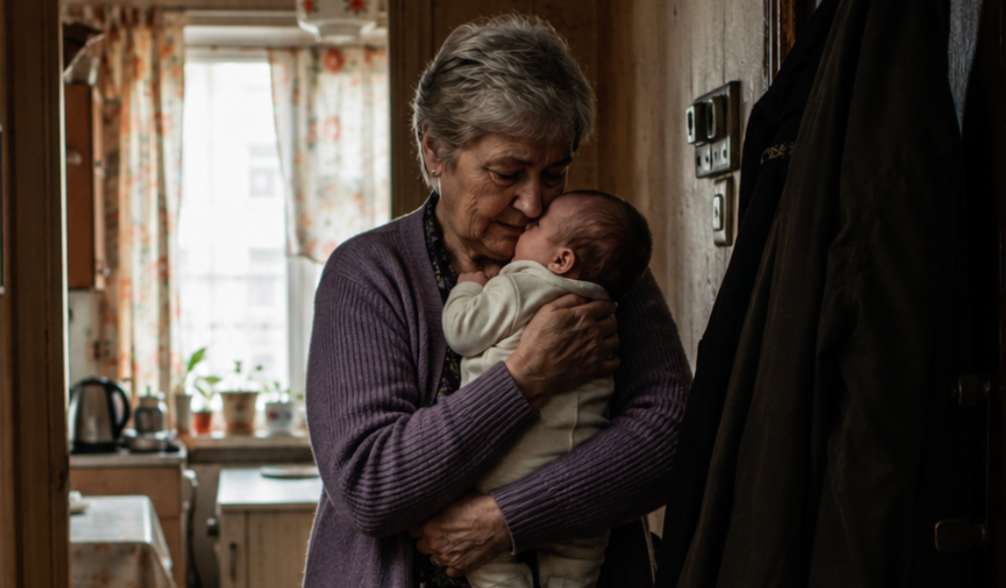
Daughter Left Her Three-Week-Old Baby With Me and Went Off to Build a New Life: When He Grew Up, He Chose His Real Mother Himself
Svetlana Stepanovna was finishing mopping the floor in the hallway when the doorbell rang. She straightened up, holding her lower back, and looked through the peephole. Her daughter was standing on the landing with a travel bag. Beside her, leaning against the doorframe, was a baby carrier.
Svetlana Stepanovna opened the door. Ira stepped inside, placed the carrier right on the old doormat, set the bag against the wall, and, without even taking off her coat, began speaking:
“Mom, this is Nikita. My son. He’s three weeks old. His documents are in the bag, in the red folder. He’ll stay with you for a couple of months. I’m going to Lipetsk. Yura got a plot there for building, and the house is almost ready. I’ll get a job at the payment center, settle in, and then I’ll come straight back for Nikita.”
Ira kissed her mother on the cheek, quickly glanced at the carrier, and stepped back toward the door.
“At least have some tea after the road,” Svetlana Stepanovna said.
“No time. Yura’s waiting. A freight truck is leaving in ten minutes, and I know the driver.”
The door slammed shut. Svetlana Stepanovna remained standing in the hallway, a mop in her hand, staring at the carrier. The baby stirred and began crying loudly.
The apartment was a two-room panel apartment on the outskirts of Tambov. Svetlana Stepanovna had privatized it in 1994, back when she still worked at the knitwear factory. Her husband had died when Ira was twelve—he had fallen from scaffolding while helping a neighbor roof a house.
Svetlana Stepanovna had raised her daughter alone. Ira finished technical college, got married, divorced four years later, returned to her mother, then rented rooms here and there and changed part-time jobs.
For the last three years, she had worked on the phone at an information service, earning pennies. Svetlana Stepanovna had been waiting for her daughter to finally settle down sooner or later. But not like this. Not with a baby left in the hallway like a forgotten bag.
She carried the baby carrier into the room and unwrapped the blanket. Nikita was tiny, wrinkled, with thin dark fuzz on the top of his head. Svetlana Stepanovna placed her palm on his back—it was warm and tense.
“There, there, little one, hush,” she whispered.
She wrapped him up again, took him in her arms, pressed him to her shoulder, and began walking around the room, gently rocking him. Nikita did not calm down. Then she sat on a chair and, still holding him with one hand, pulled the bag toward herself with the other. She dumped its contents straight onto the floor. She found a tin of baby formula—opened, already started—two bottles, and a pack of diapers.
“Now, now,” she kept repeating, no longer sure whether she was speaking to him or to herself.
She went to the kitchen, boiled water, cooled it to the right temperature, mixed the formula, and attached the nipple. Only when Nikita latched onto the bottle and began sucking did Svetlana Stepanovna breathe out. Still holding him in her arms, she returned to the room and only then opened the red folder.
Inside the red folder were a birth certificate, an insurance policy, and a certificate from the maternity hospital. In the “mother” field was written: Irina Valeryevna Simonova. In the “father” field: a dash. There was no money in the bag. No note, no envelope. Only a pack of the cheapest diapers, four undershirts, and a pair of baby pants.
She thought that now she had to decide how they were going to live.
Her pension was fourteen thousand. She had filed for it a year earlier, exactly at sixty. Her previous job as a cleaner in a small office had ended when the manager said, “Svetlana Stepanovna, please forgive us, but we need someone younger.” So she had left. And now she sat there with her grandson in her arms.
A month later, she called Ira. The phone rang for a long time, then the call was rejected. She sent a message: “Ira, Nikita is gaining weight well, he eats on schedule. Call me.” The message remained unopened. Two weeks later she called again, and a mechanical voice informed her that the subscriber was unavailable.
At social services, they explained that only the child’s legal representative could receive child benefits. She had to apply for guardianship. The police searched for Ira and sent a request to Lipetsk. At the address Ira had once mentioned, there was an unfinished house with no residents. The court declared Irina Simonova missing and appointed Svetlana Stepanovna as Nikita’s guardian. She was handed the ruling, and she carefully filed it in the same red folder.
There was a little more money now—the benefit until the child turned one and a half, then the monthly child allowance, plus her pension. Svetlana Stepanovna budgeted almost nothing for her own food: potatoes, cabbage, grains.
She started a thick checkered notebook and recorded expenses. In the left column—income. In the right—spending. Every kopeck had to account for itself. At the bottom of every month, she drew a line, and if the result was negative, she looked for where to get more.
She remembered the old knitting machine gathering dust in the pantry. From her factory days, she still knew how to knit to order. She called her former coworker Lyusya:
“Lyus, I’m knitting. Sweaters, vests, socks. If anyone needs anything, tell them.”
A week later, she received her first order: a sweater for a five-year-old girl, simple and pink, with a braid pattern. Svetlana Stepanovna knitted it in four evenings and charged three hundred rubles.
Then Galina Ivanovna, the neighbor from the first floor, asked for socks. Svetlana Stepanovna knitted three pairs and charged two hundred. A month later there was another order, then another, then more. By winter, she had a queue of five people.
She knitted at night while Nikita slept. She also took cleaning jobs. Two apartments in the neighboring building—washing floors, wiping dust, cleaning the plumbing. Five hundred rubles per apartment, once a week. That brought in about another four thousand a month.
During that time, she left Nikita with Galina Ivanovna, who doted on the boy and was ready to watch him every day. Svetlana Stepanovna could not pay her, but she knitted things for her for free.
That was how they lived. Nikita grew, learned to hold his head up, roll over, and crawl. Svetlana Stepanovna moved everything dangerous away from the walls, wrapped old rags around chair legs, and bought plug covers for the outlets.
They went to the clinic every month: to be weighed, measured, and examined. The district pediatrician, Elizaveta Markovna, at first kept asking where the mother was, but later stopped. She saw that the child was clean, well-fed, developing according to his age, and Svetlana Stepanovna answered every question briefly: “His mother is on a business trip.”
One day, when Nikita was one year old and already trying to walk while holding onto the sofa, Svetlana Stepanovna sat on the floor showing him pictures. A ball, a cat, a house, a car. Nikita poked at them with his finger and babbled. Then suddenly he said clearly:
“Ma-ma.”
She froze. He looked at her with clear gray eyes—exactly Ira’s eyes—and repeated:
“Mama. Mama.”
Svetlana Stepanovna pressed him to herself and cried. For the first time in that entire year.
She finally stopped waiting for her daughter. Not with bitterness, not with resentment, but with quiet acceptance of the fact. If Ira had wanted to be found, she would have been found. Through social media, through acquaintances, through the same police. Since she had not been, it meant she had her own life. And Svetlana Stepanovna accepted it like weather.
At three, Nikita started kindergarten—an old Soviet-built one with peeling paint on the verandas, but kind teachers. The headmistress, Olga Petrovna, a plump, tired woman, looked at the documents, where under “parents” it said “guardian: Simonova Svetlana Stepanovna,” and simply nodded.
Meanwhile, Svetlana Stepanovna increased her part-time work—she took on one more apartment to clean.
At five, Nikita learned to read. Svetlana Stepanovna bought a primer from the kiosk by the bus stop—an old-style one with large letters and simple pictures—and studied with her grandson every Sunday. He grasped things quickly; by six, he was already reading signs.
“Grandma, look—‘Bread,’” he said, pointing at a shop.
“Correct. And what does that one say?”
“Phar-ma-cy.”
“Well done.”
He grew smart and curious. Svetlana Stepanovna did not remember Ira being like that at his age.
At seven, Nikita started school. Svetlana Stepanovna bought him a uniform, a backpack, notebooks with green covers, pens, pencils, and an eraser shaped like an elephant.
On September 1st, she stood in the crowd of parents—the oldest one there, in a blue raincoat and a white headscarf. Nikita, holding a bouquet of asters, kept looking around and waving to her. She waved back, and for some reason a lump rose in her throat.
At the first parents’ meeting, the teacher clarified:
“You’re his grandmother?”
“His mother,” Svetlana Stepanovna said. “I’m his mother.”
The teacher faltered but said nothing.
At ten, Nikita came home from school and asked:
“Mom, why does everyone have children and parents, but I only have you? Where is my dad? Where is the woman who gave birth to me?”
Svetlana Stepanovna had been expecting that question. She sat him beside her on the sofa and told him the truth, but without unnecessary details.
“The woman who gave birth to you is my daughter. Her name is Irina. When you were three weeks old, she brought you to me and said she would leave for a little while. And she never came back. I don’t know where she is or why it happened that way. But I raised you and I love you. You are my grandson and my son.”
Nikita was silent for a long time, then asked:
“Is she bad?”
“I don’t know,” Svetlana Stepanovna said honestly. “It happens. Sometimes people don’t cope. That doesn’t mean they are bad. It means it was hard for them. But I coped. Because I have you.”
Nikita leaned his shoulder against her and did not ask again.
Years passed. At twelve, he joined the school athletics section—he shot up, became thin and wiry. The coach praised him.
At fifteen, he became interested in computers. He sat up at night writing code. Svetlana Stepanovna did not understand a word of it, but she saw how his eyes lit up.
“Mom, I wrote a program that sorts files into folders! Can you imagine? It works!”
“Everything you do works,” she nodded.
One day he showed her a simple game where a spaceship dodged asteroids.
At sixteen, he was already earning money—helping acquaintances with computers, setting them up, repairing them. He brought the money home.
Svetlana Stepanovna no longer washed floors in the shop—her back was giving out—but she continued knitting.
Ira never appeared. Not once. No call, no letter, no news. Sometimes Svetlana Stepanovna caught herself thinking that if her daughter rang the doorbell now, she probably would not be surprised. But she would not be happy either. She simply would not know what to say. Too many years had passed. Life had become too different.
Nikita finished school with good grades and was admitted to a technical university on a state-funded place, to the Faculty of Information Technology. When the acceptance notice came, he burst into the apartment waving the printout:
“Mom, I got in! On my own!”
“I knew you would,” she said.
She hugged him and felt him trembling with happiness.
In his first year, he lived in the dormitory, but every weekend he came home. She waited for him with pies and clean bed linen.
In his third year, he got a job at a small IT company. The salary was modest, but every month he sent part of the money to Svetlana Stepanovna. She put it into a savings account—“for a rainy day,” though in truth it was for him, for his future.
After university, he was invited to work at a large company with a good salary. He showed her the contract, and she did not believe the numbers until he read them aloud.
“Mom, now I can support you. You won’t knit to order anymore.”
He met a girl named Katya—quiet and serious. Two years later, they got married. The wedding was modest, in a café on the outskirts, only close people.
The host asked for a toast from the groom’s mother. She stood up, took the microphone, and said:
“Nikita, I raised you. You are the best thing that ever happened to me. Be happy.”
Then she sat down. And everyone fell silent, because there was nothing more to add.
After the wedding, Nikita and Katya rented an apartment, but every Sunday they came to visit her. Svetlana Stepanovna baked pancakes, and Nikita devoured them, dipping them in sour cream. Katya laughed and asked for more. Svetlana Stepanovna looked at them and thought how strangely her life had turned out.
She had waited for her daughter, but raised her grandson. She had expected loneliness, but found a family.
Who is truly a mother—the one who gives birth, or the one who raises a child without ever once doubting her right to be called Mom?