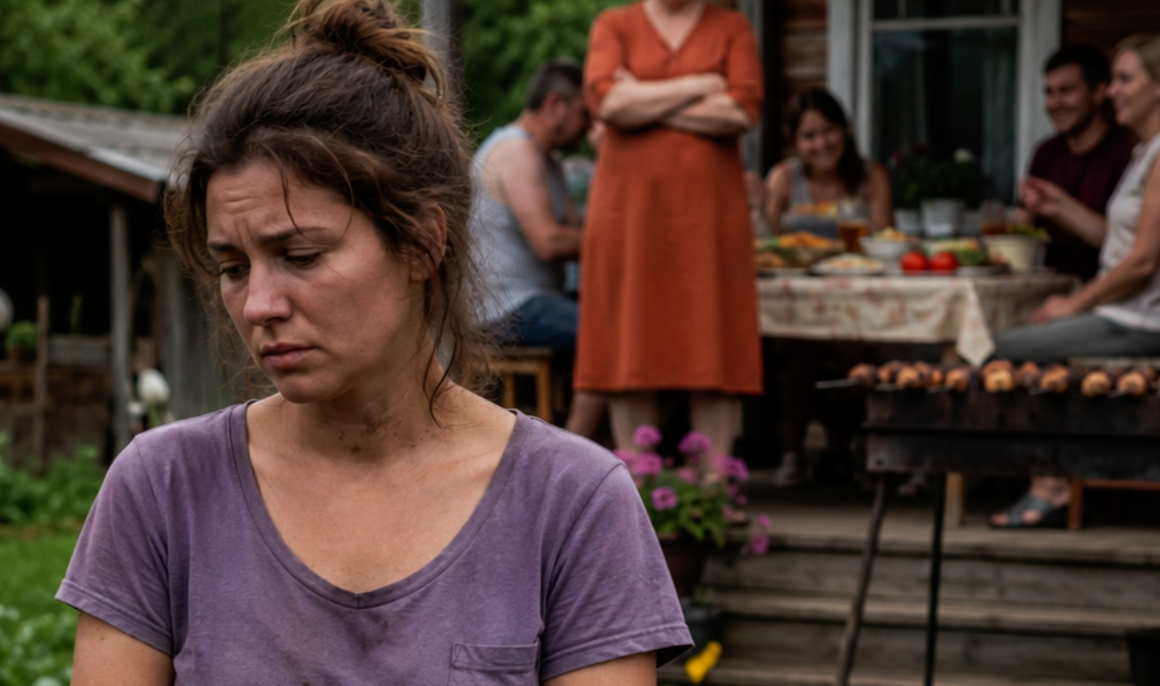
For Three Weekends I Dug Garden Beds While My Husband’s Family Grilled Shashlik — Then One Word From My Mother-in-Law Made Me Leave
The shovel was standing by the porch, leaning against the drainpipe — brand-new, with the price sticker still on the handle, which no one had even bothered to peel off. I got out of the car to stretch my back after sitting in traffic, and it was the first thing I saw.
“Oh, Zhenya, look, the tool is already prepared,” I chuckled, turning to my husband.
Zhenya slammed the trunk shut, stretched, and looked at the shovel without any expression.
“Oh, that. Mom asked me to buy it. We stopped by the market. I took it out while you were rearranging the bags.”
I nodded. We had arrived at Zhenya’s parents’ country house on Saturday around noon. It was our first trip after the wedding — we had gotten married in April, it was now the end of May, and my in-laws had finally invited us to “come see the land.” I work as a merchandise specialist in a chain grocery store, with a floating schedule, and getting two days off in a row is rare, so we had planned the trip around my shifts.
Zhenya works at a transport company, handling paperwork. His parents, Lidia Sergeyevna and Oleg Viktorovich, are retired. They bought the plot about eight years ago, but only recently began settling it properly, when Oleg Viktorovich finally had the time.
A timber house, a terrace, a barbecue area. When we arrived, Oleg Viktorovich was already busy with the coals. Lidia Sergeyevna came out onto the porch, wiping her hands on a towel.
“You’re here! Take off your shoes, wash your hands. Oleg, stop for a second, the kids are here.”
“Hello, Lidia Sergeyevna.”
“Hello, Anya. How was the drive?”
“Fine. Just a bit of traffic outside the city.”
We took off our shoes in the hallway. The house smelled of wood and baking — Lidia Sergeyevna was making a pie. I offered to help, but she waved me off: everything was ready, only tea needed to be brewed. I went into the room, changed into work clothes — old jeans and a long-sleeved T-shirt I had brought on purpose — and went outside.
Oleg Viktorovich was laying meat on the grill. Zhenya stood nearby, telling him something about accounting at work.
“Anya,” Lidia Sergeyevna called, “come with me.”
She was standing near that same shovel.
“You see, not all the beds have been dug up yet. That patch over there,” she pointed to a three-by-four-meter rectangle overgrown with dry grass, “needs to be prepared for cucumbers. It’s hard for me now, my back isn’t the same. And it’ll be good for you — in the city you’re always indoors with goods and shelves. You’ll breathe some fresh air, loosen up. Dig for an hour and the tiredness will go away.”
She smiled openly, almost kindly. I was even taken aback.
“Lidia Sergeyevna, I’m actually on my feet all day.”
“Well, that’s good. You’ll straighten your back, stretch your muscles. You’re young, what’s the big deal? The men will handle the shashlik, and we’ll take care of the garden.”
And she handed me the shovel. I took it. Simply because it seemed like the easiest solution. I didn’t want to spoil the first trip or start an argument over nothing. I was twenty-seven, had been married for a month and a half, and at that moment I truly believed it would only happen once.
The soil turned out to be heavy, clay-like, packed tight. The shovel went in with difficulty. I had to press down with my foot, turn over the clumps, break them apart. After ten minutes, my back was soaked with sweat. After twenty, my shoulders began to burn. Lidia Sergeyevna stood nearby, talking about cucumber varieties, manure, and occasionally correcting me: “Dig deeper. There are still roots here, pull them out.” I dug and listened with half an ear, glancing toward the grill.
Everyone had already gathered there. Zhenya’s brother Sasha had arrived with his wife. Sasha works as a mechanic at an auto shop, and Katya is on maternity leave with their one-and-a-half-year-old son. The toddler ran through the grass, Oleg Viktorovich tossed him into the air, and the child squealed. Katya sat in a wicker chair with tea, scrolling through her phone and laughing at Sasha’s stories about customers. Zhenya stood with them, holding a plate of sliced vegetables, laughing too. The sun beat down. The meat sizzled. It smelled of smoke and spices.
I turned away and continued digging.
An hour later, the bed was ready. I stuck the shovel into the ground, wiped my forehead, and went over to the table. No one noticed that I had not been with the group — or rather, no one had been waiting for me. Everyone had been busy with themselves. Zhenya asked, “You got sweaty?” and pushed a plate of shashlik toward me. I sat down, very hungry. The meat was excellent, tender, with a crust. I ate and listened to the conversations, but there was already a chill inside me. I felt cut off, only I couldn’t understand whether I was being overly sensitive or whether something really was wrong.
That evening, as we were getting ready to leave, Lidia Sergeyevna came up to me and put her arm around my shoulders.
“Thank you, Anechka. It turned out wonderfully. You’re a good girl. Next week we’ll manage a couple more beds, and the garden will look like a picture.”
She said it as if it went without saying — that I would come every weekend and dig. I looked at Zhenya. He was standing by the car with his father, discussing some gasket for a faucet. I said nothing and got into the car.
At home, in bed, I said:
“You know, that felt strange. Everyone was relaxing, and I was digging a garden bed.”
“Mom asked for help,” he yawned. “You weren’t against it, were you? It’s hard for her. Her back hurts.”
“I’m not against helping. But why only me? Sasha could have done it, or you, or Katya — she sat in a chair all day.”
“Katya has a child. Sasha helps Dad, you didn’t see. And I was handling the shashlik.”
The arguments were weak, but I didn’t escalate. Once. I told myself it had happened once, and everything was fine.
A week later, on Friday, Zhenya said:
“Mom called. She invited us for the weekend. Shall we go? They promised to heat the sauna.”
I tensed, but again I couldn’t refuse. A sauna is a sauna, and I love the sauna.
We arrived on Saturday morning. The shovel was standing in the same place by the drainpipe, only now the handle was wrapped with electrical tape where a crack had formed. Lidia Sergeyevna greeted us warmly, gave us tea with a casserole, and then, as soon as I finished drinking, said:
“Anechka, remember what we agreed on? Today we’ll dig for cabbage and zucchini. There isn’t much.”
She wasn’t asking. She was informing me. “Not much” meant two beds. One was about the same size as the previous one, and the second was smaller, but the soil there was even harder: an old trailer had once stood in that corner, and the ground had become almost stone-like.
I took the shovel again. I dug again. This time no one came over to me — Lidia Sergeyevna went inside to make lunch. Oleg Viktorovich and Sasha were working at the far end of the plot, building a greenhouse. Katya was inflating a small plastic pool for the baby. Zhenya was helping them with the pump.
I stood in the middle of the garden, gripping the handle, and felt blisters swelling on my palms. Last time I hadn’t thought to wear gloves, and now the skin hurt badly. I stopped and caught my breath. Why was I here again? Why me specifically?
There was an answer, but I didn’t want to say it out loud. Because once I said it, I would have to change something.
I finished digging both beds. Then I sat down on an upside-down plastic bucket and looked at my hands. The blisters had burst in two places. I covered them with bandages from the car and went to the table.
At lunch, Lidia Sergeyevna announced loudly to the whole terrace:
“Look how hardworking Anya is! Not like young people nowadays — all they do is sit on their phones.”
Everyone nodded. Sasha raised his mug of compote in a joking toast. Katya said, “Yes, Anya, well done.” Oleg Viktorovich gave an approving grunt. Zhenya looked at me proudly, and that look made me feel sick. They were praising me for work none of them wanted to do. Praise instead of payment.
I ate my soup in silence.
Before the sauna, I finally said to Zhenya:
“Listen, this isn’t fair. Why am I working like a horse while your mother rests? She talked about her bad back, but she carries grocery bags just fine, I saw it. And she bends over when she needs to.”
“Her back doesn’t hurt from everything,” Zhenya replied, “only from certain movements. You’re not a specialist, so you can’t judge.”
“Fine. Why doesn’t Katya help?”
“Katya has a child.”
“And you?”
“I’m helping Dad.”
“With what? Last time you held a plate of vegetables and told jokes. Today you inflated a pool with a pump. That’s not work, Zhenya.”
He fell silent. Then he said quietly:
“You want me to fight with my mother over garden beds?”
“I want you to notice that I’m being used.”
“No one is using you. They’re just asking for help. Like family. You’re part of the family now, and in a family everyone helps.”
I looked at him and understood: he truly believed that. To him, there was no difference between “helping” and “working for free.” He had grown up in this family, where his mother gives orders and everyone obeys. The fact that I had been placed on the lowest rung seemed natural to him.
I barely remember the sauna. I sat on the bench, breathing in the hot, damp air and wondering what would happen next.
After that, things escalated. On the third weekend, Lidia Sergeyevna called me personally — not Zhenya, but me on my mobile, even though she had always called him before.
“Anechka, here’s the thing. It’s time to plant the beds. Come early, around eight, before it gets hot. The seedlings are ready. We’ll make the holes, water them, and plant them. The two of us will finish quickly.”
“Lidia Sergeyevna, I wasn’t planning to come this weekend. I have a shift on Sunday and need to rest. And honestly, I just want to stay home.”
She went silent.
“Anechka,” her voice became colder, “we were counting on you. A garden is serious business. You don’t abandon it halfway through. I thought you understood. You saw how much effort we put into it.”
I wanted to say that I was the one who had put in the effort, while “we” meant her giving instructions and the men not going near the garden. But instead I said:
“I’ll call you later.”
That evening, I spoke to Zhenya directly: I was not going to dig, plant, or weed anymore. If help was needed, everyone could help. Or they could hire someone.
Zhenya listened and nodded.
“Fine, let’s go one more time, and I’ll talk to Mom myself. I promise.”
I agreed. Stupidly. But I wanted to believe he would talk to her.
On Saturday we arrived again. Lidia Sergeyevna greeted us with a strained smile. There was no shovel by the porch, and for one second I exhaled. But instead of the shovel, there were two crates of seedlings — tomatoes, peppers, zucchini, cucumbers. A lot.
“Anechka, change your clothes and we’ll begin. Now is the perfect time, while the soil is damp.”
I changed and went over to Zhenya.
“You promised to talk to her.”
“I will, I just need to choose the right moment.”
I waited. Lidia Sergeyevna stood by the beds with a trowel. Zhenya went over to the grill and started talking with his father about the pump.
“Zhenya!”
He turned, made a “wait” gesture, and continued.
I walked over to the beds. I stood opposite Lidia Sergeyevna.
“I’m not going to plant today. I’m tired. I’ve been working hard for three weekends in a row, and I haven’t had any days off. Let’s do it differently.”
Lidia Sergeyevna placed the trowel on the ground, straightened up, and looked at me for a long time.
“What do you mean, you’re not going to?”
“Exactly that. I’m tired. Let Zhenya help, or Sasha, or we can all do it together in an hour and be done.”
“Sasha is building the greenhouse. Zhenya is helping his father.”
“I’ve seen how they help. Oleg Viktorovich manages on his own, and last time Sasha spent forty minutes looking for a drawing on his phone and drinking tea. That’s not help.”
Lidia Sergeyevna pursed her lips and said loudly enough for everyone to hear — Oleg Viktorovich, Sasha, and Katya, who was coming out of the house with the child:
“Just look at this. I told you she was lazy. She dug three beds and nearly collapsed. When I was her age, I worked eight hours in the garden and didn’t complain.”
Everything inside me tightened. “Lazy.” In front of everyone. Deliberately, with an audience.
Sasha snorted. Oleg Viktorovich turned away toward the grill, but I saw him smirk. Katya looked away, hugged her son close, and said, “I’ll go inside, there’s a draft here.” Zhenya stood there looking confused, as if he didn’t know whose side to choose.
And I stood in the middle of the garden in old jeans, with blisters on my palms and an aching back, listening as they called me lazy. And the most painful part was that Zhenya stayed silent. He stood ten steps away and said nothing.
I shook off my hands and walked to the car.
“Where are you going?” Zhenya asked.
“Home.”
“What do you mean, home? We just got here.”
“Exactly. I’m leaving. You can stay.”
I got into the car and turned on the ignition. My fingers were trembling. I understood that now the thing I had feared would happen: an open conflict, after which there would be no way back. But if I stayed now, if I picked up the trowel again and silently planted seedlings under their contemptuous looks, there would also be no way back. I would stop respecting myself.
Zhenya came over and opened the door.
“Anya, wait. Mom got carried away, she didn’t mean it. That’s just her character, she always speaks directly.”
“Directly is when it’s private. This was public humiliation. Don’t you see the difference?”
“She didn’t humiliate you. She just said what she thought.”
“Zhenya, if you don’t get in the car right now, I’m leaving alone.”
He hesitated. He looked at the house, at the terrace where Lidia Sergeyevna stood looking like an offended queen, at his father, who demonstratively did not turn around, at Sasha, who was saying something to Katya as she leaned out of the doorway. Then he looked back at me.
“You’re forcing me to choose.”
“No. You made that choice yourself when you watched me work like a horse for three weeks and stayed silent. You made it today when you stayed silent again.”
He got into the car. We drove out through the gate. In the rearview mirror, Lidia Sergeyevna threw up her hands and shouted something to Oleg Viktorovich, pointing in our direction.
The drive passed in silence. Zhenya looked out the window, and I drove. Only one word spun in my head: “Lazy.” Said in front of everyone. And it wasn’t about the garden. The garden was just the excuse. It was about putting everyone in their place: who is in charge and who obeys. I had become inconvenient — I asked questions. I had to be put in my place.
That evening, at home, I sat in the kitchen and thought. Zhenya and I lived in a two-room apartment bought with a mortgage a year before the wedding. The down payment had come from my parents, and part of the savings were ours together. It was registered in both our names, fifty-fifty. We both worked and paid equally. I was financially independent. And my independence, it seemed, did not fit into his mother’s worldview.
Lidia Sergeyevna grew up in Soviet times, when a daughter-in-law came into her husband’s family and proved her usefulness. According to Zhenya’s stories, she had gone through something similar herself: her own mother-in-law, a harsh woman, drove her without rest. Now Lidia Sergeyevna was reproducing the same scenario, only in the role of the elder woman. To her, it was right. She even considered herself kind — she wasn’t making me milk a cow, she was simply asking me to help with the garden. She did not understand that for me, “helping” meant spending my weekends working on someone else’s land. Or she didn’t want to understand.
Zhenya came in and sat across from me.
“Anya, maybe you overreacted? It could have been handled more calmly.”
“How? By taking the shovel and digging again?”
“Well, you could have discussed it later, privately, with Mom.”
“Zhenya, I tried. I talked to you. I talked to her on the phone. I asked, explained, looked for a compromise. In response, I was publicly called lazy. That wasn’t an accident.”
“She just lost her temper.”
“And you? Why didn’t you lose yours? Why didn’t you say a single word?”
He lowered his head, studying the pattern on the oilcloth. I knew the answer. It was easier for him to stay silent than to confront his mother. He had been taught his whole life: mother is authority, you don’t argue with her, she only wants what is best. Even when she publicly humiliated his wife, he couldn’t step over that.
“I’ll talk to her,” he said. “I’ll call tomorrow and explain that this isn’t acceptable.”
“Call. But I’m not going to the country house anymore.”
“At all?”
“At all. Not to dig, not to plant. And I don’t need shashlik at that price.”
He sighed, but didn’t argue.
The next week, I didn’t go. Zhenya went alone — “I need to help Dad with the plumbing.” I stayed home. For the first time in a month, I had a normal, quiet weekend. I woke up at nine, made coffee, sat on the balcony with a book. No one called me to dig, gave me instructions, or evaluated my work. Silence. Peace. Solitude.
Closer to lunchtime, the phone rang. Lidia Sergeyevna.
“Anechka, where is Zhenya? We can’t reach him.”
“He’s at your country house. Or he should be there already, he left an hour ago.”
“And why didn’t you come?”
“I told you — I’m tired. I want to rest.”
A pause. Then in another tone, almost pleading:
“Our tomato seedlings are dying. I can’t manage by myself, my back is killing me. Maybe you could come? Just for a couple of hours. We’d drive you back afterward.”
I almost laughed. The scheme was transparently obvious.
“Lidia Sergeyevna, I’m not coming. If you need help, ask Sasha. Or Katya — she’s home, she has time. Or hire someone. There are surely people in the village.”
“Anechka, what kind of person are you?” the familiar steel entered her voice. “We opened our hearts to you, and you… I never thought you were so unresponsive.”
“Yes, I’m unresponsive. And lazy. You already said that. Goodbye.”
I ended the call. My heart was pounding, but my soul felt calm. As if I had finally closed a door that should have been closed long ago.
That evening, Zhenya returned — quiet and tired.
“Mom called,” he said from the doorway.
“I know. She called me too.”
“She says you hung up on her.”
“Yes. Because I don’t want to listen to insults.”
Zhenya sat down on the small stool in the hallway, untying his sneakers. He looked lost — like a person who had suddenly realized that two roads he had been trying to walk at once had finally split apart.
“Anya, I talked to her. I said she was wrong. I said she couldn’t behave like that.”
“And what did she say?”
“That I’m under my wife’s thumb and that you’re turning me against my family.”
I smirked.
“Classic. And Oleg Viktorovich?”
“Dad said not to get involved in women’s business. Women will sort it out themselves.”
“So he supports her.”
“He just doesn’t want to fight. He always steps aside when she gets worked up.”
Everything was clear. A family system: the main woman holds everyone in her fist, and the men don’t interfere because it’s easier that way. And I was the new element that didn’t fit. I didn’t obey, didn’t agree to the role of junior worker. Now they were trying to push me out — creating conditions where I would either break and accept the rules, or become the guilty one.
Two more weeks passed. I didn’t go to the country house. Zhenya went alone, then stopped — his mother was sulking, barely speaking to him, while his father kept insisting he could manage on his own. He was managing badly: the garden remained unplanted, the seedlings were dying. Lidia Sergeyevna called Zhenya, complaining about her health and her ungrateful daughter-in-law. Zhenya repeated those conversations to me, and I could see how hard it was for him. He loved his mother and didn’t want to fight with her, but he didn’t want to lose me either. He was caught between two fires, and this was his test.
One evening, over dinner, he said:
“Maybe we should make peace after all? Go together, you apologize — not for refusing to work, just for being sharp — and everything will settle down.”
I put down my fork.
“Zhenya. I’m not going to apologize. I have nothing to apologize for. I worked on their land for free for three weeks. I was publicly insulted. And now I’m supposed to ask forgiveness?”
“For the sake of peace in the family.”
“At what cost? So I admit: yes, I’m lazy, I’m bad, put me in the corner and hand me a shovel?”
He was silent. I could see two desires fighting inside him: to return everything to the way it was and to preserve our relationship. But the way things had been was no longer possible.
“I’m not against helping,” I said more quietly. “If something serious happens — weakness, trouble — I’ll come and help. But I will not work every weekend while everyone else grills shashlik. That’s not help, that’s exploitation.”
“Exploitation,” he repeated. “That’s a strong word.”
“It’s an accurate one.”
We finished eating in silence. I cleared the plates, turned on the kettle, and sat back down. Outside the window, summer twilight thickened, poplar fluff drifted in from the street, and somewhere a dog barked. I looked at my hands — the blisters had almost healed, leaving thin strips of dry skin that would soon disappear completely.
That evening, I made a decision. I would not get divorced, would not issue ultimatums. But I would not go to the country house again. And I would not allow anyone — neither my mother-in-law nor my husband — to make me feel guilty for not wanting to be free labor. My weekends are mine. If everyone else is resting and you are working, you are not part of the company. You are an employee without wages. And if they don’t understand that, it is their problem, not mine.
When Zhenya went to bed, I sat in the kitchen for a long time. The tea had long gone cold, and I barely noticed it. One trip to the country house, one shovel by the porch — and everything fell into place. It is better to learn the truth now than ten years later, when there are children, shared property, and a habit of enduring things. The truth turned out to be simple: in his family, a daughter-in-law is a labor resource, and if you disagree, you are the enemy. Well then. If I have to choose between that kind of “family” and self-respect, I choose the latter.
I washed the cup and went to bed. Tomorrow was Wednesday, a workday. A new batch of dairy products would arrive, and I would need to check the expiration dates and process the invoices. An ordinary life, where I decide for myself what to spend my time and energy on.
And not a single garden bed.
Has this ever happened to you? When “helping as family” turns into your obligation, and refusing becomes a reason for offense? And where is that line?