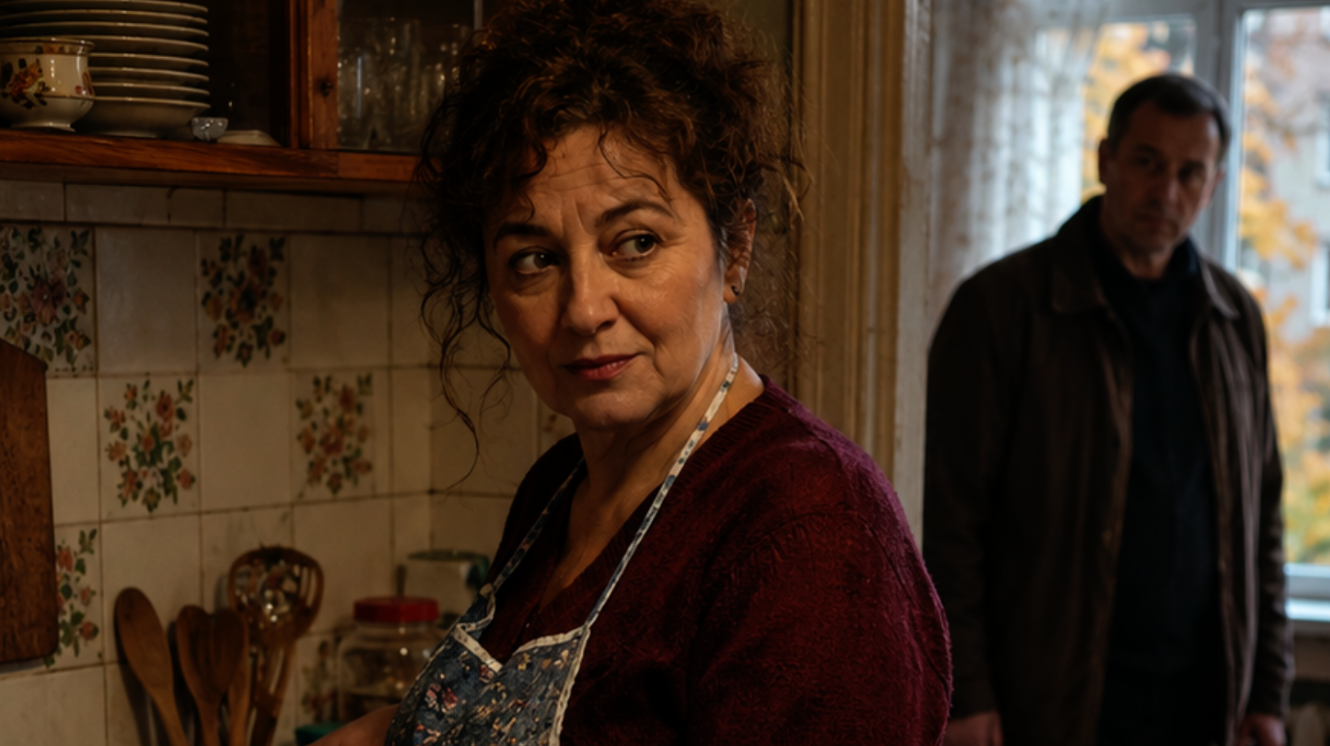
My ex came back after 12 years — on the very day he found out about the inheritance. I poured him borscht and called my daughter
The doorbell rang at seven in the morning. On a Saturday. I was just preparing dough for pies — memorial pies, because Monday would mark nine days since Aunt Galya’s passing.
I went to the peephole, wiping my hands on my apron. At first, I couldn’t believe my eyes.
Standing on the landing was Seryozha. My ex-husband. The man I hadn’t spoken to for twelve years, eight months, and, if I’m being completely honest, four days.
With a suitcase.
The very same checkered suitcase into which, when he left in 2013, he had packed his shirts, his razor, and a photograph of our daughter Katya. That photograph, by the way, he later threw away — Katya herself told me she had found it in the trash by the entrance the morning after he left.
I opened the door. Silently.
“Lena,” he said. And he smiled that same smile that once used to melt me. “Lena, I’ve been thinking… I was a fool, Lena.”
“Hello, Seryozha,” I said evenly. “What brings you here?”
“May I come in?”
I stepped aside. Silently. And you know, at that moment, something very calm clicked inside me. Like a switch. I didn’t even get angry. I simply understood very, very clearly why he had come.
Because ex-husbands do not show up on your doorstep at seven in the morning on a Saturday with a suitcase. Ex-husbands show up on your doorstep with a suitcase in only one case: when they need something very, very badly.
And four days earlier, I had inherited Aunt Galya’s three-room apartment. On Chistye Prudy. With a view of the water, stucco ceilings, and oak parquet floors that even my aunt’s father had once walked across in polished boots.
And Seryozha, obviously, already knew about it. From whom — that wasn’t hard to guess. His mother was friends with my neighbor on the landing. And my neighbor, Aunt Valya, had found out first because I had asked her to help me bring in boxes of Aunt Galya’s papers.
Moscow is a small town, as they say.
“What a smell!” Seryozha said, putting his suitcase in the hallway. “Borscht, is it?”
“Borscht. From yesterday.”
“Oh, Lena. How I missed your borscht. That one, you know…” He waved his hand and sat down on a kitchen stool without waiting to be invited. “She couldn’t cook it. Made it from a packet. Can you imagine?”
“That one” was Ira. She had been twenty-three when he left me for her. So now she was thirty-five. And apparently, “that one” was over.
Silently, I poured him some borscht. Put out sour cream. Added bread.
He ate greedily. I watched.
“Lena,” he said, without lifting his eyes from the plate, “I know I’m guilty. But so many years have passed. I thought maybe… we’re adults. Maybe a second chance. I’m tired, Lena. Completely alone.”
“And Ira?”
“She left. For someone else. A younger man.” He gave a bitter smirk, and I almost applauded: an actor, straight out of the Moscow Art Theatre. “See, life taught me a lesson too.”
“It happens,” I agreed.
“And how are you? Alone?”
“Alone.”
“How’s Katya?”
That was when I nearly dropped the ladle.
Twelve years. For twelve years, he had never asked how Katya was. Not once. Not on her eighth birthday, not when she was in the hospital with appendicitis, not when she graduated from school with a gold medal. Child support — yes, he transferred the bare minimum from his unofficial salary, about eight thousand rubles. But “How’s Katya?” — this was the first time in twelve years.
“Katya is fine,” I said. “She’s studying.”
“Where?”
“In Saint Petersburg. To become a designer.”
“Oh, she’s growing into a talented girl. Takes after her father.”
I turned away toward the stove so he wouldn’t see my face. Because I was smiling. I was smiling the way a fox probably smiles outside a chicken coop.
Because Katya was not in Saint Petersburg.
Katya was sitting in the small room. The one that used to be her nursery. She had flown in yesterday. For the memorial.
And she heard everything.
“Seryozha,” I said, turning back to him, “what’s the suitcase for?”
He choked on his borscht. Wiped his lips.
“Lena, well, I thought… maybe you wouldn’t throw me out. I could stay for a couple of days. We could talk. I’m renting an apartment in Butovo, and the landlord decided to sell it. I have to move out by the fifteenth. Not permanently, Lena. I’m not some kind of shameless man.”
“Mm-hmm,” I said. “Of course. Not shameless.”
“Is it true that Aunt Galina’s apartment went to you?”
And there it was. That was what the bowl of borscht was for, what “I was a fool” was for, what “I missed you” was for. I even respected him a little for his directness. He asked after about twenty minutes, not two hours. Progress.
“It’s true,” I said. “It did.”
“On Chistye?”
“On Chistye.”
He blossomed. Truly, like a tomato in August. His face turned pink, his eyes lit up.
“Lena,” he said with feeling, “Lena, this is a sign. It’s fate. We could be there together… well, start over. I’d renovate it. I still know how to work with my hands, I still have skills from that old house. We’d turn it into a gem. Rent it out or live there ourselves. Lena…”
“Seryozha,” I interrupted softly, “do you remember how you left?”
He stopped short.
“Lena, well…”
“Do you remember what you said when you were leaving? I just want to check. My memory isn’t what it used to be.”
He was silent for a moment.
“Lena, why…”
“I remember. You said: ‘Lena, you’ve gotten old. Life with you is boring. I want to live, not merely exist.’ Those were your words, exactly. I replayed that sentence in my head for ten years so I could learn not to cry into my pillow. I memorized it.”
“Lena, I was an idiot.”
“I won’t argue.”
“I’ve changed.”
“That’s very noticeable. Especially by the way you asked about the apartment almost as soon as you walked in.”
He blushed. For real. Not theatrically.
“Lena, I didn’t come because of the apartment…”
“You did, Seryozha. Let’s not pretend. We’re both adults. You said so yourself.”
He fell silent. And at that moment, the door creaked.
Katya came out of the room wearing my old stretched-out T-shirt and sweatpants. Her hair looked like a nest. Her face was sleepy. She was twenty.
She walked into the kitchen without looking at her father. Opened the fridge. Poured herself some kefir. Sat down across from me.
Only then did she raise her eyes.
Seryozha froze with a spoon in his hand.
“Katya?” he breathed.
“Hello,” Katya said evenly. “Who are you?”
I nearly choked. That, of course, was a blow below the belt. But what a beautiful one.
“Katya, I… I’m your dad.”
“Ah,” Katya said. “Dad. Got it. And I thought you were a courier. Why are you not letting Mom sleep at seven in the morning?”
“Katyusha…”
“Not Katyusha. Ekaterina Sergeyevna. We are on formal terms, if you don’t mind.”
Seryozha opened his mouth. Closed it. Opened it again.
“Katya, I came… to talk. With your mother. And with you too. I… I wanted…”
“Aunt Galina’s apartment?” Katya asked, sipping her kefir. “It’s mine.”
The silence that followed was so deep you could hear the upstairs neighbors flushing water.
“What do you mean?” Seryozha asked quietly.
“I mean exactly what I said,” Katya replied. “Aunt Galya was my godmother. She wrote the will in my name. Six months ago. Mom will handle it as my representative — I’m only twenty, so it’s just a technical formality. The apartment is mine. Mom knew. I knew. Aunt Galya knew. Only you didn’t know. And honestly, you shouldn’t have come with a suitcase.”
I silently looked at my daughter and thought: Who did she get that from? Definitely not me. I would have hesitated for an hour before saying it. But she fired it off like a machine gun.
“Lena,” Seryozha turned to me, “Lena, is that true?”
“It’s true, Seryozha.”
“And you… you kept quiet? You listened while I sat here…”
“Did you ask?” I shrugged. “You came in, sat down, helped yourself to borscht, invented everything for yourself, decided all on your own that we’d be making that apartment on Chistye into ‘a gem.’ I didn’t convince you of anything. I just poured you borscht. Hospitality.”
Katya snorted into her kefir.
Seryozha stood up. Very slowly. His face looked as if someone had just dumped a bucket of water over him. Cold water. In January.
“Thank you for lunch,” he said through clenched teeth.
“You’re welcome,” I said. “Don’t forget your suitcase.”
He went out into the hallway. Picked up the checkered suitcase. The same one he had left with twelve years ago when he went off to Ira of the packet soup.
“Seryozha,” I called after him when he was already by the door. “One question. May I?”
“What?”
“If Aunt Galina’s apartment hadn’t been on Chistye Prudy, but somewhere, let’s say, in Kapotnya — would you still have missed me?”
He didn’t answer. He slammed the door.
He slammed it so hard that the crystal in my cabinet clinked.
Katya looked at me. I looked at Katya.
And we burst out laughing. Both of us. Like lunatics. Laughing until we cried, until I had to sit down on the floor because my legs wouldn’t hold me.
“Mom,” Katya said through laughter, “you’re a genius. ‘Hospitality.’”
“You’re the genius. ‘Hello, who are you?’”
“I take after Mom,” Katya said proudly.
We sat for a while longer. Then I got up and went to finish kneading the dough.
Aunt Galya, may she rest in peace, knew how to choose her heirs. And you know, I think she deliberately arranged everything this way — in Katya’s name, not mine. So Seryozha wouldn’t have even the slightest chance to think he could come back. She had never liked him, Seryozha. From the very first meeting, she used to say, “Lenka, his eyes are shifty. Don’t trust him.”
It took me twelve years to understand that my aunt had been right.
And four days after her death for Seryozha to confirm it.
With a suitcase.
That very same checkered one.
The pies turned out finger-licking good that day. Cabbage pies and apple pies. Katya devoured three in one sitting and demanded that I teach her how to bake.
And that evening she said:
“Mom. You’re going to rent out Aunt Galina’s apartment, right? I’m studying in Saint Petersburg, I don’t need it for now.”
“I will, sweetheart. The money will go toward your education.”
“Mom.”
“What?”
“You choose the tenants yourself. And single men around forty-five with checkered suitcases — reject them immediately.”
I laughed. And hugged her. And for the first time in those four days, I cried. From relief. From the fact that my daughter had grown up like this. From the fact that I hadn’t broken her while I myself was breaking.
And from the fact that Aunt Galya — somewhere up there — was surely smoking her favorite Belomor cigarette right now and laughing her head off.