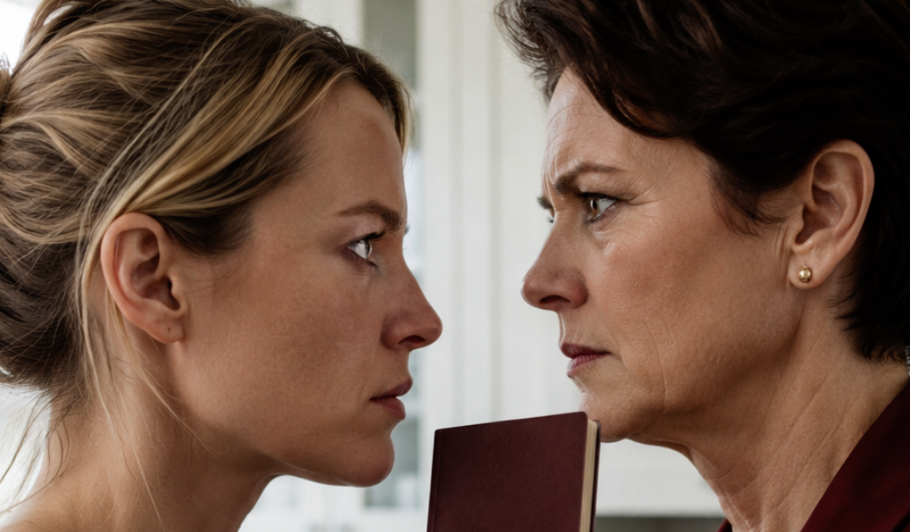
“Hide her passport so she can’t fly to sign the contract!” I read in my husband’s hidden chat.
“Hide her passport so she can’t fly to sign the contract,” I read in my husband’s hidden chat. “In the morning she’ll be looking for her documents, and I’ll go instead. I have the power of attorney.”
Kirill’s phone was lying on the kitchen table next to my laptop. He had brought it to me himself ten minutes earlier, asking me to transfer photos from last year’s trip because, as he put it, “you’re better at these things.” I opened the gallery, plugged in the cable, and then a message from Raisa Arkadyevna popped up at the top of the screen.
“I’ll put the passport in my bag. Don’t worry. Olya will make some noise and calm down. She wouldn’t be able to handle a contract like that on her own anyway.”
I sat in the kitchen, staring at those two lines. Water was running in the bathroom. Kirill was calmly taking a shower while his mother discussed where to hide my passport so I wouldn’t make it to the negotiations in Kazan.
The contract was not his. The workshop was not his. For five years, I had carried the furniture business on my own: taking orders, visiting suppliers, arguing with delivery services, checking drawings late at night while Kirill told his friends that his wife “made little stools for fun.” But he spent the money from those “little stools” without embarrassment. On a car, on trips, on debts I only found out about after the transfers had already been made.
On the morning of June 6, 2026, I was supposed to fly to Kazan. They were waiting for me there — Olga Ilyina, the owner of the workshop. But Kirill had decided that his wife had grown too comfortably out of the role of a household assistant, and now she needed to be put back in her place.
Kirill came out of the bathroom. Wet hair, house pants, the calm face of a man who had not yet realized he had been caught not saying something rude, but making a vile plan.
“Did you transfer the photos?” he asked, reaching for the phone. “Just don’t touch the messages. There are work matters there.”
I turned the screen toward him.
“Is this a work matter? ‘Hide her passport’?”
He froze for only a second. Then he frowned and immediately did what he always did when he was caught: he started speaking louder than me.
“You’re sticking your nose where it doesn’t belong again. Mom and I are worried about you. It’s a major contract, serious people, and you’re flying alone, without your husband. Normal families discuss these decisions.”
“Where is my passport, Kirill?”
“How would I know? Keep track of your own things.”
“In the chat, your mother writes that she’ll put it in her bag.”
He exhaled through his nose, as if I had tired him with some trivial nonsense.
“Mom sometimes expresses herself sharply. The point is different. I can go instead of you and sign everything calmly. I have a power of attorney.”
The power of attorney did exist. I had issued it on February 18, 2026, when some work documents had to be picked up from a supplier and I had an urgent deadline at the workshop. It was an ordinary notarized power of attorney to represent my interests in work-related paperwork. Back then, I thought my husband was helping. Now it turned out he had been holding that paper like a spare key to my work.
The apartment door opened with its own key. Raisa Arkadyevna came in without ringing, as she always did: not as if she were entering someone else’s home, but her son’s room, where his wife was merely temporary furniture. She was wearing a light-colored suit, and a large bag hung from her elbow. The very bag in which, according to the chat, my passport was supposed to be lying.
“Another scandal?” she asked, barely taking off her shoes. “Kiryusha, I told you not to talk to her in the evening. Before a trip, she’s not herself.”
“Raisa Arkadyevna, give me my passport.”
My mother-in-law did not even try to look surprised. She walked into the kitchen, put her bag on a chair, and looked at me with that tired pity she always showed whenever she wanted to humiliate someone without shouting.
“Olya, you’re a grown woman. What kind of contract are you going to handle alone? There will be men there, negotiations, obligations. Kirill will go, talk to them, look over the papers. If everything is decent, he’ll bring you in later.”
“He’ll bring me into my own workshop?”
“Don’t cling to words. We’re family. You have a shared home, a shared life, shared responsibility. If you sign something carelessly, everyone will have to answer for it later.”
“Everyone, or Kirill, who wants to go instead of me?”
Kirill sat down at the table and opened his leather folder. He had prepared in advance. Inside were printouts, a copy of the power of attorney, and my itinerary, which I had left by the laptop the day before.
“I’m not trying to deceive you,” he said, now more calmly. “I’m simply taking control. You’re a creative person, Olya. You know how to draw, choose fabrics, argue with craftsmen. But contracts and negotiations — that’s not your thing.”
Raisa Arkadyevna immediately joined in.
“Exactly. A woman should be grateful when her husband doesn’t leave her alone with serious people. You’ll thank him later.”
At that moment, I stopped arguing. Not because they had convinced me. It simply became clear: what stood before me was not a request and not concern. It was an attempt to take away my right to sign, my right to speak, and my right to walk out of my own apartment with my passport in my bag.
I walked over to the chair where my mother-in-law’s bag stood.
“Don’t touch my things,” Raisa Arkadyevna snapped, placing her hand on top of it.
“My passport is in your things. Those are different things.”
Kirill stood up, but did not come closer. He was always brave in messages and in words, but when it came to direct action, he started looking around: who was watching, what could be said later, how he could present himself as the victim.
I opened the bag. The passport was in the inner compartment, next to a makeup pouch and a packet of tissues. I took it out and placed it into my work bag.
Raisa Arkadyevna threw up her hands.
“So it was there. I just wanted to put it away so you wouldn’t lose it in your fuss.”
“In your bag?”
“Don’t nitpick. You’re nervous right now.”
Without saying a word, I took the spare set of workshop keys from the drawer. Kirill noticed and could no longer keep quiet.
“Leave the keys. In the morning I’ll stop by Sergey’s, pick up the samples, and go to the airport. You won’t make it anyway.”
“Sergey takes instructions from me.”
“Don’t make me laugh. He talks to me normally, unlike you.”
“He talks to you because you’re my husband. That’s not a job title.”
Kirill smirked, but the smirk came out nervous.
“Olya, you’re making a stupid mistake. I’ll call the partners and tell them you’re ill. Then I’ll come myself with the power of attorney, and no one will create drama because of your character.”
Raisa Arkadyevna nodded, pleased that her son was finally speaking “like a man.”
“That’s right. Enough of this amateur performance. A wife should understand when her husband is taking responsibility.”
I looked at both of them and, for the first time that evening, did not bother explaining why it was vile. Explanations were for people who did not understand. These two understood perfectly. They were simply hoping I would be frightened by the scandal, the missed flight, the big meeting, the words “you’re destroying the family,” and give in again.
“All right,” I said. “Then we’ll act according to the documents.”
Kirill became alert.
“What do you mean, ‘according to the documents’?”
“I mean exactly that. The power of attorney was issued by a notary. So in the morning, the matter of revoking it will be handled there as well. The partners will be notified that I am coming in person, and that any messages from representatives are not to be accepted without my confirmation.”
Raisa Arkadyevna immediately changed her tone.
“You’re acting on emotion. You can’t treat your husband like that.”
“Hiding my passport is allowed, but revoking the power of attorney isn’t?”
Kirill tried to take his phone from the table, but I had already managed to send myself screenshots of the chat. He noticed and reached for the screen.
“Delete them.”
“No.”
“That’s private correspondence.”
“That’s correspondence about my passport and my contract.”
He wanted to say something else, but I took my laptop and went into the room. I did not close the door. From the kitchen, I could hear Raisa Arkadyevna whispering to her son that they needed to “push me harder now, before it was too late.” Kirill answered quietly but irritably. Apparently, the plan of gentle concern was already cracking.
I wrote to the partners in Kazan briefly, without family details: “I will attend the meeting on June 6, 2026, in person. Please do not accept documents or messages from representatives without my separate confirmation.” Then I found the email from the notary office where the power of attorney had been issued on February 18, 2026, and made an appointment for the earliest time the next morning.
The reply from Kazan came twenty minutes later: “Olga, we are expecting you in person. Kirill’s participation in the discussion has been suspended until his authority is clarified.”
That sentence was enough for me to breathe normally for the first time that evening. Not because it was a victory. There was no victory yet. It was simply that Kirill had lost the opportunity to show up there with his folder and play the head of my business.
In the morning, Raisa Arkadyevna was already sitting in the kitchen, as if it were not she who had spent the night at our place, but her right to control someone else’s life. Kirill was wearing an expensive shirt and holding the leather folder under his arm. He was clearly planning to go.
“The car is downstairs,” he said. “I’m going to the airport. You stay home and don’t ruin what I’m trying to save.”
“You’re not going.”
“Olya, enough. I have the power of attorney.”
“In an hour, you won’t.”
He laughed, but he looked not at me, but at his mother. He needed support.
Raisa Arkadyevna rose from the table.
“Kirill, don’t listen to her. She’s bluffing. Women love loud words when they feel they are losing control.”
“Control over my workshop remains with me,” I said, putting on my coat. “You can keep discussing me in the kitchen. I’m going to the notary.”
Kirill blocked my way to the exit. Not sharply, but in a tired manner, as if he were the most exhausted person in the entire story.
“Do you understand how this looks? A husband finds out last that his wife revoked a power of attorney. After everything I’ve done for you.”
“I found out first that my husband was hiding my passport. After everything I paid for on his behalf.”
He stepped aside. Not out of respect. It had simply become inconvenient to argue.
There was no spectacle at the notary office. I confirmed my identity, submitted an application to revoke the power of attorney from February 18, 2026, and asked them to send Kirill a notification. I sent a separate confirmation to the partners in Kazan. It all took less time than the argument in the kitchen the previous evening.
At the exit, Kirill was waiting by the car. Raisa Arkadyevna was sitting beside him, looking at me as if I had taken not a passport from the family, but the family honor itself.
“What have you done?” Kirill asked.
“I removed you from my work documents.”
“Do you understand that now I can’t sign anything on your behalf?”
“That is exactly why I came.”
Raisa Arkadyevna abruptly opened the car door.
“Olya, you’ve gone too far. Kirill supported you, tolerated your workshop, didn’t interfere. And now, because of one trip, you humiliate your husband.”
“He didn’t tolerate the workshop. He lived off its money while calling it a shed with boards.”
Kirill shot his mother a quick glance, telling her to be quiet. Too much unnecessary truth was being said right outside the notary office.
“Let’s not make a scene,” he said. “I can still go with you. Introduce me as your partner.”
“A partner doesn’t hide a passport through his mother.”
I called a car and went to the airport alone. On the way, my phone lit up several times with messages from Kirill. First he wrote that I was making a mistake. Then that the partners were “laughing at this family hysteria.” Then that his mother felt unwell because of my stubbornness. I did not answer. I had no more time for a domestic performance.
In Kazan, I was received calmly. That was the most important thing. No one asked where my husband was. No one said it would be difficult for a woman to understand the contract. They led me into the meeting room, offered water, opened the project folders, and the conversation immediately turned to business: deadlines, materials, samples, logistics, responsibility at each stage.
After half an hour, the project representative said carefully:
“Olga, Kirill called us this morning. He introduced himself as your husband and said you couldn’t come.”
I put my pen down on the table.
“I came. Kirill’s authority under the power of attorney has been revoked. I make all decisions regarding the workshop.”
The woman nodded without unnecessary questions.
“That is why we did not discuss the details with him.”
That was when Kirill received the first real blow to his plan. Not through shouting or resentment. He was simply not allowed into the place where he intended to become the main figure.
The negotiations continued. I showed the samples, explained production timelines, spoke with people who listened to me as a manager, not as an attachment to my husband. The contract was signed that same day. I signed it with my own hand and immediately sent a copy to Sergey at the workshop.
My phone came alive again closer to evening.
“You were supposed to agree this with me.”
Then another message:
“You made me look like an idiot in front of people.”
I read it and answered for the first time in twenty-four hours:
“You called them yourself.”
After that, Kirill stayed silent for a long time. Apparently, he did not like that this story now had a simple cause-and-effect chain: he hid the passport, tried to intercept the meeting, and was refused.
I returned home late. Kirill and Raisa Arkadyevna were sitting in the kitchen. Beside the table stood two of her boxes with dishes and some towels. So while I had been flying to sign the contract, my mother-in-law had decided to establish herself in our apartment even further, with her belongings too. As a family, the way she liked it.
“Did you sign your little paper?” she asked.
“I signed the contract.”
Kirill stood up. He no longer looked confident, but angry and worn out. There was no folder in his hands. Without it, he looked like an ordinary man whose stolen pass had been taken away.
“We need to talk,” he said. “Without Mom.”
“You discussed my passport in front of Mom. You’ll hear the result in front of Mom.”
Raisa Arkadyevna demonstratively picked up her bag.
“She’s announcing the result. Look at her, Kirill. The girl from the workshop has decided she’s the boss.”
“I was always the boss in my own workshop,” I said. “It was simply convenient for you to pretend it was a hobby.”
I placed the keys I had taken from Kirill that morning on the table and held out my hand.
“The rest.”
“What rest?”
“The apartment keys, the workshop keys, the key to the cabinet with the samples. All the keys you received as a husband and used as access to my affairs.”
Kirill frowned.
“Are you kicking me out?”
“I’m offering you the chance to pack your things calmly. Yesterday, you chose your side when you decided my passport could be hidden and my contract could be taken.”
“I wanted to help.”
“No. You wanted to go instead of me.”
Raisa Arkadyevna sharply turned to her son.
“Kirill, do you hear that? She’s throwing you out of the house because of some work paper.”
“Because of the passport,” I said. “The work paper came later.”
Kirill sat back down. For several seconds, he was silent, and then suddenly he snapped not at me, but at his mother.
“Mom, why did you even put the passport in your bag? We should have just talked.”
Raisa Arkadyevna leaned back in her chair.
“Oh, so that’s how it is. When you needed help, I was good enough. And now I’m the one to blame?”
I looked at them and realized the argument was over. They were no longer pressuring me. They were dividing between themselves who had been more foolish and who could more loudly call themselves the victim.
“Take the boxes today,” I said. “Leave the keys on the table. Kirill is no longer coming to the workshop. Sergey has already received my schedule and a copy of the signed contract.”
Kirill jerked his head up.
“You already wrote to Sergey?”
“Of course. It’s a work matter.”
That phrase struck him harder than any accusation. Just yesterday, he himself had called the correspondence with his mother a work matter. Now the real working space had closed in front of him without shouting and without family meetings.
Raisa Arkadyevna began collecting the boxes. She grumbled that I was ungrateful, that Kirill would regret having such a wife, that normal women held on to their families. Kirill helped her silently. When they carried the things to the elevator, he came back and placed a bundle of keys on the table. The apartment keys. The workshop keys. The key to the cabinet with the samples.
“Olya, let’s not break everything,” he said more quietly. “I lost my temper.”
“You didn’t lose your temper. You wrote to your mother about where to hide my passport.”
He opened his mouth but found no decent explanation. There was no room left in that sentence for concern, family, or a manly shoulder to lean on.
“Where am I supposed to go?” he asked after a pause.
“To your mother. To a hotel. To friends. That is no longer my work matter.”
He took a sports bag, his laptop, and a few shirts. Raisa Arkadyevna waited for him by the elevator with a face that suggested her son had not failed at a vile plan, but had suffered from a woman’s ingratitude. The door closed without a slam. It simply closed.
The next day, Sergey wrote from the workshop: “Olga, Kirill came by. He said he wanted to take the samples for negotiations. I didn’t let him in. Did I do the right thing?”
I replied: “You did. All negotiations now go through me.”
Then I opened the new production schedule for the Kazan contract and made the first edits. The apartment felt unusually peaceful. On the kitchen table lay my documents, my passport, and the keys to the workshop. No one was digging through my bag. No one was explaining that a woman could not manage without her husband. No one was calling my work a shed with boards while eating bread paid for by it.
In the evening, Kirill wrote once more: “We’re family. We could have handled this normally.”
I looked at the message, placed the phone face down, and returned to the drawings. He could have handled it normally the day before, when he saw my passport in his mother’s bag. Now all he had left were messages.
And I had the contract, the workshop, and the keys that no longer lay in someone else’s pocket.