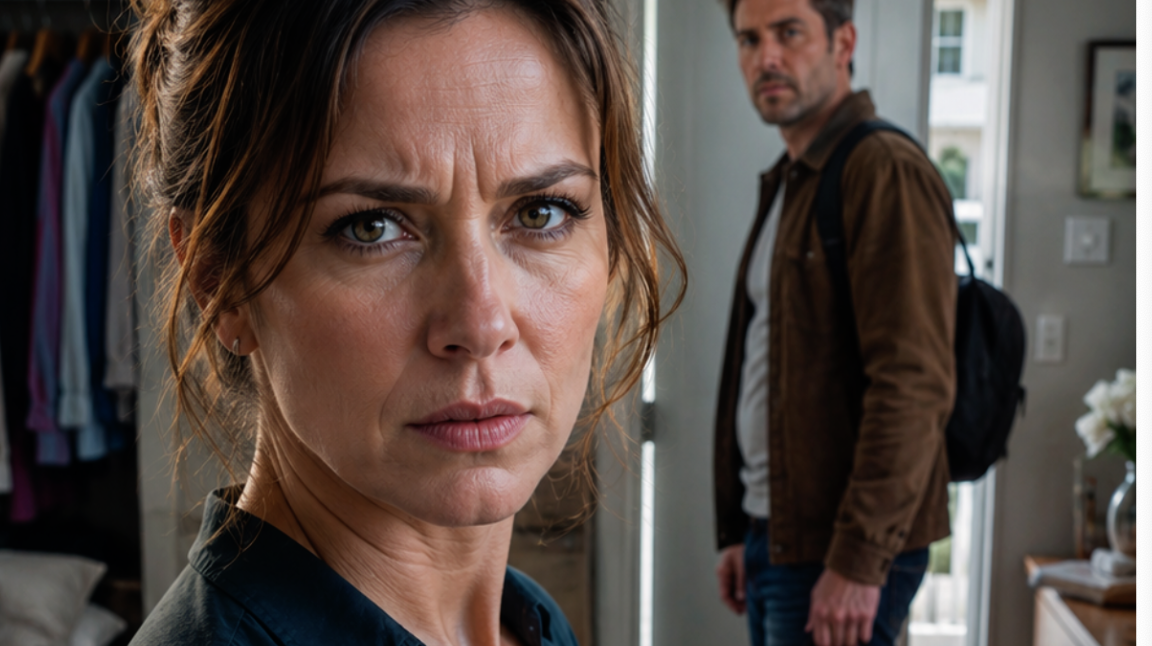
My Husband Decided to Take a Break from Me and the Kids and Ran Off to His Mother. When He Came Back, He Was Stunned.
“I packed a bag. I’ll stay at my mother’s for a while. I’m tired of this circus,” Vadim announced, without even looking at Liza and Artyom, who had frozen in the hallway.
They were standing there with their backpacks, having just come home from school, and for the first time in their lives they heard their father refer to them not as children, but as obstacles to his own rest. The word “circus” hung in the hallway air — heavy, booming, and sticky, like syrup spilled across linoleum.
Vadim stood in the middle of the corridor, his bulky sports bag dropped heavily by his leg, as if it were his strangled conscience.
In reality, over the past few months, my husband had been tired in a very selective way. He had enough strength to sink into the sofa until it looked like a hammock. He had enough strength for endless scrolling through the news feed.
He had plenty of energy for fierce arguments with some unknown colleague online about the fate of the world economy. But checking Artyom’s math problem about the speed of two trains or listening to Liza talk after her dance class — that was when our “breadwinner” suddenly suffered an energy blackout. He wore his exhaustion like a heavy crown, demanding that everyone clear the way for him, speak in whispers, and serve dinner strictly on schedule.
“How delightful, Your Majesty,” I said calmly, crossing my arms over my chest. I had no intention of throwing a tantrum. “Just don’t forget the hammer drill.”
Vadim blinked. He had clearly expected me to throw myself around his neck, try to take the bag away from him, and swear that from now on the children would walk on tiptoe and I would stop asking him to take out the trash.
“They’re old enough,” he snapped, pulling on his jacket and justifying his escape. “Nothing will happen to them if they spend a couple of days without their father. And I’m not made of iron.”
“Of course you’re not made of iron,” I nodded. “The only iron thing we have is the old system unit under the desk, and even that rattles. Have a nice trip to Mother’s Sanatorium.”
When the door slammed shut behind him, the apartment became unnaturally quiet. I went to the kitchen to get juice from the fridge. Artyom was sitting at the table, pointlessly picking at the oilcloth with his finger.
“Mom, if I’m noisy, will Dad always leave now?” my son asked, not really asking me, but somewhere up at the ceiling.
And that was when all my irony caught in my throat for a second. The jokes were over. It was one thing to fight with a grown man for the right to rest. It was another to watch your child try to squeeze himself into the narrow frame of his father’s comfort. I walked over, put my arm around his shoulders, and said firmly:
“Dad didn’t leave because you’re noisy. He left because he forgot how to be an adult. And we’re going to deal with that.”
That evening, we ordered pizza. I did not stand at the stove preparing some complicated French-style meat dish. I did not iron shirts for the next day, and I did not listen to dissatisfied grumbling from the sofa about how it was absolutely impossible to relax in this house after work. I calmly finished my order on my laptop, received the payment on my card, and suddenly realized something paradoxical: without a male presence that demanded constant service, it became easier to breathe at home. One important part had fallen out of the structure of our daily life, but somehow the whole thing stood even straighter.
Meanwhile, Vadim’s “expedition to Mars without a spacesuit” had reached its destination.
Raisa Nikolaevna, my dear mother-in-law, did not invite Vadim over out of blind maternal pity. She was an incredibly practical woman. If her son had quarreled with his wife and was “temporarily free from family,” then he could be used for his intended purpose. Raisa Nikolaevna’s trap snapped shut with the inevitability of a guillotine the very next morning.
First, she fed him pies, pitying his “thinness” with dramatic sighs, and then she took out a sheet of paper. A to-do list.
Vadim called me on Wednesday. Judging by the hollow echo, he was standing on a concrete floor.
“Ira…” His voice sounded like that of a wounded heron. “She made me redo the balcony floors. And tomorrow we’re going to the dacha. She suddenly decided she needs to uproot an old tree stump and haul junk out of the attic.”
“A change of activity is the best kind of rest!” I replied cheerfully. “You went there for peace, didn’t you? Enjoy the silence and physical labor.”
He escaped on the third day.
He burst into our hallway on Friday evening — rumpled, smelling of dust, old boards, and total defeat. He dropped his bag on the floor with such a heavy thud that it sounded as if he had brought bricks back from the dacha.
“I’m hungry as a wolf,” Vadim announced, kicking off his sneakers. “What’s for dinner?”
He expected the punishment to be over. He expected me to rush joyfully to the stove to heat up some borscht, forget every offense, and for the children to run out shouting with happiness.
I came out of the kitchen, slowly wiping my hands on a towel. Liza appeared silently behind me.
“Hi, Dad,” my daughter said in a flat, icy voice. “Did you get enough rest from us?”
Vadim stopped short in surprise. His prepared smile — the smile of a tired but generous lord of the manor — instantly soured and disappeared somewhere around his collar.
“You weren’t running away from noise, Vadim,” I said, looking him straight in the eyes. “You were running away from responsibility. And you didn’t come back to your family. You came back to dinner. That’s why there is no dinner for you tonight.”
He opened his mouth to protest, but just then my phone, lying on the dresser, rang. The screen showed: “Raisa Nikolaevna.” Without hesitation, I put it on speaker.
“Irochka!” my mother-in-law chirped energetically. “Has my runaway come back? Don’t you spoil him over there! On Sunday, let him come back again. The wardrobe in the hallway still isn’t assembled, and the doors are hanging on by a thread!”
I silently ended the call.
Vadim turned so pale it was as though he had just been handed orders for a second construction shift in a row. The realization that at his mother’s house he was not the beloved, exhausted little son, but free labor with a family discount, was reflected on his face in the full range of genuine sorrow.
“I actually came home!” he tried to put his knocked-off crown back on, raising his voice and stepping toward me. “I have the right to lie down and rest in my own apartment!”
“The apartment was mine before marriage,” I reminded him softly, but with such steel in my voice that it felt as though the keys in the lock might start ringing.
And his words, “I came home,” instantly hung in the air like a ridiculous joke. It seemed that for the first time in all our years of marriage, Vadim remembered that fact not from utility bills, but from my tone. The arrogance finally drained out of him. He stood in the middle of the hallway — a vacationer nobody needed, one everyone had already managed to rest from.
“You are not sleeping here tonight, Vadim,” I said, enunciating every word. “And you are not ruling from the sofa. If you want to return to this family, you will not start with dinner. You will start with a conversation with the children, apologies, and family therapy.”
Liza silently turned around and went back to her room. The click of the lock closing sounded louder in the hallway silence than any scandal could have. It was a blow no bag full of belongings could protect him from.
Vadim looked at me in confusion, as if expecting me to laugh and say it was all a joke. But I did not smile.
“Keys on the nightstand, Vadim,” I said. “And close the door properly. The draft in this house didn’t start from the stairwell. It started the moment you called our children a circus.”