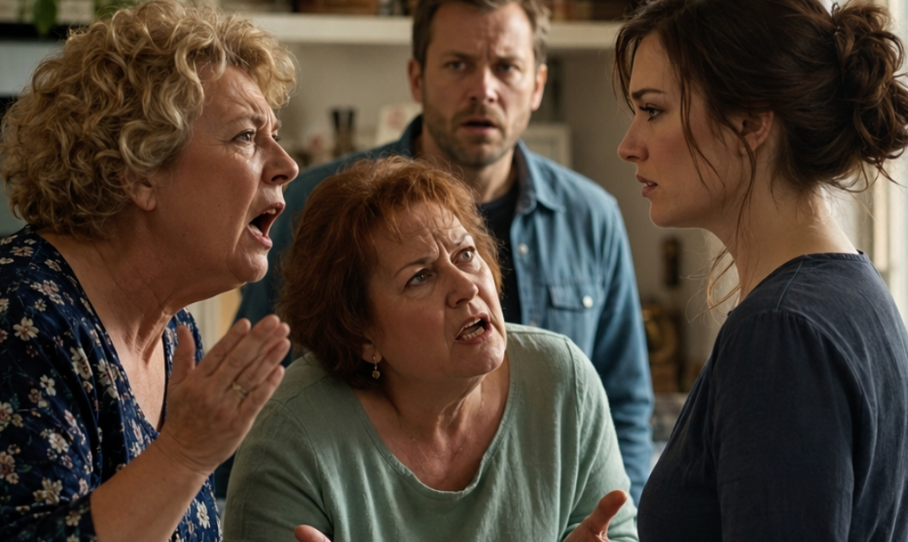
“We’ll just look at the dacha and leave!” my mother-in-law promised on Friday evening. They left on Sunday. I came on Monday — and hung a lock.
“Well then,” my mother-in-law said from the doorway, without saying hello and without taking off her shoes, “what kind of dump is this in your hallway? People live here, and it looks like a homeless shelter!”
Katya did not answer. She stood by the kitchen window, looking out into the yard, holding a phone in her hand that no longer showed anything important — it simply glowed like a nightlight. Her husband, Seryozha, shifted from foot to foot behind his mother with the look of a man who had long forgotten how to have his own opinion.
Ninel Fyodorovna — that was her mother-in-law’s name — was a monumental woman. Not in terms of height, but in terms of presence: she filled the space completely, leaving no room behind, like a piece of furniture that had nowhere to be moved. Dyed hair the color of burnt caramel, rings on every finger, a sweater with lurex — on a Friday evening and even in the heat. Her lips were pressed tight. Her eyes were sharp, quick, noticing everything and putting a price on everything.
“All right,” she said, already softer, already with another intonation — the one Katya privately called “pretend mode.” “We’ll just look at the dacha and leave. Show us what’s there and how everything is, and we’ll go straight back. Seryozha, you said it would only be for a couple of hours, didn’t you?”
Seryozha nodded. Seryozha always nodded.
The dacha had come to Katya from her grandmother — a wooden house in Malakhovka, with a small garden, an old apple tree, and a veranda where one could drink coffee in the mornings and listen to the silence. Katya had put three years and all the money she had been saving since university into that house. She had replaced the floors. Changed the windows. Painted the walls in that exact shade of white she had searched for so long in catalogues. Hung linen curtains. Installed a cast-iron bathtub that had been brought all the way from Saint Petersburg.
It was her house. Hers alone.
Before marriage — definitely hers alone. Afterward, somehow, by itself, it became “ours,” even though Seryozha had not spent a single day there with a paintbrush or shovel in his hands.
On Friday they left at seven in the evening. Katya drove, while Ninel Fyodorovna sat in the back and commented on the road, the other drivers, the road signs, and the behavior of trucks on the highway. They arrived at the house when dusk had already begun to fall.
“Well,” her mother-in-law said, getting out of the car and sweeping her gaze over the plot, “some people really do know how to live.”
There was no admiration in that phrase. There was envy, hidden behind carelessness. Katya caught it immediately, the way one catches the smell of smoke before seeing the fire.
They walked through the house. Ninel Fyodorovna touched everything with her hands — the curtains, the countertop, the dishes in the cupboard. She opened cabinets. Looked into the pantry.
“It’s damp here,” she announced, standing in the bedroom.
“It’s fine here,” Katya replied.
“I’m telling you, it’s damp. Seryozha, do you feel it?”
Seryozha sniffed the air and nodded. Of course, he nodded.
Katya went out onto the veranda. She sat down. She looked at the garden — there, in the darkness, she could make out the currant bushes she had planted herself. Behind her, she heard her mother-in-law already speaking on the phone, telling someone about the house, about “what a beauty Seryozha’s wife has built here.”
Seryozha’s wife. Not Katya. Not a person with a name. Just an attachment to her son.
“Listen,” Ninel Fyodorovna called from the room, “can I bring my sister tomorrow? She’ll like it here.”
Katya did not have time to answer.
The sister arrived on Saturday at eleven in the morning. Along with her husband, her adult daughter, and the daughter’s boyfriend, whose name Katya never managed to remember.
They arrived empty-handed.
Katya noticed that right away — the car, the people, the noise, the laughter, and not a single bag. No bread, no sausage, not even a couple of tomatoes. Just people who had come to eat.
Her mother-in-law’s sister, Zoya, was a version of Ninel, only louder. She immediately began explaining to everyone how the veranda should have been built, where it would have been better to place the grill, and why the apple tree had been planted in the wrong spot.
“Did you plant it yourself?” she asked Katya.
“No, it was my grandmother’s.”
“Well, your grandmother can be forgiven,” Zoya said generously.
Katya went to the kitchen. She took everything out of the refrigerator: cheese, sausage, eggs, greens, the leftover noodles she had boiled for herself yesterday. She put the kettle on.
Seryozha came in after her.
“Maybe we should make shashlik?” he asked.
“The meat is in the freezer. It’ll take a long time to defrost.”
“Well, take it out. Let it defrost.”
Katya looked at him. He was looking out the window, where his mother was showing Zoya the garden with the air of a hostess.
“Seryozha,” Katya said quietly. “You promised — we would look around and leave.”
“Well… they’re already here.”
“Who invited them?”
“Mom wanted to show them…”
“Mom wanted to.” Katya repeated it slowly, so he could hear how it sounded.
He did not hear. Or pretended not to.
The meat had defrosted by three. By then Katya had already set the table on the veranda — with her own hands, her own food, her own dishes, which she would also have to wash later. Seven people whom she had not invited sat at the table. Everyone spoke at once. Ninel Fyodorovna was telling them how, in Soviet times, she used to visit the dacha of a factory director, and that was “a real dacha, not like nowadays.” Zoya complained about the neighbors. The daughter’s boyfriend stared at his phone.
Seryozha laughed. He was enjoying himself.
Katya cleared the plates.
“Leave it, do it later!” her mother-in-law waved her hand. “Sit down, why are you acting like a servant?”
A servant. Exactly.
Katya placed the plates in the sink and went out into the garden. She stood by the apple tree, which she had not planted, but which was now hers — according to the documents, by right, by every line in the agreement. She took out her phone. She wrote to her friend: “They’re staying the night. I feel like I’m suffocating.” Then she deleted it. She wrote again: “They’re staying. I’m going home.”
But she did not leave.
Because this was her house. They were the ones who had to leave.
On Sunday morning, Ninel Fyodorovna drank tea and said it would be nice to come again next weekend — “overnight, properly, like normal people.”
Katya listened, nodded, and thought of only one thing: the small iron lock lying at home in the drawer of her desk.
She remembered where it was.
On Monday, she took it from the drawer right after work.
The lock was small — solid, heavy, with a hardened steel shackle. Katya had bought it about two years earlier, back when she had just finished the renovation, afraid that someone from the street might get to the tools. Then she had forgotten about it. Then found it. Then forgotten again.
Now she held it in her hand and looked at it the way one looks at an object that has suddenly become necessary.
She had the keys to the gate. Only she did.
She drove to Malakhovka on Wednesday evening — alone, after work, around seven. She told no one. She wrote to Seryozha that she would be late. He answered “ok” and sent a heart, because that was easier than talking.
The house stood quiet and dark, smelling of wood and cooling grass. Katya walked through the rooms, opened the windows, put the kettle on. She sat on the veranda and stared for a long time at the garden, where in the darkness she could make out the apple tree — the apples were already beginning to swell, small and hard, and they would ripen only by August.
Then she took out the lock.
There was already one on the gate — old, loose, with a gap. It could have been opened with anything, even a hairpin. Katya removed it, put it in her pocket, and hung the new one. She turned the key twice. Tugged at the shackle.
It did not give way.
She returned to the house and sat for a long time at the kitchen table with a cup of tea that had gone cold while she was thinking. She was not thinking about whether she was doing the right thing — that had already been decided, it was obvious, as obvious as the fact that the apple tree was planted exactly where it needed to be, and no Zoya would ever move it. She was thinking about something else: what Ninel Fyodorovna would say when she discovered she had no key. How Seryozha would say, “Why did you have to do that? Mom just wanted to, they didn’t mean any harm.” About how she had heard the words “they didn’t mean any harm” so many times that they had stopped meaning anything.
Not meaning harm is when it happens once.
When it happens every Friday, it is just how things are.
Seryozha called on Thursday.
“Mom is asking if they can come again this Saturday.”
Katya was silent for a second.
“No,” she said.
“What do you mean, no?”
“No, not this Saturday.”
“But they…”
“Seryozha.” She said his name evenly, without any tone he could interpret as anger. He knew how to avoid anger — he would put on an offended face, fall silent, and the conversation would slide elsewhere. “I want us to agree on something. When someone comes to the dacha, I need to know in advance. Not on Friday morning, not the day before. In advance.”
“Well, Mom didn’t know that Zoya…”
“I’m not talking about Zoya. I’m talking about a rule.”
“What rule…”
“Mine.” She paused for a moment. “This is my house, Seryozha. I built it. I pay for it. I decide who comes there and when.”
The silence on the line was long — so long that Katya had time to see in it everything Seryozha did not know how to say aloud: confusion, irritation, the desire for everything to somehow settle itself.
“You’re selfish,” he finally said. Quietly, almost in surprise.
“Maybe,” Katya agreed.
She did not try to explain that selfishness is when you take something away. And when you protect what is already yours, it is called something else.
Ninel Fyodorovna called on Sunday.
“I heard you’re changing locks there.”
“I put a new lock on the gate, yes.”
“Will you give me the keys?”
“No.”
A pause.
“What do you mean, no?”
“No,” Katya repeated as calmly as she had spoken to Seryozha the day before. She discovered that the word became easier each time — like a muscle you finally begin to use. “If you want to come, we’ll agree in advance, and I’ll open it. But there will be no keys.”
“You…” Ninel Fyodorovna seemed unable to find words at once. “It’s Seryozha’s dacha too!”
“Seryozha knows my number.”
She hung up.
Not rudely. Not with a slam. Simply hung up, because the conversation was over.
The following Friday, she came to Malakhovka alone.
She opened the lock with her own key.
She made coffee, went out onto the veranda, and listened as something hammered away in a neighbor’s garden — a woodpecker, rare for these parts, a random guest. She read a book she had been putting off since February. At lunchtime, her neighbor Tamara Ivanovna came by — she brought a jar of raspberry jam, sat for half an hour, and talked about how dry the summer was this year and how the apples would be small, but sweet. Then she left. Katya returned to her book.
By evening, Seryozha arrived.
He called ahead — an hour in advance. It was the first time.
She opened the gate for him, and they sat for a long time on the veranda, almost in silence — not because they were offended, but because there was nothing to say yet. Everything important had already been said, and the fact that Seryozha had come and called an hour beforehand was also a conversation, just without words.
He washed the dishes himself after dinner.
Katya noticed it, but said nothing.
Sometimes it is enough simply to notice.
The lock hung on the gate — small, solid, made of dark metal, hardly noticeable at all. Katya saw it every time she came. It was not a symbol. Not revenge. Not a statement.
It was simply a lock.
On her gate. To her house.
And the key lay only in her pocket — exactly where it should have been from the very beginning.
August arrived hot and quiet.
The apples swelled, just as Tamara Ivanovna had promised — small, firm, with that special smell that belongs only to old garden apple trees untouched by any agricultural chemicals. Katya now came every Friday, sometimes on Thursday evening if work released her earlier. She opened the lock, put the kettle on, sat on the veranda, and felt something so simple and long forgotten that for a long time she could not find the word for it. Then she found it: peace. Not silence, not loneliness — precisely peace, the kind that comes when the space around you is finally yours.
Seryozha came on Saturdays. He called an hour ahead, sometimes two. Once he arrived with a barbecue barrel he had bought without asking, awkwardly unloading it from the trunk and explaining that he had wanted one for a long time, that it was a good thing, stainless steel, it would not rust. Katya looked at him, at that ridiculous barrel, at the back of his head, which she had known by heart for six years already, and thought: well, there it is. One has to start sometime.
They did not talk about Ninel Fyodorovna. It became an unspoken rule — not because it was forbidden, but because there was no need: everything had been said, positions had been defined, and returning to it would mean picking at something that seemed to have finally begun to heal.
Her mother-in-law called at the beginning of August — again, as if nothing had happened, with the same monumental confidence with which she entered other people’s hallways without taking off her shoes.
“Zoya and I would like to come next Sunday. Seryozha says you now require a week’s notice.”
“I ask for it,” Katya corrected her. “I don’t require it. I ask.”
“Well, ask, then. May we?”
Katya paused — not out of spite, but because she was truly thinking. The following Sunday she had planned to whitewash the borders along the path and wanted quiet. But endlessly holding the defense was not her goal. Her goal was different: order. Not war.
“I’m busy next Sunday,” she said. “The Sunday after that — you’re welcome. But Zoya should let me know whether she’s coming or not. I need to understand how many people there will be.”
Ninel Fyodorovna was silent for a moment. In that silence, Katya heard a struggle — between the habit of pushing through and the new, still unfamiliar feeling that here, perhaps, there was nowhere to push.
“All right,” she finally said. Dryly, without warmth, but she said it.
The Sunday after that, they came together — Ninel and Zoya, without husbands, without young men. Katya met them at the gate. She opened the lock with her own key, let them in, and entered after them.
The table was set on the veranda: tea, Tamara Ivanovna’s jam, and an apple pie Katya had baked herself — for the first time in her life, using a recipe from her grandmother’s notebook, which she had found in the pantry back in May. The pie had burned a little on one side and was slightly crooked, but it smelled good.
“Did you bake it yourself?” Zoya asked.
“I did.”
“Well, well,” she said without irony. She was simply surprised.
Ninel Fyodorovna sat upright, as always, and looked at the garden. Her rings glittered in the sun. Today her sweater had no lurex — it was simple, linen, light. Maybe because of the heat. Maybe because of something else.
“The apples will need picking soon,” she said.
“Probably at the end of August.”
“Zoya and I know how to make jam. If you want, we can help.”
Katya looked at her. Ninel Fyodorovna did not look back — she looked at the apple tree, and her face was one Katya had never seen before: without pressed lips, without quick appraising eyes. Simply an older woman looking at someone else’s garden and thinking about something of her own.
“Maybe,” Katya said.
She did not say yes. But she did not say no either.
Seryozha arrived toward evening, when his mother and aunt were already preparing to leave. They did not meet Katya’s eyes, did not discuss the past, did not put any final dots over any final letters — they simply drank tea, talked about apples, about the dry summer, about how next year they should plant strawberries along the fence. Katya listened and answered — briefly, evenly, without that inner tension that used to sit inside her all day after their visits like a splinter.
When they left and Seryozha went out through the gate to see the car off, Katya remained alone on the veranda.
Behind the fence, voices quietly exchanged words, then a car door slammed, then there was silence. The sunset lay across the veranda boards in long orange stripes. Somewhere in the neighbor’s garden, the woodpecker was knocking again — either another one or the same random guest that, for some reason, had stayed.
Katya sat and thought that nothing had been resolved once and for all. Ninel Fyodorovna had not become another person. Seryozha had not suddenly turned into a man who knew how to say no to his mother — he had only begun, with difficulty, one word at a time, to learn it. Zoya still thought the apple tree had been planted in the wrong place. None of that had disappeared.
But something had changed.
The lock hung on the gate — small, dark metal, almost invisible. The key lay in her pocket. And when Seryozha returned from the path and sat down beside her, and they stayed silent for a long time, watching the light fade over the garden, the silence was different. Not the kind where unspoken resentments hide. The kind where it is simply good.
Katya poured herself some cooled tea and thought that at the end of August, when the apples ripened, she would probably call Ninel Fyodorovna herself. First. And say: come over — we’ll make jam.
Maybe.
If she wanted to.
Because it was her house, her apple tree, and her choice who to open the gate for.
The key lay in her pocket.
Exactly where it should have been.
At the end of August, the apples fell on their own after all.
Not all of them — only the ones hanging at the edge, near the fence, where the shadow fell the longest. Katya found them on Saturday morning when she stepped out onto the veranda with her coffee: three apples in the grass, slightly bruised, but whole.
She picked one up. Bit into it just like that, without a knife.
Tamara Ivanovna had not lied — they were small, but sweet.
Seryozha was asleep that morning. He had arrived late, tired, and Katya did not wake him — let him sleep. She sat alone, listening as someone else’s garden began its morning beyond the fence, and thought that September was already very close and soon it would smell different here — of damp leaves, cooling earth, that special smell of ending which, for some reason, is never sad.
She never did call Ninel Fyodorovna. Not out of anger — she simply did not call, that was all. Maybe she would call next year. Maybe not. That, too, was her right — not to rush, not to close or open anything before she herself felt ready.
Seryozha came out onto the veranda around ten — his hair messy, a pillow mark on his cheek, with a mug he had filled himself, without asking where anything was. That meant he remembered. That meant he had been there enough.
He sat down beside her. Looked at the garden.
“The apples are falling,” he said.
“I know.”
“We should gather them.”
“Later.”
They were silent. Quietly, comfortably silent.
Katya finished her coffee, placed the cup on the railing, and looked at the lock — it was visible from here, from the veranda, if you knew where to look. Dark, solid, reliable.
Just a lock.
On her gate.