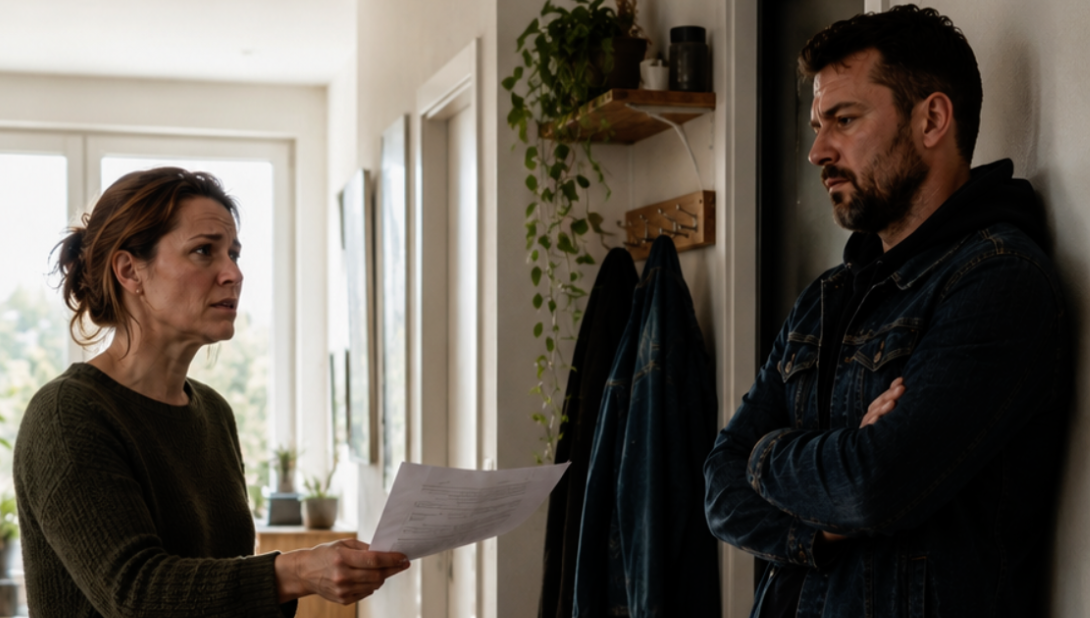
“Mom Asked You to Do the Laundry, So You’ll Do It!” My Husband Declared. He Had No Idea Every Bag Would Be Sent Back
“Are you seriously going to stare at those bags as though I’ve brought you a load of bricks? Mom asked you to wash the clothes. Is it really that difficult?”
Sergei dropped two enormous checkered bags beside the front door without even taking off his coat. A gray trail immediately appeared across the floor from the tiles in the apartment building’s entrance. The snow on his boots melted, mixed with sand, and stretched toward the doormat.
I was holding a mug of coffee, but I wasn’t looking at the bags. I was looking at his face.
He spoke as though he had already made the decision and all that remained was to inform me.
“Your mother has a washing machine,” I said.
“It doesn’t spin properly.”
Sergei walked into the kitchen, opened the refrigerator, and peered inside with the expression of a man who had just returned from an exhausting shift.
Not that he had carried those bags all the way from the bus stop. He had driven them over, taken them up in the elevator, and dropped them at my feet.
A sleeve from a man’s shirt was sticking out of one of the bags. It wasn’t Sergei’s. He never wore short-sleeved shirts.
On top of the other bag lay one of Galina Pavlovna’s kitchen curtains. I recognized the brown squares. That curtain had been hanging above her sink since Sergei and I got married.
“Sergei, these aren’t only your mother’s things.”
He took a container of buckwheat from the refrigerator, lifted the lid, and frowned.
“Who else’s would they be?”
“Judging by that shirt, not hers.”
“Ira stopped by Mom’s place and left a couple of things. Don’t start.”
That phrase—“don’t start”—always appeared before I had even managed to complain.
It was convenient. You could use it to close any conversation like putting a lid on a saucepan. The steam would eventually find a way out, but the kitchen would remain quiet for a little while.
I placed my mug on the table.
“I’m working until nine today. After that, I need to finish a report. I’m not washing other people’s clothes.”
Sergei turned toward me, still holding the container.
“Lida, don’t embarrass yourself. It’s laundry, not some heroic feat. You throw it into the machine and forget about it.”
He said it so casually.
As casually as people speak when they have never pulled soaking duvet covers from a drum, hung strangers’ towels all over the apartment, or removed socks from the drying rack that even their owner would have been ashamed to see in daylight.
To him, doing laundry meant pressing a button.
To me, it meant time, detergent, water, space, work, and somebody else’s smell in my bathroom.
I washed everything anyway.
Not because I agreed, but because I was exhausted enough that doing it seemed easier than explaining why I was under no obligation to do it.
I ran two loads during the night.
By morning, shirts, curtains, towels from somebody else’s kitchen, and Galina Pavlovna’s bathrobe were hanging in the bathroom. The hallway was filled with damp air.
The dress I had planned to wear to a meeting remained in the laundry basket. There had been neither time nor space for it.
Sergei left for work looking pleased.
On his way out, he kissed my temple and said, “See? It wasn’t a big deal.”
I watched the door close behind him and, for the first time, thought that terrible things rarely begin with shouting.
More often, they begin with someone saying, “It’s not a big deal,” on your behalf.
A week later, there were four bags.
Sergei brought them in on Friday evening.
He left one beside the door, dragged two into the bathroom, and placed the fourth beside the wardrobe because there was no room left in the hallway.
Sheets, towels, our nephew’s jacket, Ira’s sweatpants, and a white blouse tied into a knot were spilling out of them. It looked as though someone had taken the blouse off in the middle of a room and thrown it aside without looking.
“What is all this?”
I asked calmly, but Sergei still heard something in my voice that he didn’t like. His shoulders immediately tensed.
“Mom asked me. Her machine is acting up again.”
“And Irina?”
“Ira has children. It’s difficult for her.”
“I have a job.”
“Everyone has a job, Lida.”
His tone had changed.
He was no longer asking.
He sounded like the man of the house issuing an order.
I walked into the bathroom.
My clothes were still in the basket, crushed against the wall by somebody else’s bag. A box of detergent I had bought the day before stood on top of the washing machine.
Sergei had opened it without asking.
On the edge of the sink was a note written in Galina Pavlovna’s handwriting:
“Wash whites separately. Do not spin the curtains. Wash Irina’s blouse by hand.”
I picked up the note between two fingers.
“She even sent instructions?”
Sergei came up behind me.
“There’s no need to be sarcastic. Mom is simply careful.”
“Careful people wash their own clothes.”
He exhaled sharply.
“That isn’t how things are done in my family.”
That was when I turned around.
The bathroom was cramped.
Between us stood the basket containing my clothes, and above it loomed a bag filled with his relatives’ belongings.
Suddenly, that small room became a remarkably accurate picture of our marriage.
Other people’s needs were occupying my space, while Sergei stood there explaining that this was exactly how it should be because that was how things were done in his family.
“In my family, people don’t bring dirty laundry into someone else’s home and appoint a housekeeper without asking her permission.”
He wanted to answer immediately, but no words came.
Instead, he took the note from my hand, smoothed it with his thumb, and placed it on the shelf.
“Wash at least Mom’s things today. You can do the rest later.”
“No.”
The word was short, but it wasn’t empty.
It stood between us like a stool placed in front of a door—small, but impossible to walk past.
Sergei looked at me as though I had disrupted not merely his plan, but the entire natural order of things.
“You’re starting a scandal over a few pieces of cloth?”
“I’m not starting a scandal. I’m refusing to become a laundry service.”
He smirked.
“That’s a dramatic way to put it.”
I did not wash anything that evening.
I removed my clothes from the bottom of the basket, carried them into the bedroom, and closed the bathroom door.
The bags remained there like four silent guests whom nobody had invited but everyone somehow expected me to feed.
Galina Pavlovna called the next morning.
I knew it was her before I even picked up the phone.
Sergei had gone to the market to buy vegetables, and ten minutes later the phone began vibrating on the table.
It vibrated insistently, with short pauses, as though the person on the other end were pressing not a call button but my doorbell.
“Lidochka,” my mother-in-law said sweetly when I answered. “Sergei told me you didn’t have time yesterday. That’s all right, I understand. You only need to wash Ira’s little blouse by hand because it’s expensive. And it’s better to wash my towels at sixty degrees, otherwise the smell remains.”
I stood beside the window.
Outside, a maintenance worker was shoveling gray slush toward the curb.
My salary card lay on the windowsill. I had taken it out of my handbag the previous evening and hadn’t put it away.
Beside it was a receipt from the store: detergent, fabric softener, stain remover.
I had paid for all of it.
Yet somehow it had already been declared communal property whenever their convenience was involved.
“Galina Pavlovna, I will not wash your things.”
The other end of the line went silent.
Not confused. Cautious.
As though she had heard not a refusal but an unfamiliar sound in a familiar room.
“I don’t understand.”
“Sergei will bring the bags back.”
“Are you offended? Over laundry?”
She said “laundry” as though she were talking about a glass of water.
Pass it over. Bring it here. Throw it into the machine. Hang it up. Return it.
No weight. No time.
No me.
“I’m not offended. I never agreed.”
“You have a good washing machine. There’s no reason for it to sit idle.”
That sentence was the final one.
It wasn’t loud or dramatic.
It simply settled into the place where I had previously kept my remaining desire to explain myself.
I looked at my washing machine.
It was white and narrow, with a scratch across the lid.
I had bought it myself after the old machine finally stopped draining water. I had spent two months researching models, saving money, and comparing prices.
Sergei had said he didn’t care which one I bought as long as it worked.
Now his mother spoke about my purchase as though it were a communal village well.
“It will work for our apartment,” I said. “Not for the entire family.”
Galina Pavlovna dropped the sweetness from her voice.
“Lida, don’t try to be clever. Family means helping one another.”
“Help is requested. Work is not assigned.”
I ended the call first.
I didn’t hang up dramatically. I simply said goodbye and pressed the button.
My hands were steady.
Strangely steady.
Inside, there was neither triumph nor fear.
It felt like cleaning out a cupboard, pulling down an old box, and realizing that it had been empty for years and had merely been taking up space.
Sergei returned around lunchtime carrying a bag of potatoes, some herbs, and a renewed sense of confidence that he had clearly borrowed from his mother.
“Mom is crying,” he announced from the doorway.
I was cutting bread.
The knife moved evenly through the crust.
“Because of the laundry?”
“Because of your attitude.”
“My attitude is lying in the bathroom in four bags.”
He dropped the potatoes onto the table.
“Can’t you behave like a decent human being for once?”
I wiped the knife, placed it beside the cutting board, and looked at him.
Sergei was expecting the usual performance.
I would begin defending myself, he would become irritated, and eventually I would grow tired and go turn on the washing machine.
He already knew that route.
We both did.
The only difference was that I no longer intended to follow it.
“I can,” I said. “That’s why you’re taking all the bags back today. Every single one.”
“I’m not taking them anywhere.”
“Then they’ll remain in the hallway until you do.”
“They’re in the way.”
“Yes.”
Sometimes one short word is more useful than a long argument.
It doesn’t decorate the conversation, but it places a fact squarely on the table.
Sergei paced around the kitchen, opening cupboards, closing them, and opening them again.
He pretended to be looking for salt, although the salt was directly in front of him.
I could see that he wasn’t truly angry about the bags or even about his mother.
He was angry because I had stopped being a convenient part of the mechanism.
Before, he brought home a problem, and I transformed it into clean, neatly folded piles.
Now the problem remained in his hands.
That evening, he finally dragged the bags out of the bathroom and into the hallway.
Not because he intended to take them back.
He simply wanted to demonstrate how much they were in the way.
“Enjoy the view,” he said.
I looked.
The four bags occupied half the passage.
A child’s T-shirt stained with berries had fallen out of one of them.
Sergei waited for a reaction, but I walked past him, picked up my laptop bag, and went into the bedroom to work.
At nine o’clock, Galina Pavlovna arrived in person.
She entered without warning.
She still had a key from the time when Sergei and I had gone on vacation and asked her to water the plants.
Ira, Sergei’s sister, followed her, carrying a fifth bag.
Ira held it in both hands as though she were carrying a gift, although her face was full of annoyance.
“Well,” my mother-in-law said, looking around the hallway. “You’ve turned this into a circus.”
I came out of the bedroom and stopped in the doorway.
Sergei stood beside the shoe cabinet.
He wasn’t looking at me.
He was looking at his mother like a schoolboy whose parent had arrived to deal with a problem.
Galina Pavlovna removed her boots, carefully placed them with the toes facing the wall, and walked farther into the apartment without asking.
That was how she always entered our home.
Not as a guest, but as though it were her territory and we were living there by mistake.
“Lida, you’re a grown woman,” she began. “Do I really have to explain that family members help one another?”
Ira placed her bag on the floor.
“I have two children. I physically don’t have time.”
I looked at her fingernails.
Fresh dark polish. Perfect shape.
Her husband’s jacket was lying on top of the bag.
Apparently, the entire family was too busy—including the adult man who had enough strength to wear the jacket but not enough strength to put it into a washing machine.
“I understand that you don’t have time,” I said. “That’s why the bags will go somewhere the clothes can be washed for money.”
My mother-in-law narrowed her eyes.
“What money?”
I walked into the bedroom and returned holding a sheet of paper.
Earlier that day, while Sergei was demonstratively moving the bags around the hallway, I had found the nearest self-service laundromat and written down its address, opening hours, and prices.
No tricks.
Just an ordinary sheet of paper.
Black letters. Straight lines.
“Here’s the address. They have large machines for blankets, curtains, and jackets. They’re open until ten in the evening.”
Ira took the page first, scanned it, and scoffed.
“We’re supposed to pay to wash clothes now?”
“If they’re your clothes, yes.”
Galina Pavlovna straightened her back.
She had the expression of someone who had arrived expecting obedience and had instead been handed instructions.
“Sergei, are you hearing this?”
Sergei finally looked at me.
“Lida, enough. You’re humiliating my mother.”
“No. I’m returning her belongings.”
“That’s the same thing!”
“Not to me.”
The hallway felt cramped, but not because of the bags.
It felt cramped because everyone was finally standing in their true position and could no longer pretend that the conflict had happened by accident.
My mother-in-law did not want help.
She wanted the right to give me orders through her son.
Ira did not want support.
She wanted my time to become an extension of her weekends.
Sergei did not want peace.
He wanted me to smooth everything over again because that was easier for him.
I picked up Galina Pavlovna’s keys from the small table.
The keys to our apartment.
The key ring was heavy, with a metal horseshoe charm attached to it.
She had brought the charm herself once and said that a home should always have good luck.
Now the cold edge of the horseshoe struck against my palm.
“You’ll leave these keys here.”
My mother-in-law blinked.
“What?”
“You will no longer enter without calling. When you want to visit, we’ll arrange it in advance.”
Sergei stepped toward me.
“Have you completely lost your mind?”
I raised my hand to keep him from coming closer.
It wasn’t theatrical.
I was simply preserving the distance I needed.
“Sergei, you’re going to take these bags and return them to your mother. Along with this paper. If you want to help, then help her yourself. Wash the clothes, take them to the laundromat, or hang them up at her apartment. But this will no longer go through me.”
Ira smirked.
“You’ve arranged things nicely for yourself. You’re turning your husband against his family.”
I looked at her.
On top of her bag lay children’s tights, a man’s jacket, and a towel from someone else’s bathroom.
All of it had arrived in my home without a request, without gratitude, and without a question.
And now I was being accused of causing trouble because I did not want to live inside someone else’s disorder.
“I’m not turning anyone against anyone. I’m refusing to take on somebody else’s work.”
Galina Pavlovna slowly removed a bracelet from her wrist and then put it back on.
She had a habit of touching her jewelry whenever a conversation stopped following her plan.
“Sergei, choose. Either your mother or a wife who has staged this entire performance over laundry.”
He looked at me.
For a moment, I saw hope in his eyes.
He hoped the sentence would frighten me.
Perhaps it would have once.
Not because I feared the choice itself, but because I had always been afraid they would make me responsible for someone else’s cruelty.
But now five bags stood before me, along with a sheet containing the address of a laundromat, the keys to my own front door, and a man who had not once said, “Lida, I’ll handle it myself.”
“The choice is yours,” I told him. “But it isn’t a choice between me and your mother. It’s a choice between having an adult conversation and continuing the habit of bringing other people’s bags to me.”
He rubbed his forehead.
“I’m tired of this.”
“So am I.”
I said it quietly, but there was more finality in those words than there could ever have been in a scream.
Sergei understood.
I saw it in the way he stopped moving.
He didn’t soften or apologize.
He simply understood that the familiar door would no longer open.
He grabbed the first bag with a sharp movement.
Then the second.
Ira seized her own bag as though she were afraid I might charge her for the air in the hallway.
Galina Pavlovna remained until the very end.
She did not place the keys on the table immediately.
When she finally did, she pressed them down deliberately so that the metal struck the wood with a loud clang.
“Remember this day, Lida.”
I nodded.
“I already will.”
The three of them left.
Sergei returned forty minutes later.
Alone.
Without the bags.
He unlocked the door with his own key, removed his coat, and hung it on a hook.
The hallway felt unusually spacious.
Only a rectangular patch of dust remained on the floor where the bags had stood.
I brought a cloth, dampened it, and wiped the tiles.
Sergei watched me move my hand across the floor, and for some reason, that seemed to upset him more than anything else.
“You didn’t have to let it go this far,” he said.
I wrung out the cloth over the bucket.
“You could have asked me on the first evening.”
He was silent.
The refrigerator hummed in the kitchen. The laptop screen flashed in the room beyond the wall.
There was no triumphant music in the apartment.
There was no beautiful ending.
There was only a man who had grown accustomed to his mother speaking and his wife obeying.
And there was me, so exhausted that I could no longer confuse love with servitude.
“Mom said she’s never coming here again,” he said.
“That’s her decision.”
“Ira is offended.”
“That’s her decision too.”
“And what about me?”
I looked at him.
For the first time, there was something genuine in his question.
It wasn’t a demand or his usual defense of his mother.
It was the confusion of a person whose convenient system had suddenly been taken away.
“Tomorrow, you’ll buy a separate laundry basket for your clothes,” I said. “And you’ll decide for yourself how to take care of them. I will not wash clothes for a man who considers my refusal an embarrassment.”
He wanted to object.
I could see the words rising inside him and his face beginning to form the familiar expression.
But then he looked at the empty hallway, at his mother’s keys lying on the table, and at my damp sleeve.
And he remained silent.
The following day, he really did buy a laundry basket.
A cheap blue one with a crooked handle.
He placed it beside his side of the wardrobe, awkwardly, as though he were putting down not a basket but an admission he did not know how to say aloud.
Galina Pavlovna called that evening.
Not me.
Sergei.
He went into the kitchen but didn’t close the door, and I could hear fragments of the conversation.
“No, Mom, I’m not taking them.”
A pause.
“Because they’re your things.”
The pause grew longer.
“Yes, I understand that you’re upset. But Lida isn’t obligated to do it.”
He didn’t speak heroically.
He didn’t even sound particularly firm.
He simply refused, for the first time, to transfer the conversation onto me.
It wasn’t enough to make everything right.
But it was enough that I no longer had to turn on the washing machine out of fear of someone else’s displeasure.
An hour later, he placed two cups of tea on the table.
Mine had no sugar.
He had remembered.
He sat opposite me, pushed a saucer with lemon slices toward me, and did not pretend that nothing had happened.
“I honestly thought it was a small thing,” he said.
I wrapped my hands around the mug.
“For you, it was a small thing. Because I was the one doing it.”
He did not nod immediately.
He looked down at the table, where the hot mug had left a mark on the pale surface.
Then he stood, took a napkin, and wiped the mark himself.
It was a small action, almost ridiculous after everything that had happened.
But sometimes a new boundary begins with actions exactly like that.
Quietly.
Without promises that will last a lifetime.
Without beautiful speeches.
I finished my tea and went into the bathroom.
The washing machine stood empty.
There were no notes, strangers’ blouses, or bags full of curtains on top of it.
Only my clothes lay in the basket.
I closed the machine’s door and ran my finger over the scratch on its lid.
The washing machine was no longer sitting idle.
It had simply stopped working for people who believed my time was free.