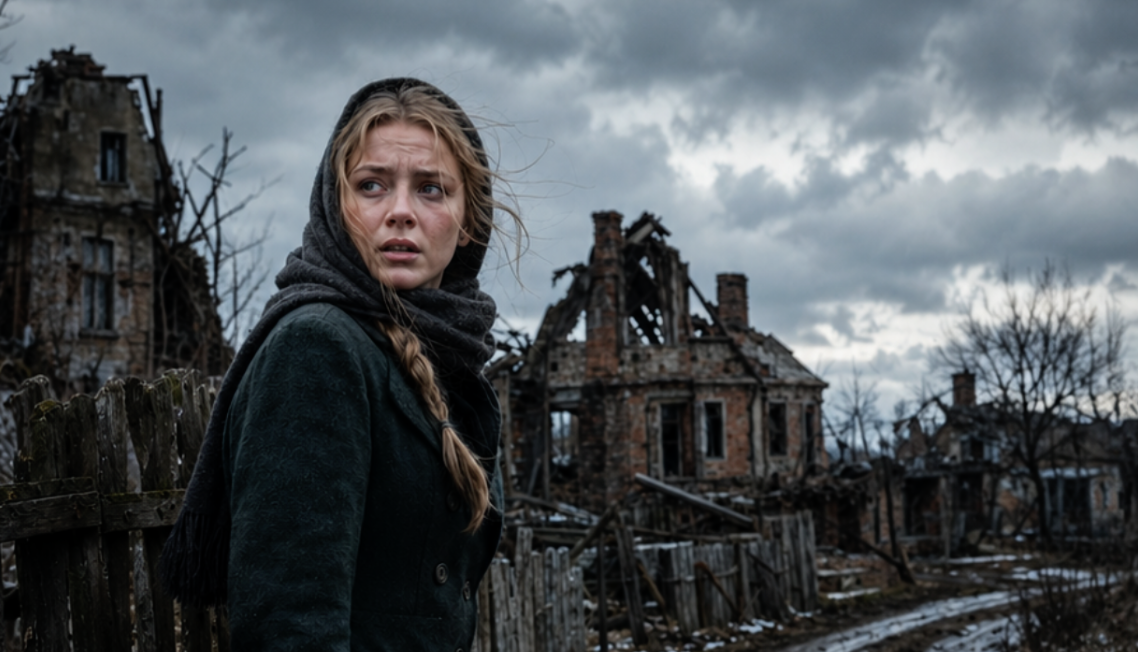
She Sold Her House and Went North in Search of Big Money. When She Returned, a Cottage Stood Where Her Home Had Been—and They Wouldn’t Even Let Her Cross the Threshold
Zinaida returned to the village in autumn.
The bus dropped her off on the highway near the turnoff. From there, she had to walk—four kilometers along a broken dirt road, beside the forest and past overgrown fields. As she walked, she barely recognized the place. The river had grown shallow. The bridge across it was leaning to one side. The old farm, where they had once kept cows, stared out through empty window frames. The forest had crept right up to the road—dark, silent, autumnal.
Fifteen years. An entire lifetime.
She had left when she was twenty-eight. Young, strong, and furious at poverty. The house had been left to her by her parents—an old log cottage on the edge of the village, built by her grandfather. The house was sturdy, but what was she supposed to do with it? There were no jobs. No men. No prospects at all. So when her neighbor, Uncle Ignat, offered to buy it, Zinaida agreed.
She sold it for what was considered good money at the time. Ignat counted out the banknotes, and Zinaida signed the document.
That was it.
She no longer had a house. No land. Nothing left to keep her there.
And then came the North.
Vorkuta. A dormitory. Work at a factory. Twelve-hour shifts. Coal dust worked its way so deeply into her skin that it could never be fully washed away. The pay was good—the famous high northern wages people dreamed about in impoverished villages.
But the money disappeared quickly.
Food. Clothes. A rented apartment after she grew tired of the dormitory. Then the 1990s ended, the factory shut down, and layoffs began.
Zinaida survived however she could. She worked as a cleaner. A dishwasher. She took rotational jobs, moving from one extraction site to another. Her personal life never worked out. There had been one man, but he drank and eventually left. She never had children.
The money—the very same high northern wages—slipped through her fingers like sand.
By the age of forty-three, she had been left completely alone. No family. No savings. No place of her own.
And that was when she decided to return.
She could not even explain why.
It wasn’t as though anyone in the village was waiting for her. She had no relatives left there. She simply felt drawn back. She wanted to see the house. That same old house built by her grandfather. The garden beds where her mother had grown cucumbers. The bird-cherry tree by the fence—it had probably grown so large by now that it covered half the yard. The river where she used to swim as a girl.
As Zinaida walked, she imagined what she would see.
The village would appear around the bend. There would be Ignat’s house at the edge. Then the turn. And there would be her old cottage—aged and darkened, but still hers in her heart.
She would go inside.
Perhaps Ignat would let her stay the night. After that, she would see what happened. Maybe she could even buy the house back, provided he did not ask for an outrageous price.
She came around the bend and stopped.
A large cottage stood where her house had once been.
It was two stories tall, built of red brick, with large windows, an attic floor, and a neat metal-tiled roof. The fence was tall and wrought iron, decorated with patterns. Inside the yard was a lawn, a paved walkway, and a gazebo.
A car stood near the gate.
It was black and polished, with a silver star on the hood.
Zinaida stood motionless and stared.
Her legs went weak. Her eyes began to sting.
Nothing remained of her old cottage. They had even cut down the bird-cherry tree. Even the fence her grandfather had built before the war was gone.
Someone else lived there now.
Someone wealthy.
A stranger.
She stood for a while, gathering her courage. Then she pushed open the gate and entered the yard.
A man was standing on the porch.
He was about fifty. Tall and broad, dressed in an expensive jacket. He was holding a phone. When he noticed Zinaida, he frowned, came down the steps, and walked toward her.
“Who are you looking for?” he asked.
His voice was calm and even, but there was no warmth in it.
“I…” Zinaida hesitated. “I used to live here. In this house. Well… there used to be a house here. An old wooden one. It was mine.”
The man looked at her.
For a long time.
Closely.
From head to toe—at her worn coat, her scuffed shoes, and the bag with a torn handle.
“Ah,” he drawled. “So you’re the woman who sold the house?”
“Yes. That was me. Zinaida. Zinaida Petrovna.”
“I see.”
He slipped his phone into his pocket and folded his arms across his chest.
“So what do you want?”
Zinaida became confused.
She had not expected to be welcomed with open arms, but she had not expected such coldness either.
“I only wanted to… look around. I haven’t been here for fifteen years. I thought the old house was still standing. But now…”
“But now this is my house,” the man said. “I built it. On my land. Land I bought from Ignat. Legally. With proper documents. So there’s nothing here for you to look at.”
“From Ignat?” Zinaida repeated. “Where is he? Is he still alive?”
“He died five years ago. His son sold me the land. So now everything here belongs to me.”
A silence fell between them.
Zinaida looked at the cottage again, at the large windows and the light glowing behind the curtains. Inside, warm yellow lamps were burning.
Someone moved past one of the windows.
A woman, perhaps.
His wife.
“Could I…” Zinaida swallowed the lump in her throat. “Could I at least step inside? Just to look? I grew up here. My parents lived here. My grandfather. My great-grandfather. I only want to see…”
“No,” the man said sharply. “I’m sorry. I have a family. Children. I don’t let strangers into my home.”
“I’m not a stranger. I was born here.”
“You were born here, and then you left,” he said. “You left of your own free will. You sold the house. You took the money. And now you want a guided tour? No. I’m sorry. Let’s not do this.”
Zinaida stood in silence.
There was nothing she could say.
Everything he said was true.
She had sold the house herself. She had left on her own. She had gone North in search of big money.
And that money had turned into fifteen years of emptiness.
“All right,” she said quietly. “I’ll go.”
“Go,” the man replied. “And you know what? You’re not the first. People come here. They walk around and stare. ‘We used to live here.’ But you don’t live here anymore. You left. So don’t come back with this now. It’s too late.”
He turned and walked back toward the house.
He climbed the porch steps and opened the door.
Warmth, the smell of food, and the feeling of comfort drifted outside.
Then the door closed.
The lock clicked.
Zinaida remained standing alone in the yard.
A stranger.
The village greeted her with silence.
She walked down the street, past old cottages and leaning fences. A few people still lived there—old women and old men. They watched her through their windows, but no one came outside. No one called out to her.
Perhaps they did not recognize her.
Perhaps they did recognize her but did not want to speak.
Or perhaps they simply could not believe that this exhausted woman carrying a battered bag was the same Zinka who had once gone North in search of happiness.
She reached the bus stop and sat down on the bench.
Beside it stood an old poplar tree—the same one beneath which she had kissed Lyoshka the tractor driver when she was in the ninth grade.
The poplar was still there.
Alone.
The only thing left from her former life.
The bus was due in two hours.
Zinaida sat and stared at the road.
She did not want to think.
She did not want to feel either.
Inside her was an emptiness as gray and heavy as the autumn sky above her.
She remembered her mother.
“Zinka, don’t sell the house,” she used to say. “You’ll be lost without it. A house is an anchor. As long as you have a home, you have somewhere to return to.”
But Zinaida had not listened.
She had been young and foolish. She had believed money mattered more.
She had imagined she would return wealthy, buy everything back, and build a new house—one even better than the old one.
She had not bought it back.
She had not built anything.
She had not returned.
And now she sat at the bus stop, a stranger on the land where she had been born.
Meanwhile, behind the large windows of the cottage, warm yellow lights were glowing.
The man, whose name was Andrei Viktorovich, was sitting in the kitchen drinking tea. His wife, Elena, stood at the stove. Their children—a son and a daughter—were playing in the living room.
“Who was that?” Elena asked.
“No one important,” Andrei Viktorovich replied. “Some woman. She said she used to live here. Apparently, her house stood on this land.”
“What did she want?”
“To look around. I didn’t let her in.”
Elena was silent for a moment.
“Maybe you should have?” she said cautiously. “She’s still a human being. She came from far away.”
“But why?” Andrei Viktorovich shrugged. “What would she see? Our children? Our belongings? Our house? It isn’t her house. It’s ours. She sold everything herself. She left by her own choice. And now what? She feels nostalgic? No. She can be nostalgic somewhere else.”
Elena said nothing.
She only sighed.
Andrei Viktorovich took another sip of tea.
He was certain he had done the right thing.
Completely certain.
He had bought the land honestly. He had built the house honestly. With his own money. And no one—not even a former owner—had any right to cross his threshold.
That was what he believed.
And of course, he was right.
Formally.
Legally.
According to the documents.
But there was something in that righteousness that suddenly made the tea taste bitter.
Something he could not put into words.
Something that scratched at him from inside.
What about mercy?
What about simple human kindness?
The woman had traveled from very far away. She was exhausted. Poor. Alone.
She had asked only to look around.
And he had said no.
Not allowed.
No entry for strangers.
He finished his tea and stood up.
Then he walked over to the window.
Outside, in the gathering darkness, the empty road could be seen.
Somewhere out there, at the bus stop, a woman was sitting and waiting for the bus.
A strange woman.
On someone else’s land.
But once, she too had belonged there.
Then she stopped belonging.
People are not born as one of their own.
They remain one of their own.
Or they do not.