My Father-in-Law Called His Son While I Was There—He Had No Idea I Could Hear Everything
Galina accidentally overheard a conversation between her father-in-law and her husband. One sentence turned everything she thought she knew about her family—and herself—upside down.
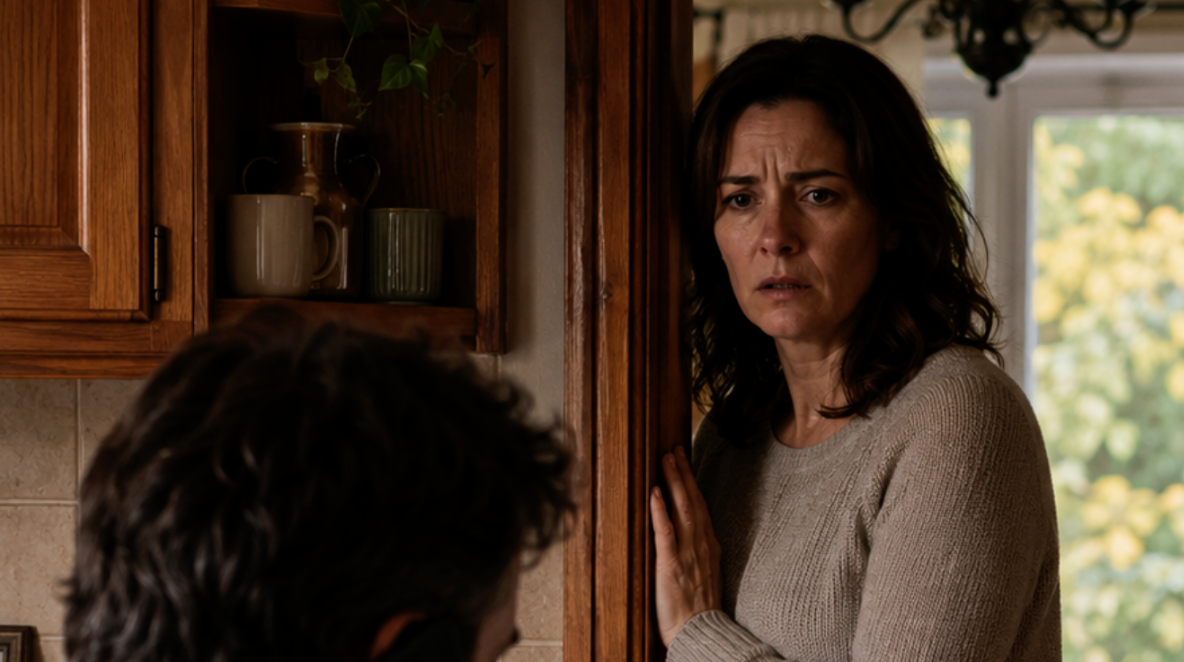
Galina heard it all by accident.
She was walking barefoot across the cold laminate flooring from the bathroom to the bedroom when she stopped in the hallway because Kostya was talking on the phone in the kitchen. The door was slightly open. Her father-in-law’s voice came through the speaker so clearly that it sounded as though Gennady Pavlovich were sitting right there at the table.
She had not meant to eavesdrop.
She simply froze, the way people freeze when they hear their own name.
“Tell me honestly, Kostyan. Are you even happy with her?”
Silence.
Galina pressed her palm against the wall. The wallpaper was slightly damp, as it always was in that corner during winter.
“Dad, what kind of question is that this late at night?”
“A perfectly normal question. I’m your father. I have the right to ask. Your mother is worried sick. She can’t sleep.”
“What exactly is she worried about?”
“You, of course. What else? You’ve become so lifeless lately. Your mother says your eyes look the way your grandfather’s did before he retired. Empty.”
Kostya gave a quiet grunt.
Galina knew that sound. He made it whenever he did not want to answer but could not bring himself to lie. He would grunt, and usually the other person would change the subject.
But Gennady Pavlovich did not change the subject.
“I’m asking you seriously. Can you give me an honest answer, man to man?”
“Dad. Everything is fine.”
“Fine. I hate that word. Your mother told me everything was ‘fine’ for twenty years, and then it turned out she had an ulcer and her nerves were completely shot. Fine, Kostya, is when a person smiles and isn’t lying while doing it.”
Galina stood in the hallway. Her toes were beginning to freeze. She shifted her weight from one foot to the other, trying not to make a sound.
They had been together for seven years.
They met at the birthday party of a mutual friend in a café on Taganka, where the music was too loud and there were too many people. Kostya was sitting in a corner, eating olives straight from the jar with his fingers. Galina sat beside him because it was the only empty seat.
He held the jar out to her and said, “Careful. They have pits.”
That was their entire first conversation.
Then came three years of dating, a wedding in November, and a move into a two-room apartment on the outskirts of the city.
They did the renovations themselves. Kostya hung the wallpaper crooked, and Galina straightened it. He laughed and said she had a surgeon’s hands. She replied that she had the hands of a woman who was tired of living with crooked walls.
Their daughter was born during their second year of marriage.
Polina. Polinka. Polya.
She weighed four and a half kilograms, a big baby with fists the size of apricots. Kostya held her at the maternity hospital and remained silent for five full minutes.
Galina thought he was in shock.
Later, he said, “I was memorizing it. I wanted to remember what it felt like so I would never forget.”
And he did not forget.
For the first two years, he was always there. He got up at night, carried Polya around the apartment, and sang incomprehensible songs to her. Galina would wake to the sound of his footsteps and fall asleep again because they were steady and calm.
Like a metronome.
Then something shifted.
Not suddenly. Not with a bang.
One day, she simply noticed that when he came home from work, he went straight to the shower. Before, he would go to Polya first, kiss the top of her head, and ask Galina how her day had been.
Now it was shoes, coat, shower.
Then dinner in silence.
Then his phone.
She did not ask him about it. She decided he was going through a difficult project at work. Kostya worked as an engineer at a ventilation-equipment factory, and every six months there was some new emergency: certification, an inspection, or a demanding new client with forty pages of requirements.
She was used to those cycles.
But this cycle never ended.
Her father-in-law’s voice grew quieter through the speaker, as though Gennady Pavlovich had moved the phone away or leaned toward something.
“Listen. I don’t interfere in your life. But your mother told me something, and now I can’t sleep peacefully.”
“What did she tell you?”
“She said Galina called her. A week ago. And she was crying.”
Galina’s mouth went dry.
She really had called her mother-in-law.
Lidia Sergeyevna was the kind of woman who did not ask unnecessary questions. You could call her and remain silent on the phone, and she would simply say, “I’m here, sweetheart. Breathe.”
That was exactly what happened.
Galina called because it was Sunday, Kostya had gone “to the warehouse” on his day off, Polya was taking her afternoon nap, and the walls were pressing in on her so tightly that she wanted to step onto the balcony and scream.
She did not scream.
She called Lidia Sergeyevna and began to cry.
No words. No explanation.
She simply cried while her mother-in-law listened and occasionally said, “It’s all right. It’s all right. These things happen.”
Galina had been certain Lidia Sergeyevna would not tell her husband.
Completely certain.
“Dad, I didn’t know she called.”
“Exactly. You didn’t know because apparently you don’t notice what is happening in your own home.”
“What is happening? We live normally. Polya goes to kindergarten, I work, Galya…”
“What about Galya?”
A pause.
Galina heard Kostya take a sip of tea. His mug knocked against the table.
“Galya works too. She’s all right.”
“People who are all right do not call someone else’s mother and sob into the phone, Konstantin.”
Whenever her father-in-law called his son by his full name, it meant the conversation had become serious.
Galina knew that tone.
She had heard it once when Gennady Pavlovich discovered that Kostya had taken out a car loan without discussing it with anyone. He had also said “Konstantin” then and paused for ten seconds before continuing.
“Dad, I’ll deal with it.”
“How are you going to deal with it? You don’t even see the problem. I’m going to tell you something now, and you are not going to interrupt me. Sit down and listen.”
Galina worked as an accountant for a construction company. She worked remotely from home, sitting with her laptop at the kitchen table.
Every day from nine until five, sometimes until seven when reconciliation statements came in or the tax authorities sent requests.
Polya stayed at kindergarten until four.
Between four and seven, Galina checked payment orders with one hand while feeding her daughter with the other. She read her the story of the wolf and the seven little goats, washed the dishes, wiped the table, and picked up toys.
Kostya came home at seven.
Sometimes at eight.
Polya was usually already asleep or falling asleep. He looked into her room, went to take a shower, and then ate dinner.
Galina sat opposite him, thinking about the kindergarten payment that had to be made by Friday.
They did not argue.
Not once during the past year and a half.
And that was worse than any argument, because an argument meant that people still cared.
Silence meant there was no energy left for conflict.
Galina had tried.
In October, she made his favorite meat patties with potatoes. She placed a candle on the table and brought out a bottle of wine they had purchased in Crimea two summers earlier.
Kostya came home, saw the candle, and said, “Oh, that’s nice.”
He sat down, ate two patties, and went to watch YouTube on the sofa.
The candle burned down while she washed the plates.
In November, she suggested going to the movies. They had not been to a movie theater in three years.
Kostya agreed, but on Saturday, something came up at work.
She went alone.
The film was about a woman leaving a small town. Galina came out of the theater and stood on the escalator for a long time, watching the people below move past the fountain.
In December, she stopped trying.
“I’ll tell you something, Kostya. I’ve lived with your mother for thirty-four years. Do you know what I’ve learned? A woman doesn’t remain silent because she has nothing to say. She remains silent because she has already said it. Many times. And you didn’t hear her.”
Kostya did not answer.
Galina could hear him breathing heavily through his nose, as though he had just been running.
“Your mother almost left me in 1998. You didn’t know that, did you? Of course you didn’t. You were twelve and busy playing hockey. Back then, I thought everything was fine too. I worked, brought home money, kept a roof over our heads. What else could she possibly need?”
“What happened?”
“She packed a suitcase. It was standing by the door. I came home from work, saw it, and asked, ‘Where are you going?’ She looked at me and said, ‘Gena, I’ve been asking you to fix the bathroom faucet for three years. Three years. It leaks, and every night I hear those drops. Every time, you say you’ll do it tomorrow. And suddenly I realized that it isn’t about the faucet. It’s about the fact that you don’t care whether it leaks or not. You don’t care that I listen to it every night.’”
Galina covered her mouth with her hand.
She stopped breathing.
“And what did you do?”
“I fixed the faucet. That same evening. My hands were shaking, the tools kept slipping, and I replaced the washer three times before I finally got it right. Then I sat down on the bathroom floor and stayed there for an hour because I finally understood that it wasn’t about the faucet.”
“What was it about?”
“It was about the fact that I had stopped seeing her. She was beside me every day, but I no longer saw her. She had become like furniture. There’s a wardrobe standing there, and you walk past it without even looking. But let that wardrobe disappear, and for a month you’ll be wondering where to put your clothes.”
Kostya grunted.
But this time it sounded different.
He was not brushing the comment aside. It sounded as though something had tightened around his throat.
“Dad, but I’m not…”
“Not what? Not like me? Son, you are exactly like me. You are my son. You have my eyes, my character, and my way of hiding from problems. I thought the same thing. I’ll work harder, bring home more money, and she’ll see that I’m trying. But she didn’t need money, Kostya. She needed me to sit beside her in the evening and ask how she was. And she needed me to genuinely care about her answer.”
Galina stepped backward.
A floorboard creaked.
She froze, but Kostya continued listening to his father and apparently did not notice.
She went into the bedroom, sat on the edge of the bed, and stared at her hands.
Her palms were damp.
She had bitten the nails on her left hand the previous week while sitting over a report at two in the morning, unable to sleep even though the report was already finished.
Her father-in-law’s voice still came from the kitchen, but she could no longer make out the words.
Only the tone: calm, low, persistent.
And Kostya’s silence between sentences.
Polya was asleep in the next room.
Galina could hear her breathing through the wall, steady with a slight whistle on each exhale. Her daughter’s nose was a little blocked, but it did not wake her.
She slept soundly, hugging a plush rabbit with one missing ear.
The ear had torn off a month earlier.
Galina wanted to sew it back on, but Polya had said, “Don’t, Mommy. He’s still beautiful. He’s just a little bit broken.”
For some reason, Galina had cried afterward.
Not in front of her daughter.
Later, in the bathroom.
She turned on the water so no one would hear.
“Kostya, are you listening to me?”
“I’m listening, Dad.”
“I’m not saying you’re a bad husband. You aren’t a bad man. You’ve simply stopped being a husband. You’ve become a neighbor. She cooks, and you eat. She washes your clothes, and you wear them. She waits, and you come home. But you aren’t with her. You’re somewhere inside your own head, at your job, or on your phone. And she is alone.”
“She isn’t alone. She has Polka.”
“A child is not companionship for an adult woman, Kostya. A child is a responsibility. She needs a person she can sit beside in silence and still feel that she isn’t alone. There’s a difference. Do you understand?”
Kostya was silent.
“You’re silent now, and I don’t know what’s going through your head. Are you angry? Do you think I’m interfering? Say something.”
“I’m not angry. I’m thinking.”
“About what?”
“About the faucet.”
Gennady Pavlovich laughed quietly.
It was not a cheerful laugh. It was the kind of laugh that contained many years and a great deal of silence.
“There. That’s the right thing to think about. Everyone has their own faucet, son. Find yours and fix it before the suitcase is standing by the door.”
Galina lay down, pulled the blanket up to her chin, and closed her eyes.
She pretended to be asleep, although her heart was pounding so hard that the pillow seemed to vibrate.
Or perhaps she only imagined it.
About ten minutes later, Kostya entered the bedroom.
She heard him take off his T-shirt and throw it onto the chair. She heard him unfasten his belt.
Then he sat down on the edge of the bed.
On her side.
He never sat on her side.
“Gal, are you asleep?”
She did not answer.
She could not.
Had she opened her mouth, everything would have poured out: the candle that had burned down alone, the movie she had attended by herself, December, when she had stopped trying, the phone call to Lidia Sergeyevna, and the rabbit with one ear.
Everything would have come pouring out, and she would not have been able to contain it.
He sat there for a minute.
Perhaps two.
Then he leaned over and kissed her temple.
His lips were warm and dry.
He had not kissed her in a long time.
Not like that.
Not the automatic kiss on the forehead before sleep, but a slow kiss on the temple, as though he were memorizing her.
Like that day in the maternity hospital, when he held Polya and remained silent for five minutes.
He moved to his side of the bed, lay down, and after a while his breathing became steady.
Galina lay with her eyes open, staring at the ceiling.
The crack above the chandelier, which they had noticed when they first moved in and never repaired, looked like a river.
It had a single tributary curving to the left.
She lay there thinking.
Not about what her father-in-law had said.
Not about the faucet, the suitcase, or the marriage that had turned into a relationship between neighbors.
She thought about how Kostya had sat on her side of the bed.
He had never done that.
Not once in seven years.
One telephone conversation with his father.
One sentence about a faucet.
And he had sat on her side.
In the morning, Galina woke to a smell.
Not to her alarm clock.
Not to Polya’s voice.
To a smell.
Someone was frying eggs.
She walked into the kitchen.
Kostya was standing at the stove in the same pants he had slept in and a clean T-shirt. Three eggs were sizzling in the frying pan. Beside him was a plate of sliced bread.
The slices were crooked, thick, and uneven.
He turned around.
“Good morning. I, uh… thought I’d let you sleep a little longer.”
Polya was sitting at the table in her chair with the footrest, drawing something on a napkin with a marker.
She saw her mother and held up the picture.
“Mommy, look! This is Daddy making fried eggs. See, this is the fire, and this is the frying pan.”
There was a circle with lines on the napkin.
The lines stuck out in every direction.
The fire was blue.
“It’s beautiful, Polinka.”
Galina sat down at the table.
Kostya placed a plate in front of her.
The eggs were slightly overcooked, with crisp edges.
That was exactly how she liked them, although she had never told him.
Or had she?
Perhaps once, a long time ago, when they lived in a rented apartment with windows facing the courtyard.
“Thank you.”
“Mm-hmm.”
He sat down opposite her.
He did not pick up his phone.
He simply sat there, poured himself some tea, and looked at her.
Not briefly.
Not with a passing glance.
He looked at her the way someone looks at a person they have not seen in a long time.
Galina lowered her eyes.
For some reason, she could not endure his gaze.
Her nose began to sting.
“What’s wrong? Don’t you like them?”
“They’re delicious. Really delicious.”
She ate the fried eggs while looking down at her plate.
Crisp edges, slightly burnt.
The yolk was whole and had not run.
Polya continued drawing.
Another circle appeared on a fresh napkin, this one larger, with something that resembled hair.
“And this is Mommy. She’s eating fried eggs and crying.”
“I’m not crying, Polinka.”
“Just a little. Your eyes are wet.”
Kostya stood, walked over, and placed a hand on her shoulder.
It was heavy and warm.
His fingers tightened slightly.
Not hard.
Just enough to say: I’m here.
Galina placed her hand over his.
She did not tell him that she had overheard the conversation.
Not that morning.
Not the following day.
It was her knowledge, and she carried it carefully, the way someone carries a full glass through a hallway, trying not to spill it.
On Saturday, Kostya came home from the store carrying a bag.
He took out a set of faucet washers.
“The bathroom faucet is dripping. I’ve been meaning to replace the washer for a while.”
Galina stood in the doorway and watched as he searched through the toolbox, took out an adjustable wrench, and turned it in his hands, trying to remember which direction to twist.
His hands were large, with broad palms and short fingers.
An engineer’s hands, accustomed to technical drawings and metal.
The bathroom faucet really was dripping.
Galina had stopped noticing it six months earlier.
She had grown accustomed to its rhythm.
Drip.
Pause.
Drip.
Pause.
Like the pulse of the apartment.
“Do you need help? Should I hold something?”
He looked at her from beneath the sink.
His hair had fallen across his forehead, and from that angle he looked younger.
Like the man in the café on Taganka who had eaten olives straight from a jar.
“Hold the flashlight.”
She sat on the floor beside him, picked up her phone, and turned on the flashlight.
The beam illuminated the pipe.
Kostya struggled with the nut. She could hear him breathing heavily with the effort and the wrench scraping against the metal.
“Stubborn little bastard.”
“Maybe you’re turning it the wrong way?”
“Oh. Right.”
The nut loosened.
He replaced the washer, reassembled everything, and turned on the water.
Silence.
Not a single drop.
“There. Done.”
He crawled out from beneath the sink and sat beside her on the floor.
The bathroom was small. They sat shoulder to shoulder, and Kostya’s legs did not fit properly. His knees pressed against the washing machine.
“Kostya.”
“Mm?”
“There’s something I’ve wanted to tell you for a long time.”
He turned his head.
He was close.
She could see the mole beneath his left eye.
Small and dark.
Like the period at the end of a sentence.
“What?”
She wanted to tell him about the candle that had burned down alone.
About the movie she had attended without him.
About December.
About the call to his mother.
About the rabbit with one ear.
About how, at some point, she had stopped waiting and had begun merely existing beside him like furniture, like that wardrobe people passed every day without noticing.
Instead, she said, “The fried eggs you made that morning were really delicious.”
He laughed softly from deep in his throat, as though the laughter had become stuck and could not fully escape.
“Seriously?”
“Completely seriously. They had crispy edges. Just the way I like them.”
“You like crispy edges?”
“Yes. I told you once.”
“I don’t remember.”
“It was a long time ago. In the old apartment.”
He was quiet for a moment.
“There are probably a lot of things I don’t remember.”
Galina rested her head against his shoulder.
It was firm and smelled of metal and something mechanical.
“That’s all right. I’ll remind you.”
She did not know what would happen next.
One conversation, one kiss on the temple, and one replaced faucet washer were not salvation.
It was a beginning.
Or an attempt at a beginning.
Or an attempt to make an attempt.
On Monday, Kostya came home at seven and went straight to the shower again.
But afterward, he sat beside Polya while she assembled a puzzle.
He did not help her.
He did not give her hints.
He simply sat beside her.
On Tuesday, he called from work at lunchtime.
“How are you?”
Galina replied, “Fine.”
Then immediately corrected herself.
“I’m tired. But I’m glad you called.”
He was silent on the phone for a moment.
Then he said, “I’m going to keep calling.”
He called again on Wednesday.
And Thursday.
On Friday, he picked Polya up from kindergarten himself, even though Galina usually did it.
He brought her home with an ice cream stain on her jacket.
“She asked for one. I couldn’t refuse.”
“In January, Kostya? Ice cream?”
“She was very persuasive.”
Polya squeezed between them and showed them a drawing.
This time it was not on a napkin but on a real sheet of paper.
There was a house, a window, and three figures. One figure had stick arms, and there was something round in one of its hands.
“That’s the ice cream, Mommy. And that’s us. All together.”
Gennady Pavlovich called on Saturday morning.
Kostya spoke to him on the balcony while Galina stood in the kitchen and heard fragments through the half-open door.
“Yes, Dad. Yes, everything is good. No, not ‘fine.’ Good. I’m fixing things little by little. No, not just the faucet.”
He returned from the balcony, his face red from the cold, and rubbed his hands together.
“Dad sends his regards.”
“Thank him. Send him mine too.”
Kostya nodded.
He looked at her.
Not with a passing glance.
“Gal.”
“Mm?”
“I may not always understand what I’m supposed to do. But I’m trying. Can you see that?”
She could.
For the first time in a long while.
“I can see it, Kostya.”
That evening, after Polya had fallen asleep, Galina took the bottle of Crimean wine from the cupboard.
The same bottle they had brought home two summers earlier.
She had hidden it behind the jars of jam and had already forgotten that she was hiding it.
She set out two wineglasses.
Then she lit a candle.
It was the same candle from October, now reduced to a two-centimeter stub.
“What’s the occasion?” Kostya asked.
“No occasion. Just because.”
Kostya sat opposite her.
She poured the wine.
It was slightly sour, with the flavor of something herbal.
She remembered how they had bought it in a small shop by the road, where a salesman with a sunburned nose had poured samples into plastic cups and said, “This is the best wine we have. My wife makes it.”
“Do you remember that salesman?”
“The one with the nose? I remember.”
“He also said wine should be drunk slowly. You shouldn’t rush it.”
“Was he talking about the wine?”
Galina smiled.
For the first time in a long while, smiling did not require an effort.
“Maybe he wasn’t only talking about the wine.”
They drank slowly.
The candle burned.
The stub softened, and wax ran down onto the saucer.
Snow fell outside the window. The streetlamp in the courtyard swayed in the wind, casting yellow stripes across the kitchen wall.
Kostya stretched his hand across the table.
He did not turn his palm upward or openly invite her to take it.
He simply placed it beside hers.
Close enough.
She could take it.
Or she could leave it there.
She took it.
That night, Galina lay listening to the silence.
The bathroom faucet was no longer dripping.
Polya was breathing on the other side of the wall.
Kostya slept beside her, smelling faintly of wine and toothpaste.
She thought that her father-in-law was probably awake too.
Perhaps he was sitting in his kitchen in Kaluga, drinking tea from the same faceted glass in the same metal holder he had used since the 1990s, thinking about his son.
About his granddaughter.
About his daughter-in-law, who had once called his wife and cried.
And Lidia Sergeyevna was asleep.
Or perhaps she was not asleep but lying beside her husband, listening to him turn in bed and knowing what he was thinking.
Because they had been together for thirty-four years.
The faucet had long ago been repaired, and the suitcase had long ago been unpacked, but the memory of that evening still lived inside both of them.
A reminder.
Galina rolled onto her side.
The crack in the ceiling was invisible in the darkness.
But she knew it was there.
It looked like a river, with one tributary curving to the left.
Perhaps tomorrow, they would repair it together.
Or perhaps they would not.
Perhaps the crack would remain, the way traces of life remain on the walls of a house people do not abandon but continue living in.
A house with creaking floorboards.
Windows that never quite close.
And a hallway lightbulb that has needed replacing for two months.
But the faucet no longer dripped.
That was already something.