My Husband Received a Million-Ruble Bill from a Private School—for Children We Don’t Have
“A bill came in for one million four hundred and twenty thousand rubles.”
Artyom placed his phone faceup on the kitchen table.
Lida lowered the lid of her laptop by an inch but did not close it completely. The banking app remained open on the screen, and the balance was clearly visible from where they were sitting: 112,000 rubles to last them until the end of the month.
Their eleven-month-old son, Timosha, was sleeping in the baby sling against her chest. On the chair opposite them, a second phone lit up silently. Artyom’s mother was calling. He declined the call, but she immediately called again.
“Who sent the bill?” Lida asked.
“The school. President Gymnasium. In Krylatskoye.”
“We don’t have any school-age children.”
“That’s exactly the problem.”
Lida shifted her son higher against her chest and turned her husband’s phone toward herself with her left hand.
A standard-form contract was attached as a PDF.
Payer: Sidorov Artyom Vladimirovich.
His taxpayer identification number, passport series and number—everything belonged to him.
Students: Sidorov Mikhail Igorevich, eleven years old, and Sidorova Sofia Igorevna, eight years old.
Zhanna’s children.
“That’s Misha and Sonya,” Artyom said. “Zhanna’s kids.”
“I can see their patronymics. Igorevich and Igorevna.” Lida placed the phone back on the table. “These things happen.”
Zhanna was Artyom’s older sister. She was thirty-nine and had been divorced for three years. Her ex-husband’s name was Igor, and they had two children.
Zhanna owned a beauty salon near Sokol and operated as a sole proprietor under the simplified tax system, paying six percent. Lida had once caught a glimpse of her tax declaration when Zhanna had asked her to help “sort out a problem with the tax authorities.” Her annual turnover hovered around eight million rubles.
According to Lida’s rough calculations, after all expenses, Zhanna took home approximately 350,000 rubles a month. She was not a millionaire, but she was hardly struggling.
Before going on maternity leave, Lida had worked as the chief operating officer of a logistics startup. Her take-home salary had been 380,000 rubles, with quarterly bonuses starting at 150,000.
Now, she received maternity benefits—slightly more than 60,000 rubles a month.
Artyom was an engineer at a factory. Officially, he earned 110,000 rubles, but because his bonuses were often delayed, his actual monthly income was closer to 90,000.
The mortgage on their two-room apartment in Nekrasovka cost 52,000 rubles a month. It was registered in Lida’s name. She had also paid the down payment using the proceeds from selling an apartment in Tula that she had owned before their marriage. She had sold it for a little over four million rubles.
Artyom remembered that fact only when it suited him.
At the moment, after paying the mortgage, the family had approximately 140,000 rubles a month for everything else. Around 100,000 of that went toward food, diapers, formula and Timosha’s other needs.
One million four hundred and twenty thousand rubles was approximately what they spent on their child and groceries in an entire year.
All of it. Almost down to the last ruble.
“Call her,” Lida said.
Artyom dialed his sister’s number. He put the call on speakerphone—not as a deliberate choice, but because he was holding a charging cable across his lap and his hands were occupied.
“Artyom, darling!” Zhanna’s voice was warm and familiar. “You’re calling about the school, right? I’ll explain everything. Just don’t get worked up.”
“Zhanna, I received a bill for one million four hundred thousand.”
“Artyom, you have to understand.” Her voice faltered slightly. “Igor and I have a child-support hearing in March. I don’t want him to know that I can afford a private school. Otherwise, he’ll try to have the amount reduced. He’ll say that if I can afford a private gymnasium, I can support the children on my own.”
“I enrolled them through you so that the documents would show you as the payer. You don’t mind, do you?”
Lida lowered her eyes to her sleeping son.
She did not move.
“Zhanna,” Artyom said slowly, “I don’t have one million four hundred thousand rubles. Not this year. We have Timosha, and Lida is on maternity leave.”
“But I’ll pay you back later! Gradually, from my business income. The salon is doing pretty well. You know that.”
“It is doing pretty well,” Lida said toward the phone.
There was a pause.
“Lida, are you there too?”
“I am. Zhanna, you’re a sole proprietor under the six-percent simplified tax system. Your annual turnover is approximately eight million rubles. You can enroll the children in your own name and pay for the school yourself.”
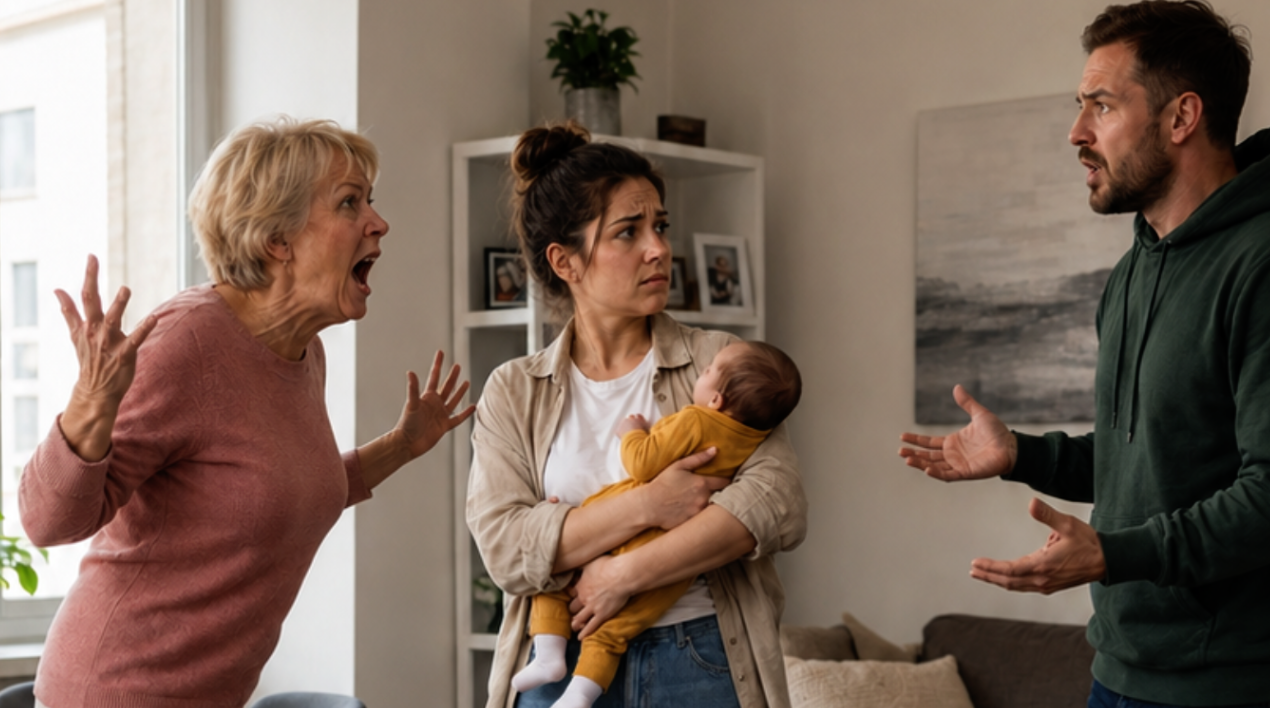
“Lida, stay out of this.” All warmth immediately disappeared from Zhanna’s voice. “This is between a brother and his sister.”
“I’m not staying out of it. One million four hundred thousand rubles is our family’s annual food budget and the annual budget for your nephew. Not Misha and Sonya. Timosha.”
“You really are something else,” Zhanna exhaled into the phone. “Counting every kopeck in someone else’s pocket.”
“My own money,” Lida said, adjusting her son. “And we’re not talking about kopecks.”
Artyom sat between his wife and the phone without saying anything.
He was wearing the fleece jacket he practically lived in on weekends and a pair of slippers. A fishing rod case hung on the wall above the sofa. He had bought the Japanese spinning rod in February for 42,000 rubles—the same month he had announced that his bonus had been reduced and they would not be able to afford a summer vacation.
The phone on the chair rang again.
It was his mother for the third time.
Without looking, Artyom tapped the green answer button and automatically put her on speakerphone too.
“Artyom, what on earth have you done?” Galina Petrovna launched into the conversation at full volume. “Zhanna called me in tears! Help your sister! It will be difficult for little Misha and Sonya in an ordinary school. They’re sensitive children. They’ve been sheltered!”
“They’re sensitive,” Lida repeated evenly. “And we’re trying to survive.”
“Who is that? Lida? Sweetheart, at least you should stay out of it. This has nothing to do with you. This is a matter for the Sidorov family!”
“It has everything to do with me. My husband is listed as the payer in the contract. The money would come from our shared budget—the same budget that feeds my son.”
“Oh, how disgusting, turning everything into a question of money! Family is sacred! You’re supposed to help relatives!”
“Help relatives?” Lida tilted her head. “All right. Let’s handle this like relatives and deal with the facts at the same time.”
She opened her laptop again.
Timosha frowned in his sleep. She gently rocked him with her knee, and he settled down.
“Artyom, give me your passport.”
“What for?”
“The contract was created through Gosuslugi. President Gymnasium is a state-accredited school, so it retrieves the payer’s information through a verified government-services account. The deposit was transferred through the Faster Payments System.”
“To draw up a contract in your name, someone had to log into your Gosuslugi account using your password.” Artyom brought his passport from the hallway.
Lida did not open it. She did not need it. She was checking something else.
Using her husband’s phone, she opened his personal account and navigated to the login history. Artyom knew his password and entered it himself.
She scrolled through the account activity until she reached the date when the contract had been created—the twelfth of the previous month.
There it was.
A login.
The device was unfamiliar.
The IP geolocation showed Moscow, Zhulebino.
“Artyom.” Lida turned the screen toward him. “Here’s a login from the twelfth. It wasn’t your phone. The location is Zhulebino.”
Artyom stared at the screen.
“That’s Mom’s neighborhood,” he said quietly.
“That’s your mother’s neighborhood,” Lida confirmed. “Someone logged into your verified government account from your mother’s apartment and signed a contract in your name for one million four hundred thousand rubles.”
“That isn’t helping relatives. That falls under Article 272—unauthorized access to computer information.”
The line went silent.
Galina Petrovna was still connected through the speakerphone, but she said nothing.
Artyom called his sister again.
The speakerphone remained on.
“Zhanna, how did you get into my Gosuslugi account?”
There was a brief hesitation.
“Artyom, how do you think?” Zhanna answered as though it were nothing unusual. “Mom writes down your passwords. They’re in that little blue book of hers, the one called ‘Family Archive.’ They’re written inside the front cover.”
“She has kept all your passwords there since you were children. I took the password, logged in and completed the application. It wasn’t a big deal.”
“Bingo,” Lida said quietly to herself, not into the phone.
Artyom ended the call with his sister and called his mother.
Lida did not interfere.
She listened.
“Mom, Zhanna says you have my Gosuslugi password written in a book.”
“So what if I do?” Galina Petrovna’s voice rose to a shriek. “I keep it there for your sake, so everything is organized and nothing gets lost! I told you not to give it to anyone!”
“Mom, you’re the one keeping the passwords in a book. Out in the open. Lida told you two years ago that you couldn’t store passwords on paper where anyone could take them. You called her insolent and said she was interfering.”
“I—I didn’t give it to Zhanna! She took it herself!”
“From your book, Mom. The book you keep in your apartment. Where Zhanna was.”
Silence followed.
Then Galina Petrovna spoke in a different tone. Her voice sounded deflated.
“The two of you have conspired against your sister. Artyom, she is your own flesh and blood. Lida is an outsider.”
“Wonderful,” Lida said.
That was all.
Afterward, she laid everything out clearly and calmly for Artyom. The decision was his, and he was completely out of his depth.
“Here’s what you do. The contract was created without your consent by a third party who gained unauthorized access to your account.”
“You write a statement to the school saying that you did not enter into the contract, did not accept the offer, did not consent to being named as the payer and that the agreement was created by an unauthorized person.”
“You attach the login history. The school will cancel the contract and return the deposit. They don’t need a scandal or a police complaint. They’re accredited, and they have a reputation to protect.”
“If Zhanna wants to enroll her children, she can do it herself, through her own business, and pay for it herself. She can afford it. Six-percent tax rate, eight million rubles in annual turnover—she can afford it.”
“What if she doesn’t pay me back later?” Artyom asked.
“Artyom, she was never planning to pay you back ‘later.’ She wanted the documents to show that you were paying, while in practice no one would investigate where the money actually came from.”
“Before her court hearing with Igor, she needed to keep a private-school bill of one million four hundred thousand rubles out of her financial records so that her child support would not be reduced.”
“She was transferring her risk onto our budget. Onto Timosha.”
Artyom stared at the table for a long time.
“I’ll write to the school,” he finally said.
“Good.”
He wrote the statement that same evening.
Lida helped him with the wording: “expression of intent,” “acceptance of the offer” and “unauthorized access.” She attached a screenshot of the login history showing the geolocation.
The school replied four days later.
The contract had been terminated. The 300,000-ruble deposit would be returned to the account from which it had been transferred.
It turned out that the account belonged to Zhanna.
She had paid the deposit using her own card.
Apparently, she had been able to pay after all.
That same evening, Artyom enabled biometric authentication on his Gosuslugi account, changed his password and asked his mother to tear the page out of her blue book.
Galina Petrovna was offended that “her own son didn’t trust his mother.”
Zhanna called once.
She called Artyom, not Lida.
She told him that they were no longer brother and sister because he had “chosen some outsider woman over his own sister.”
Artyom listened without saying anything.
Then he ended the call and said only one thing to Lida:
“So that’s how it is.”
Zhanna did not invite them over for New Year’s.
She made a point of excluding them.
She hosted her mother, her children and several friends at her apartment, then posted stories showing a table covered with crab and sparkling wine.
Lida watched the stories once and closed the app.
Their mother-in-law found herself caught between two sides. Her daughter was not speaking to her son, and her son barely spoke to her.
A month later, Galina Petrovna came to visit them on her own.
She brought several brightly colored food containers filled with cutlets, salad and peppermint gingerbread that no one in the household ever ate.
She sat with them and played with Timosha.
As she was leaving, she stood in the hallway putting on her burgundy coat. For the first time in ten years, she spoke to Lida without any venom in her voice.
“You’re not cruel. You’re practical. Apparently, that’s better. I used to think it was worse.”
“These things happen,” Lida said, handing her the beret from the side table.
Six months later, in June, Zhanna called again.
This time, she called Lida.
“Lida.” Her voice was unusually calm and businesslike. “Listen, do you remember how quickly you calculated everything with the school?”
“My business partner cheated me at the salon. She convinced me to invest in a second location. I contributed 600,000 rubles, and now it turns out the ownership share is registered in her husband’s name and legally I’m nobody.”
“Could you look through the documents? I’ll pay you.”
Lida examined the contracts.
Everything really had been structured to exclude Zhanna. There was an investment agreement without her signature, while her money had been recorded as an interest-free loan with no repayment deadline.
She had a chance of recovering it, but the court proceedings would be lengthy.
Lida summarized everything on two pages: what evidence Zhanna had, what was missing, what kind of lawyer she needed and which documents she should collect.
Then she issued an invoice.
Fifty thousand rubles for the consultation—her standard rate, with no family discount.
Zhanna paid it that same day.
She did not say a single word.
In September, they enrolled Timosha in an ordinary municipal daycare center in their neighborhood. It cost 8,000 rubles a month.
Four months later, Lida returned to work.
She did not go back to her former startup. She joined a different company as chief operating officer, earning 420,000 rubles a month.
Artyom eventually sold the Japanese spinning rod on Avito for 35,000 rubles. The money went toward Timosha’s new boots and the family’s shared budget.
Lida closed the banking app.
The balance had finally stopped frightening her.
She placed the phone on the charger.
Her charger.
In her kitchen.
In the apartment whose mortgage was in her name.