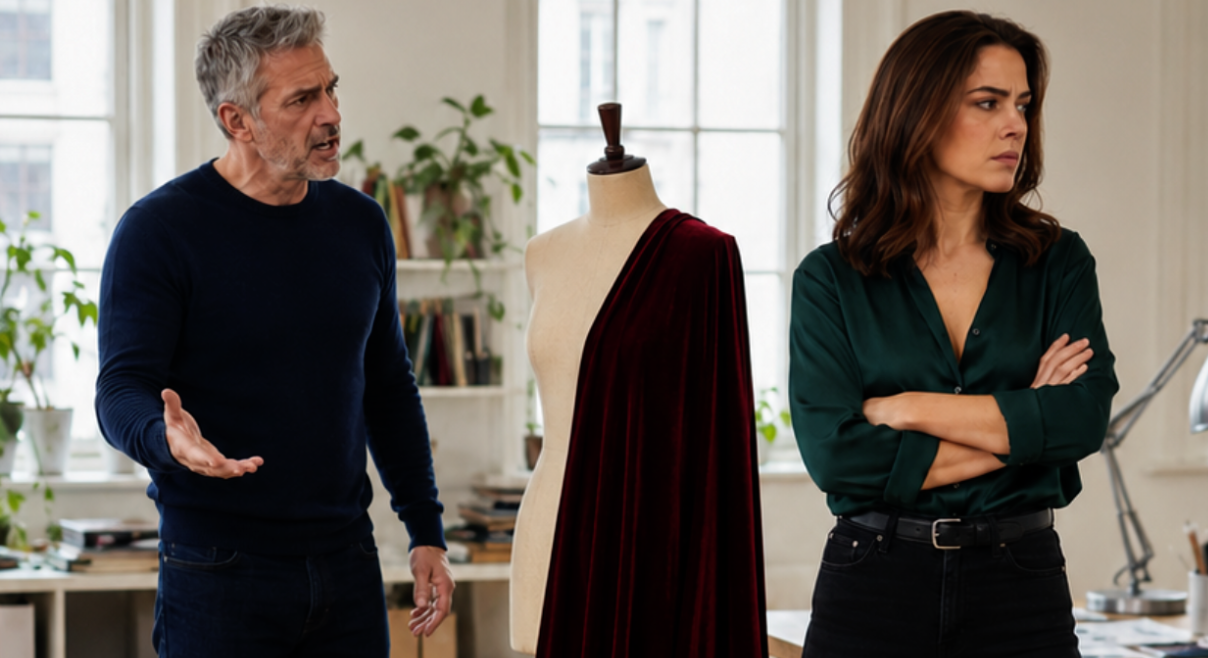
“Let’s Keep Emotions Out of It—This Is the Law.” After Leaving Her for Another Woman, Her Husband Demanded Half of Her Sewing Equipment
The hallway smelled of bergamot. Pavel drank that kind of tea only in the evenings, and only when he was in a bad mood. Olga had known that for thirty-two years.
She had not even had time to take off her coat.
“Ol,” her husband said, coming out of the room. “Sit down. I need to tell you something.”
“Is something wrong with Mom?” She always asked about his mother first.
“No. Mom’s fine. This is about me. And you.”
She never hung up her coat. She sat down opposite him just as she was. “I filed for divorce. This morning. The papers are already with the court.”
The kettle could be heard clearly from the kitchen as it cooled.
“Pasha, are you serious?”
“I am. I’ve met someone else.”
She looked at the gray hair at his temples. At the shirt she had altered across the shoulders for him the previous autumn. At his wedding ring.
The ring was still there.
“How long has this been going on?”
“Six months.”
“What’s her name?”
“Liza. She’s forty-three. She teaches at a university.”
Olga nodded. For some reason, she did not cry. Later that night, she would think about how strange that was. Thirty-two years of marriage, yet there were no tears.
“Ol, just don’t interrupt me. I’ve thought about this for a long time. You haven’t really been here for the past two years. You’re always buried in your fabrics. You come home at nine and leave at eight. All you talk about is the overlock machine, your clients and some kind of pattern paper. I need a woman who is actually there beside me.”
“I’m at the sewing studio, Pasha. Not ‘somewhere.’ At the studio. It’s forty minutes away by trolleybus.”
“You know what I mean.”
She did understand. She simply did not say anything aloud.
The next morning, she went to the studio at seven, as usual.
There was an order from a café called “Beans”: twenty aprons for the baristas, made from thick sand-colored linen with leather ties. The owner, Artyom, who was about thirty, had come up with the concept himself: handmade aprons, each embroidered with the initials of the employee who would wear it.
Olga had agreed. She liked young people who took their work seriously.
She switched on the light above the cutting table and spread out the pattern. Cutting was the most important part. If you cut something incorrectly, everything that followed would come out crooked.
She had known that for a long time.
The first apron. The second. The third.
At lunchtime, Vera came in. She was a thirty-five-year-old student who attended Olga’s classes twice a week. She looked at Olga’s face and sat down beside the overlock machine.
“Olga Vladimirovna, what happened?”
“Pasha left.”
“What do you mean?”
“Exactly what I said. We’re getting divorced. He has someone else.”
Vera remained silent. Olga continued sewing.
“And you… How are you?”
“I’m sewing. You can see that, can’t you?”
“I can.”
“So can I.”
She finished the twenty aprons in two days instead of four. By evening, her neck and lower back hurt, and her eyes ached from the light. She did not stop.
When her hands were working, her mind became quieter. And when her mind was quieter, she could keep living.
On the fourth day, Pavel called.
“Ol, Liza and I will come by on Saturday. I need to pick up some things.”
“‘We’?”
“Well… yes. She’ll help me.”
“Come over.”
She ended the call and looked at the stack of finished aprons.
Liza was exactly as Olga had imagined her. Slender, dressed in a gray cardigan, with her hair tied in a low ponytail. She had a kind face.
That was the most painful part.
If she had been loud, arrogant and obviously fake, it would have been easier.
“Hello,” Liza said quietly. “I… I didn’t know you would be home. Pasha said…”
“What did he say?”
Liza looked at Pavel. Pavel looked away.
“He said that you hadn’t really been together for a long time. That you lived like roommates. That you…” She hesitated. “That you wanted the divorce yourself. He said you told him six months ago, ‘Pasha, leave. I don’t care.’”
Olga turned toward her husband.
Slowly.
“I never said that, Pasha.”
He remained silent.
“Never. Not to you. Not to anyone.”
“Ol, that isn’t important now…”
“It is important. Come into the kitchen. I’ll put the kettle on.”
Liza did not want to. Olga could see it.
Olga insisted.
Pavel sat opposite her in one of his everyday shirts. It was the same shirt Olga had altered the previous autumn. His shoulders had grown broader with age, and ready-made clothes no longer fit him properly. She had spent two evenings working on that shirt—unpicked the seams, cut an extra panel and sewed in a new yoke.
He had said, “Ol, you’re a magician. It’s like a brand-new shirt.”
Now he was sitting in that same shirt in her kitchen.
With Liza.
“Your home is beautiful,” Liza said. “Did you make the curtains yourself?”
“I did.”
“Pasha told me that you… do some sewing.”
“‘Lifeless,’” Olga corrected her. “He told you I was lifeless. That I was always buried in my fabrics and was never there for him.”
Liza flushed.
That was answer enough.
“Olga, I never wanted to hurt you…”
“No one wanted to hurt me, Liza. That’s how it always is. No one ever wants to hurt anyone, yet somehow everyone ends up wounded.”
Pavel stared into his cup—the same cup he had drunk from every morning for thirty years.
“Take your things,” Olga said. “Pash, I didn’t finish altering your gray shirt. Take it as it is. It’s hanging in the dressing room.”
“Ol, you don’t have to…”
“I do. I don’t want it hanging here.”
They left an hour later carrying boxes and a bag of clothes.
Pavel took the shirt.
Silently.
Olga sat alone in the kitchen and looked at the empty table.
Then she cried.
For the first time in a week.
She cried for a long time—ugly, gasping sobs that escaped in low wails. Then she stood up, washed her face with cold water and put on another kettle.
Five days later, the phone rang again.
“Ol, I spoke to a lawyer. We need to discuss the division of our property.”
“The apartment and the car. I know, Pash. Everything will be handled according to the law.”
“And the sewing studio.”
A pause followed.
“What about the studio?”
“You bought the equipment while we were married. Four hundred and sixty thousand rubles, remember? It’s jointly acquired property. My lawyer says I’m entitled to half.”
She stood in the middle of the kitchen with a towel in her hands. For about ten seconds, she said nothing.
“Pash, for two years you watched me operate at a loss. You called it a hobby. You said, ‘The important thing is that you’re happy.’ And now that the studio is finally making money, you want half of it?”
“Ol, don’t get emotional. This is the law. It’s jointly acquired property.”
“Fine. We’ll discuss it in court.”
She ended the call.
Her hands were trembling.
For the first time since all of this had begun, they were trembling.
The following day, she went to see a lawyer.
The lawyer was a woman of about thirty with curly hair and thin-framed glasses. Her name was Marina. She listened without interrupting and then asked Olga for the documents.
“Olga Vladimirovna, let’s go through everything in order. Where did the money for the equipment come from?”
“My aunt’s apartment. My mother’s sister, Aunt Nina. She was alone and had no children. I took care of her during the final five years of her life—groceries, doctors, cleaning. When she died in 2021, she left the apartment to me in her will. I sold it in 2022. I used that money to open the sewing studio.”
Marina looked up.
“Do you have the certificate confirming your inheritance rights?”
“Yes. I also have the apartment sale agreement and the bank statement. The money was kept in a separate account. I didn’t mix it with anything else. Later, I transferred it to my sole proprietorship’s account.”
“When did you register the business?”
“In October 2022. Before that, I was saving money and looking for suitable premises.”
“And the equipment?”
“Some of it was leased, and some I bought outright. Industrial sewing machines, overlock machines, a buttonhole machine and a cutting table. Everything was registered under the business. I kept all the documents. I worked in banking, so it’s a habit.”
Marina removed her glasses and wiped them.
“Olga Vladimirovna, I’m amazed. Your documentation is so clean that it’s almost unbelievable. Property purchased using one spouse’s personal funds—money received through inheritance, as a gift or from the sale of inherited property—is not considered jointly acquired marital property under Article 36 of the Family Code. That is, provided you can prove where the money came from. And you can. All your documents are in order. Your husband apparently doesn’t know about the apartment, or he has forgotten.”
“He forgot,” Olga said. “He didn’t like Aunt Nina. He didn’t even attend her funeral. He said, ‘Ol, I have a construction project to complete. Go without me.’ Later, when I was registering and selling the apartment, he didn’t pay attention. I handled everything myself.”
“That’s even better for us. He probably won’t mention it in his claim at all. You can present the documents during the hearing.”
For the first time in a month, Olga took a deep breath.
Then she exhaled.
“And him?”
Marina smiled.
“He’ll hear about it in the courtroom. Along with his lawyer.”
It was November.
Olga put on a dark-blue suit—the one she had worn to the bank during her final years there before she was laid off. It fit more loosely than before. She had lost weight over the past several months.
Pavel also arrived wearing a suit. He was accompanied by his lawyer, a gray-haired man of about sixty carrying a briefcase.
Liza was not there.
The judge was an older, tired-looking woman. She spent a long time reading the documents. Olga sat upright with her hands resting on her knees. Marina sat calmly beside her.
Pavel’s lawyer spoke first. He spoke confidently, referred to Article 34 and listed the apartment, the car, the sewing equipment and the funds in Olga’s business accounts.
Pavel nodded.
Then Marina spoke.
Briefly.
First, she presented the certificate confirming Olga’s inheritance of Aunt Nina’s apartment. Then she presented the 2022 sale agreement for that apartment. Finally, she presented a bank statement showing that the proceeds from the sale had remained in Olga’s separate account, had not been mixed with the family budget and had later been transferred directly to the business account and spent on equipment and lease payments.
Every transaction formed a clear, traceable chain.
Pavel’s lawyer leafed through the papers and exchanged looks with his client.
Pavel went pale.
He clearly did not remember.
Or perhaps he had never known that Olga had kept everything.
The judge read the documents for a long time. She compared the dates. She compared the amounts.
“The court,” she finally said, “has reached the following conclusion. The apartment on Geroev Sibiryakov Street and the vehicle are jointly acquired marital property and shall be divided equally, as requested by both parties.
“As for the property belonging to the sole proprietorship of Sokolova Olga Vladimirovna, the court has established that the sewing studio’s equipment was purchased using funds obtained from the sale of inherited property.
“According to Part One of Article 36 of the Family Code, property received by one spouse through inheritance, as well as property acquired using such funds, is that spouse’s personal property and is not subject to division.
“The chain of financial transactions has been confirmed by documentary evidence. The court finds no grounds for including this equipment among the jointly acquired marital assets.”
The courtroom became completely silent.
Pavel’s lawyer whispered something into his ear. Pavel listened without turning his head.
Then, very slowly, he turned around.
He looked at Olga.
His eyes contained everything at once—surprise, resentment and, for the first time in thirty-two years, something resembling fear.
The fear of discovering that the person he thought he knew by heart was not as simple as he had believed.
Olga looked directly at him.
She did not smile.
She simply looked.
After the hearing, Pavel caught up with her beside the staircase in the courthouse corridor.
“Ol. You… You knew, didn’t you? From the very beginning.”
“What did I know, Pash?”
“That everything had been registered that way. That you were protected.”
She adjusted the bag on her shoulder.
“Pash, I wasn’t protecting myself. I simply did everything properly. I worked in banking for twenty years. I know how to handle documents. You never noticed that. You thought I had a hobby.”
“Ol…”
“And you forgot about my aunt’s apartment. I sold it in 2022. You had gone to Lipetsk for three weeks to complete a project. I told you about everything afterward. You said, ‘Ol, well done for sorting it out yourself. I don’t have time to get involved.’ Do you remember?”
He remained silent.
“I remember everything, Pash. I worked in banking.”
She walked toward the exit.
He did not call after her.
In December, the “Beans” café ordered another forty aprons. Artyom was opening a second location on Leninsky Prospekt. He came to the studio himself and brought a box of chocolates.
“Olga Vladimirovna, have you considered opening a second workshop? A space is becoming available on Leninsky Prospekt, one floor below our new café. Thirty-six square meters. I know the owner, and the rent is reasonable.”
“I’ve thought about it,” Olga said. “I’m looking at different options.”
“Let me know if you need investors. I know some people.”
She wrote down his number.
After he left, a package arrived.
A courier delivered a bag. Inside was a gray shirt—the same unfinished shirt Pavel had taken with him.
There was also a short note written on a sheet torn from a notepad:
“Olya, finish it if you can. There’s no one else who can do it.
Pasha.”
Olga stared at the shirt for a long time.
Then she hung it on a hanger among the clothes belonging to her clients.
In the section where garments waited for their turn.
Let it wait.
On Tuesday, she had a meeting about the new premises. Thirty-six square meters, street-facing, with a manageable rental rate. Vera had said she was ready to work there as an administrator at first. Artyom had sent her a message:
“I’m ready to introduce you to the investors whenever you say the word.”
Olga walked over to the cutting table. She spread out the linen for the next batch of aprons.
She picked up her scissors.
Her hands began moving on their own.