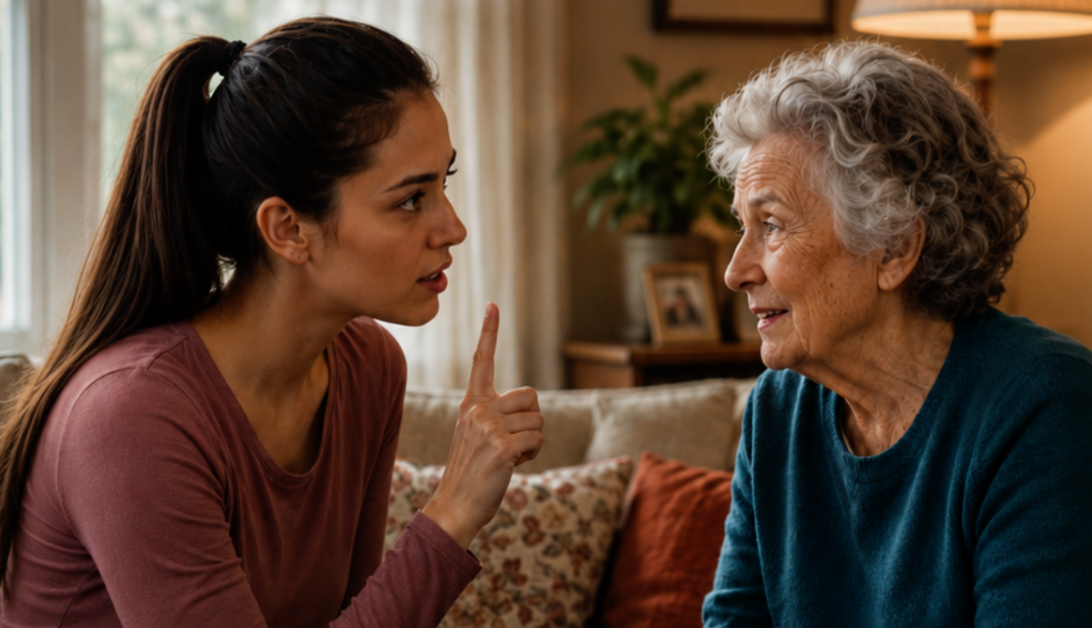
“I’m Not Giving You Any Money, Mom. Ask the Person You Signed the House Over To for Help,” the Daughter Replied
“Next. Room number three,” someone behind the reception desk called indifferently.
Lyudmila rose from her chair automatically and walked down the narrow corridor, which smelled of antiseptic and cold coffee. The linoleum echoed dully beneath her heels. She had almost reached the door when the phone in her pocket gave a brief vibration.
A message. From her mother.
“I’ve scheduled a medical examination. It’s at a private clinic—quickly and without any waiting. It’s quite expensive: twenty-five thousand. Please transfer the money today. I’m not supposed to get stressed right now. You live alone, so it’s easier for you.”
Lyudmila stopped. People walked around her, and someone sighed irritably. She reread the message, her gaze lingering on the final sentence.
It’s easier for you.
Nothing flared inside her chest. On the contrary, everything suddenly felt strangely empty and clear. There was no familiar knot of guilt and no attempt to justify herself. She opened the conversation and typed steadily, without pausing:
“I’m not transferring the money. Ask Ilya. You said yourself that you signed the house over to him so that he would be able to help you.”
The message was sent. Lyudmila put her phone away, took a deep breath, and pushed open the office door. For the first time in a long while, her steps were confident—not because things had become easier, but because she no longer intended to retreat.
When Ilya joined the family, Lyudmila had just turned nine. She remembered that day not because of any joy, but because of the strange silence in the apartment. Her mother returned from the maternity hospital exhausted and gaunt, but there was a light in her eyes that Lyudmila had never seen before. Her father held the baby carrier with both hands, as though he were afraid to take an unnecessary step.
“Well, that’s it,” her mother said, sitting down on the edge of the sofa. “Now we have a son. And you are our little helper.”
A great deal began with that word—helper. Lyudmila spent hours walking around the building with the stroller while solving math problems in her head. She got up at night whenever Ilya cried because her mother had to work in the morning. She washed clothes, ironed them, and warmed formula—not because she wanted to, but because it had to be done.
By the time she was a teenager, her entire life already revolved around her brother’s schedule. Pick him up, take him somewhere, wait for him. While her mother took extra jobs and her father left for construction sites, Lyudmila quietly became the third adult in the household.
“He needs to be given a chance,” her mother would say as she handed money to his private tutor. “It’s harder for a boy to make his way in life.”
Lyudmila got into university by herself, without tutors, and earned a state-funded place. Ilya tried to enroll several times, then studied at the family’s expense, changed his major repeatedly, and eventually dropped out altogether. This was explained as him “trying to find himself.” Finding himself was expensive: electronic devices, trips, and new clothes. By then, Lyudmila was already working—first at a school and then at a private organization. Her salary was higher, and sharing it seemed natural. She simply brought money home without asking any questions.
After her father’s death, her mother invited both children to the country house—the same house into which their father had poured all his energy and had managed to finish shortly before he passed away.
“I’ve decided to sign the house over to Ilya,” she said calmly. “It will be more sensible that way. A man should have something to fall back on.”
Lyudmila silently stirred her tea. Ilya did not even look surprised. At the time, she did not yet know that her silence would one day become her greatest mistake.
The journey home took Lyudmila a long time. She had to change buses and ride in an overcrowded vehicle whose windows were fogged by the passengers’ breath. When she reached her rented apartment, she took off her coat and remained standing in the middle of the kitchen without turning on the light. Eventually, she flicked the switch, put the kettle on, and sat down at the table. She opened her phone. Her social media feed seemed to scroll by itself before stopping on a familiar face.
Ilya.
Smiling and relaxed. A barbecue grill, guests, and the veranda of the country house. The caption was brief and smug:
“Weekend at my place.”
Those final two words hurt more than anything else.
Lyudmila put her phone aside and took out a folder of documents—an accountant’s habit. Bank transfers, receipts, and bills. She began to calculate, without emotion, as though she were preparing a financial report. The total rose slowly but relentlessly.
Money for medicine, doctors, and repairs to a house that did not belong to her. Gifts for her brother—“so he won’t be offended” and “because it’s a special occasion.”
Her own plans were always postponed.
An apartment—later.
A vacation—someday.
New clothes—when the old ones were completely worn out. The phone rang sharply. She looked at the screen but did not answer. A minute later, a message arrived, full of harsh words and exclamation marks. Lyudmila did not even reread it. She had known its meaning for years.
She opened the conversation from that morning and looked again at her short message. It was clear and contained no excuses.
Then she suddenly realized that nothing had happened.
The house had not collapsed. The sky had not fallen. Someone in the neighboring apartment was laughing loudly, the kettle was boiling on the stove, and traffic hummed outside the window.
Lyudmila took a sip of hot tea and dialed Marina’s number.
“Are you home?” she asked. “I really need to talk.”
Marina’s home was warm, crowded, and peaceful. There were children’s drawings on the refrigerator, the smell of freshly baked food, and the atmosphere of an ordinary, living home. Lyudmila sat down at the kitchen table and remained silent for a long time. Then she finally said aloud what she had previously been afraid even to think: “I’m tired of being the person everyone dumps everything on.”
Marina looked at her carefully and nodded.
“Welcome to a normal life. It just took you far too long to get here.”
Her mother appeared on the doorstep the following day—without calling or warning her. Lyudmila had barely taken off her jacket after work when a sharp knock sounded at the door. When she opened it, she saw the familiar expression—heavy and scorching.
“Do you have any conscience at all?” was the first thing her mother said as she walked into the apartment. Lyudmila did not answer. She turned around, went into the kitchen, switched on the light, and put the kettle on. The sound of running water filled the silence. Her mother followed her, sat at the table, and clasped her fingers together.
“I’m not a stranger to you. I’m your own mother. How could you answer me like that?”
“Mom, I genuinely don’t have that kind of money.”
“You never have any money! But you have money for your clothes, don’t you? And all that makeup?”
Lyudmila lowered her gaze. The skin on her hands was dry, and her nails were unpolished—she had been doing everything herself for a long time. She had last bought herself a new item of clothing during the winter because the old one had become completely worn out.
“Ilya owns a house. He can take out a secured loan against it if necessary.”
Her mother immediately straightened up.
“Ilyusha already works so hard! He has plans and projects. You can’t bother a man over every little thing. And what about you? An old maid who thinks only about herself. Children have a duty to help their parents!”
“Why does that duty belong only to me?”
“Because you’re the oldest! Because you’re a woman! Because I said so!”
The kettle clicked. Lyudmila stood and turned off the stove.
“Mom, I’m not going to hand over money without question anymore. If there’s a genuine emergency, we can discuss it. But paying for a private examination when you can receive one through compulsory health insurance is not an emergency.”
Her mother jumped up so abruptly that the chair scraped against the floor.
“How dare you! I raised you and paid for your education!”
“I studied at university on a state-funded place. I’ve worked since I was eighteen. You raised Ilya too, but for some reason, you never demand anything from him.”
“Get out of my sight!” Her mother grabbed her handbag. “I never want to see you again, you ungrateful creature!”
The door slammed shut. The apartment became unbearably quiet.
Lyudmila sank to the floor in the hallway and leaned her back against the wall. Tears rolled down her face—not from pain, but from exhaustion.
And through that exhaustion, a feeling she had never experienced before suddenly emerged:
She had endured it.
What followed was a period of pressure. It was not loud or dramatic—it was sticky and exhausting.
Her phone came alive at the most inconvenient moments: early in the morning, in the middle of a lesson, and at night. Her mother called persistently, as though she were trying to break through the walls. Ilya sent short, angry messages without bothering to choose his words. Then everyone else became involved—distant and close relatives, people who had barely appeared in Lyudmila’s life before but who now suddenly knew exactly what she was supposed to do.
After several days, Lyudmila stopped answering. Then she silenced the phone. Eventually, she switched it off completely—for the first time in many years.
Her colleagues at school noticed the change quickly.
“You seem different somehow,” the deputy principal said cautiously after keeping her behind following a staff meeting. “Are you ill?”
“No.” Lyudmila nodded. “I’ve simply stopped carrying burdens that aren’t mine.”
The words sounded unexpectedly confident.
She began doing the things she had postponed for years. She bought a gym membership—not to improve her figure, but to release the tension. She replaced her work laptop because the old one could no longer cope, and she was tired of enduring it for “just a little longer.” She bought tickets and went to St. Petersburg for two days—without a plan and without company, simply walking wherever she wanted and returning whenever she pleased.
A month later, a message arrived from her mother. It was short and businesslike.
“I need medicine. Eight thousand.”
Lyudmila thought about it and replied without irritation:
“I can transfer three thousand. Ilya can help with the rest.”
The reply came immediately.
“You have no heart at all. I’m your mother.”
Lyudmila closed the conversation, transferred the money, and did not return to the subject.
Ilya called that evening. His voice was irritated.
“Why are you doing this? Mom is unwell, and you’re pretending to be principled.”
“You have a house and a job,” Lyudmila said calmly. “Why must all the help always come from me?”
“I have my own responsibilities! Loans! And anyway, you’re the oldest.”
“Being the oldest doesn’t mean being a free wallet. There are different ways to help. You can help just as I do.”
A pause followed on the other end of the line. Then came the sharp reply: “Go to hell!”
The call ended.
Lyudmila put the phone aside, opened her book, and returned to reading. She was no longer trembling. The pressure had weakened. At last, she could breathe freely—even if she had to do so in silence.
By the beginning of spring, everything had fallen into place. There had been no dramatic changes or miracles—her life had simply stopped swaying beneath her feet.
Lyudmila submitted a mortgage application to the bank and was barely surprised when it was approved. A few weeks later, she was looking at the floor plan of a small studio apartment in a newly constructed building: very little space and standard finishing provided by the developer, but it felt as though she were looking not at walls, but at the boundaries of her new territory.
She was scheduled to move closer to summer.
Her mother contacted her regularly, almost according to a schedule. The tone of the messages changed constantly: accusations, complaints, sudden gentleness, and then demands again.
Lyudmila replied with restraint. Sometimes she helped financially—but only within limits that did not throw her life out of balance. There would be no more automatic sacrifices.
In May, Ilya appeared on her doorstep. He shifted awkwardly from one foot to the other and looked around the apartment as though he were seeing it for the first time.
“We need to talk,” he began. “I need some starting capital. I’m thinking of launching my own business.” “How much are we talking about?”
“Well… at least two hundred thousand.”
Lyudmila smiled—not mockingly, but almost warmly.
“Ilya, I have a mortgage and expenses that I’ve postponed for years. I don’t have that kind of money.”
“You always found it before.”
“I used to live differently. My priorities are different now.”
“Of course they are.” He grimaced. “You only think about yourself.”
“Perhaps,” she replied calmly. “But at least I’m honest about it now. You own a house. You can use it however you consider appropriate.”
His face flushed.
“That’s mine! Dad left it to me!”
“Dad built it for the family,” Lyudmila said quietly. “But you’re right. The house is yours, and so are the decisions.”
Ilya left abruptly, almost exactly as their mother had once left.
Lyudmila closed the door behind him slowly, without any heaviness in her chest.
She returned to the kitchen, made herself some tea, and switched on her laptop. A catalog of finishing materials was open on the screen.
Lyudmila began choosing tiles for the bathroom in the apartment that would soon become her home.