When I married Denis eight years ago, I sincerely believed that love was a universal solvent. Like many young brides entering a new family, I assumed the hardest part of our union would be learning the subtle choreography of compromise—swallowing the occasional sharp retort, nodding politely through Sunday dinners, and letting my mother-in-law’s cutting remarks dissolve into the background. People always tell you that affection and patience can smooth over any rough edges. But what they fail to mention is that sometimes those edges are so finely honed that by the time you realize what is happening, you are already bleeding.
That Saturday morning began with the quiet, comforting rhythm of an ordinary weekend. I had woken early, started a load of laundry, organized the pantry, and was chopping vegetables for soup. The apartment was filled with the warm, domestic hum of simmering broth and the gentle rattle of the washing machine. Denis had left the evening before to help a college friend rebuild an engine across town and had promised he wouldn’t be back until late afternoon. I was enjoying the rare, tranquil solitude of my own home, expecting no one.
When the doorbell shattered, I wiped my hands on a tea towel and opened the door without checking the peephole. I froze.
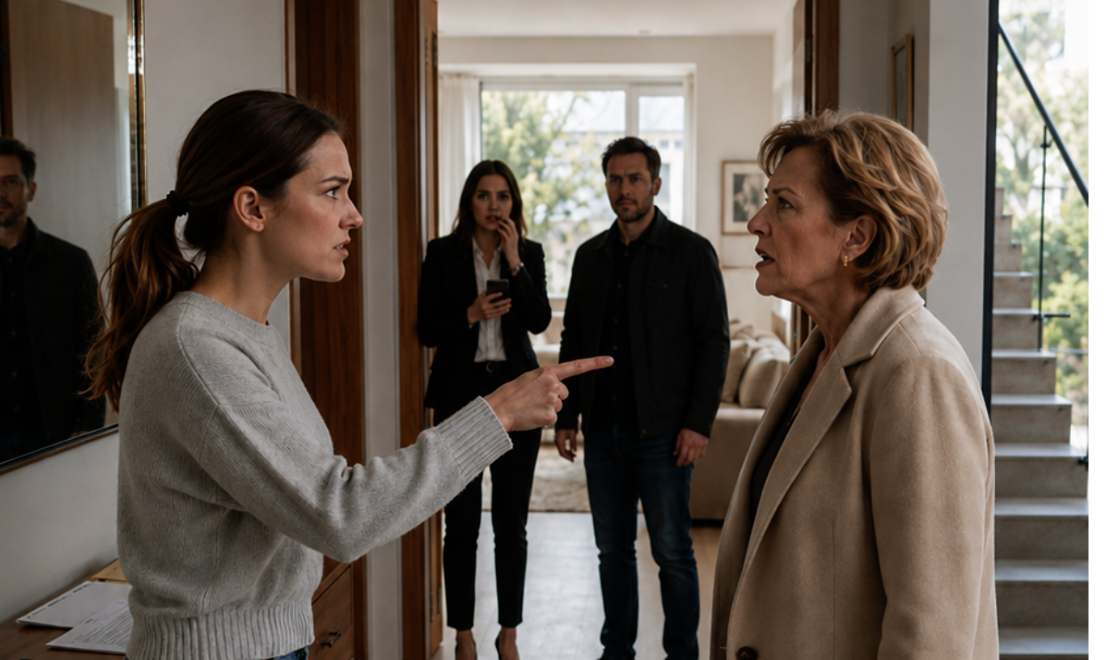
Standing on the landing was my mother-in-law, Lyudmila Petrovna. Flanking her like two dutiful sentinels were Denis’s sister, Olga, and Olga’s husband, Viktor. None of them wore the casual, relaxed expressions of family dropping by for an impromptu cup of tea. Their posture was rigid, their eyes alert and appraising. They looked like an inspection team arriving to execute a carefully rehearsed eviction.
“Hello,” Lyudmila Petrovna said dryly. She did not wait for an invitation, nor did she offer a smile. “We won’t be long.”
She stepped over the threshold with the heavy, proprietary confidence of an owner inspecting a rental property. Olga and Viktor exchanged a swift, meaningful glance and trailed after her. As I closed the front door behind them, a cold, metallic knot of unease tightened in my stomach. Lyudmila Petrovna was a woman of rigid etiquette when it suited her; she never visited without calling at least an hour in advance. Today, however, she didn’t even bother to take off her shoes until she was halfway down the hall.
“Would you like some tea?” I asked, my voice polite but thin.
“Later,” my mother-in-law dismissed, waving a hand without turning around. “First, we’re going to take a look.”
“Take a look at what?”
I received no answer. She marched directly into the living room, her head tilted upward as she scrutinized the molding, the ceiling light fixtures, and the window frames. From there, she proceeded into the kitchen, opened the pantry door, and even peered into the hallway storage closet. Olga followed half a step behind, her thumbs flying across her smartphone screen as she silently logged notes. With every room they violated, the air in my chest grew thinner.
“Mom, the wardrobe in the master bedroom is already ancient,” Olga remarked aloud, not even glancing in my direction. “It’s going to have to be replaced anyway.”
“Of course it will,” Lyudmila Petrovna agreed, running a finger along the laminate countertop in my kitchen. “And a complete kitchen renovation is in order. These cabinets have served their time. We’ll need something lighter.”
I stood by the doorway, gripping the tea towel so tightly my knuckles turned white. For a moment, I wondered if I was misinterpreting the conversation.
“Excuse me,” I said, stepping forward. “What kitchen are you talking about?”
Lyudmila Petrovna turned slowly, regarding me with mild, patronizing surprise—as though a piece of furniture had suddenly spoken up to question the interior designer.
“What do you mean, what kitchen? Denis is going to be living here for a long time. He’ll have to renovate the place anyway to suit a growing family.”
The room plunged into an eerie silence. Only the sound of the faucet dripping into the stainless-steel sink punctuated the stillness.
“Denis already lives here,” I said carefully, weighing every syllable. “And we aren’t planning any renovations.”
My mother-in-law offered a small, condescending smirk. “You aren’t planning them yet. You will eventually. Young people need to modernize everything.”
Meanwhile, Viktor was pacing the length of the living room, measuring the floorboards with heel-to-toe strides. “If we move the sectional over to the east wall, there will be plenty of room for a dining table,” he muttered thoughtfully.
“Exactly,” Lyudmila Petrovna chimed in. “And that old wall unit can be hauled out. No one keeps heavy furniture like that anymore.”
A slow, burning wave of indignation rose from my chest into my throat. “What are you all talking about?”
My mother-in-law sighed, turning to face me fully. “Don’t get nervous, dear. We’re simply discussing the future.”
“What future?”
“The normal kind,” she said smoothly. “The family’s future. Denis is my son. Everything that belongs to the family should remain in the family.”
The phrase remain in the family scraped against my nerves like rusty iron. I knew Lyudmila Petrovna’s vocabulary intimately. Throughout our eight-year marriage, she had consistently treated anything Denis touched as communal property. When I bought our second car with my own bonus, she referred to it as “our vehicle.” When Denis received a modest promotion, she boasted to the neighborhood women that “we are earning excellent money now.”
But this apartment was entirely different.
I had purchased these walls long before Denis and I ever exchanged vows. To make the down payment, I had made the most agonizing decision of my young life: selling the old wooden cottage in the countryside that my grandmother had bequeathed to me. That cottage had been the sanctuary of my childhood—a place smelling of dried lavender, warm dill, and baking bread. After I sold it, I worked for three consecutive years without a single vacation, taking on freelance accounting contracts until my eyes burned, just to secure a mortgage I could manage alone. Every document, every title deed, every insurance policy was registered exclusively in my legal name.
When Denis proposed, he was candid about his empty bank account. I had loved him for his gentleness and honesty, and I never held his lack of capital against him. We had promised each other we would build our life together and tackle the mortgage side by side. In reality, the economic tides shifted, and over the years, I ended up absorbing nearly eighty percent of the monthly payments myself.
“Lyudmila Petrovna,” I said, keeping my tone low and steady. “This apartment belongs to me.”
She smiled—a slow, maternal curve of the lips that conveyed nothing but pity for my naivety. “Formally, yes.”
“Not formally. Legally.”
“The law is one thing today and another tomorrow,” she said dismissively, waving her hand as if swatting away an annoying insect. “Family is what matters in the real world.”
“I’m sorry, but I don’t understand where this conversation is leading.”
My mother-in-law let out a heavy, theatrical sigh, exchanging a look with Olga. “Fine. If you want it said bluntly, I’ll say it directly. Denis and I have already discussed the fact that the apartment needs to be registered properly.”
The kitchen seemed to tilt beneath my feet. “What do you mean, you discussed it?”
“Surely he hasn’t kept you in the dark?” she asked, her brow furrowing in genuine surprise for a fraction of a second before her mask of control slid back into place. “Well, then he’ll explain it to you later. The apartment should belong to my son anyway. That would be fair to him.”
Olga nodded vigorously from the hallway. “Of course. You’re a married couple. What difference does it make whose name is on the paperwork?”
What difference does it make?
To someone who had spent eight years sacrificing weekends, ignoring fatigue, and measuring every grocery bill against an amortization schedule, the difference was the size of a chasm. I looked at Olga, then at Viktor, and finally back at the woman who had birthed my husband. In that single, crystal-clear moment, the illusion of our extended family shattered. They hadn’t come to advise, nor had they come to visit. They had come to survey a territory they had already quietly annexed in their minds.
“Listen to me very carefully,” I said, my voice hardening into steel. “You are currently standing in my apartment.”
“In our family apartment,” Lyudmila Petrovna immediately corrected, her chin rising.
I drew a deep, stabilizing breath. “No.”
She frowned, dark eyes narrowing. “What do you mean, no?”
I stepped forward, closing the distance between us until we were barely three feet apart. My heart was pounding against my ribs like a trapped bird, but my voice remained terrifyingly level. “I think you’ve forgotten. This apartment doesn’t belong to your son.”
The silence that followed was absolute.
My mother-in-law stared at me as if I had struck her across the face. Her cheeks flushed a mottled, furious crimson. “How dare you speak to me like that?”
“I am speaking the way the owner of this home should speak.”
“Oh, I see,” she hissed, taking a threatening step forward. “So you’ve decided to humiliate us? To remind us that you have property and my son doesn’t?”
“No. I am simply reminding you of a legal and moral fact.”
“Denis will never allow you to treat his mother this way!”
“Denis and I will discuss this between ourselves.”
She threw her hands up, her voice rising into a shrill echo that bounced off the hallway walls. “As long as he is my son, everything connected to his life and his security concerns me too!”
“No,” I said, immovable. “It does not.”
“You deliberately turned him against his family! You think holding a piece of paper makes you the master of his fate?”
I looked at her with profound, bone-deep exhaustion. “No. What makes me the master here is the fact that I bought, paid for, and maintained this home.”
I walked past her to the entrance, grasped the brass handle of the front door, and swung it wide open. “It’s time for you to leave.”
Olga’s jaw dropped. Viktor shuffled nervously toward the threshold, muttering, “Maybe we should talk about this another time…”
But Lyudmila Petrovna was trembling with rage. She grabbed her handbag from the console table, her knuckles white. “You will bitterly regret this!”
“Perhaps,” I replied quietly. “But not today.”
She paused on the landing, waiting for me to falter, to apologize, to remember my place as the accommodating daughter-in-law. I didn’t blink. She spun around, her heels clattering against the concrete stairs, and shouted over her shoulder: “Denis will hear about every single word you said to his mother!”
Olga shot me a venomous glare before hurrying after her. Viktor offered a helpless, apologetic shrug and slipped out. I shut the door and turned the deadbolt.
When the latch clicked into place, my knees gave out slightly, and I leaned my back against the cool plaster wall. My hands were shaking so violently I had to tuck them into my armpits. I had never spoken to anyone in my husband’s family with such raw defiance. But what chilled me far more than Lyudmila’s screams were seven casual words: Denis and I have already discussed it.
If that were true, my husband had been sitting at a negotiation table I didn’t even know existed.
Two hours later, the key turned in the lock.
Denis entered with an unusual, measured slowness. Normally, his arrival was heralded by the cheerful jingle of keys tossed onto the entryway table, followed by a loud greeting. Today, he slid his boots off in utter silence, hung his jacket on the hook, and stood in the dim hallway for several seconds, staring at the floorboards.
I remained seated at the kitchen table, a cold cup of tea between my hands.
He appeared in the doorway, his shoulders slumped, his eyes evasive. “Mom called,” he said after a long, suffocating pause.
“I guessed as much.”
“She’s very upset, Lilit. She was crying on the phone.”
A dry, humorless smile touched my lips. “Really? That’s fascinating. When she was here, she seemed far more interested in taking measurements and evicting my furniture than crying.”
Denis pulled out a chair and collapsed into it, running both hands over his face. “Couldn’t you have been a little gentler with her?”
The question felt like a blade sliding neatly between my ribs.
“Gentler?” I repeated, my voice dropping an octave. “She walked into my home uninvited. She paced through my bedroom, declared my kitchen obsolete, and announced that the property title should be transferred to you. And your first instinct is to ask why I wasn’t gentle?”
He looked out the window, his jaw tightening. “She just lost her temper. You know how passionate she gets about family.”
“No, Denis. That wasn’t a sudden temper tantrum. She arrived with a tape measure, a phone full of notes, and a decision already made.”
He fell silent. That silence—cowardly, heavy, and familiar—spoke louder than any confession.
I looked at the man across from me. For eight years, I had cherished his calm demeanor. I had mistaken his avoidance of conflict for kindness, his quietness for stability. Whenever Lyudmila Petrovna had overstepped in the past—criticizing my cooking, commenting on my weight, or demanding money we didn’t have—Denis would kiss my forehead and whisper, “Just ignore it, honey. You know how Mom is. Let’s not start a war.”
I had excused his passivity for nearly a decade. But suddenly, the scattered puzzle pieces of our marriage snapped together to reveal a terrifying portrait: Denis didn’t avoid conflict because he loved peace; he avoided conflict because he refused to bear the weight of a decision.
“Answer me honestly,” I said, leaning across the table. “Did you discuss my apartment with your mother?”
He shifted uncomfortably. “It was just a casual conversation.”
“What kind of conversation, Denis?”
He swallowed hard. “Mom said… she said it would be more reassuring for everyone if the apartment were registered in both of our names.”
“Both names?”
“And then… later on, she mentioned that since I’m the head of the household, it might make more sense to put it in my name.”
The room seemed to shrink. “And you didn’t tell me?”
“I didn’t want an argument!” he defensive-flared, his voice rising for the first time. “I knew you’d react like this!”
“Like what? Like a woman who spent eight years paying off a mortgage alone while her husband gave his bonuses to his mother and paid for his sister’s vacations?”
“I contribute to this house!”
“You pay for groceries and utilities, Denis! I paid the principal! This apartment existed before you ever put a ring on my finger!”
He rubbed his temples, looking genuinely miserable. “Mom believes a husband should feel secure about his future. She thinks a man shouldn’t be living as a guest in his wife’s house.”
“And what about my security?” I asked softly. “Does a wife not deserve a foundation?”
He had no answer.
That night, my phone became a vessel of collective outrage. First came Olga, accusing me of causing their mother’s blood pressure to spike. Then came two cousins and an aunt, each repeating the same scripted reprimands: You must respect your elders. Lyudmila has welcomed you like a daughter. Material things don’t matter when you have family.
Not a single person asked what Lyudmila Petrovna had actually said. Not one inquired why I had felt compelled to open the door and order her out. In their collective mythology, the apartment had already been absorbed into the Dilbaryan family estate; my name on the deed was merely an administrative error waiting to be corrected.
The true turning point arrived two days later.
I had taken a personal day from work to deal with the mounting anxiety that made it impossible to concentrate on spreadsheets. Returning from a quick trip to the grocery store, I spotted Lyudmila Petrovna standing by the entrance of our residential block. Beside her stood a well-dressed man in his fifties holding a leather folder.
When she saw me approach, her eyes glinted with malicious triumph. “Ah, here comes the owner,” she said, loading the word owner with venomous sarcasm.
I stopped a few feet away. “Good afternoon.”
“Lilit, this is Sergey Ivanovich,” my mother-in-law announced smoothly. “He works in real estate.”
My blood turned to ice. “And why is a real estate agent standing outside my building?”
Sergey Ivanovich offered a polite, professional smile. “Good afternoon. Lyudmila Petrovna asked me to evaluate the building and discuss potential market valuations for a three-room layout on the fourth floor. We were just talking about exchange options.”
“Exchange options?” I repeated, turning a slow, incredulous gaze toward my mother-in-law.
“Of course,” she said calmly. “Once the paperwork is updated, we’ll need to see if it makes more sense to sell this place and buy two smaller apartments—one for Denis and one to help Olga with her mortgage.”
Sergey Ivanovich’s smile faltered as he looked between our contrasting expressions. “I… was informed the family had already reached a consensus regarding the asset.”
“There is no consensus,” I told the agent, my voice ringing clear across the courtyard. “This property is solely owned by me. It is not for sale, it is not for exchange, and any further discussions you have with this woman are a waste of your professional time.”
The agent flushed red, mumbled an apology about a misunderstanding, and beat a hasty retreat toward his car.
Lyudmila Petrovna turned on me, her face contorted with rage. “You spiteful, arrogant girl! You made a fool of me in front of an expert!”
“You made a fool of yourself by trying to appraise property that doesn’t belong to you!”
“It will belong to Denis!” she screamed, dropping all pretense of maternal dignity. “You think you can keep my son trapped with your money? We’ll see what the courts have to say about marital property!”
She stormed off toward the bus stop, leaving me trembling in the afternoon sun.
That evening, our downstairs neighbor, Nina Sergeyevna—a sweet, observant pensioner who had known me since I first moved in—knocked timidly on my door. She brought a plate of warm pastries, but her eyes were filled with distress.
“Lilit, dear,” she began once we were seated in the kitchen. “I don’t want to gossip, but my conscience won’t let me stay quiet. Three weeks ago, I was sitting on the bench by the lilac bushes. Your mother-in-law was there with Olga. I heard them talking about your apartment.”
I set my teacup down. “What did they say, Nina Sergeyevna?”
“Lyudmila was bragging. She told Olga not to worry about her debts because Denis was going to get his name on the deed by the end of the summer. She said, ‘Once he’s a co-owner, we can force a sale or buy her share out for pennies. Lilit is soft; she’ll sign whatever Denis puts in front of her if she thinks it’ll save her marriage.’”
A cold, heavy numbness spread from the base of my skull down to my fingertips. Lilit is soft.
After Nina Sergeyevna left, I walked into the master bedroom. My husband was at work, doing overtime. I opened the bottom drawer of our closet where I kept our important household documents in a locked fireproof box.
The key was in its usual hiding place inside a winter boot. I opened the box and began flipping through the manila folders. Everything seemed in order until I reached the back.
Tucked neatly behind my mortgage discharge papers were five crisp, white sheets of paper that hadn’t been there a month ago.
They were high-resolution photocopies. One of my national identity card. Two of the original purchase agreement from eight years ago. And two of my historical property tax receipts.
I sat on the edge of the bed, the photocopies shaking in my hands. Someone had taken my keys, unlocked my private box, removed my legal records, copied them, and replaced them.
When Denis came home at nine o’clock, he found me sitting at the kitchen table with the five sheets of paper laid out in a neat row across the wood.
He stopped in the doorway, his coat half-unbuttoned. His eyes darted to the papers, and for the first time in eight years, I saw him look truly terrified.
“Where did these come from?” I asked, my voice barely above a whisper.
He didn’t try to feign ignorance. He sagged against the doorframe. “I made them.”
“Why?”
“Mom… Mom said she wanted to consult a family lawyer. Just to understand what my rights were after eight years of marriage.”
“Your rights to my home?”
“We’ve been married almost a decade, Lilit!” he cried, stepping into the room with a desperate, defensive energy. “I’ve lived here! I’ve fixed the plumbing, I’ve painted the walls, I’ve paid for repairs! Why is it so terrible that I want some security? What happens to me if you decide you’re tired of me tomorrow? I walk out into the street with nothing!”
“And so your solution was to steal my identity documents and conspire with your mother to dismantle my ownership behind my back?”
“It wasn’t a conspiracy! She was just trying to protect me!”
“From me?”
The question hung in the air, toxic and devastating. Denis lowered his head, staring at the floor.
“I want you to answer one question,” I said, standing up. “Did you know she brought a real estate agent here today to appraise the apartment for a sale?”
Denis’s head snapped up, genuine shock registering on his features. “What? No… no, she said she only wanted to see about a joint title—”
“She’s planning to sell it, Denis. To pay off Olga’s debts. And you handed her the ammunition.”
The next morning, while Denis was at work, I called a professional locksmith. By noon, the old deadbolts were gone, replaced by high-security cylinders with restricted key duplication. By two o’clock, a technician had installed a discreet security camera above the front door, linked directly to my phone.
When Denis returned that evening, his key wouldn’t turn. I opened the door from the inside and handed him a single, new key.
“What is this?” he asked, staring at the polished brass.
“A new lock,” I said. “And a reminder that this is my house. If your mother or your sister steps foot on this floor again, I will call the police for trespassing.”
We lived in a state of suspended animation for five days—two strangers sharing a kitchen, speaking only in functional monosyllables. But the final revelation was still waiting in the shadows.
On Friday afternoon, I received an unexpected phone call from Lyudmila Petrovna’s cousin, Marina Sergeyevna—a quiet, dignified woman who had always avoided family gatherings. She asked to meet me at a café near the botanical gardens.
When I sat down across from her, Marina Sergeyevna slid a faded manila envelope across the marble table.
“I heard what happened from Olga,” Marina said softly. “And I couldn’t stay silent any longer. You need to know who you are dealing with.”
“What is this?” I asked, touching the envelope.
“Twenty-two years ago,” Marina said, “Lyudmila had an older sister, Vera. Vera was unmarried and owned a lovely two-room flat near the river. When Vera fell ill with kidney disease, Lyudmila started visiting her every day. She brought groceries, cleaned her kitchen, and told everyone she was a saint.”
I felt a chill settle over my shoulders. “What happened to Vera?”
“Lyudmila convinced Vera to sign a Power of Attorney under the guise of helping with medical bills. Within three months, Lyudmila had attempted to transfer the title of the flat to her own name. Vera found out from a bank clerk just in time. She revoked the papers and threw Lyudmila out. They never spoke again until the day Vera died.”
Marina leaned forward, her eyes sad and urgent. “Lyudmila doesn’t see people, Lilit. She sees resources. She believes the world owes her and her children a comfortable existence, and she will consume anyone who stands in her path. Don’t let her do to you what she tried to do to her own sister.”
Inside the envelope was a handwritten letter from Vera, dated sixteen years ago, explaining the estrangement to Marina. One line leaped off the yellowed page and seared itself into my memory:
“The most frightening thing is not when someone tries to rob you; the most frightening thing is when they convince themselves they are doing it for the good of the family.”
That Sunday, Denis informed me that his mother had demanded a “family meeting” at her country cottage to resolve the tension.
“I’m not going to be interrogated by your family, Denis,” I said.
“Please,” he begged, his voice cracking. “We need to put an end to this. She promised she would listen calmly. Just come with me. Let’s talk it out.”
I looked at my husband—pale, exhausted, and fundamentally lost. I realized then that this meeting wasn’t about saving my apartment; I had already secured the legal title and changed the locks. This meeting was about discovering whether my marriage could still be salvaged from the wreckage of his allegiance.
“Fine,” I said. “I’ll go.”
When we arrived at the cottage, the staging was undeniable. A long dining table was laden with food, surrounded by Lyudmila Petrovna, Olga, Viktor, and two elderly uncles. It was a tribunal disguised as a Sunday dinner.
We sat down. For twenty minutes, everyone ate in strained, artificial silence. Finally, Lyudmila Petrovna set her fork down with a sharp clink.
“Well,” she said, her eyes fixing on me from across the bowl of salad. “I hope you’ve had time to cool off, Lilit. Your aggressive behavior last weekend was a terrible shock to this family.”
I didn’t reach for my glass. I looked directly into her eyes. “I am entirely calm, Lyudmila Petrovna.”
“Good,” she nodded, assuming a tone of magnanimous benevolence. “Then let’s speak like adults. We have consulted a notary. To restore peace in this household, Denis needs to be added as a co-owner on the apartment deed. It is the only way he can feel respected as a man, and it is the proper Christian thing to do after eight years of marriage.”
“And if I refuse?” I asked.
Olga scoffed from the end of the table. “You can’t refuse forever. Denis has rights. You’re just acting greedy because you want to hold power over him.”
I didn’t raise my voice. I reached into my handbag, pulled out the faded manila envelope Marina Sergeyevna had given me, and placed it gently on the wooden tabletop.
“Do you remember your sister Vera?” I asked.
The color vanished from Lyudmila Petrovna’s face instantly. Her mouth opened, but no sound came out. The two uncles glanced at each other uneasily.
“What are you talking about?” Olga demanded, looking between her mother and me. “Who is Vera?”
“Vera was your aunt,” I said, keeping my gaze locked on my mother-in-law. “The woman who owned an apartment by the river. The woman whose property you tried to transfer into your own name while she was dying in a hospital bed twenty-two years ago.”
“Shut up!” Lyudmila Petrovna shrieked, slamming her palms onto the table so hard the teacups rattled. “How dare you bring her up! That was an entirely different situation!”
“Was it?” I asked quietly. “Or is this just what you do? You find someone soft, someone who values peace over conflict, and you slowly strip them of their autonomy and call it ‘family loyalty’?”
I turned to Denis. He was staring at his mother, his face white as chalk.
“Did you know about Vera?” he whispered to Lyudmila. “Mom… did you try to take Aunt Vera’s apartment?”
“She was sick! She couldn’t manage it!” Lyudmila screamed, her facade of aristocratic composure entirely shattered. “Everything I did, I did for our family! For you and Olga! And this ungrateful wench comes into our lives, flaunting her money, refusing to share what should belong to my son—”
“It belongs to me!” I finally raised my voice, the sound cutting through the room like a thunderclap. “Every brick, every nail, every square meter of that apartment was paid for by my sweat, my overtime, and the inheritance of my grandmother! I supported your son when he was unemployed. I paid off his debts. I opened my home to all of you. And in return, you treated me like a temporary tenant in my own life!”
I stood up, pushing my chair back.
“I am not Vera,” I said, my voice steadying into an icy, unshakable resolve. “You will never touch my title, you will never set foot in my home again, and if you ever attempt to contact a real estate agent regarding my property again, I will file charges for fraud.”
I looked down at Denis. He sat paralyzed in his chair, torn between the mother who had programmed his compliance from birth and the wife whose trust he had destroyed.
“Are you coming home?” I asked him. “Or are you staying with your family?”
He opened his mouth, looked at his mother’s trembling, furious face, and then lowered his eyes to the table. “Lilit… please, let’s just calm down…”
That was all the answer I needed.
“Goodbye, Denis,” I said.
I walked out of the cottage into the cool autumn evening alone, and for the first time in months, I could breathe to the very bottom of my lungs.
Two days later, Denis came to the apartment to collect his clothes. He moved with the quiet, broken shuffling of a man who had finally seen the invisible strings controlling his limbs, only to realize he didn’t know how to walk without them. He asked for forgiveness, but forgiveness cannot restore a foundation that has been hollowed out by deceit.
We separated by the end of the year.
People often assume that family wars fought over real estate are motivated by greed or financial calculation. But standing in my living room a year later—surrounded by the morning sunlight streaming through the windows I had paid for, in the quiet, unassailable sanctuary of my own home—I knew that wasn’t true.
It was never about the square meters. It was about the right to exist without being consumed. It was about learning that true love never asks you to surrender your keys, your dignity, or the roof over your head just to prove your loyalty. And sometimes, the most profound act of self-preservation is simply closing your front door, turning the deadbolt, and realizing you are finally home.