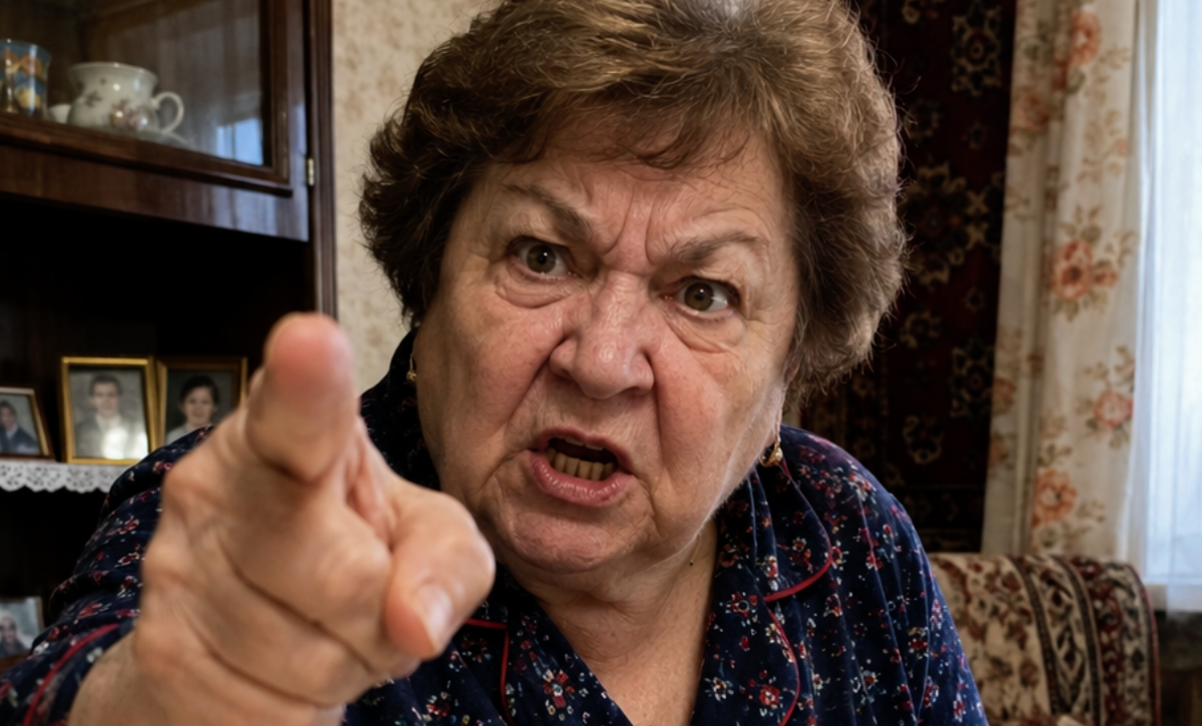
— Mom, can you believe it? Irka kicked me out!
Kostya burst into the entryway of his mother’s apartment without warning, like a meteorite fallen from the sky—loud, disheveled, and filled with cosmic indignation. He dropped his battered old gym bag onto the floor, where it landed with a dull, soft thud of fabric, and walked into the kitchen without taking off his shoes. He was convinced that he had every right to barge in like this, every right to sympathy and a cup of hot tea. He was her son, and sons—especially sons mistreated by cruel wives—were not judged. They were pitied.
Antonina Vasilyevna was sitting at the old kitchen table, which was covered with faded oilcloth patterned with tiny flowers. In front of her, a small pile of buckwheat was scattered across a wooden cutting board. Methodically, with a kind of detached concentration, she was sorting through it, separating the dark, unusable grains from the light, clean ones. Her fingers moved slowly but confidently. She did not flinch at his outburst and did not even raise her head immediately.
— She says I’m a lazy bum, Kostya continued, dropping onto the stool opposite her. He ran a hand theatrically through his hair. — Can you imagine the nerve? A man spends one year—just one year—trying to find himself and going through a creative crisis, and apparently she expects some hard laborer with calloused hands. She’s filing for divorce and threw me out. Like a dog.
He fell silent, waiting for a reaction. He had already pictured the familiar scene in his mind: his mother would throw up her hands, call Irina an ungrateful bitch, rush around putting the kettle on, and begin lamenting over how terribly her poor boy was suffering.
But Antonina Vasilyevna continued her meditative task. The sound of the bad grains being flicked into a small bowl was the only response during the silence that followed. That dry clicking sound began to get on Kostya’s nerves.
— Mom, are you even listening? he finally snapped. — I’ve been thrown out of my home. My own home!
Only then did Antonina Vasilyevna sweep the cleaned buckwheat to one side of the cutting board and the debris to the other. She wiped her palms on her apron and looked up at her son. Her gaze was clear, calm, and completely devoid of the maternal warmth he had been counting on. It was the look of an appraiser examining merchandise of questionable quality.
— What do you mean your wife threw you out, son? Where are you going to live now? And if you’ve decided to move in with me, you’ve made a mistake! I’m not letting you come back home! Go and make peace with Ira!
— Hey… Mom…
— On the other hand… She threw you out. And she was right to do it.
Kostya froze. He stared at his mother, and his brain refused to process what she had just said. He must have misheard her. Perhaps she meant that Ira had thrown him out and that coming here had therefore been the right thing to do. He blinked, trying to reboot reality and return it to its usual course.
— What do you mean she was right? Are you serious? You’re taking her side?
— There are no sides here, son, Antonina Vasilyevna said as she stood and tipped the debris from the cutting board into the trash. Her movements were just as measured and final as before. — There are only facts. And the fact is that my daughter-in-law Irina has been working two jobs for the past year to pay for the apartment and feed a healthy, grown thirty-year-old man who lies on the couch and “tries to find himself.” In her place, I would have thrown you out six months ago. Her patience is something to be admired.
She turned toward the stove to put the pot of buckwheat on to cook, deliberately presenting him with her back.
Kostya remained seated on the stool, but the feeling of firm support beneath him had disappeared. The familiar, cozy world of his mother’s kitchen, which had always been his safe refuge, had suddenly turned into hostile territory. The air grew thick—not with hurt feelings and tears, but with the cold, sober realization that his first and final line of defense had not merely been breached. It had defected to the enemy.
The stupor into which Kostya had fallen felt like a physical blow. The air had been knocked from his lungs, and his familiar world tilted like the deck of a sinking ship. He had expected anything: his mother’s tears, furious tirades against her daughter-in-law, comforting pats on the shoulder.
But life had not prepared him to receive such a precise, cold stab in the back from the one person who, in his opinion, was obligated to be on his side.
— What… What are you talking about? he finally forced out, bewilderment and rising anger mingling in his voice. — Are you my mother or hers? Whose side are you taking?
Antonina Vasilyevna turned toward him. Not a single muscle moved in her face. She leaned back against the countertop and crossed her arms over her chest. The gesture was more eloquent than any words. It was the posture of someone who no longer intended to fuss over him or give in.
— I’m taking the side of common sense, Kostya. Unfortunately, common sense stopped living with you a long time ago and moved in with Irina instead. Or did you think I couldn’t see what was happening? Did you think I never spoke to her?
She paused, allowing her words to sink into the heavy kitchen air, which was already beginning to smell of cooking buckwheat.
— I remember visiting you three weeks ago. Without warning. You were lying on the couch wrapped in a blanket, watching some television series about gangsters. When I asked what you were doing, you told me you were “studying narrative techniques.” An hour later, Ira came home from work carrying two heavy bags. And do you know what the first thing she did was? She didn’t yell at you. She silently put away the groceries, started reheating dinner, and asked whether you had found anything interesting during your “search.”
— She looked as though she hadn’t slept for a week. Her face was gray, and there were dark circles beneath her eyes. And you didn’t even get up to help her.
Every one of her words was like a neat, precise stitch driven through the coarse fabric of his excuses. Kostya felt a deep crimson flush spreading across his face.
— That was different! It was part of the creative process! You women don’t understand anything about that! And anyway, it’s her own fault. She nags me all day long!
— Nags you? Antonina Vasilyevna gave a brief, humorless smile. — She asked you to do just one thing: find a job. Any job. Work as a loader, a janitor, or a courier. Anything, as long as you stopped being a living reproach lying around your own apartment. She wanted to stop feeling like a draft horse carrying the household, the mortgage, and a thirty-year-old “creator” on her back.
— And what did you tell her? That you hadn’t earned a university degree just to deliver pizzas? Well, son, I didn’t raise you so that you could live off a woman either, no matter how educated you might be.
She straightened, and her gaze became as hard as steel.
— So you’ve come to the wrong address. My home is not a transit station for freeloading men or a sanatorium for offended husbands. You have two options. The first is to get off your backside right now, go to your wife, fall at her feet, apologize, and swear that tomorrow you’ll attend any job interview you can find.
— The second is to find yourself a rented bed, a homeless shelter, a railway station—anything. But you will not be living here. Not for a single day. Am I making myself clear?
His mother’s ultimatum hung in the kitchen air, thick and heavy like the smell of cheap tobacco.
Kostya stared at her, and his anger, finding no outlet, began to mutate into something stickier and more pathetic: resentment. He was an actor who had suddenly found himself without an audience, so he instinctively changed tactics. The mask of the offended husband slipped away, replaced by the expression of an unrecognized genius—a sensitive soul crushed beneath the merciless weight of everyday life.
— So that’s how it is, he began in a quiet, cracked voice, allowing his shoulders to slump. — You’re simply going to throw me out onto the street. As if I were a stranger. I wasn’t lying on the couch because I was lazy, Mom. I’m trying to find my path. My calling. Do you have any idea how much pressure that creates?
— We live in a world where everything is measured in money, where everyone expects you to become a cog in the machine. But my soul wants something else! I wasn’t made for offices and factories. That kind of life would kill me.
He buried his head in his hands and stared at the floor. It was his signature performance, rehearsed countless times in front of Irina: the story of a delicate soul that must not be traumatized by routine or meaningless work.
He hoped that this pitiful melody would at least awaken something in his mother’s heart and stir memories of little Kostenka, the boy who had once loved drawing and dreaming.
Antonina Vasilyevna walked over to the stove, removed the pot of fully cooked buckwheat from the heat, and placed it noisily on the neighboring burner. She did not even glance in his direction.
— Your calling is very simple right now, Kostya. It’s called responsibility. Your soul might want something else, but your stomach wants the food Ira buys. Your body wants the roof over your head that Ira pays for. So stop this performance.
— Your calling is to get up and earn a living. Like every normal man.
At that exact moment, just as Kostya opened his mouth to launch into another round of complaints, the doorbell rang sharply and insistently in the hallway.
It was so sudden that Kostya flinched. A foolish hope flickered through his mind. Perhaps it was a neighbor asking for salt. Perhaps someone had come to the wrong floor. Any interruption, any outsider, would have been a rescue at that moment.
Without saying a word, Antonina Vasilyevna wiped her hands on her apron and went to answer the door. Her steps were calm and confident. The ringing had not surprised her.
She had been expecting it.
Kostya heard the lock click. He listened carefully, trying to identify the visitor from the voices, but the hallway remained silent.
A few seconds later, Irina appeared in the kitchen doorway.
She looked exhausted. Beneath her eyes were the same shadows his mother had described, and the corners of her mouth were marked by a permanent crease of fatigue. But she held her back straight, and the gaze she fixed on Kostya was firm and clear.
There was no anger or hysteria in it. There was only a final, irrevocable decision.
She nodded to her mother-in-law, who took her place beside her. That silent nod was a sign of agreement, confirmation of the alliance they had formed.
A chill ran down Kostya’s spine. The kitchen, which only moments before had been a battlefield, had transformed into a courtroom. And he had just realized that the judge and the prosecutor were working together.
— You… he whispered, looking at his mother. — You called her? You arranged all of this?
— We needed to talk. All of us together. We needed to settle everything once and for all, Antonina Vasilyevna replied calmly, placing a hand on her daughter-in-law’s shoulder.
The gesture was a demonstration—a public declaration of which side she had chosen.
Irina stepped forward. She did not raise her voice. Her quiet, even speech cut more painfully than any scream.
— Kostya, I can’t do this anymore. I can’t come home after a twelve-hour shift and find you lying on the couch. I can’t keep listening to your stories about “finding yourself” while knowing that I have to get up at six the next morning to earn enough money for us to live.
— I’m tired of being your mother, your sponsor, and the shoulder you cry on. I’m simply tired. So what I told you this morning wasn’t a fit of hysterics. It was my decision.
She stood beside her mother-in-law.
The two women whom he had always regarded as opposing forces—women he had tried to use and turn against each other—now stood shoulder to shoulder. They formed a solid wall against which all his manipulations and tricks shattered into pieces.
He was alone, completely and irrevocably cornered in that small kitchen that smelled of buckwheat.
The trap had snapped shut.
Kostya looked from one woman’s face to the other. There was nothing in their expressions but calm, cold determination. He was like a wild animal trapped in a cramped cage, and instinct showed him the only remaining way out: attack.
Pity, manipulation, and resentment were swept away by a wave of pure, helpless rage.
— Oh, so that’s what this is! he shouted, leaping up from the stool, which flew backward and struck the wall with a crash. — You conspired against me! The two of you decided to finish me off together?
— And you’re a fine mother! You take your daughter-in-law under your wing and kick your own son out! What did she promise you? Are you going to leave our apartment to her after we get divorced? Have you found yourself a new little daughter?
He jabbed a finger toward Irina. She did not even flinch and continued standing there like a statue carved from exhaustion.
— And you! You came running to my mommy to complain? You didn’t have enough brains to deal with me yourself, so you decided to find an ally? Do you think I don’t understand what this performance is about? You both simply want to get rid of me so you can live in peace!
He kept shifting his gaze from one to the other, trying to find a crack in their alliance, even the slightest hint of doubt. But their faces remained unreadable.
That infuriated him even more. He received no reaction. His words disappeared into empty space, inspiring neither fear nor retaliatory anger. He stood at the center of the stage, but his performance moved no one.
— Why are you silent? he practically screamed. — Have you got nothing to say? Of course not! My very existence has ruined everything for you! I’m a living reproach! One person needs creativity, but everyone else only cares about money, money, money!
— Two accountants, two narrow-minded philistines! You’ve certainly found each other!
At that moment, Antonina Vasilyevna stepped forward.
She looked at her screaming, red-faced son as though she were seeing him for the first time. There was no anger or pity in her gaze. There was only the cold, detached curiosity of a pathologist examining an interesting specimen.
She tilted her head ironically, and her voice sounded surprisingly loud against Kostya’s deafening tirade.
— Oh, poor little thing! Poor, miserable baby! Nobody loves him! Nobody appreciates him! And what exactly are we supposed to appreciate you for? For being an educated freeloader?
She delivered the words he had intended to use in his own pitiful story with such caustic, devastating mockery that Kostya choked on the air.
Saying it here, now, in Irina’s presence, was more than rejection. It was a public execution. She had transformed his tragedy into a pathetic, shabby farce.
He fell silent and stared at his mother in shock. He had expected anything except such a cynical blow to the stomach.
Without giving him time to recover, Antonina Vasilyevna turned and silently walked into the hallway. Kostya and Irina were left alone in the kitchen, but it no longer mattered. The duel was over.
A few seconds later, his mother returned. She did not look at her son.
She walked to the front door, opened it wide, and placed his gym bag—which had been lying abandoned on the floor the entire time—out on the landing. Then she straightened and looked at Kostya.
— Ira will give you the rest of your things sometime later. If she feels like it. Now leave.
She stood in the doorway beside Irina, who was still silently watching everything unfold.
His mother wrapped an arm around her daughter-in-law’s shoulders and pulled her close. The gesture was the final nail in the coffin of his old life.
The two women he had spent years turning against each other now stood as one, like a fortress from which he had just been permanently expelled.
Kostya looked at them—his mother and his wife—and understood that he had not merely lost a battle.
He had lost everything.
Unable to find any more words, he silently walked past them and crossed the threshold of his own mother’s apartment like a stranger.
The door closed behind him.
It did not slam.
There was only the soft, final click of the lock, cutting him off from everything he had once believed belonged to him…