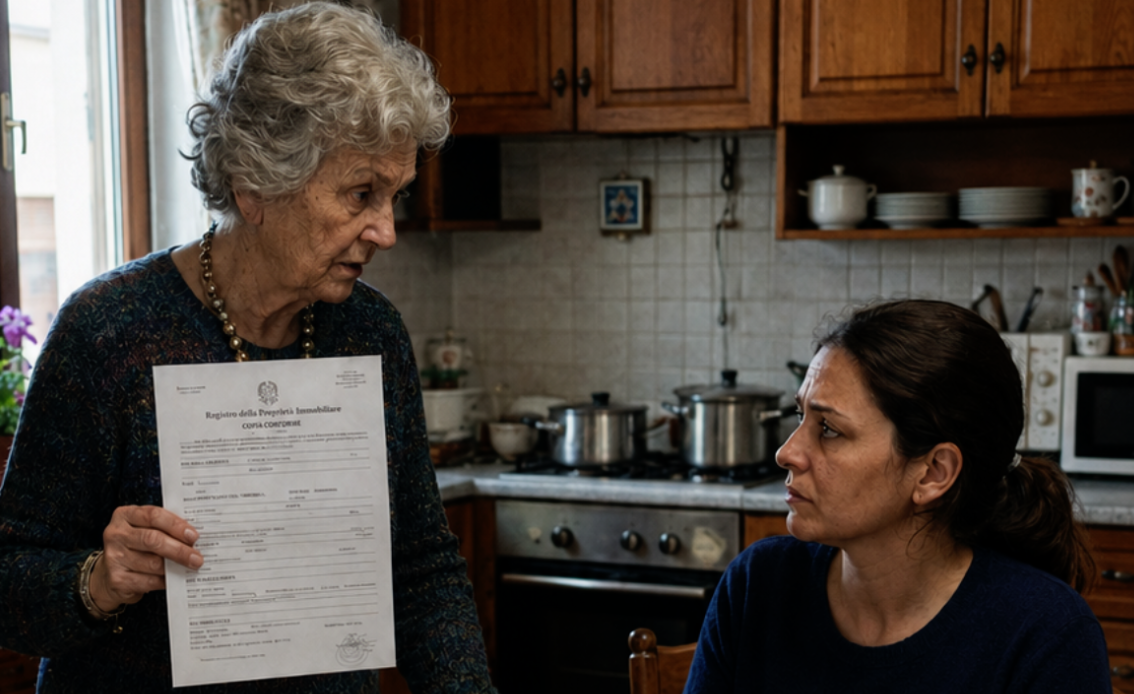
— “You got a bonus, didn’t you? I’ve already decided what to spend it on,” the mother-in-law announced.
— “Here, I’ve written everything down. Two hundred thousand for Tanya toward a car, another fifty thousand for the children’s activities and school clothes. One hundred thousand to repair the roof at my country house—it’s leaking terribly. And whatever is left, you can use for current expenses.”
Lyudmila Sergeyevna placed a sheet covered in writing in front of her daughter-in-law and smiled with satisfaction—the way people smile when they are certain they have done something good and right. Alina quickly scanned the list. The figures were arranged in neat columns, with someone’s name written next to each amount. She did not find her own. Slowly, she raised her head.
— “Excuse me, but where are we on this list?”
Her mother-in-law blinked in surprise, as though the absurdity of the question had caught her completely off guard.
Family law
— “And what do you need anything for?”
Outside the window, the April rain rustled.
Alina and Matvey had been married for seven years. They had met back in college, dated for a long time, and officially married as soon as Matvey got a permanent position at the factory.
— “Now everything is serious,” he had said then, squeezing her hand. “We’re going to build a normal life together.”
They bought an apartment with a mortgage—a small two-room place on the outskirts, with low ceilings and a view of the neighboring roof. But at least it was theirs. They always had just enough money for the essentials: the mortgage payment, groceries, and utilities. Every year, vacations were postponed until later, the bathroom renovation had already been put off for three years, and the old Lada parked in the yard was barely hanging on. — “One more year, and we’ll definitely replace it,” Matvey kept saying, though Alina no longer really believed him. That spring, everything changed. Matvey was put in charge of a difficult project at the factory—the modernization of one of the production workshops. He worked without days off, came home late, and collapsed into bed barely taking off his clothes. Alina never complained. She understood that it was important.
The project was completed three weeks ahead of schedule. Management was pleased and promised the entire team a substantial bonus.
When the money arrived in his account, Matvey called Alina directly from work.
— “It came through,” he said, and she heard something almost childlike in his voice, a kind of bewildered happiness. “Four hundred thousand.”
That evening they sat in the kitchen and did the calculations. They decided to pay off part of the mortgage early and finally renovate the bathroom. Alina opened a folder on the computer filled with pictures—tiles, faucets, shelves.
— “I want these tiles,” she said, pointing at the screen.
— “You’ll get your tiles,” Matvey promised.
The next day, he went to visit his mother. On the way, with his usual innocent openness, he told her about the bonus. He had never been good at keeping good news to himself. At first, Alina did not think much of it. So her mother-in-law had found out and told Tanya—so what? They were family, after all.
But then it began.
Tanya started calling almost every day. There was something distinctive about her voice—a little tired, a little plaintive, with a barely noticeable suggestion that life had treated her unfairly.
— “Alina, you have no idea how exhausted I am,” she would say. “Alone with two children, working, and now the car has broken down again. It stalled right at a traffic light, can you imagine?”
Residential property rental
— “I’m sorry,” Alina would answer.
— “I’ve been dreaming of buying a decent car for three years. But you understand—there’s no money.”
After calls like that, Alina would sit for a long time with the phone still in her hand.
Lyudmila Sergeyevna did not stay silent either. She called Matvey and spoke at length about how difficult things were for Tanya, how the children were growing up without a father, and how unfair life was. Matvey listened and responded with vague murmurs.
— “Matvey,” Alina said one evening, “do you notice what’s happening?”
— “What’s happening?” He did not take his eyes off the television. “Nobody’s asking for anything. They’re just talking.”
Law
— “This isn’t just talking.”
But he had already changed the channel.
A week later, Lyudmila Sergeyevna called herself and announced that she would come over on Sunday to discuss an important family matter.
On Sunday, her mother-in-law arrived exactly at noon—with a large bag in which something clinked and a cardboard folder tucked under her arm. She walked into the kitchen, placed a homemade pie and the folder on the table, and sat down like the chairperson of a meeting.
Currencies and currency exchange
— “I’ve thought everything through,” she began in a businesslike tone. “It’s a large amount of money, so it needs to be distributed properly.”
Matvey exchanged a glance with Alina. Alina said nothing.
— “Tanya needs help first,” Lyudmila Sergeyevna continued, opening the folder. “She’s alone, the children are small. She should have replaced the car long ago, and the children need new clothes. And my roof at the country house—you know about that.”
She spoke confidently, like someone who had already made every decision and had come only to announce it. Not to discuss it—to announce it.
Alina listened and felt something heavy and cold rising inside her.
Bathroom
— “Lyudmila Sergeyevna,” she finally said, trying to keep her voice level. “What about our mortgage? We planned to make an early payment. And renovate the bathroom—there’s already mold in the corners.”
Her mother-in-law looked at her with mild irritation, as people look at someone who has raised an irrelevant issue.
— “You’re young. You’ll earn more,” she said simply. “Things are harder for us right now.”
Matvey remained silent, staring at the table.
— “A brother should help his sister and his mother,” Lyudmila Sergeyevna added firmly. “It’s his duty.”
Alina slowly lowered her eyes to the written list. Other people’s names. Other people’s needs. And somewhere at the very bottom, the vague phrase: “the remainder for family expenses.”
She looked up at her husband.
He was still silent.
— “Tanya has always lived like this,” Alina said, her voice even, almost calm. “For ten years now.”
Pregnancy and motherhood
— “What do you mean?” Lyudmila Sergeyevna asked warily.
— “Exactly what I said. Who bought Tanya her first car? You and Matvey. The down payment on her apartment—remember? The entire family contributed to that too. And I’m not even going to mention the debts from three years ago.”
— “She was in a difficult situation!”
— “She’s always in a difficult situation,” Alina replied quietly. “Because she knows someone will always come and rescue her.”
— “You’re simply greedy,” her mother-in-law snapped, pursing her lips. “You only care about yourselves.”
Alina stood up, went into the hallway, and returned with a notebook. She placed it on the table, opened it to the right page, and silently pushed it toward Matvey.
He stared at it for a long time.
There were dates, amounts, and short notes. Everything neatly arranged in columns.
Over seven years, the total had exceeded eight hundred thousand rubles.
Matvey slowly raised his eyes to his mother.
— “Mom,” he said hoarsely, “I didn’t know it was that much.”
Lyudmila Sergeyevna reached for the notebook, but Alina gently covered it with her hand.
Family
The kitchen became very quiet.
Only the faucet dripped. They had been meaning to repair it for a long time, but kept putting it off. Lyudmila Sergeyevna left without saying a word, forgetting the folder with the documents on the table.
That evening, Matvey sat in the kitchen for a long time, flipping through Alina’s notebook. She did not rush him. She simply poured some tea and sat beside him.
— “Why didn’t you say anything all these years?” he finally asked.
— “You wouldn’t have listened before.”
He did not argue.
The next day, Matvey called his mother himself.
— “Mom, I love you,” he said. “But Alina and I earned this money ourselves. And we’ll decide ourselves what to do with it. Tanya will get what we can give her: my time and my support. Not money.”
Lyudmila Sergeyevna hung up without answering.
Tanya called almost every day. She said her brother had become a stranger, that Alina had turned him against the family, that the children were suffering.
Matvey listened without interrupting, but he did not give in.
Family law
— “I love your children,” he repeated. “But solving your financial problems isn’t my job.”
At the end of April, the couple submitted a request for an early partial mortgage repayment. They set aside the remaining amount for renovations.
Alina once again took out her folder of clippings—tiles, faucets, shelves.
— “I want these tiles,” she said.
— “You’ll get your tiles,” Matvey replied.
Time passed.
The bathroom finally gleamed with new tiles. Their mortgage debt had noticeably decreased. In the evenings, Alina sometimes opened the banking app and looked at the numbers with quiet, almost embarrassed satisfaction.
At first, Tanya continued complaining to anyone willing to listen. But gradually, when it became clear that her brother was not going to change his decision, she found a second job as an administrator at a fitness club.
She called less often now.
And she spoke differently.
Without the familiar dramatic strain in her voice.
Lyudmila Sergeyevna came over for holidays, drank tea, and praised the pie Alina had baked. She no longer brought up money. Once, she tried to hint at it indirectly, but Matvey gently interrupted her:
Garden and lawn maintenance
— “Mom, Alina and I will decide for ourselves how to spend the money we earn.”
He said it without anger, almost tenderly. The way people say something that was decided long ago and no longer requires explanation.
His mother pursed her lips, nodded, and changed the subject to the weather.
At that moment, Alina was pouring tea and thinking that silence could be different too.
One kind weighs heavily on you.
Another is simply silence.