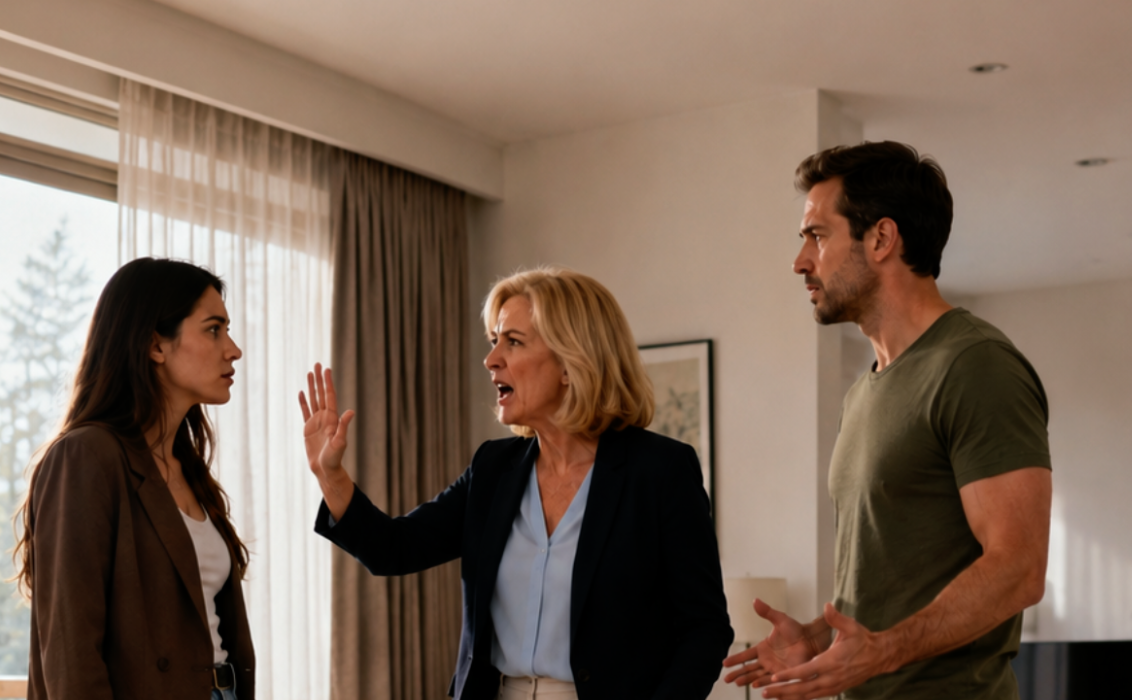
“Don’t you dare humiliate her!” — For the first time in her life, my mother-in-law stood between us
Svetlana stood at the stove, silently stirring the soup. Steam from the pot hit her face, and her eyes stung from more than just the onions. She was no longer even listening to exactly what her husband was saying—the familiar tone, the familiar intonation: irritation, dissatisfaction, reproach. Lately, Vadim seemed to be looking for any excuse at all to criticize her.
“I asked you not to put potatoes in it!” His voice cut through the kitchen like a shout in the silence. “They make my stomach feel heavy!”
“There are only a couple of pieces,” Svetlana said calmly without turning around.
“I don’t give a damn how many there are! I asked you! Is that so difficult for you?”
She bit her lip. Whatever she did, it was wrong. Absolutely everything. The wrong food, the wrong words, the wrong way of walking, the wrong look.
Vadim had once been different. Smiling, attentive, slightly shy. Five years ago, she had fallen in love with him like a schoolgirl. He knew how to say beautiful things, knew how to listen, brought her coffee in bed. And then—it was as if someone had switched off the light.
The first warning sign had been when she quit her job at his request.
“Why do you need all that accounting work? I’ll provide for you. I’d rather have you taking care of the kitchen and the house. You want children, don’t you? Then focus on the family.”
At the time, Svetlana thought perhaps he was right. She would take a break and return to work later.
She never did.
And after that, everything began to unravel.
Her mother-in-law, Tamara Petrovna, lived in another city. She visited rarely and remained reserved and neutral. Svetlana felt no particular warmth toward her, but she had nothing to complain about either—the woman didn’t interfere, didn’t impose herself, and rarely called. Her son was her pride, and she often repeated:
“The important thing is that Vadim is happy. Then there will be order in the family.”
And now Vadim was so thoroughly “happy” with everything that Svetlana woke up anxious and went to bed feeling guilty.
“Well?” he demanded. “Are you going to remake the soup, or do I have to cook something for myself?”
“Do whatever you want,” she replied quietly.
“Have you completely lost your mind?”
He suddenly moved toward her, and at that moment the front door slammed in the hallway.
“Mom!” Vadim exclaimed in surprise. “What are you doing here?”
Svetlana flinched. She hadn’t even known Tamara Petrovna was planning to visit. A wave of shame immediately washed over her. What would she hear now?
“Lazy wife.”
“Can’t even feed her husband.”
“Completely spoiled.”
But when Tamara Petrovna saw her daughter-in-law’s face, she stopped, put her bag down by the entrance, and looked carefully at her son. Then she glanced toward the stove.
“I stopped by on my way. There’s an anniversary celebration at our school, and they invited the former teachers. So I decided to spend the night with you. You don’t mind, do you?”
Vadim froze. He wasn’t happy about the visit, but he didn’t want to argue with his mother either.
“Well, if you’d called beforehand…”
“I deliberately didn’t,” she said with a gentle smile. “I wanted to see you in your natural environment. And now I have.”
Svetlana wanted to say something, to explain herself, but her mother-in-law raised a hand.
“No need to say anything. I’ll go wash my hands. And you, Vadim, calm down. You and I will talk this evening.”
Vadim silently left the kitchen, slamming the bedroom door behind him.
Svetlana stood rooted to the spot.
For the first time in many months, someone had been there when the truth was happening—not the pretty picture, not the smiles they showed in public, but this: her real, suppressed life.
That evening, Tamara Petrovna sat in the kitchen drinking tea. Svetlana cleared away the dishes, feeling her anxiety growing inside her. Vadim had gone out with friends without even saying goodbye.
“Does he often yell at you?” Tamara Petrovna suddenly asked without looking at her.
Svetlana froze, holding a plate against her chest.
“Sometimes…”
“No. Often. I saw the way he looked at you. That isn’t irritation. It’s a habit of controlling and suppressing someone.”
Svetlana lowered herself onto a stool. Her hands began to tremble.
“I don’t know what to do… I can’t leave. I have nowhere to go.”
“Everyone has somewhere to go. The question is when.” Tamara Petrovna took a sip of tea. “All my life, I tried to stay out of things. Not interfere. I thought that if my son was happy, that was enough. But he isn’t happy. He’s become like his father.”
Svetlana looked at her mother-in-law in surprise. She had never heard her speak about her husband before.
“His father never hit me, but he destroyed me emotionally. He extinguished me. Wore me down. Eventually, there was nothing left in my eyes. I lived with him for twenty years—for the sake of our child. And then, when Vadim left to study, I left too. For the first time, I could breathe.”
Svetlana listened as though she herself were finally breathing again.
“Do you know what the worst part is?” her mother-in-law continued. “I stayed silent. And now I can see that my son has become exactly like him. I won’t stay silent anymore.”
That night Svetlana barely slept.
She remembered every moment when she had endured, swallowed humiliation, and made excuses for Vadim in her own mind. Everything seemed to have lasted too long, to have become too thick and suffocating, as though she were drowning in her own thoughts.
But in the morning, for the first time in a long while, she woke with the thought that she wasn’t alone.
Someone had seen.
And hadn’t turned away.
Tamara Petrovna was already in the kitchen. Neat and composed in a light robe, her hair carefully styled, she was stirring oatmeal in a saucepan and calmly looking over the stove.
When she saw her daughter-in-law, she nodded.
“Good morning. You didn’t sleep well.”
“It happens.” Svetlana smiled awkwardly. “I’ll make something now.”
“It’s already ready. Have breakfast.”
Sveta suddenly felt like a guest in her own home. But there wasn’t a trace of discomfort—only mild amazement. The gentleness and care coming from this woman, who had always seemed so strict and distant, seemed to cut through something inside her.
“Thank you…” she said quietly as she sat down at the table.
“I’m going to talk to him. But you need to understand something: you shouldn’t live somewhere if every day feels like a fight for survival,” her mother-in-law said, sitting opposite her. “I’m not telling you to get divorced, don’t misunderstand me. But you must stop being a silent victim.”
Svetlana said nothing, absorbing every word.
Vadim returned after lunch, hungover and irritated. Muttering something about the noise in the stairwell, he threw his jacket over a chair, opened the refrigerator, and grumbled loudly:
“Where’s the food?”
“In the pot,” Sveta answered calmly. “Heat it up.”
He shot her a displeased look, but when he noticed his mother behind her, he stopped himself.
“Oh, Mom. You’re still here?”
“Did you think I’d run away?” Tamara Petrovna replied calmly. “I’m staying for a couple of days. I want to see how you two live.”
Vadim looked at Sveta the way he usually did—with a challenge in his eyes.
But this time, she didn’t lower her gaze.
She simply moved slightly away from the table and stood up.
“I’m going for a walk. I need some fresh air.”
“And who’s going to wash the dishes?”
“You are.”
He opened his mouth to say something, but his mother suddenly rose from the table.
“Don’t you dare humiliate her!” Tamara Petrovna’s voice wasn’t loud, but it was cold as steel. “I see everything, Vadim. And I’m not going to stay silent anymore.”
He straightened as though he had been struck.
“Mom, you don’t understand. This is between us. You’re interfering where you shouldn’t…”
“You’re living exactly like your father did. Complaints, accusations, and the belief that everyone owes you something. She owes you nothing. She’s your wife, not your servant.”
“What, do I hit her or something?”
“You don’t have to hit someone to destroy them from the inside,” his mother replied firmly. “I stayed silent once. You remember perfectly well how I lived with your father. Well, I’m not going to make the same mistake again.”
Svetlana stood in the hallway, unable to move.
It was as though she had frozen.
She heard every word and couldn’t believe those words were being spoken in her defense.
“Mom, you used to say yourself that the main thing was for me to be happy…”
“I was wrong. If you’re happy while the person beside you is slowly fading away, that isn’t happiness. It’s a tragedy.”
This time Vadim said nothing.
He didn’t snort, grumble, or wave her off.
He simply sat down and stared at one spot.
Svetlana quietly stepped out onto the landing. The air burned her cheeks—not because of the cold, but because of the strange feeling of relief.
Something had finally shifted.
That evening, Tamara Petrovna came into her room and placed a small stack of banknotes on the bedside table.
“It isn’t much, but it’ll be enough at first. Take it. I’m serious. If you decide to leave, I’ll help you.”
“You… really…” Sveta could barely breathe from emotion. “I didn’t ask…”
“But you thought about it,” the woman said with a gentle smile. “I was blind. Now I want to be there for you. For your sake. And for my future grandchildren, if you ever have them. But not in a family like this. Not under these conditions.”
Svetlana pressed a handkerchief to her lips, closed her eyes, and began to cry.
Not from resentment.
Not from pain.
From relief.
For the first time in her life, there was an adult beside her who had seen, understood…and taken her side.
“Don’t rush your decision,” Tamara Petrovna said quietly, stroking her shoulder. “Just remember: you’re no longer alone. If the moment ever comes, call me. Don’t hesitate. Even if it’s the middle of the night.”
Sveta only nodded, unable to say a word.
She had carried this silence inside herself for years.
Now someone had finally heard it.
And that alone was enough for her to straighten her shoulders inside.
Three days later, her mother-in-law left. Before departing, she hugged Svetlana tightly and, surprising even herself, whispered:
“Take care of yourself. If you don’t, no one else will.”
Vadim had spent those days looking gloomy. He didn’t argue with his mother, but he didn’t approach Svetlana either.
No explanations.
No apologies.
It was as though he were simply lying low.
On the fourth day, something finally erupted.
“All right!” he began loudly as soon as he came through the door. “Enough! Am I the husband here or not? How long is this going to continue?”
Svetlana came out of the room and calmly stood by the wall.
She didn’t look at him the way she used to—from below, guiltily.
She looked directly at him.
Straight into his eyes.
“What exactly is supposed to stop?”
“You’ve become… different. You answer back. You argue. You walk around as if you’re the one in charge here instead of both of us. Is this all because of Mom?”
“No. Because of you.” She paused. “Or rather, because of the way you’ve treated me all these years.”
“Oh, of course.” He twisted his face. “So I’m the monster, and you’re the poor victim. I fed you, clothed you, supported you. Where’s the gratitude?”
Svetlana remained silent.
He expected her to react the way she always had—to flare up, make excuses, become uncertain.
But she simply stood there, stubborn and restrained.
And that only made him angrier.
“Aha, so this is the real you. You got a little support and suddenly grew bold. You think because my mother said a couple of nice things to you, you’re some kind of star now?”
“No,” Sveta replied. “I simply remember who I am now. And I won’t let you trample me again.”
He exhaled irritably.
“You really think I humiliate you?”
“I know you do. You’ve done it for years. And if you can’t see that, that isn’t my problem.”
“Who are you without me?!” he exploded. “Nobody! You were a gray little mouse, and that’s all you’ll ever be!”
Svetlana didn’t flinch.
She stood calmly.
Not because the words didn’t hurt.
But because she was no longer afraid of the pain.
Pain had become an old acquaintance—not frightening anymore, only predictable.
“If I’m such a ‘nobody,’ why are you losing control? Are you afraid that ‘nobody’ will leave and you’ll be alone?”
“Leave? Where are you going to go?”
“I don’t have to answer that right now. But remember this: if I leave, I won’t call you asking to come back. And you won’t know where I am.”
Vadim swore, slammed the bedroom door, and disappeared inside for several hours.
The next day, he was restrained, almost polite.
He washed the dishes, suggested going shopping, and even bought her a chocolate bar.
Svetlana picked it up, looked at it, and placed it back on the table.
She didn’t turn away.
She didn’t make a scene.
She simply refused to accept a gesture that contained no remorse—only fear of losing control.
He understood.
And it seemed he also understood that his old methods no longer worked.
So new ones began.
Subtler ones.
“You’re not perfect either, Sveta. How many times did I come home from work and dinner was cold? Or you were always on your phone. I put up with it.”
“You didn’t put up with anything. You considered yourself superior to me.”
He smirked.
“You’ve just got some kind of obsession. A woman thing. Mom spoiled you. She supported you, and now you imagine you’re something special.”
“No,” Svetlana replied gently. “For the first time, I simply believed that I have a right to be respected.”
He snorted and walked away.
A week later, Sveta opened her laptop and went to a job-search website.
She hadn’t updated her profile in years, but now she did.
She checked the box:
“Ready to return to work.”
She filled in the expected salary field.
She honestly listed what she knew how to do.
The interview was the very next day.
It was a small company with a cozy office and a polite director. She was nervous, her hands trembled, but her voice remained steady.
Nine years of experience was no small thing.
Two days later, they called.
She got the job.
She came home carrying the documents and announced:
“I start work on Monday.”
“What?!” Vadim went pale. “Why? I already provide for you!”
“I don’t want to be dependent anymore.”
He sat down as though he had been struck.
“This is all because of her. Because of Mom. She filled your head with this.”
“No, Vadim. She didn’t fill my head with anything. She opened my eyes.”
He slowly stood up, as though struggling with himself.
“Have you really decided everything? Is this the end?”
“No,” Svetlana said. “It’s a comma. But only if you listen to me. If you don’t—then it becomes a period.”
He went out onto the balcony and smoked for a long time.
And she sat in the room, thinking for the first time in years not about what she was afraid of, but about what she wanted.
And she knew:
Everything was only beginning.
Work became a breath of fresh air for her.
The office was modest but cozy, her colleagues were friendly, and her boss was polite and reserved. Nobody shouted at her, mocked her, or demanded that she account for every last penny.
There she began to feel useful again.
Her mind quickly returned to its working rhythm, and her fingers remembered how to handle numbers, software, and reports.
Svetlana seemed to blossom more with every passing day.
She received her first money just two weeks later—an advance payment.
And instead of giving it all to Vadim as she would have done before, she bought something for herself: hand cream and a new warm coat, modest but beautiful.
When she brought the shopping bags home, Vadim stood in the doorway looking puzzled.
“You bought all that?”
“Yes.”
“With your own money?”
“Yes.”
He pressed his lips together.
“You could have asked first. We’re a family.”
“A family is about support, not control,” she replied quietly and walked past him.
He remained silent.
But that evening, he approached her anyway.
“I probably went too far sometimes. We argued, yes… But I tried. We had good moments too.”
“We did,” Svetlana nodded. “But you didn’t notice how much worse I was feeling. I tried to tell you, and you treated it like I was being difficult.”
“Maybe we could start over? Now that you’re working, perhaps I could think about behaving differently too…”
Svetlana looked at him for a long time.
He seemed confused and uncertain—not at all like the man who had once commanded everything in their home.
But he also wasn’t the man she wanted to continue her life with.
“Vadim, I don’t want to start over. I want something different. No fear. No humiliation. Respect. And if you’re truly ready to change, start with yourself. No promises. No conditions.”
He sighed heavily, as though only now realizing how much had already been lost.
“It’s… difficult for me to accept.”
“And it was difficult for me to live when every day felt like an exam.”
Tamara Petrovna called often.
She didn’t only ask about her son anymore. She asked specifically about Svetlana.
“How are you feeling?”
“How’s work?”
“Is your coat warm enough?”
“What’s new?”
Sometimes Svetlana caught herself smiling into the phone.
One day, her mother-in-law called and said:
“I found a small foundation that helps women who’ve been through a difficult period. Maybe you could go there? They have a good psychologist. Just to talk.”
Sveta agreed.
Not immediately.
She had doubts.
But she went.
And talking to a stranger became a revelation: someone who didn’t know her personally simply listened without interrupting.
They didn’t give unsolicited advice.
They didn’t blame her.
They didn’t shift responsibility onto her.
They simply listened.
And that helped more than anything.
In the spring, Svetlana rented a room of her own.
It was small but cozy, with windows overlooking a park.
Vadim still hoped it was temporary.
He called.
He texted.
He came to see her.
Once, he even brought flowers.
But Sveta was no longer searching for what they used to have.
She had found something new:
Respect for herself.
She didn’t rush to file for divorce.
She simply lived separately.
She worked.
She paid her own electricity and water bills.
She didn’t beg anyone for permission.
She didn’t explain herself.
She didn’t justify herself.
A month later, she filed for divorce.
Calmly.
Without a scandal.
Just a document—as final as a period at the end of a sentence.
Not revenge. Not anger. Not hysteria. A decision.
Vadim refused to believe it until the very end.
He came on the day she was collecting the rest of her belongings, sat down on a stool in the kitchen, and said:
“Are you really leaving?”
“I’ve already left.”
“I thought… you’d come to your senses.”
“I thought you’d change. But for too long, you believed I owed you everything. I don’t owe anyone anything anymore.”
He nodded.
Not angrily.
He genuinely looked lost.
Then he quietly added:
“Mom was right. I became just like Dad.”
“But you still have a chance to become different. If you want to.”
Svetlana moved out permanently in the summer.
She received a promotion at work and was now responsible for an entire area of the business.
Her boss told her:
“You know how to maintain balance. That’s rare.”
She simply smiled because she knew exactly what it had cost her to learn that skill.
Tamara Petrovna came to visit.
She brought treats, discussed the news with Sveta, watched movies with her, and left with a gentle smile.
“I’m proud of you,” she said one day as she was leaving. “I used to think you were too soft. It turns out you’re stronger than all of us put together.”
Svetlana hugged her and whispered:
“Thank you for standing between us that day. It changed everything.”
Now Svetlana had the most important thing in her life:
Respect.
For herself.
And for the people around her.
Everything else would follow.
And no voice would ever make her doubt herself again.