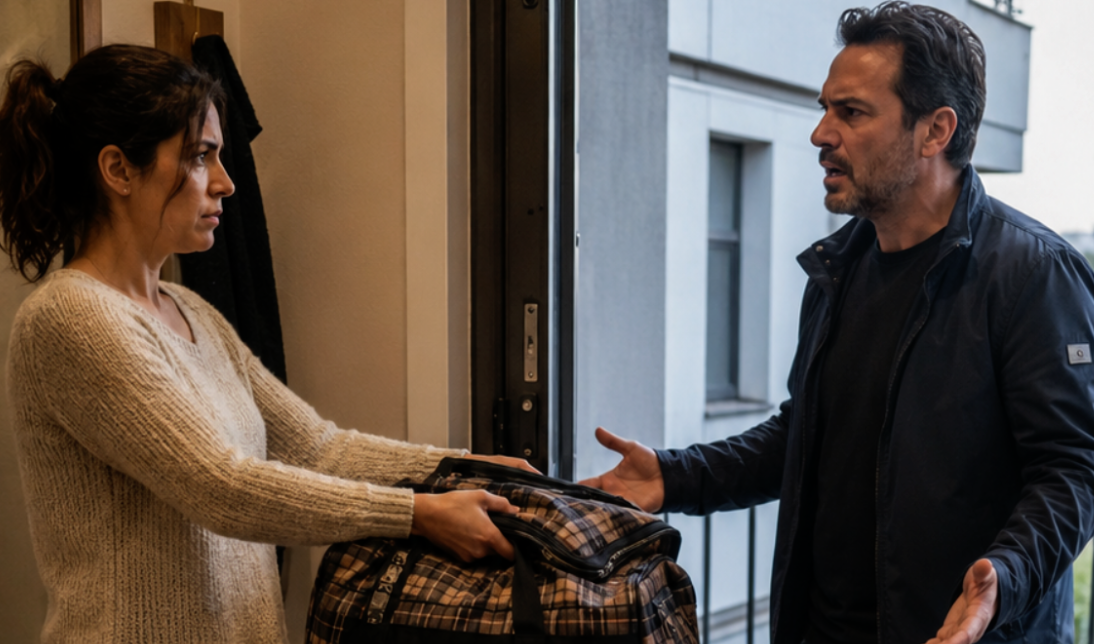
I was handing my six-year-old son, Vanya, over to his father. This was not a temporary weekend arrangement—it was for good. There was no bureaucratic paperwork required for such an act. You cannot legally draft a formal relinquishment of your child; such a document simply doesn’t exist. I merely packed a plaid bag.
“Olya, how much longer are you going to be?” Seryozha asked, standing in the doorway in his street shoes, not even bothering to take them off. “Mom’s waiting in the car.”
“Just a second. His medical records are in the side pocket. His slippers are in the bag—I labeled them,” I replied calmly.
Vanya walked out of his room in his socks, carrying a backpack slung over one shoulder. He was only six, yet he had packed it and zipped it shut all by himself.
“Mom, what time are you coming to pick me up?” he asked.
I crouched down to his eye level and gently straightened his collar. “I’m not coming, Vanya. You’re going to live with Dad now.”
Our neighbor lingered on the landing with a bucket, clearly watching the spectacle. Let her watch. Seryozha picked up the bag, staring at me. He was waiting for the breakdown—for me to grab the boy, burst into hysterical tears, and scream. Instead, I simply opened the door wider.
It was May 14th, but the true beginning of this moment traced back to the autumn, to a pair of outgrown boots. In September, Vanya outgrew his winter boots. His toes were painfully pressing against the front, but he never complained. I only noticed when he struggled to pull them off at kindergarten. That evening, I told my husband we needed to buy new ones.
“He’ll wear them until spring,” Seryozha dismissed, not even looking up from his dinner. “Kids’ feet grow. You can’t keep buying new shoes every five minutes.”
I hadn’t held my own salary in six years; it went straight into his wallet. He controlled our finances completely, leaving a meager allowance under a magnet on the fridge and demanding receipts for basic necessities. I worked at the front desk of a dry cleaner—a job he mockingly called my “sitting-around job.”
While he refused to buy our son boots, he happily spent money on himself. A week later, he went to a recreation lodge, bought four brand-new tires for his car just to show off to the neighbors, and purchased a new fishing rod he left brazenly on the kitchen table.
I had never raised my voice at him in six years. Maybe that was the problem. I went to my manager and demanded every available Saturday shift. I bought Vanya’s boots myself with my extra earnings. I bought them two sizes too big so they would last for two winters, and Vanya shuffled around in them like boats. In response, Seryozha completely stopped leaving my allowance under the magnet.
The breaking point arrived on New Year’s Eve at my mother-in-law, Anna Vasilyevna’s, house. Extravagant gifts were exchanged, but I received nothing. When Masha, his sister, asked why, he laughed, “What am I supposed to do, give presents to myself?” The room chuckled. His mother coldly added that I was “hopeless” and would be begging on the streets without him.
“I’m not hopeless,” I said, placing my cup down. “I’m inconvenient.”
I dressed Vanya and left. By January, I had secretly rerouted my salary to a private bank account. By February, I officially filed for divorce. Realizing a divorce meant I was entitled to half our apartment, Seryozha retaliated by filing for full custody, aiming to reduce me to weekend visits.
The legal battle began. In court, Seryozha spoke eloquently, claiming I kept Vanya in rags and oversized boots while he provided everything. But my lawyer and I were ready. We presented eighteen months of his bank statements. I read them aloud to the judge: hundreds of thousands spent on jewelry and electronics for other people, while claiming poverty when his son needed winter boots. Our divorce was finalized that day, but the custody decision was delayed until June.
Shortly after, Masha caught me outside. She confessed that their mother had promised to sign over her two-room apartment to Seryozha—but only on the strict condition that he won custody of Vanya.
On May 14th, Seryozha and his mother showed up unannounced. He delivered an ultimatum: sign away my half of our apartment and waive child support, and he would drop the custody suit. He threatened to drag the battle out for months, forcing me to live in constant, agonizing fear of losing my son. Anna Vasilyevna even pulled out Vanya’s oversized, battered boots, threatening to use them against me in court.
He didn’t want Vanya because he loved him; he wanted him to keep his hands securely around my throat.
So, I pulled down the plaid bag. I packed Vanya’s clothes, his throat medicine, his slippers.
“Take him,” I told them. “For good. Don’t withdraw your petition. Let it stay in court. But in June, you go to the hearing yourself. You let child services inspect your home. You raise him.”
They were stunned. My mother-in-law called me a heartless suitcase-packer, but Seryozha admitted the truth: he was doing it for his mother’s apartment.
When I called my lawyer, his calm response was terrifying. He warned me I had just handed Seryozha the ultimate advantage: an established living arrangement.
I lay in Vanya’s empty bed that night. The gamble was set, and the only thing left to count was the days. Seryozha’s involvement was short-lived. He quickly dumped Vanya at his mother’s house, claiming he needed time to sort out his schedule. By early June, Anna Vasilyevna was exhausted. She called, demanding I take Vanya for the weekend.
“I’m not lending him to you,” I refused firmly. “I’ll take him back permanently or not at all.”
I suffered through every evening phone call, breaking when Vanya quietly asked if I would visit. I could have retrieved him with the police at any moment. But I held my ground. I had bet that Seryozha and his mother would break before I did.
On June 20th, Anna Vasilyevna arrived in a taxi. Vanya stood on the landing holding his plaid bag. Seryozha had left for a two-month work rotation up north with nothing but a text message. Disgusted, she had canceled the apartment transfer. She left without apologizing, and I finally brought my son inside, collapsing on the floor in relief.
Seryozha missed every subsequent court date. I won full custody and my half of the apartment by default.
Today, Vanya is thirteen. I am a senior receptionist with a mortgage. Seryozha rarely pays child support.
When a neighbor asked if she should call her husband’s bluff by handing over her child, I stopped her. “Don’t you dare,” I said. “Fight with documents, not a gamble.”
I had risked my child’s heart because my own strength was gone. In the hallway today sit Vanya’s sneakers. Size forty-one. Exactly his size. I don’t buy them with room to grow anymore.
How does this pacing and structure feel for capturing the emotional weight of the story?