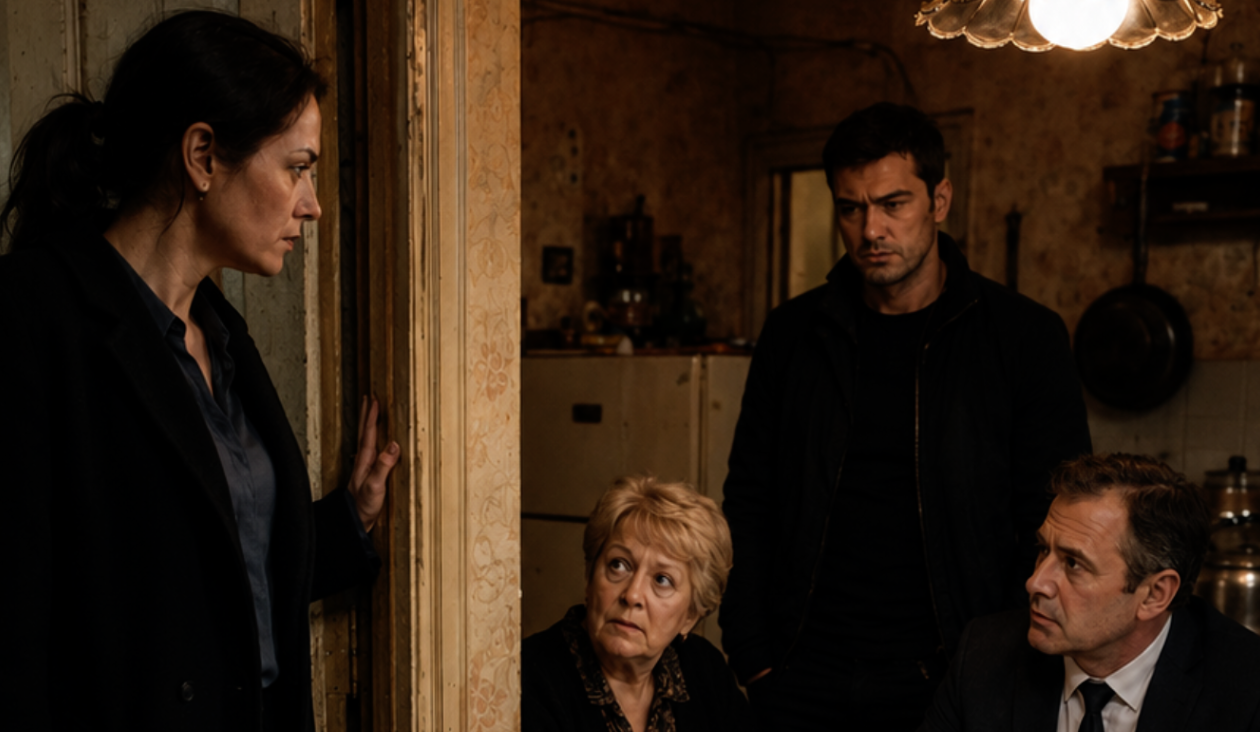
“Pack your things and leave—all three of you,” the daughter-in-law said when she found her mother-in-law sitting in her kitchen with a lawyer.
“Mom, why is some lady sleeping in my bed?”
Eight-year-old Kirill stood in the doorway of his room, pointing toward the far side, where an unfamiliar elderly woman was reclining on the lower bunk, right on top of the bedspread decorated with little cars. The woman was scrolling through her phone and did not even look up.
Marina froze on the threshold of her own apartment without taking off her coat or boots. The smell of boiled cabbage drifted from the kitchen—a smell that had never existed in this home before. Bags were lined up along the hallway. Three, four, five of them—large plaid bags, the kind people used when going to wholesale markets. Several pairs of unfamiliar slippers stood neatly against the wall.
“Kirill, come here,” Marina said quietly, pulling her son close.
Her mother-in-law appeared in the kitchen doorway. Nina Arkadyevna was grinning broadly as she wiped her hands on a towel—Marina’s towel, the waffle-knit one with little roosters on it.
“Marinochka! We’ve been waiting and waiting for you. Come in, why are you just standing there? I made shchi, real homemade cabbage soup, not those store-bought soups you eat.”
“Nina Arkadyevna,” Marina swallowed hard. “Who is in Kirill’s room?”
“Oh, that’s Zoya, my cousin. She just got off the train and she’s tired. She’ll lie down for an hour or so, all right? You don’t mind, do you?”
Marina slowly shifted her gaze from the kitchen to the hallway, then from the hallway to the children’s room.
Five bags.
A strange woman lying in her son’s bed.
Her mother-in-law in an apron by the stove.
And the smell of cabbage, which already seemed to have soaked into everything.
“Where’s Artyom?” she asked about her husband.
“Your Artyom is at work, where else would he be? He’ll be home this evening. Take your coat off. Why are you standing there like a stranger?”
Marina had inherited this apartment from her grandfather. It was nothing huge—a three-bedroom apartment in a prefabricated building on the outskirts of the city, overlooking the tram turnaround. But it was hers.
Her grandfather, Pyotr Nikolayevich, had signed the apartment over to her as a gift just after Marina graduated from university. He took her to a notary himself and made sure everything was done properly.
“Here you go, granddaughter,” he had told her. “Having a roof of your own means nobody can throw you out. Remember this: the person who owns the door owns their own fate.”
Marina had laughed at her grandfather’s philosophy back then.
Now, standing in the entryway, she remembered every single word.
When she married Artyom, he moved into her apartment. It made perfect sense—why pay rent when they already had a place of their own?
Artyom was easygoing and hardworking. He helped with the renovations: they repainted the walls, installed new laminate flooring, and replaced the kitchen faucet. Marina appreciated everything he had done.
But the apartment remained her property.
That was how her grandfather had arranged it, and that was what the documents said.
Until that day, her mother-in-law had rarely visited. Nina Arkadyevna lived in the region in a house of her own and usually came only for major holidays.
Every time she crossed the threshold, though, she would slowly scan the rooms with an appraising look, as if imagining how she would rearrange everything if the apartment belonged to her.
Artyom came home around nine o’clock.
By then Marina had fed Kirill and taken him into their bedroom—her and Artyom’s bedroom, because the mysterious Zoya was still occupying the children’s room. Marina had also washed a mountain of dishes that her mother-in-law and Zoya had left behind after lunch.
Nina Arkadyevna had settled herself in the living room in front of the television, her feet resting on the ottoman, commenting on the TV series so loudly that anyone would have thought she was home alone.
“Oh, the breadwinner is finally home!” she exclaimed happily when she saw her son. “Tyomochka, are you hungry? I made shchi.”
“Later, Mom.”
Artyom caught his wife’s expression.
“Marina, what’s wrong with you?”
Without saying a word, Marina nodded toward the bedroom.
She went in first, waited for her husband to follow, then closed the door.
“Artyom. What is going on in my apartment?”
“What do you mean?”
He sat down on the edge of the bed and began pulling off his socks.
“Mom came to stay with us. Didn’t I tell you?”
“No, you didn’t. And as for ‘staying with us,’ there are five bags in the hallway. Nobody packs that much luggage for a weekend visit.”
Artyom sighed.
Marina knew that sigh by now.
It was the sigh of a man who had prepared himself for an unpleasant conversation in advance and planned to wait it out like rain under an awning.
“Listen, here’s the thing. Mom has a problem with her house. The roof is leaking and it needs serious repairs. She’ll stay with us for a while, and meanwhile she’ll get everything sorted out.”
“How long is ‘a while’?”
“A month, maybe. Or however long the repairs take.”
“And why is her sister here?”
“Zoya? She’s going to help Mom around the house. It’s difficult for her to manage everything by herself.”
Marina sat down across from her husband.
The television was blaring through the wall, and her mother-in-law burst into loud laughter at something.
“Artyom. Do you understand that you brought two people into my home without asking me?”
“Marina, what do you mean, ‘my home’?” her husband said with a grimace. “We’ve been living here for six years. It’s our home.”
“It’s our home when we’re talking about who washes the dishes. But the moment we’re talking about deciding who gets to move in, it becomes mine. Because the apartment is registered in my name. And I’m the one who decides who lives here.”
“Are you serious right now? This is my mother. She needs help, and you’re arguing about whose apartment it is.”
“I’m not arguing. I’m telling you that you should have discussed it with me. Before she arrived. Before her sister lay down in our son’s bed.”
Artyom waved his hand dismissively and lay down, turning toward the wall.
“We’ll talk in the morning. I’m tired.”
Marina sat in the darkness for a long time.
Eventually, the television in the next room finally went silent.
But Marina still could not fall asleep for a long while.
The first week was difficult.
Nina Arkadyevna took complete control of the kitchen. She cooked everything her own way—greasy, heavy meals, always with fried onions, whose smell gave Marina a headache by evening.
The food in the refrigerator was constantly rearranged according to some mysterious system. Marina’s favorite tea disappeared, and in its place were bags of some cheap tea that smelled like hay.
Zoya, the cousin, turned out to be a quiet woman, but she was everywhere.
She washed the floors three times a day, moving the furniture around. She dusted places nobody had asked her to touch. And one day she rearranged all of Marina’s books on the shelf “by color,” making it nearly impossible to find anything.
“But it looks prettier this way,” Zoya shrugged when Marina asked her about it.
On the eighth day, Kirill came home from school in tears.
“Mom, Grandma Nina said I’m going to sleep in your bedroom on a folding bed now. And she and Aunt Zoya are going to live in my room because there isn’t enough space for the two of them.”
Marina slowly put down her spoon.
Her heart began pounding.
“Who told you that?”
“Grandma Nina. She’s already packed all my toys into a box…”
The continuation is just below in the first comment.
“Mom, why is a strange lady sleeping in my bed?” Eight-year-old Kirill whispered from the doorway. He pointed at his lower bunk, where an unfamiliar, elderly woman lay sprawled across his car-patterned bedspread, scrolling through her phone.
Marina stood completely frozen in the tight space of the entryway. The stifling stench of overboiled cabbage and fried onions clung to the air—an alien odor in her home. Five massive, checkered bags barricaded the hallway, accompanied by a row of unfamiliar slippers.
“Kirill, come here,” Marina murmured.
Her mother-in-law, Nina, emerged from the kitchen, wiping greasy hands on Marina’s rooster-print towel. “Marinochka! Come in! I made authentic cabbage soup, not that store-bought nonsense.”
“Nina,” Marina swallowed. “Who is in my son’s room?”
“My cousin Zoya. She just arrived and needed rest.”
Marina’s gaze drifted over the intrusive bags. This apartment, a modest three-room flat overlooking the tram line, was entirely hers. Her grandfather had gifted it to her, passing down a vital piece of wisdom: “Having your own roof means no one can cast you out. Whoever owns the door owns their destiny.” She had laughed then, but now, the words echoed with weight.
When Marina married Artyom, he moved in. He was amiable, helping with renovations—laying laminate, painting walls—yet the deed remained solely Marina’s. Nina rarely visited, but when she did, her appraising eyes always mentally rearranged the furniture.
When Artyom returned, Marina cornered him. “Artyom, why are there five bags in our hallway, and a stranger in Kirill’s bed?”
He sighed heavily, completely avoiding her intense, questioning eyes. “Mom’s roof is leaking. She and Zoya are staying here until it’s fixed.”
“Without asking me? This is my apartment.”
“We’ve lived here for six years. It’s our home. She’s my mother; she needs help,” he dismissed.
The following week was domestic purgatory. Nina seized the kitchen, saturating everything with grease and replacing Marina’s premium teas with cheap substitutes. Zoya ruthlessly reorganized Marina’s belongings, even color-coding her bookshelves.
The absolute breaking point finally arrived on the eighth agonizing day when Kirill returned from school in heavy tears. “Grandma packed my toys. She said I have to sleep on a folding cot in your room so she and Aunt Zoya can have mine.”
Marina’s heart hammered furiously against her ribs. She immediately marched straight into her son’s room. Half his shelves were violently emptied into a cardboard box; a strange nightgown draped his mattress.
“Nina, why are my child’s things boxed up?” Marina demanded.
The older woman scoffed. “We are cramped, Marinochka. Kirill is small; he can sleep anywhere. You are terribly selfish.”
“Put his things back. Now,” Marina commanded.
When she confronted Artyom, he barely glanced up from his phone, casually suggesting Kirill sleep with them. In that chilling moment, Marina realized a terrifying truth: her husband was not her partner. He was merely a tenant with shared DNA to the invaders.
Days later, an elderly neighbor shattered any illusions, revealing she had overheard Nina interrogating the building’s concierge about claiming a legal share of the apartment and securing permanent residency.
When Marina confronted him, Artyom’s brief hesitation betrayed him. “We thought it would make her medical care easier,” he stammered, defending his claim to the property based on the laminate flooring he had installed. He wasn’t building a home; he was accumulating a legal stake.
The ultimate betrayal unfolded soon after. Returning early from work, Marina walked into her kitchen to find a surreal tribunal: Artyom, Nina, Zoya, and a man in a gray suit.
“Ah, the owner,” the man smiled. “I am Gennady Lvovich, a family lawyer. We were discussing formalities.”
Nina leaned forward, her tone now venomous. “Tyoma invested in this flat. He’s entitled to a share. As his mother, I need security. Just sign these papers, Marinochka. We register me here, recognize the flat as joint marital property, and live in peace.”
The lawyer slid the documents forward. Blank spaces waited for her signature.
Marina stared at the meticulously typed pages, then at her husband. Artyom looked down, his posture devoid of guilt, radiating petulant resentment. While she worked to build their life, he had smuggled a lawyer into her sanctuary to carve up her inheritance.
Marina picked up the pen. Nina’s eyes gleamed. Zoya held her breath.
Slowly, Marina placed the pen down.
“Gennady Lvovich,” she said, her voice dropping to a glacial calm. “Gather your papers and leave.”
“Marina Sergeevna, don’t be hasty—”
“Take them.” She walked to the window, throwing it open to purge the stench of onions. “Now, pack your things and get out. All of you. Nina, Zoya, and you, Artyom.”
The entire kitchen instantly plunged into a stunned, breathless silence.
“Me?” Artyom sputtered. “I’m your husband!”
“You were. I’ll file for divorce. But today, pack a bag.”
“You have no right!” Nina shrieked, crumbling into hysteria. “My son lives here!”
“I have every right,” Marina replied, fortified by unbreakable resolve. “None of you are registered here. You are guests. And I am asking you to leave.” She glanced at the lawyer. “Confirm it.”
The lawyer cleared his throat. “Legally… she is correct.”
The eviction was a chaotic symphony of wailing and slammed doors. Nina screamed curses about being tossed into the street. Zoya frantically stuffed the plaid bags. Artyom begged for negotiation, but Marina was a fortress of stone. She personally carried their luggage out, watching with crossed arms as they piled into a taxi. Artyom lingered, looking like a beaten stray, accusing her of destroying the family.
“I didn’t destroy anything, Tyoma,” she said softly. “I called things what they are.”
An hour later, Kirill returned to a quiet apartment. The invasive slippers were gone. His toy cars rested safely on their shelves.
“Mom, where did everyone go?” he asked.
“Grandma and Aunt Zoya went home. Dad is staying elsewhere for a while,” Marina explained.
“Can I sleep in my room again?”
“Always.”
That evening, they ordered pizza, sitting in a pristine silence broken only by the distant chime of the tram. The apartment finally smelled like crisp evening air.
Later, sipping tea by the window, Marina braced herself for the impending storm: the divorce, lawyers, and vicious gossip. Yet, she felt no fear. The alternative—signing away her sanctuary for a parasitic definition of family—was far more terrifying.
Her grandfather had been right. Whoever owns the door owns their destiny. He hadn’t just meant square footage or legal deeds; he meant the absolute, inviolable boundary of the self. Marina washed her cup, turned off the light, and walked down the hall. The door was securely locked. The key was in her hand. And once again, she was the undisputed master of her destiny.