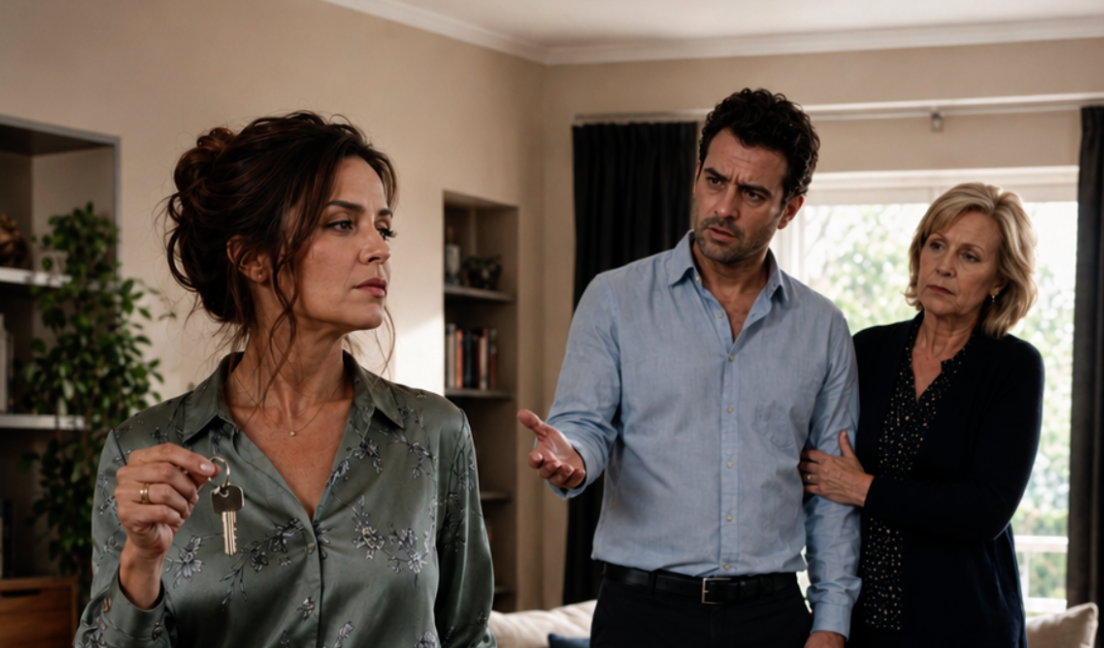
“My Mom and I Decided This Would Be Better,” My Husband Said. I Made a Decision Too—Without Him
“Mom and I decided this would be better,” Vadim announced solemnly, setting his empty cup down on the kitchen table with the air of a man who had just saved humanity from a global catastrophe while simultaneously solving the problems of melting glaciers and holes in the ozone layer.
I froze.
My cozy three-bedroom apartment, where just a week earlier I had finally reclaimed one spare room for a sewing workshop, was suddenly under threat of a hostile takeover.
I had already bought a luxurious cutting table, ordered shelves for my fabrics, and mentally arranged the mannequins so their headless silhouettes wouldn’t scare me at night. And now they were planning to take away my little personal oasis of peace.
“What exactly did you decide?” I asked cautiously, knowing perfectly well that whenever my husband used that solemn tone, some grand piece of mischief was usually hiding behind it—one that I would ultimately have to pay for, both financially and emotionally.
“Mom is moving in with us. Temporarily.” Vadim tried to lean majestically back in his chair to reinforce the image of a stern but fair head of the family.
But he had failed to take the physics of the room into account. The button on the cuff of his house shirt became hopelessly caught on the lace edge of the decorative tablecloth. He leaned back dramatically, dragging the cloth with him—and along with it, a heavy ceramic fruit vase.
For the next thirty seconds, Vadim fought gravity like a panicked juggler at a country fair. He jerked around, tried to free the button, caught the early July apples rolling off the table against his stomach, and desperately attempted to preserve the dignity of a patriarch making difficult but decisive choices.
One green apple escaped anyway and rolled under the refrigerator with a loud thud, symbolizing the collapse of male authority.
“They’re starting major renovations in her building, replacing the pipes,” he continued, breathing heavily as he stuffed a couple of rescued apples into his trouser pockets, making his hips look strangely lumpy. “It’ll be absolute hell for several weeks. Hammering, cement dust, no water. An elderly person simply can’t stay there.”
Vadim finally freed himself from the tablecloth and caught his breath.
“Some builders we know will stay in her apartment. They’ll keep an eye on the renovations and wipe away the dust so the furniture doesn’t get ruined. Mom will live in that spare room of yours. You don’t mind, do you?”
I was genuinely surprised. I had an excellent relationship with my mother-in-law, Anna Matveyevna. She was tactful and independent, and she would sooner agree to sleep in a tent on a windblown balcony than barge into someone else’s home with suitcases without asking and disrupt the family’s routine.
“Why didn’t she call me herself?” I asked, mentally draping my brand-new cutting table in black mourning cloth.
“She’s embarrassed,” Vadim dismissed confidently. “She’s afraid of seeming intrusive. Old people have their quirks, you know. But Mom and I discussed everything in detail. Ira, you need to clear some shelves in the wardrobe right away. She’s coming this evening. And I’m just about to start a twenty-four-hour shift, so you’ll meet her, feed her, and get her settled. I’ll be back tomorrow evening.”
The most generous people are always those who pay with someone else’s resources.
My husband fluttered around the kitchen, ordering me where to move the boxes of sewing supplies and radiating such blinding nobility that you could have lit a cigarette from his halo.
I sighed, went into the spare room, packed away my things, put my dream of a sewing workshop back into cardboard boxes, and made the bed with fresh sheets. Generosity at someone else’s expense isn’t kindness—it’s a loan you take out without showing your passport. Still, if Anna Matveyevna truly needed help, I wasn’t going to refuse her.
A few hours later, an uncertain ring sounded from the hallway. My mother-in-law stood at the door with one small rolling suitcase. She looked confused and embarrassed, gazing at me with the kind of universal awkwardness of someone who had come to borrow a large amount of cash without offering a receipt.
“Irochka, my dear girl, thank you so much.” Anna Matveyevna began removing her shoes, fumbling with the buckles on her summer sandals. “I would never have agreed to inconvenience you, but Vadik said you insisted so strongly…”
“Insisted?” I took her light jacket, feeling a suspicion the size of a respectable Arctic iceberg beginning to form inside me.
“Well, yes. He said you were terribly worried that I was all alone there, getting lonely within four walls. That you practically cried and begged him yourself to bring me here while you had an empty room,” my mother-in-law said, blinking in confusion as she adjusted her hair.
Anna Matveyevna spread her hands apologetically.
“I resisted! I told him my violets were blooming on the windowsill, the clinic is nearby, and preserving season has just begun—they’ve only just brought in the berries for jam! And there’s my neighbor Zina, whom I discuss TV shows with in the evenings. But he kept saying, ‘Mom, Ira will be terribly hurt. She means it from the bottom of her heart. She’s already baking pies and can’t wait for you to come.’”
We stood in the hallway staring at each other. The silence became so thick you could have sliced it with a serrated bread knife and spread it on sandwiches.
“Anna Matveyevna,” I said slowly, feeling my left eye begin to twitch, “when exactly are they starting to replace the pipes in your building? Tomorrow or Monday?”
“What pipes?” my mother-in-law asked sincerely, freezing with one slipper in her hand. “Good Lord, Ira. Our building has already been completely renovated. Everything is new—plastic pipes, neat and tidy. Nobody is going to replace anything for another twenty years.”
Every fragment of the story came together in my head with a loud, almost physical click.
There were no pipes.
There had been no tearful pleading from me about reuniting the family either.
My brilliant husband had simply invented two completely different yet equally touching stories for two women, knowing that we liked each other too much to start a direct confrontation or bother checking the facts.
We went into the kitchen in complete silence. I took the roast pork out of the oven—a large piece of farm-raised pork neck I had prepared especially for our guest’s arrival. It released an intoxicating aroma of garlic, black pepper, and rosemary. Its golden, crispy crust crackled appetizingly from the sudden change in temperature. Thick, clear juices ran down its gleaming sides onto the baking tray, mixing with the melted fat. Inside, the meat remained juicy and tender, separating easily into even slices with glossy drops of broth shining along each cut.
But neither my mother-in-law nor I had any appetite. We sat staring at that culinary masterpiece, thinking exactly the same thing.
“Irochka,” Anna Matveyevna said quietly, firmly pushing her fork away. “If I’m sitting here now, occupying your spare room… then who exactly is in my apartment?”
We didn’t call Vadim at work. He was on his twenty-four-hour shift, which gave us plenty of time to figure things out without his frantic interference.
While we discussed everything, the roast pork cooled slightly. I transferred it to a clean container, closed the lid tightly, and put it in the refrigerator. There was no point letting perfectly good food go to waste because of my husband’s stupidity.
Then we called a taxi and rushed to the other side of the city, prepared for anything.
Despite the late hour, my mother-in-law’s neighbor Zinaida was sitting on a bench outside the entrance—a woman with built-in radar instead of intuition and powerful binoculars instead of a conscience. She knew everything about everyone, including things people hadn’t yet discovered about themselves, and regularly updated her database while enjoying the warm July evening.
“Oh, Matveyevna!” Zinaida exclaimed happily, cracking sunflower seeds at the speed of a sewing machine. “Why are you back so late? Forget something? Your tenants aren’t moving in with their stuff until tomorrow morning. Your son Vadik has been dancing around them here for three days. A married couple with a daughter. They seem respectable enough. He showed them everything, opened cupboards, slammed doors—like some lord giving a tour of his ancestral estate.”
The color drained from Anna Matveyevna’s face until she almost blended into the pale wall of the building, but her back straightened like a string.
After thanking Zinaida for her priceless intelligence report, we went upstairs. My mother-in-law pulled out her keys with trembling hands, unlocked the door, and we stepped into the dark hallway and turned on the light.
Vadim had been managing someone else’s property like a voracious woodworm larva inside an antique cabinet—quietly, secretly, and with complete confidence that everything around him existed exclusively for his personal comfort.
Some of my mother-in-law’s belongings, including her favorite knitted shawls, winter boots, and collection of gift mugs, had been carelessly shoved into a far cupboard on the balcony and covered with an old plastic sheet. The hallway shelves stood completely empty.
The food had vanished from the refrigerator, but on the kitchen table lay a notebook containing the carefully written Wi-Fi password and a strict garbage collection schedule.
Beside it was a list of rules written in my husband’s sprawling handwriting:
“Do not run the washing machine at 90°C—protect the heating element.”
“Water the flowers strictly on Thursdays; let the water stand first.”
And the absolute masterpiece:
“Do not sit on the living-room sofa without a blanket. The upholstery stains easily.”
But we found the most interesting thing on a small cabinet in the hallway.
There was a receipt signed by Vadim acknowledging that he had received money, along with a printed standard residential lease agreement in which my beloved husband had unilaterally described himself as the “legal representative of the owner.”
I almost laughed.
Any competent lawyer would have thrown up their hands at that wording. Legally, a “legal representative” is generally a parent representing a minor or a guardian. To rent out the apartment of a legally competent adult mother, Vadim needed properly granted authority. But my overconfident husband had simply downloaded the first template he found online, inserted his own name, and the exhausted prospective tenants hadn’t investigated the legal details.
Naturally, Anna Matveyevna’s signature was nowhere on the fake agreement.
According to the receipt, my husband had collected a substantial advance covering several months. The amount was enormous—equal to three of my monthly salaries.
The easiest way to sit on someone’s neck is to pretend you’re showing them the way forward.
My husband had moved his own mother into my home for free, assigning me the role of caring companion, while appointing himself successful landlord and casually pocketing someone else’s money.
We spent the night at Anna Matveyevna’s apartment.
At exactly nine the following morning, the doorbell rang.
A few seconds later, we heard a key turning quietly in the lock. Vadim had already given the tenants a spare set of keys and told them to enter on their own in the morning because the apartment would be empty. Out of politeness, however, the new tenants had rung the bell first.
Konstantin and Olga were standing at the door, with a thin girl of around twelve shifting nervously between them, a small backpack over her shoulders. Two enormous travel bags and a clinking grocery bag stood nearby.
They froze like people who had opened the wrong door at the worst possible moment, clearly shocked to see my mother-in-law and me in bathrobes instead of the enterprising Vadim.
It turned out that the couple had come from outside the city because their daughter needed several months of examinations and treatment at a specialized clinic.
They had already checked out of their short-term hotel, returned the keys to reception, and expected to move into this apartment immediately.
Without saying much, we seated them at the table, poured freshly brewed berry tea, and placed our passports with registered addresses and the original apartment ownership documents in front of them.
Konstantin, a large, solid man with the calloused hands of an experienced auto mechanic, studied the official seals for a long time, looked from the documents to us, and finally sighed heavily.
“So your Vadim deceived us,” he concluded, pushing his cup aside. “And he certainly knew how to sell the story.”
Konstantin shook his head.
“Vadim showed us copies of the apartment documents and a photo of his mother’s passport on his phone. He said he was acting on her verbal instructions. He didn’t have a notarized power of attorney, but he rushed us, kept pointing out that he was the owner’s close relative, and offered a very noticeable discount if we paid for the entire period upfront. My wife and I were exhausted from searching for housing and dealing with hospitals, so we believed him.
“He told us his mother had gone to a country sanatorium for six months to breathe the pine air. And he said he needed all the money upfront because he urgently had to pay off a loan on a trailer. Said the bank was strangling him with interest.”
“What trailer?” my mother-in-law and I asked simultaneously, feeling another previously unknown abyss of Vadim’s lies opening beneath us.
“An off-road camping trailer,” Konstantin said, scratching the back of his closely cropped head. “He spent half an hour showing me pictures and bragging about it.
“Your Vadim ordered an extremely expensive trailer, made a small down payment, and took out a consumer loan for the rest. But before they would release the trailer, it turned out he had to pay extra for additional equipment, solar panels, paperwork, and part of the purchase price the loan didn’t cover. That final payment is exactly what he used our advance for. Then he proudly collected the trailer from the dealership.”
Konstantin took a sip from his mug and, being a true professional, couldn’t resist adding his opinion.
“You see, Irochka, an off-road trailer is a financial hole on wheels. Vadim has an ordinary city crossover. Technically it can tow something, sure, but it’s clearly not designed for a one-and-a-half-ton monster like that. On a steep hill or in serious mud, you could overheat and ruin the transmission in a single trip.
“I tried to explain it to him as a mechanic: either replace the tow vehicle with a powerful SUV or choose a lighter trailer. But by then he already saw himself as king of the wilderness.
“I even asked whether he had the appropriate license category for towing that kind of weight. He just waved me off and said, ‘I’ll get there somehow. Who’s going to check documents in the middle of the woods?’”
The entire murky scheme finally became clear.
Without telling me, Vadim had plunged into a massive financial adventure for the sake of an idiotic toy for his occasional fishing trips—a toy he wasn’t even properly prepared to tow.
Once he realized the monthly loan payments would consume almost his entire salary, and that I would immediately notice the missing money in our family budget, he came up with the plan involving his mother’s apartment.
Konstantin, Olga, and their daughter were innocent. They had become hostages to someone else’s greed.
After assessing the situation and seeing how exhausted Olga looked, Anna Matveyevna firmly declared that she wasn’t going to leave them on the street.
“You can live here,” my mother-in-law said, enunciating every word. “But the new legal agreement will take effect only after my son returns every penny of the advance he took from you.
“Until then, I will not ask you to pay again. For a few days, you’ll have to return to a hotel, and Vadim will pay those unexpected expenses out of his own pocket.
“Once your money is returned, we’ll sign a proper contract directly with me, and you’ll transfer the rent monthly to my bank card.”
That evening, Anna Matveyevna and I returned to my apartment.
Not long afterward, Vadim came home after finishing his twenty-four-hour shift.
Before our serious conversation, I took the chilled roast pork from the refrigerator, neatly arranged the fragrant slices on a serving plate, and placed it on the table, although my mother-in-law and I still had only a theoretical appetite.
My husband walked into the kitchen looking radiant, rosy-cheeked, and unbelievably pleased with himself.
A born winner.
He kissed me on the temple, patted his mother on the shoulder, and confidently took his usual place at the head of the table, apparently expecting to be fed roast meat while we praised his brilliant organizational skills.
“So, how are you doing here, Mom?” he asked in a velvety, syrupy voice while pouring cherry juice from a carton into a glass. “Settled in comfortably? No draft from the window? Ira and I are so happy you’re staying with us. It warms the heart.”
“I’ve settled in wonderfully, son. Absolutely wonderfully.” Anna Matveyevna smiled sweetly, folding her hands on the table. “But you see, I’ve decided to make one tiny little adjustment to your grand plan.”
Vadim froze with the glass halfway to his mouth.
“What adjustment?” he asked suspiciously, his eyes narrowing as though an enormous unpaid bill had suddenly materialized in front of him.
“I’m going back home tomorrow,” my mother-in-law said in a metallic voice. “Konstantin, Olga, and their daughter will be able to use two rooms under a new agreement, while the third room will remain mine.
“And the money you illegally took from Kostya and Olya through deception for six months of rent in advance—you will return it to them tonight. By bank transfer. In front of me.
“And you’ll pay for their hotel yourself.”
In shock, Vadim squeezed the carton of cherry juice he was still holding in his left hand.
A dark burgundy stream happily gurgled out under pressure and splashed directly across the chest of his light-colored shirt.
My husband squeaked, dropped the carton, grabbed a thin paper napkin from the table, and tried to wipe away the stain discreetly, as though nothing had happened.
The cheap napkin instantly disintegrated in the cherry juice, turning into sticky pink pellets.
Vadim began furiously scraping them from the fabric like a frantic restorer trying to save a priceless fresco using only saliva and a finger—all while desperately maintaining the appearance of a confident family leader who had everything completely under control.
“Mom, what are you talking about?” He laughed nervously, smearing the juice even farther across his shirt until he resembled an unsuccessful actor in a provincial theater production. “Mom and I… I mean, we already decided everything! You both agreed!”
“At exactly what point did we decide it, Vadik?” Anna Matveyevna asked sweetly, with unmistakable menace. “When I was packing my suitcase and knew nothing about the tenants? Or when Ira was packing up her fabrics and knew nothing about the rental?”
“You were especially successful at achieving family consensus,” I added, enjoying his pathetic attempts to peel soggy pink paper from his shirt. “Each woman agreed to an entirely different story. You’re practically diplomat of the year. You should be conducting international negotiations.”
Vadim realized he had been pinned to the wall by a concrete slab of undeniable facts.
He threw the mangled napkin onto the table and launched into a foolish, noisy counterattack.
“Why are you making such a huge deal out of nothing? Both of you attacking me at once!” he protested, waving his sticky, stained hands. “I was trying to make things better for everyone!
“Nobody would have suffered if you hadn’t started checking up on me! Mom would have lived here comfortably with someone taking care of her, you’d have had excellent company, those people would have gotten a nice apartment at a discount, and I would have been able to collect my trailer from the dealership.
“That’s called efficient optimization of family resources!”
Compromising with an arrogant person means voluntarily giving away half so they won’t take everything.
But nobody here intended to give him anything.
“Optimization is when you manage your own resources,” I replied icily. “When you secretly rent out someone else’s apartment, occupy someone else’s spare room, and spend someone else’s time servicing your brilliant schemes, it’s called plain dishonesty.”
Anna Matveyevna said nothing.
With frightening calm, she rose from the table and went into the bathroom, where some laundry was soaking in a basin.
A second later she returned.
In her hands was a heavy, wet terrycloth bath towel twisted tightly into a rope.
Before Vadim could open his mouth to say anything about respecting the man of the house, his mother swung the towel and gave her fifty-one-year-old son one single but spectacularly loud smack across the back.
The crack was so deafening it sounded as though someone were beating the dust out of an old carpet in the courtyard.
“Ow! Mom! Have you lost your mind?! That hurts!” Vadim squealed in a falsetto.
Startled, he jerked backward, caught his foot on a chair leg, and awkwardly dove beneath the kitchen table, dragging the unfortunate tablecloth after him.
This time, the empty vase crashed onto the floor.
“That’s for lying, you parasite!” Anna Matveyevna thundered, lifting the wet towel above the edge of the table for a second strike. “Did I raise you to ride into paradise on someone else’s back? Did I teach you to deceive your wife?”
“I understand! No more! Put the towel away!” the “head of the family” immediately cried from beneath the table, protecting his head with both hands.
Once the disciplinary measure had run its course and my mother-in-law, breathing heavily, threw the towel into the sink, Vadim crawled out from his hiding place.
He was red-faced, wet, humiliated, and covered in cherry juice.
That was when the most unpleasant detail of the evening emerged.
There was nothing to give back to Konstantin and Olga.
Vadim had transferred all the tenants’ money to the dealership the previous day to pay for the trailer’s additional equipment.
He had no spare cash.
None.
“So here’s what you’re going to do, great optimizer,” I said, watching my husband rub his sore back resentfully while kicking the apples scattered across the floor. “Tomorrow morning you’re putting your precious trailer up for sale. Online.”
“I can’t!” Vadim howled, pressing his hands to his chest as though I had proposed selling one of his kidneys. “It’s brand new from the dealership! If I sell it now, I’ll have to accept much less money! I’ll lose a fortune just because technically it’s already considered used! That’s financial suicide!”
“Then you’ll lose the money,” Anna Matveyevna said mercilessly. “Consider it the price of your education. Be grateful I’m not reporting you to the police for fraud.”
The following week became a genuine test of endurance for my husband.
The trailer had to be sold urgently, with the asking price reduced every single day.
Buyers weren’t exactly lining up for such a heavy, specialized model. For most people it was unsuitable because of its weight, price, vehicle requirements, or the license category needed to tow it. And those for whom it was suitable had no reason to make an urgent purchase.
Who needed a massive metal box without a substantial discount?
After the emergency sale, almost all the proceeds went toward repaying Konstantin and Olga.
Vadim covered the remaining amount using his salary and money he hurriedly borrowed from coworkers.
Meanwhile, the consumer loan he had taken from the bank remained his personal monthly obligation—except now there was no trailer to show off to the guys on fishing trips.
And while Anna Matveyevna prepared a legitimate agreement with the tenants and sorted everything out, Vadim obediently paid for several days in a decent hotel for Konstantin and Olga out of his already empty pocket.
As promised, Anna Matveyevna returned to her own apartment.
Once the paperwork was complete, she gave Konstantin’s family two spacious rooms and kept the third for herself. They shared the kitchen and bathroom according to an agreed schedule.
Konstantin and Olga turned out to be exceptionally calm and tidy people, so living together was much easier than anyone had expected.
My mother-in-law now managed the rental income herself, and judging by the pleased sparkle in her eyes and her new Italian shoes, the substantial addition to her pension suited her very nicely.
As for the newly vacant room in our apartment, I finally turned it into exactly the workshop I had originally planned.
I installed the wide cutting table, added a comfortable chair, arranged my fabrics on the shelves, positioned the mannequins, and hung new heavy curtains over the window.
That very evening, I also removed Vadim’s access to the savings accounts in my name that had been intended for family purposes simply by changing all the passwords.
I didn’t touch the savings on his personal cards, but from that moment onward, any major spending from our shared budget had to be discussed together, with receipts shown and a clear explanation of what the money was for.
Anna Matveyevna continued treating me wonderfully. We called each other often and sometimes went together to try new desserts at shopping malls.
But with her son, she now spoke much more sternly and dryly.
Whenever Vadim slipped back into his old, incurable habit and began a sentence with, “Mom and I decided…,” she immediately interrupted him with a narrowed eye.
“Vadik, please clarify for the record: was Mom actually present when this decision was made? Or were you consulting with your reflection in the bathroom mirror again?”
My husband’s commanding habits disappeared remarkably quickly.
After losing money, his favorite masculine toy, and his status as the unquestioned supreme authority of the family, he became quiet, agreeable, and unbelievably careful with his wording.
Several months later, on a Saturday morning, we were sitting peacefully in the kitchen.
Vadim fidgeted for a long time, moved the salt shaker back and forth, wiped the already clean table with a cloth, and finally cleared his throat timidly.
“Ira, the sofa in the living room is completely worn out. The springs squeak and it’s impossible to sit on comfortably,” he said very carefully, gazing at me devotedly like a student summoned to the principal’s office after an especially unfortunate prank.
“I found a pretty good option at the furniture center. But… I wanted to ask your opinion first. Shall we go look at it together? You can choose the color and feel the fabric.”
I took a small sip of my hot drink and studied his tense expression, which seemed to be expecting a trap.
Then I smiled sincerely.
“Well, well,” I said, setting down my cup. “What astonishing, noticeable progress. A family decision finally has a second participant.
“Get ready. Of course we’ll go look at it together.
“But remember this, Vadik. If you ever decide again that you and Mom have settled something without telling me, I know exactly where she keeps that wet terrycloth towel.”
Vadim swallowed nervously, instinctively touched his back, adjusted the collar of his shirt, and silently went into the hallway to get dressed.
It seemed that genuine honesty and one hundred percent mutual agreement had finally arrived in our home.