My Mother-in-Law Convinced My Husband That Neither of Our Daughters Was His. He Demanded a DNA Test — Our Marriage Collapsed That Very Day
The sterile smell of quartz lamps and rubbing alcohol filled Elena’s nostrils. With a practiced motion, the nurse took out sterile swabs for the DNA test.
Sixteen-year-old Polina and Arina sat stiff-backed on a black leather examination couch. They stared straight ahead while unfamiliar hands in latex gloves took samples from the inside of their cheeks.
Their father paced the narrow space between the water cooler and the window. Igor rocked from heel to toe, nervously jingling the car keys in his trouser pocket and making inappropriate jokes in an attempt to fill the suffocating silence.
“Nice weather today, huh? Perfect for going out for barbecue, and here we are rattling test tubes,” he said, trying to wink charmingly at the young lab technician.
She gave him a polite but completely cold smile without looking away from the labels on the test tubes.
“Come on, girls, don’t worry. It’s no big deal. Just a formality, something we need to have on paper.”
Elena stood by the door with her arms folded across her chest.
She didn’t look at her daughters. Watching their humiliation was unbearable.
Instead, she stared at the back of her husband’s head. At the neck of a man who sincerely believed he had the right to purchase his own peace of mind at any cost, even if it meant trampling over the dignity of the people closest to him.
At that exact moment, beneath the quiet rustle of cotton swabs and Igor’s fake chuckle, twenty-five years of marriage turned to gray ash.
And the strangest thing was that Elena felt neither regret nor fear of the future.
The results of that DNA test no longer mattered.
Their family had already collapsed right there on the sterile tiled floor.
The fracture had not appeared overnight.
It had been growing for years, fed by poisonous drops of other people’s insinuations and Igor’s wounded pride.
As the owner of a successful company installing industrial heating systems, Igor was accustomed to viewing the world in terms of profit, complete control, and understandable investments.
In his system of values, his wife was a reliable home front, his house was a symbol of status, and his children were a direct continuation of himself — his personal capital.
But when it came to that continuation, there had been an irritating complication.
At least, that was how Igor saw it.
Their eldest son, Anton, and their youngest daughter, nine-year-old Sveta, looked completely like Igor’s side of the family.
Stocky, dark-haired, with sharp, heavy gazes and practical minds.
They made sense to him.
They were his.
But the twins, Polina and Arina, seemed to have come from another planet after somehow getting the address wrong.
Tall and delicate, with translucent gray eyes and thick hair with a noble copper-red shade, they had completely inherited the genetics of Elena’s great-grandmother.
The girls devoured books, were fascinated by architecture, spent hours working on academic drawings, and did not fit at all into their father’s down-to-earth world of metal, construction sites, and business.
And Igor openly divided his children, with the cold cruelty of an accountant.
Elena remembered every detail of the evening when that divide stopped being hidden.
They were celebrating the end of the school year in the spacious living room of their country house.
To approving applause from their relatives, Igor ceremoniously handed Sveta the keys to a brand-new expensive electric scooter.
Then, in front of everyone, he transferred a substantial amount of money to Anton’s bank card for the down payment on the foreign car he had long wanted.
Polina hesitantly approached her father, shifting from one foot to the other and holding a printed page from the website of an educational center.
“Dad, Arina and I found this summer intensive course in academic drawing. It’s taught by a professor from the Stroganov Academy. If we complete it, we’re almost guaranteed to get into the architecture lyceum on a scholarship. Could you pay for it by Wednesday?”
Igor pushed the sheet away with two fingers, as though it were something unpleasant, without even glancing at the column of numbers.
“I only invest in things I understand, Polina,” he said sharply, slowly pouring himself some cognac. “Your pencil scribbling is an indulgence, not a profession. Artists are useless dreamers. If you want to draw, draw in a sketchbook. Paper is cheap. Better yet, get yourselves summer jobs at a supermarket checkout, you pampered little princesses. At least then you’d get a taste of real money.”
He did not say the words “like Anton or Sveta” out loud.
But they hung in the air like a heavy, rusty axe.
The main catalyst behind Igor’s growing paranoia, however, was Zinaida Pavlovna.
His mother had mastered the art of intellectual toxicity.
She never stooped to shouting, public scenes, or obvious insults.
Her main weapons were theatrical sighs, elegant insinuations, and comments thrown casually into conversation as though they meant nothing.
At a recent family dinner, while conspicuously sorting through old photographs, she stopped at a picture of the twins and thoughtfully drawled:
“Mother Nature really is an amazing thing. Igor and I are ordinary people — solid, dark-haired. But our girls… they look as though they fell from someone else’s branch. So pale, red-haired, refined. Lenochka, darling, the chief doctor at your clinic wouldn’t happen to be a redhead, would he?”
She swept an innocent, clear-eyed gaze over the suddenly silent guests and gave a sugary laugh.
“I’m joking, of course! Just joking! It’s simply amazing how genetics shuffles the cards.”
The guests awkwardly lowered their eyes to their plates.
Igor did not make a scene in front of everyone, but Elena saw his eyes fill with anger.
Yet the true reason behind his behavior had very little to do with his mother’s words.
Igor judged everyone by himself.
Every few months, he regularly went on “business trips,” flawlessly concealing his affairs.
A second phone hidden in the glove compartment of his SUV.
Ironclad alibis provided by trusted business associates.
Expensive bouquets brought home to his wife after each trip as a kind of payment for his guilt.
His logic was simple: if he had been capable of living a double life for years without Elena suspecting anything, then she could easily have done the same thing sixteen years earlier.
For Elena, the true point of no return was not the dinner with her mother-in-law.
It was an ordinary Tuesday evening.
She returned home after an exhausting shift at the clinic and heard a strange sound coming from the bathroom.
Polina was sitting directly on the cold tiled floor.
In her hands was a bright orange marker, which she was using to slash lines across her best architectural sketches.
“Polya, what are you doing?!”
Elena rushed toward her daughter and grabbed her thin wrist.
“What’s the point of keeping them, Mom? They’re as useless as we are to Dad,” Polina replied flatly. “To him, we’re defective merchandise too. Unsellable.”
“Don’t say that, sweetheart. Dad is just very tired. His business is difficult, there are loans, and he simply doesn’t understand your kind of art…”
Elena began hurriedly repeating the same familiar excuses she had used for decades to plaster over the widening cracks in their marriage.
“Stop humiliating us with lies!”
Polina’s voice broke into a hoarse whisper.
“He looks at us like we’re strangers. Like we’re some kind of mistake someone forced on him. Grandma Zina told Anton in the kitchen yesterday that we ‘came out looking like God knows who.’ Why do you keep forcing us to play this fake, perfect-family game? Who are you trying to fool, Mom? Us? Yourself? Or him?”
Sitting there on the bathroom floor, Elena suddenly understood something terrifying and irreversible.
Her celebrated feminine wisdom, her endless patience for the sake of the sacred principle that “children need their biological father” — all of it had been grinding her daughters down slowly, day after day.
A few days later, on Saturday morning, Igor walked into the kitchen wearing an expensive tracksuit, finishing a cup of strong coffee as he went.
He cast a heavy glance at the twins, who were having breakfast at the kitchen island.
“Alright, girls,” he said in a tone that allowed no argument. “We’re leaving in ten minutes. We’re going to the company’s central warehouse. You’ll do a complete inventory of the boxes with small fittings and adapters. Time to get your heads out of the clouds and learn what real, dirty work looks like.”
Arina put down her spoon.
“We can’t go. We have the final portfolio review at the lyceum today. We’ve been preparing for it for six months. Our admission depends on it. We told you on Wednesday.”
“I don’t remember asking what your grand weekend plans were. I said get up and go to the warehouse.”
“And I said we’re not going anywhere.”
Arina stood up from the table, stubbornly lifting her chin.
Igor crossed the kitchen in two strides, grabbed the plastic tube containing their drawings from a chair, and with a deliberately cruel movement threw it into the hallway.
The cap flew off.
Rolled sheets of paper scattered across the parquet floor like a fan.
“That’s it. I’ve had enough. I’m tired of feeding someone else’s bloodline. Tomorrow morning we’re going to a clinic. Lena, do you hear me? I want DNA tests for both girls.”
He hissed the words through clenched teeth, leaning his massive fists heavily against the countertop.
Elena, who had been washing dishes, calmly turned off the water and faced her husband.
Igor stared at her with open defiance.
He expected tears.
He expected confused excuses.
He expected her to turn pale, swear that she had always been faithful, beg him not to humiliate the family in front of everyone they knew, and cling desperately to his sleeves.
Instead, Elena looked at him with the frightening, arctic calm of someone who had nothing left to lose.
“We will go to the laboratory,” she said in a completely steady voice, without a trace of hysteria. “But remember one thing, Igor. The very second the nurse takes biological samples from them, our marriage will cease to exist. That will be the point of no return.”
Igor gave her a crooked, confident smirk and squared his broad shoulders.
“Don’t try to bluff me, Lena. Been watching too many cheap soap operas? I need official proof on paper, not your dramatic speeches. You’ll take the test, and then we’ll continue living like normal people. Assuming, of course, you have nothing to hide from your husband.”
And that was how their family reached the point where biological samples were taken from their twin daughters for a DNA test.
On the drive home from the clinic, Igor suddenly became uncomfortable with the girls’ stony, unreadable faces and awkwardly tried to backtrack.
“What’s with the long faces, my eagles?”
He gave a fake laugh, glancing at them in the rearview mirror.
“It’s over. Formalities are done. Want to stop for pizza on the way home? At least now your old man can sleep peacefully without stupid thoughts in his head. Truce?”
Not a single sound came in response.
Both girls turned toward their windows at the same time, making it perfectly clear that, as far as they were concerned, the man behind the wheel no longer existed.
The results arrived by courier five days later.
Igor personally took the thick envelope and burst into the apartment like a victorious conqueror.
Elena and Zinaida Pavlovna were already waiting in the living room, his mother having conveniently stopped by to “visit her beloved grandchildren.”
Igor impatiently tore open the cardboard envelope, scanned the lines, and exhaled loudly with overwhelming relief.
“Ninety-nine point nine percent!”
His voice thundered through the apartment as he casually tossed the laboratory report onto the glass coffee table.
His face glowed with sincere, almost childlike happiness.
“It’s officially confirmed! Thank God, the girls are mine! Mom, set the table! Turns out we suspected Lena for nothing!”
He stepped toward his wife with his arms spread wide for a reconciliation hug.
“Forgive this fool, Lenochka! My nerves got the better of me. Business, competitors, stress — you know how it is. I worked myself up over nothing. I talked to the guys at the bathhouse and they added fuel to the fire too. But now the question is closed once and for all!”
Zinaida Pavlovna nodded approvingly as she adjusted her perfect hairstyle.
“Well, there you go, Igoryosha. Trust may be the foundation of a marriage, but a little verification never hurt anyone. At least now your mind is at peace. A man has every right to know for certain whose children he is feeding and supporting.”
Elena did not move a single millimeter.
She smoothly avoided her husband’s embrace, carefully picked up the laboratory report, folded it in half, and placed it inside a thick cardboard folder containing her documents.
“Are you satisfied now?” she asked quietly, looking straight at him.
“Absolutely!”
Igor rubbed his hands together happily, completely unaware of the disaster approaching.
“That’s it. It’s over. Forget it like a bad dream! Tonight we’re going out to a good restaurant. My treat!”
“Excellent,” Elena said, placing the folder on the table. “Now go into the hallway. Your suitcases are already packed. Your jackets are hanging above them.”
Igor’s smile trembled and slowly slid off his face like a piece of damp plaster.
He blinked in confusion.
“What? What suitcases? Lena, is this some stupid joke?”
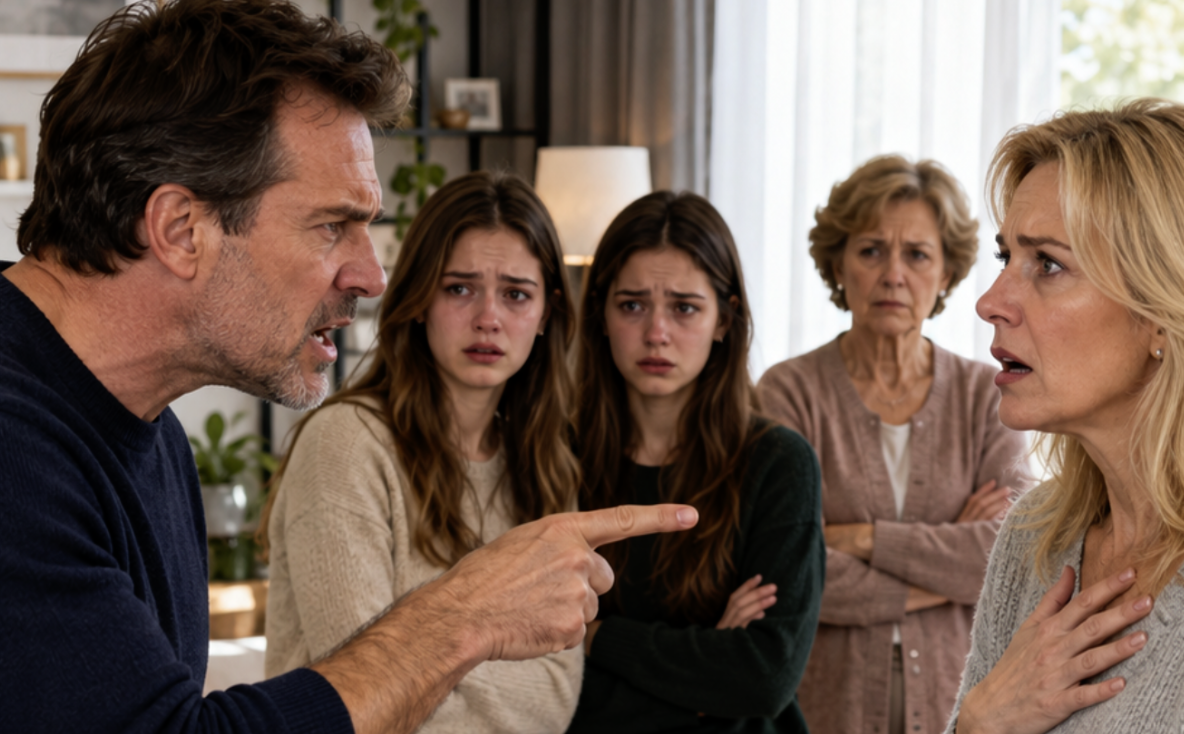
Her mother-in-law gasped loudly and theatrically clutched her chest.
“Elena, have you lost your mind?! He was only checking! He’s a man, the head of the family! He has every right to have doubts! Why are you throwing him out? Have some fear of God!”
“Tomorrow my lawyer is filing for divorce and a complete division of our property,” Elena said sharply.
“This test didn’t prove your fatherhood, Igor. It proved only that you are a pathological paranoiac. For twenty-five years, every single day, you judged me according to your own filthy standards. According to your women on business trips and your hotel rooms — all of which I knew about perfectly well for all these years.”
Igor went deathly pale.
His massive jaw dropped.
He opened and closed his mouth, unable to force out a single word.
“I kept quiet for the sake of the children, building the illusion of a family,” Elena continued mercilessly, without raising her voice. “But you decided you could trample all over their dignity simply to make yourself feel better. Congratulations, Igor. The test has been passed successfully. But there is no family anymore. Get out.”
What followed was a pathetic, frantic collapse.
Igor tried to become indignant.
Then he switched to threats.
Then to pleading and ingratiating persuasion.
When he finally realized that all he could do against Elena’s wall of resolve was destroy himself, he rushed desperately toward his daughters’ room, hoping to find at least a drop of sympathy there.
Without knocking, he flung open the door.
Polina and Arina stood silently by the window.
“Girls… daughters, talk to your mother!”
He begged them as he took an uncertain step across the threshold.
“I apologized! I admitted I was wrong! Your dad just made a mistake. It happens to everyone!”
“You’re not our dad anymore,” Arina said calmly and clearly, walking toward Igor. “Now get out of our room.”
She took hold of the door handle and closed the door directly in his face.
Igor ended up alone in an empty, unfamiliar rented apartment.
The perfect world of total control and authority that he had spent years building collapsed in a single evening.
Their eldest son Anton and youngest daughter Sveta, horrified by how low their father had sunk in his treatment of their mother and sisters, sharply distanced themselves from him.
Eventually, they limited their contact to dry, brief messages on major holidays.
And two years later, when Polina and Arina received their passports, they officially took their mother’s maiden name.
Igor won his paper proof with spectacular success.
But he lost his life as he had known it forever.