“I’m Not Leaving Until the Apartment Is Put in My Mother’s Name,” My Husband Declared — and That’s When I Realized Who He Really Was
“I’m not leaving this apartment until it’s put in my mother’s name. Call the police if you want.”
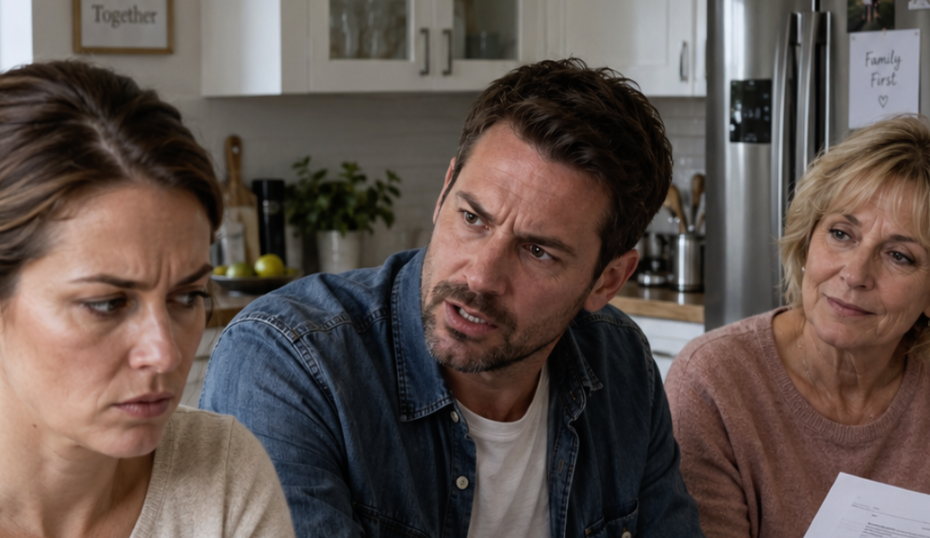
Dmitry stood in the middle of the hallway, feet planted apart as if he had grown into the parquet floor. In his hands, he held a folder of documents—the same one his mother had brought over that morning “just to show them.” Except it turned out she hadn’t brought them to show. She had brought them to be signed.
Olga stared at her husband and barely recognized him. Eight years together, and now there was a stranger standing in front of her, speaking in a stranger’s voice.
“Dima, do you even understand what you’re saying?”
“I do. I understand perfectly.”
Behind him, in the kitchen doorway, stood Tamara Ilyinichna—his mother. Quiet, modest, hands folded over her stomach, wearing the expression of a saintly martyr. As if she hadn’t been the one who, an hour earlier, had spread a deed of gift across the table and placed a pen beside it.
Olga took a breath. Twelve years of working as an accountant had taught her one simple rule: before arguing about numbers, check where those numbers came from.
And, naturally, this whole thing had started with her mother-in-law.
Tamara Ilyinichna was a woman with a complicated life story and very simple methods. All her life, she had gotten her way with one tried-and-tested technique—pressure. Soft, slow, sticky pressure, like syrup. She never shouted. She sighed, pursed her lips, dropped remarks such as, “Well, of course, who am I to any of you anyway?” and waited until the other person came running to apologize.
With her son, this method worked flawlessly. Dmitry had grown up without a father, and his mother had become his entire world—and had built that world according to her own plans. She decided which university he would attend. She chose his friends. Once, when Dmitry was twenty, she even caused a scene with a girl he was dating simply because the girl had “looked at her the wrong way.”
Olga’s mother-in-law tolerated her right up until the wedding.
After that came the sighs.
“Olenka, of course you make borscht your own way. In our family, we did it differently, but never mind, we’ll get used to it.”
“Olenka, you’re working? At your age, I’d already had two children. But everyone has their own priorities. I’m not judging.”
“Olenka, why is your wallpaper so pale? Your guests must feel gloomy. But of course, it’s your home. You know best.”
Olga endured it. She smiled, nodded, made borscht. She was one of those people who believed until the very end that kindness could overcome anything. That if she were gentle enough, accommodating enough, then one day she would be accepted.
She was wrong.
Her mother-in-law did not interpret gentleness as kindness. She interpreted it as weakness.
And Tamara Ilyinichna had no sympathy for the weak.
She used them.
The apartment that had caused the current firestorm had come to Olga from her grandmother. It was a two-bedroom apartment in a quiet neighborhood near a park, with high ceilings and large windows. Olga’s grandmother, Nina Petrovna, had lived there for forty years while working as a music teacher. She saved, economized, denied herself everything. And before she died, she left the apartment to her only granddaughter.
“Olya,” her grandmother had said then, holding her hand with dry, warm fingers. “This is yours. Yours alone. Don’t give it to anyone. Ever. Do you hear me?”
Olga had heard her.
And she remembered.
The young couple lived in that very apartment. Dmitry moved in after the wedding—he had no home of his own and had spent his whole life living with his mother in a small one-room apartment on the other side of the city. Olga didn’t mind. A husband was a husband; they lived together, so what was there to divide?
Then her mother-in-law began getting sick.
Tamara Ilyinichna’s illnesses were seasonal—and amazingly selective. They flared up at exactly those moments when she wanted something. If Dmitry mentioned taking a vacation alone with his wife, his mother’s heart would suddenly start acting up. If Olga bought herself a new coat, her mother-in-law would develop a migraine from worrying about “what you’re spending money on while your old mother walks around in rags.”
Six months earlier, Tamara Ilyinichna announced that she could no longer live alone. Her health wasn’t what it used to be. Her blood pressure was unstable. She was frightened at night.
“Dima, I’m not going to live forever,” she sighed into the phone loudly enough for Olga to hear. “I just need to be closer to you. So my son can be nearby. An old woman doesn’t need much.”
And Dmitry gave in.
As he always did.
His mother moved in with them “temporarily.”
Temporary became permanent. She took over the smaller bedroom, arranged her elephant figurines on the dresser, hung a portrait of her late husband on the wall, and began settling in as though she intended to stay forever.
Olga endured it again.
She felt cramped and uncomfortable. She felt like a guest in her own apartment.
But she endured it.
For peace.
For Dmitry.
And then, that morning, the peace ended.
Olga walked into the kitchen and found a silent tableau: her mother-in-law sitting at the table, a folder in front of her, and beside it an uncapped pen with a gold-colored cap. Dmitry stood by the window with the guilty look of a man who had already made a decision but had not yet gathered the courage to announce it.
“Olenka,” Tamara Ilyinichna cooed sweetly. “Dimochka and I have been talking. Sit down. We need to discuss something.”
Olga sat.
Inside her, something tightened like a string.
“You see, dear,” her mother-in-law said, stroking the folder as if it were a cat. “Life is unpredictable. Today we’re healthy, tomorrow—who knows? And I thought: what will happen to the apartment if, God forbid, something happens to you? On paper, Dima has nothing. He could end up on the street.”
“Nothing is going to happen to me,” Olga said evenly.
“Well, nobody knows what the future holds!” her mother-in-law exclaimed, throwing up her hands. “I thought I’d live to a hundred too. And now I’m barely walking. No, dear, you have to think about family in advance. We decided the apartment should be transferred.”
“To whom?”
“To me.”
Olga did not immediately understand.
For a moment, she thought she had misheard.
“To you?”
“To me,” Tamara Ilyinichna said with dignity. “I’m his mother. I’m the one who holds this family together. My mind is still clear, and I have experience. And when I’m gone, it will all pass to Dimochka, my only heir. That way it’s safer. You never know—you’re still young, you could get divorced, rush off and marry someone else, bring some strange man into your grandmother’s apartment. This way, everything stays in the family.”
And that was when Olga heard the important part.
Not the concern.
Not the health.
The part about a “strange man” and “keeping it in the family.”
Her mother-in-law wasn’t afraid for Dmitry.
She wanted control.
She wanted the only truly valuable thing in the family to belong to her—and through it, she could keep both her son and daughter-in-law on a short leash.
Olga looked at her husband.
“Dima. Did you know about this?”
Dmitry turned toward the window.
“Olya, what’s the big deal? Mom’s making sense. It really would be safer that way.”
And that was when the string inside Olga snapped.
But not with screaming.
Not with tears.
Instead, she suddenly became very calm.
It was the cold, crystal-clear calm that comes when every illusion collapses at once, crumbling to the floor like plaster.
She stood up, left the room, and returned a minute later. Her husband and mother-in-law watched her tensely.
“So you want me to transfer the apartment,” Olga said. “Fine. Let’s discuss it. But let’s do it honestly, with numbers. I am an accountant, after all.”
Tamara Ilyinichna straightened up, sensing victory.
“That’s my smart girl. I always knew you were sensible.”
“Sensible,” Olga agreed. “So. You are asking me to give you the apartment my grandmother spent forty years paying for. My grandmother, who worked as a music teacher for pennies and saved from every salary. And in return, I get… what?”
Her mother-in-law blinked.
“What do you mean, what? Peace of mind! Security for the future!”
“So, nothing,” Olga clarified. “I give away the apartment, and in return I get a promise that I’ll feel secure. Interesting exchange. And what if tomorrow you decide that living under the same roof with me is too cramped for you? You’ll be the owner. You could simply tell me to leave. From my own grandmother’s apartment.”
“How can you say such a thing!” her mother-in-law gasped. “I treat you like a daughter!”
“Like a daughter,” Olga nodded. “Tamara Ilyinichna, in eight years, you have never once said my borscht was good. You call me ‘Olenka’ with the expression of someone being forced to smell a sour lemon. You moved in with us ‘temporarily’ six months ago and rearranged the furniture to suit yourself. What kind of daughter am I to you? I’m a temporary inconvenience standing between you and this apartment.”
Silence fell over the kitchen.
Dmitry shifted from one foot to the other.
“Olya, why do you have to talk to Mom like that…”
“And you stay quiet,” Olga said without raising her voice, and for some reason Dmitry did. “You come later. I’m having a separate conversation with you.”
Her mother-in-law immediately changed tactics.
Righteous indignation had failed.
Now came the tears.
Tamara Ilyinichna dabbed her dry eyes with the corner of a handkerchief and began wailing.
“So this is the gratitude I get! I gave my entire life to my son, stayed awake night after night, and now in my old age I’m being thrown out of the family! Nobody needs me! I’ll die alone under some fence and not a soul will shed a tear!”
This was her signature performance.
Usually, by this point, the other person broke down, rushed to comfort her, apologized, agreed to anything—just to make the spectacle stop.
Olga poured herself a glass of filtered water and calmly drank half of it.
“Tamara Ilyinichna, you have your own apartment. A one-room apartment on Zarechnaya Street. You haven’t sold it or rented it out—it’s sitting empty. So you’re in no danger of dying under a fence. If you want, rent it out and add the income to your pension. I’ll even help you draft the agreement properly, honestly, with no tricks. That, by the way, would be real care. Unlike what you’re doing.”
Her mother-in-law’s tears dried up instantly, as if they had never existed.
Her gaze turned hard and sharp.
“You’ll regret this,” she hissed. “Dima will leave you. He won’t abandon his mother. Right, Dimochka? Choose—either your mother or this… calculating woman.”
Both women looked at Dmitry.
Dmitry stood between them—a large, fully grown thirty-four-year-old man, yet his face looked like that of a little boy caught after breaking a vase.
He opened his mouth.
Closed it.
Opened it again.
His whole life, he had chosen his mother.
His mother was the law, strength, authority.
Olga was the one who forgave.
The one who would always forgive.
“Olya,” he finally managed. “You understand… she’s my mother. I can’t… Let’s just sign it and everything will calm down. Mom doesn’t have that many years left anyway. What does it matter to you? Are you really that stingy?”
What does it matter to you?
Those words made Olga understand once and for all that there was nothing left to save.
A man asking you to hand over your grandmother’s inheritance to another woman because “what does it matter to you?” was not a husband.
He was just another person collecting tribute from someone else’s pocket.
Olga placed a sheet of paper on the table—the same one she had gone to get from the other room. It was an ordinary printer sheet, covered in her neat accountant’s handwriting.
“Fine,” she said. “Since we’re having a serious conversation, I’d like to show you something too. For clarity.”
She turned the paper toward her husband and mother-in-law.
“The apartment is registered to me under an inheritance. I inherited it four years ago, before Dima and I officially married… no, wait.” Olga checked her notes. “Actually, it doesn’t even matter when. Inherited property is personal property. It isn’t divided in a divorce. At all. Not a single kopeck.”
Dmitry went pale.
“Next,” Olga continued. “The deed of gift you brought, Tamara Ilyinichna, is voluntary. Nobody can force me to sign it. Not my husband, not my mother-in-law, not the police Dima threatened to call. In fact, if it turns out that someone pressured me in order to take possession of my home, then we’re talking about a very different matter. And a very different legal code. I won’t frighten you with details—just keep that in mind.”
Her mother-in-law opened her mouth, but Olga raised a hand.
“I’m not finished. Dima is registered at this address. Registration is just registration at a place of residence. It is not a share. It is not ownership. In a divorce, he will have to unregister. If he wants to do it peacefully, he’ll do it himself. If not, I’ll do it through the courts. The grounds are straightforward: the apartment is mine, and the family relationship will have ended.”
She folded the paper neatly in half.
“And now the main thing. Today, both of you showed me who you really are. Dima,” Olga looked at her husband, “in eight years, you have never once taken my side. Not once. Every time your mother humiliated me, you looked at the floor and stayed silent. But today, you didn’t just stay silent—you suggested that I give away my grandmother’s apartment. Calmly. As though it were obvious.”
Dmitry flinched.
“Olya, I didn’t mean it badly…”
“I know you didn’t,” Olga nodded. “That’s the problem. If you did it out of malice, at least that would be character. But you’re just… empty. All your life, you go wherever your mother pushes you. You have no will of your own, Dima. I spent eight years waiting for you to develop one. You never did.”
The silence became so thick they could hear pigeons cooing outside on the windowsill.
“So,” Olga said, getting to her feet, “here’s what I propose. Tamara Ilyinichna, you pack up your elephant figurines and your portrait and go back to Zarechnaya. That’s your home. You’ll be comfortable there. Dima, you are free to choose. If you want to stay with me, then today you tell your mother that I am not transferring the apartment and that we will live here alone, without her living right beside us. If you want to go with your mother, pack your things. But understand this: there will be no coming back. I’m changing the lock either way.”
“You have no right!” her mother-in-law shrieked. “This is his home too!”
“This is my grandmother’s home,” Olga said quietly but firmly. “She spent forty years teaching other people’s children music so she could pay for it. And before she died, she made me promise I would never give it away. Never. I’ve broken plenty of promises in my life, Tamara Ilyinichna. I will not break this one.”
Dmitry stood between the two women.
His mother drilled into him with the same demanding stare that had controlled him for thirty-four years.
His wife looked at him calmly and wearily, asking for nothing.
Simply waiting.
And in that silence, something shifted in Dmitry’s face.
For one second—just one—Olga thought he was about to straighten his shoulders, turn to his mother and say, “Mom, enough. Olya is right.”
But the second passed.
“Mom,” Dmitry whispered, without looking at his wife. “Come on. I’ll help you pack. We’ll go home.”
Home.
He had called the one-room apartment on Zarechnaya “home.”
So for him, home had always been there—with his mother.
He had only been visiting here.
For eight years.
Olga nodded.
She wasn’t hurt—or at least, not in the way she had feared.
Instead, there was a strange, clean feeling of relief, as though someone had taken a backpack from her shoulders that she had carried for so long she had stopped noticing how heavy it was.
“Fine,” she said. “Pack. I’m going for a walk. I’ll be back in two hours. Please make sure your things are gone by then.”
She took her keys, put on her jacket, and left.
Outside, it was cool and smelled of wet leaves.
Olga walked to the park—the same one her grandmother had once chosen the apartment for because of the view.
She sat on a bench near the pond where, forty years earlier, little Olya had fed ducks while holding her grandmother’s hand.
Her phone rang about forty minutes later.
“Tamara Ilyinichna.”
Olga looked at the screen, sighed, and answered.
The final loose end had to be tied up.
“Yes, Tamara Ilyinichna.”
“Shameless woman!” her mother-in-law’s voice rang loudly through the phone. “You forced a son to choose against his own mother! You destroyed the family! Are you happy now?!”
“Tamara Ilyinichna,” Olga answered calmly, “you were the one who forced him to choose. You gave the ultimatum: ‘Either your mother or your wife.’ I simply accepted his choice. Dima chose you. You won. Why are you shouting?”
“Because you… you…” her mother-in-law choked. “You left him without an apartment! Where is he supposed to go now?!”
“To you,” Olga said softly. “To Zarechnaya. You spent your whole life wanting your little son close by. Well, your dream has come true. Now he’s with you, under the same roof, forever. Make him borscht according to your recipe. The proper one.”
Silence hung on the other end.
Apparently, only now was Tamara Ilyinichna beginning to understand the full scale of her victory.
An adult son with no home of his own, no wife, back under his mother’s roof.
“He loved you,” her mother-in-law said more quietly now, without her earlier force.
“No, Tamara Ilyinichna,” Olga said, watching a duck lead a row of ducklings across the water. “He loved convenience. It was convenient when his mother made the decisions. Convenient when his wife endured everything. Convenient to have an apartment without having to pay for it. That isn’t love. That’s a habit of comfort. And the comfort is over.”
She ended the call.
That evening, Olga returned to an empty apartment.
The elephant figurines were gone from the dresser.
The portrait had disappeared from the wall.
In the smaller room, only a lonely dent remained in the parquet where her mother-in-law’s trunk had stood for the last six months.
Olga walked through the apartment and opened the windows wide.
Cool evening air flowed in, carrying the smell of the park.
For the first time in a long time, the apartment could breathe.
For the first time, it belonged to her grandmother again.
Quiet.
Bright.
Hers.
She called a locksmith to change the lock.
A calm middle-aged man arrived with a toolbox and replaced the cylinder in twenty minutes.
“Good lock,” he said as he packed up his tools. “Just make sure you turn it twice. Safer that way.”
“Three times,” Olga replied.
After he left, she made tea and took her grandmother’s old music book from the cupboard.
She flipped through its yellowed pages, covered in her grandmother’s handwriting:
“Olya—exercise for Thursday.”
“Repeat scales.”
Olga ran her finger over the lines.
“I didn’t give it away, Grandma,” she said softly, looking out at the darkening park. “Just like I promised. To anyone.”
Outside, the streetlights were coming on.
The apartment was warm, quiet, and spacious.
And for the first time in eight years, Olga realized that she wasn’t enduring the silence.
She was enjoying it.
Sometimes, in order to find your home, all you have to do is stop letting in the people who came to take it away.
And kindness is a good thing.
But only when it has a lock.
Preferably one that turns three times.