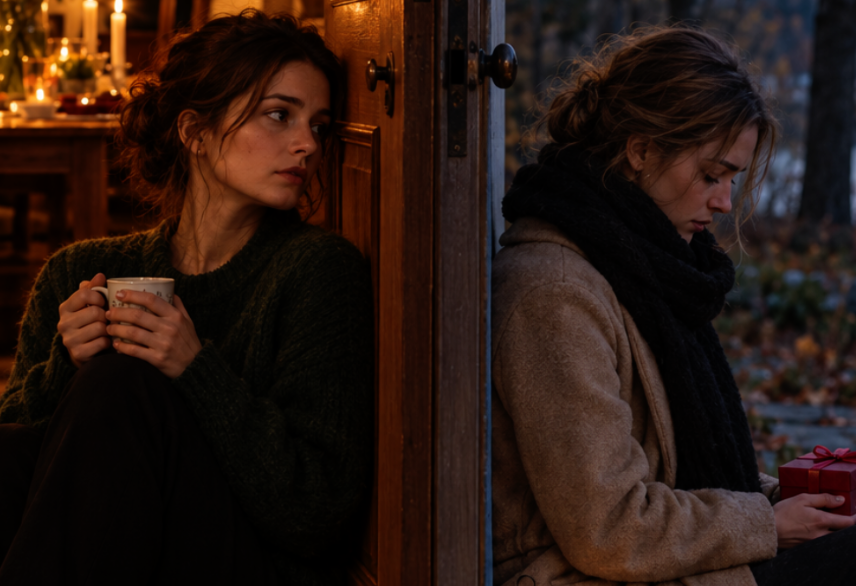
Six months ago, my husband left me for my best friend. I kept my pain to myself. Then, on my birthday, she showed up at my door, asking to come in. But by then, I already knew something she didn’t know about herself.
Fifty-two years old. Not a milestone, not a round number, no reason for a fancy restaurant or a crowd of guests. Just a simple birthday I planned to spend quietly with my daughter, a cake from the local bakery, and the peaceful silence I’ve grown used to over these past six months. Tanya called at ten in the morning, wished me happy birthday, and said she’d come by at three. Her voice was that same careful one she’s used with me all these months, as if I were made of glass, as if saying the wrong thing might cause me to shatter.
My best friend stole my husband
But I didn’t shatter. Not because I’m especially strong. By fifty-two, you realize that if you break every time someone betrays you, there won’t be anything left.
And yes, it was a real betrayal. The classic kind you see in TV dramas. My husband left me for my best friend. Twenty-six years of marriage, eighteen years of friendship with Lena, and just like that. Sergey packed his suitcase in March, when there was still dirty, pitted snow outside, and said he loved another woman.
He didn’t say her name. He didn’t have to.
I saw the way he looked at her at our kitchen table. I saw how she would avoid my gaze. I watched this for months and kept telling myself I was being paranoid. That my friend, who knew about my penicillin allergy, my fear of heights, the scar on my left knee from a bike accident in eighth grade, would never do such a thing.
But she could. And she did. Sergey left quietly. No drama, no shouting or broken dishes. He put his keys on the hall table, next to my little ceramic vase where I kept spare change for delivery couriers. The keys clinked against the coins. I remember that sound better than his words. The first week, I didn’t cry. I went to work, cooked dinner for one instead of two, washed a single plate, spoon, fork, knife, and cup. Just one set. The dish rack looked lonely.
On the eighth day, I broke down in the bathroom because I found his old razor behind the washing machine. The handle was cracked—he’d forgotten it there. That forgotten razor hurt more than his leaving did. Because he hadn’t just left. He’d left and didn’t even come back for the little things. I realized I had become a little thing.
Tanya came that evening. My daughter. Twenty-four years old, serious, with my eyes and his stubborn chin. She hugged me—no words, no advice, no, “Mom, you deserve better.” She just hugged me and held on until I stopped shaking.
It’s been half a year since then. Six months where I’ve learned to sleep diagonally across the bed. Six months where I stopped buying his favorite kefir (2.5 percent, only Prostokvashino, never any other kind). Six months in which I finally painted the bedroom walls a warm grey, because I’d always wanted to, and he always said grey was depressing. It wasn’t. It didn’t depress me at all.
And then came my birthday. September—warm, golden, with the scent of apples drifting over from the neighbor’s garden behind the fence. I live in a regular house on the edge of town, two stories and a small front yard. It was my father’s house before mine, before I got married, and it’s the only thing I never regretted. Sergey couldn’t lay claim to it. He didn’t even try. Tanya promised she’d be by at three. I put the kettle on, took the cake out of the fridge, sliced some lemon. There were two cups on the table. White, brand new. I bought them in August at a little shop on Pokrovka, just because I liked them. I used to buy dishes thinking about whether they fit the set. Now I didn’t have a set. Just single cups, each with its own character.
At two-thirty, the doorbell rang.
I thought Tanya was early. I wiped my hands on the towel, walked into the hallway, and looked through the peephole. Lena was on the other side. She wore a beige coat—the one we bought together three years ago at GUM. I’d told her how good it looked on her. Her hair was pulled back in a low ponytail. In her hands—almost painfully out of place—was a box of chocolates. Korkunov, in a red wrapper.
She rang the doorbell again. Then she knocked.
“Ira. I know you’re home. Your car’s by the gate.”
Same voice. Soft, a little husky. She always spoke quietly, as if saving her voice for something important.
I stood in the hallway, silent. My heart beat steadily, which caught me off guard. I thought seeing her would flip something inside, make it catch fire, burn. But nothing. Just silence. Like opening the door to an old cupboard and finding it empty.
“Ira, I need to talk to you. Please.”
Please. She always knew how to say that word—softly, almost apologetically, so you couldn’t refuse. For eighteen years, I never said no. Give me a ride to work, please. Watch Alyoshka for me, please. Lend me five thousand until Friday, please. I sat down on the hallway bench Sergey had made himself out of old boards. I kept that bench. It’s good, sturdy, and it didn’t do anything wrong.
“I’m not going to open the door,” I said. Quietly, but she heard. The door was thin.
A pause.
“I understand. But this is important. Really.”
“Lena. Go away.”
Another pause, longer this time. I could hear her shifting from foot to foot. Heels tapping on the concrete steps.
“I’ll wait,” she said. “I’ll stay right here.”
And she stood there.
I got up from the bench, went to the kitchen, sat at the table. Two white cups, cake, lemon. The September sun outside the window. From the hallway, I heard her breathing—or maybe I just imagined it. The phone rang. An unfamiliar number.
“Irochka, happy birthday, dear!” It was Vera Pavlovna, a former coworker—I used to work with her at the school. “How are you? How’s your mood?”
“Thank you, Vera Pavlovna. I’m doing well.”
“Oh, thank goodness. Galina told me she saw Sergey yesterday. Alone. Without ‘her.’”
“Vera Pavlovna, I don’t want to talk about Sergey.”
“Of course, of course. Just mentioning it. You know, Galina lives on Rechnaya, right across from his new place. She says she saw him alone. Without her. And he looked—God forgive me—just like a beaten dog.”
I thanked her and hung up. Alone. Without her. It didn’t mean anything. People go out to the store by themselves. People are alone sometimes.
But here’s the strange thing. Over the past two weeks, four different acquaintances have called me, and all of them, completely by chance, mentioned the same thing. Sergey is alone. Something happened. Nobody knew the details, but rumors in a small town spread like water on blotting paper.
I didn’t ask. Didn’t clarify. I didn’t want to know. And now Lena was standing on my porch with a box of chocolates.
The doorbell rang. I jumped.
“Mom, it’s me, open up!” my daughter Tanya called out.
I went to open the door. Through the peephole, I saw Tanya with bags and Lena standing to the side by the railing. They were looking at each other. Tanya was surprised, and Lena had an expression I didn’t recognize right away.
I opened the door.
Tanya came in, hugging her bags to her chest. A rush of cold air followed her in, along with the scent of chrysanthemums she was carrying.
“Mom,” she turned around, “Lena’s out there.”
“I know.”
“Has she… been waiting long?”
“About twenty minutes.”
Tanya put the bags down on the floor. She looked at me the way only daughters can: at the same time questioning and ready to accept any answer.
“Are you going to let her in?”
“No.”
She nodded. Took off her jacket and went into the kitchen. I closed the door. We drank tea. Ate cake. Tanya talked about work, about her new boss who doodles horses on the margins of his notepad at every meeting. I laughed. It was real laughter, not forced, not just for Tanya’s sake. I was genuinely amused. At one point, Tanya fell silent. She stirred her spoon in her cup.
“Mom, I have to tell you something.”
“About Lena?”
“About Dad.”
I set my cup aside.
“He called me last week. Twice.”
Sergey had called Tanya. That was something new. Since he left, he rarely called his daughter—once a month, briefly, out of obligation. Tanya would answer curtly. She hadn’t forgiven him, even though I never asked her to take sides.
“And what did he say?”
“He asked about you. It was weird, Mom. He never asks. And he did it twice.”
“Maybe his conscience caught up with him.”
“Maybe. But he also said something else. He wants to talk to you. He said there are things you need to know.”
“What things?”
Tanya shook her head.
“He didn’t say. But his voice… I don’t know, Mom. He sounded like he hadn’t slept for days.”
It was getting dark outside. September evenings come quietly, almost unnoticed, as if someone’s slowly turning down the light. I got up and turned on the lamp above the table. A yellow circle fell onto the tablecloth, our cups, and the crumbs from the cake.
“Is she still out there?” Tanya asked.
I went to the window. Through the curtain I could see the porch. Lena was sitting on the steps. The box of chocolates was beside her.
“Yes.”
“Mom, maybe…”
“No.”
Tanya didn’t argue. We sat for another hour. Tanya washed the dishes, I cleared the table. The usual routine, the usual evening. Almost. At eight, Tanya started getting ready to go home.
“Mom, call me if you need anything.”
“Alright.”
She hugged me on the threshold. Long, tightly. Then she left. I saw her walk past Lena, slow her pace, but not stop. She got into her car and drove away. Lena stood up from the step. Turned toward the door.
“Ira,” she said. “I won’t leave until you hear me out.”
I stood in the hallway. Behind me was the warmth of the kitchen, the glow of the lamp, the scent of cake and chrysanthemums. Ahead was a door with a woman standing behind it—a woman who knew more about me than anyone except my daughter. I didn’t open it. But I didn’t walk away either.
“Speak,” I said through the door.
There was a long pause. Then her voice came, but it sounded different. No pleasantries, no softness. Just dry, tired words.
“Sergey and I broke up. A month ago.”
There it was. The thing everyone had been whispering about. The reason for his calls to Tanya. I stayed silent.
“I know what you’re thinking,” she continued. “You think I came because he left me and I have nowhere else to go. That I’m here to complain. Or to ask for forgiveness, because now that he’s gone, my conscience caught up with me.”
Exactly. That’s precisely what I was thinking.
“But that’s not why I’m here.”
Her voice changed again, dropping lower. I could hear her lean against the door, the wood giving a little creak.
“Ira, I’m sick.”
Three words. The world outside the door changed entirely.
“I was diagnosed in August. Breast cancer. Stage two. I’ve already started chemo.”
I pressed my palm against the door. I didn’t know why. Maybe because there were just three centimeters of wood between us, and suddenly it felt like I could sense her breathing.
“Sergey left when he found out. Not immediately, no. He tried. For two weeks. Then he said he couldn’t handle it. That it was too much for him. That he wasn’t ready.”
She fell silent. I could hear something small tapping against the roof. Not rain—acorns. The oak by the fence always drops them in September.
“You know what’s funny?” she continued. “When he left you, he said he’d found true feelings. That life with me would be different. But half a year later, he left me too, because that different life turned out to be illness, nausea, losing your hair. He left because of the sickness, Ira. Not because of me.”
I sat down on the hall floor. Right on the cold laminate, my back to the door.
“I didn’t come to ask for forgiveness,” her voice was barely above a whisper. “Well, no, I did. But not for that reason.”
She swallowed. I could hear it.
“I needed you. Not him, not the doctors, not sympathy from people who barely know me. I needed you. Because you’re the only person who knows how scared I am of hospitals. Who knows I spent three months in surgery as a child and have needed the light on to fall asleep ever since. Who knows…”
She didn’t finish. I sat on the floor, staring at the wall across from me. There was a photo. Me and Lena, twenty years ago, by the lake, tanned, wet hair, laughing with all our teeth showing. I’d never taken that photo down. Not because I forgot, but because I was happy in that moment, and the picture belonged to me, not her. You know what’s the cruelest thing about betrayal? It’s not the act itself. You can grow used to it, process it, put it away on a distant shelf. The cruelest thing is that after betrayal, you can’t trust your own memories. Every good moment becomes suspicious. Every call she made, every “how are you?”, every dinner together. Was it real? Or had she already been looking at my husband?
I didn’t open the door. You need to know that.
“Lena,” I said. “I’m very sorry. About your diagnosis.”
“I know.”
“But I won’t open the door.”
Silence. A long one. It’s already totally dark outside. The lamp by the gate flickered and turned on, just like it does every evening at half past eight.
“I understand.”
I heard her get up. Heard her brush off her coat. Heard her pick up the box of chocolates.
“Ira.”
“Yes.”
“Happy birthday.”
Footsteps on the stairs. The squeak of the gate. Silence.
I sat on the floor for another ten minutes. Maybe twenty. My knees ached, so did my lower back—at fifty-two, sitting on laminate isn’t anything like it was at twenty. I got up. Walked to the kitchen. Turned on the kettle. Opened the window. The air smelled like autumn, earth, fallen leaves. Somewhere in the distance a dog was barking. My phone rang. Sergey.
I looked at the screen. His name. I still haven’t changed the label. Seryozha. With the small photo where he’s smiling, squinting in the sunlight. A photo from two years ago, our last vacation together. I didn’t answer. He called back a minute later. And again three minutes after that. Then he sent a message.
Ira, happy birthday. I need to talk. It’s about Lena. Call when you can.
I put the phone down. I washed the cup I’d had tea with Tanya in. One cup, white, with a blue rim. And then I cried.
Not because of Lena. Not because of Sergey. Because I felt sorry for her. Truly sorry, big lump in the throat, hot tears. And it was unfair. I didn’t want to feel sorry for her. I wanted to feel angry, to feel justified behind my closed door, to tell myself: she’s the one who made her own choices, she took my husband, and he took everything else from her.
But pity came anyway. Uninvited, out of place, real.
Because I knew about the hospital. Knew that Lena was six when she had her appendix removed with complications, and she was alone because her mother worked two shifts. Knew she sleeps with the light on. Knew that at the word ‘anesthesia’ her lips turn white. I was married to Sergey for twenty-six years. Was friends with Lena for eighteen. And this is what struck me that evening, standing in the kitchen with my face wet: Sergey left me for her, and then left her for himself. He never chose between us. He always chose what was easier. When life with me felt routine and boring, he left. When things with her got scary and heavy, he left. He always left.
And we stayed.
I stopped crying. Wiped my face with the kitchen towel—the one with sunflowers that Tanya gave me last birthday. I walked out into the hallway. There, on the porch by the door, was the box of chocolates. Korkunov, red wrapper. She had left it.
I picked up the box. Brought it inside. Set it on the cabinet next to the ceramic change bowl. The very one where Sergey once left his keys. Under the chocolates was a note. Ordinary sheet, torn from a notepad, tiny handwriting. I’d know it anywhere.
“Ira. I’m not asking for forgiveness because I know some things can’t be forgiven. I just wanted you to hear it from me, not from strangers. My first round of chemo is in a week. I’m scared. You’re the only one who knows why I’m so scared. I know I’ve lost the right. I just wanted to tell you. Lena.”
I read the note twice.
Then I folded it up and put it in the desk drawer. I didn’t throw it away. The night was warm, unusually gentle for September, with the window open and the sound of crickets outside. I lay in bed, diagonally, the way I’m used to, and I thought. Here’s what I thought.
Lena didn’t come to me because she had nowhere else to go. She has a sister in Voronezh. She has colleagues. She came because illness does a strange thing to a person: it reveals what truly mattered all along. Not the man you share a bed with. Not the passion you once thought was something extraordinary. But the person who knows you sleep with the lights on. And she lost that person. Because of her own doing. And now she was standing on that person’s porch with a box of chocolates, knowing the door wouldn’t open.
And I sat on the other side of the door, realizing that I hadn’t kept it closed out of anger. Not out of revenge. Not to punish her.
I didn’t open the door because the Ira who used to let anyone in who asked no longer existed. That Ira died in March, when the keys clinked against the coins. In her place, a different woman emerged. One with gray walls in her bedroom, cups of all different shapes, a birthday cake made for two. With the right to decide who to let in.
The closed door wasn’t a punishment for Lena. It was a boundary. The very first real boundary I had ever set in my life.
In the morning, I got up early. Made coffee. Stepped out onto the porch. September morning, cool, with dew on the railings. The oak tree behind the fence looked auburn, like a giant fox. The neighbor’s cat was sitting on the fence, squinting.
I took out my phone. Opened my contacts. Found her number. I hadn’t deleted it after everything. Still didn’t delete it now. I started to type a message. Spent a long time choosing my words. Deleted them. Started again.
“Lena. I’m not ready to talk. I don’t know if I’ll ever be ready. But I want you to know: I heard you. And I’m sorry you’re scared.”
I sent it.
I set my phone on the railing. Sipped my coffee. Watched the sun rise behind the rooftops. After ten minutes, the screen blinked. Her reply. One word.
“Thanks.”
I finished my coffee. Washed the cup. Put it back on the shelf, with the rest—mismatched, each one different. I looked at the photo on the wall. Twenty years ago. A lake, wet hair, teeth bright in the sun. I didn’t take it down. But I hung another photo next to it. Tanya took it in August, on the balcony, me laughing at something she said, hair tousled by the wind, a brush with gray paint in my hand.
Two photos. Two different people.
Both of them are me.