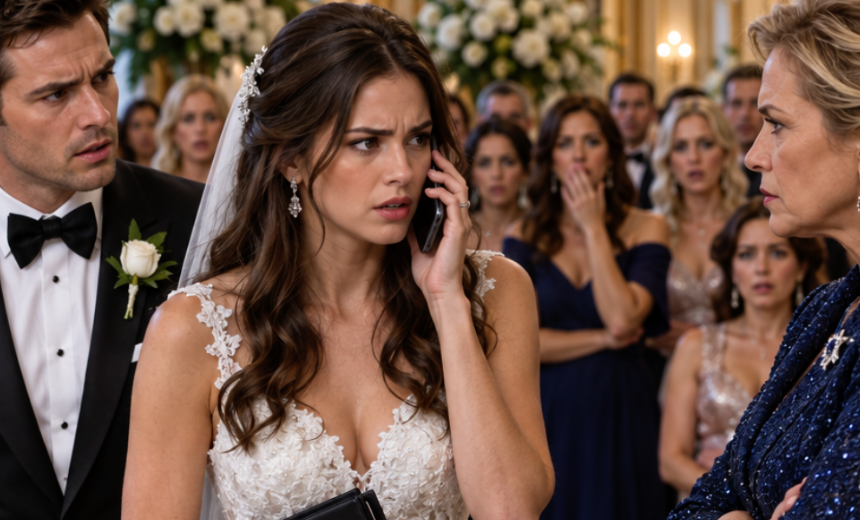
“Sign this, and then let’s go register,” Vera Nikolaevna handed me the folder with such calmness, as if she were just offering me a cup of tea.
Ten minutes left until the ceremony. All the guests were already seated in the hall. My father was fixing his tie in front of the mirror, my mom was dabbing her eyes with a handkerchief. And there I was, standing in the corridor of the Tver registry office in a white dress I’d sewn over two months, staring at a stack of papers in someone else’s hands.
“What is this?” I asked.
“A prenuptial agreement. We discussed this, remember?”
We had discussed it. Once, back in March, in Vera Nikolaevna’s kitchen. She had mentioned it would be good to have everything sorted legally so there’d be no questions later. I nodded. Artyom nodded too. The conversation lasted three minutes and melted away into lemon tea.
But what I was holding now was definitely not a three-minute conversation.
Seven pages in tiny font. Stamps. Notary signatures. Everything already notarized on one side. The only thing missing was my signature.
“Vera Nikolaevna, I can’t read all of this right now.”
“What’s there to read? It’s a standard form. Artyom already signed it.”
Artyom was standing a little apart, by the window. His suit looked perfect. He looked at me, but said nothing. Just waited.
I turned to the first page.
Clause three: all property acquired during the marriage with the husband’s money remains the property of the husband.
Clause five: in the event of divorce, the wife doesn’t claim a share in any real estate registered under the husband’s or his relatives’ names.
Clause eight: the expenses for raising any children will be split proportionally to the income of each spouse.
I looked up.
“Artyom, did you read this?”
“Yeah. Mom said it’s the right thing to do.”
That phrase. I remember it forever. Not “I think,” not “we decided.” Just, “Mom said.”
I was twenty-six. I worked as an economist in a construction company in Tver, earning forty-eight thousand. Artyom worked at his father’s company, earning, according to him, one hundred and twenty. The apartment we were supposed to live in after the wedding belonged to his parents. So did the car. Even the furniture was brought over by them.
If I signed this agreement, after a divorce I’d walk away with just a suitcase and a note proving I’d cooked borscht for eight years.
But I didn’t fully understand that yet. I just felt that something was off.
“I need time,” I said.
“What time?” Vera Nikolaevna raised her voice slightly. “People are waiting. The photographer’s waiting. The restaurant is paid for.”
“I’m not going to sign a prenuptial agreement ten minutes before my wedding.”
Silence.
Artyom turned to the window. Vera Nikolaevna straightened up, and for the first time I noticed how much she looked like a school principal summoning a student to the board. Only this student was all grown up now.
“Rita, do you understand what you’re doing right now?” she lowered her voice to a whisper. “You’re shaming our family.”
“Your family?”
“Our family. In ten minutes, you’ll be part of this family. Unless, of course, you’ve changed your mind.”
I hadn’t changed my mind. But I wasn’t going to sign either.
My mom peeked into the hallway.
“Ritochka, what’s going on? Everyone is waiting.”
“Mom, give me five minutes.”
She looked at the folder in my hands, at Vera Nikolaevna’s face. She didn’t ask anything. She just nodded and closed the door.
I sat down on the bench in my wedding dress and began to read. Vera Nikolaevna didn’t leave my side. She stood over me like an exam proctor.
It was the twelfth point that stopped me.
“In the event of divorce initiated by the wife, the wife agrees to pay compensation equal to the cost of the wedding celebration.”
I read that three times.
The wedding was paid for by Artyom’s parents — the restaurant, the photographer, the limousine, the rings. By my calculations, that was about seven hundred thousand. I’d be paying that off for a year and a half.
“What’s this?” I pointed to the clause.
“It’s only fair,” Vera Nikolaevna answered. “We made an investment. If you decide to leave, return what was spent.”
I looked over at Artyom. He was still standing by the window.
“Did you know about this clause?”
He just shrugged.
“Mom, maybe we should take it out?”
“No,” Vera Nikolaevna said firmly. “Everything stays as is.”
That’s when I closed the folder.
I didn’t throw it. I didn’t drop it on the floor. I just closed it, set it next to me on the bench, and stood up.
“I’ll marry you without this contract. Or I won’t get married at all.”
Vera Nikolaevna turned pale. Artyom turned toward me.
“Rita, why are you doing this?”
“What do you mean, ‘why’? I’m just asking to remove the clause where I’d have to pay for my own divorce. That’s a reasonable request.”
“You won’t have to pay anything if you don’t get divorced.”
It sounded logical. And at the same time, monstrous. Because the point was simple: don’t leave, or you’ll pay.
Minutes dragged on. Laughter drifted in from the hall. The photographer peeked in, saw my eyes, and quietly disappeared again.
“Fine,” Vera Nikolaevna suddenly said. “We’ll remove the twelfth point. Sign the rest.”
“No.”
“What do you mean, ‘no’?”
“I need my lawyer. I want him to read through the whole document.”
“What lawyer?! The ceremony is in five minutes!”
“Then we’ll reschedule the ceremony.”
The words came out so easily that I surprised even myself. It was like something clicked inside. Not anger. Not resentment. Clarity.
Artyom walked up to me and took my hand.
“Rita, please. We can talk about everything later. Just sign it for now, and after the wedding, we’ll figure it out.”
“Once the wedding’s over, this contract is valid.”
“We can change it afterward.”
“Then why sign it now?”
He couldn’t find an answer.
Vera Nikolaevna stepped closer and spoke in a completely different tone. Gentle, almost motherly.
“Rita, I understand you’re nervous. The wedding, the stress. But trust me, it’s just a formality. A piece of paper. It means nothing as long as you love each other. And you do love each other, don’t you?”
Beautiful words. Warm. And completely empty. Because if this paper means nothing, why is it so important ten minutes before the wedding?
I took out my phone.
“What are you doing?” Vera Nikolaevna quickly asked.
“I’m calling Natalia Sergeyevna. She’s a lawyer. My college friend.”
Natalia picked up after the third ring.
“Rita, aren’t you supposed to be signing right now?”
“Natasha, I need your advice. Right now. I’ll take pictures of the document and send them to you.”
I photographed all seven pages. Sent them. Vera Nikolaevna stood nearby, looking at me as if I were committing a crime.
Natalia called back four minutes later.
“Rita, don’t sign it.”
“Why?”
– Item five. It sounds standard, but in reality it strips you of any rights to property bought during the marriage if it was paid for from his account. Even if you contributed your share in cash. Proving otherwise later will be almost impossible.
– What about item eight?
– Child expenses are split according to income. That sounds fair, but if you go on maternity leave, your income drops to zero. So you’ll end up covering the child’s needs yourself when you return to work, but nobody will reimburse you for the time you were on leave.
I stayed silent.
– Rita, this agreement isn’t for both of you. It’s against you.
Natalia spoke calmly, like at a business meeting. No emotion. Just facts.
– One more thing, she added. – Item fourteen. Did you see it?
I didn’t read as far as fourteen.
– What does it say?
– In case of divorce, the wife agrees to vacate the premises within fourteen days.
– Fourteen days?
– Two weeks to pack up and leave. From an apartment that belongs to him. No right to rent at his expense, no temporary housing. Just leave.
I hung up the phone.
Vera Nikolaevna was looking at me. Artyom was looking at his mother.
– Who wrote this contract? I asked.
– Our family lawyer, Vera Nikolaevna replied.
– Your family lawyer wrote a document where, after a divorce, I’m left with no home, no property, and a wedding debt. And you call that a formality?
– You’re being dramatic.
– No. I read it all.
Artyom sat down on a chair by the wall.
– Mom, maybe this really wasn’t the right day for this?
– Artyom, we agreed.
– You and I agreed. Rita didn’t agree.
Those were the first words he said all day that weren’t from his mother’s script. Just from himself.
Vera Nikolaevna fell silent. Then she looked at her watch.
– They’re waiting for us.
– Let them wait, I said.
And that’s when my father came out of the hall. Calm, in a gray suit, with that familiar expression I remembered from childhood. He looked like that at parent-teacher meetings, quietly sitting while everyone argued, then saying one sentence that would silence the whole room.
– What’s going on? he asked.
– Rita is refusing to sign the prenup, said Vera Nikolaevna.
My father looked at the folder. Then at me.
– May I take a look?
I handed him the document.
He read it quietly. Page after page. No rush. Vera Nikolaevna shifted from foot to foot. Artyom stared at his shoes.
My father closed the folder.
– Vera Nikolaevna, he said quietly. – I’ve worked as an engineer for thirty-two years. In that time, I’ve learned to read documents. This one is drawn up skillfully, professionally, and completely in the interests of your family. My daughter will not sign it.
– Is that her decision or yours?
– Hers. But I support it.
He turned to me.
– Rita, if you want, we can leave now. The guests will understand. And those who don’t, we don’t need.
I looked at Artyom.
– Are you with me or with the contract?
He looked up. Eyes red. Not from tears, but from shame.
– With you.
– Then tell your mom.
He stood up.
“Mom, we’re getting married without a prenup. If you want, we can discuss it later, with two lawyers and do it properly. But not today.”
Vera Nikolaevna stayed silent for about ten seconds. Then she took the folder, put it in her bag, and walked into the living room. At the doorway, she turned back.
“You’ll regret this, Artyom.”
“Maybe,” he replied. “But not today.”
Fifteen minutes later, we were married. No prenup. The clerk smiled. The guests applauded. Mom cried. My father stood off to the side and just looked at me.
After the restaurant, once everyone had left, Artyom and I sat in his parents’ kitchen. I was still in my dress, just had taken off my shoes.
“Are you angry?” he asked.
“No. But I need to know—did you actually read that prenup before you signed it?”
He was quiet for a moment.
“Quickly.”
“Quickly.”
“Mom said it was just a standard form.”
“Artyom, that standard form has fourteen clauses, and eleven of them go against me.”
He rubbed his face with his hands.
“I know. Natasha is right. I read it afterwards, while you were dancing with Dad.”
“And?”
“I’m ashamed.”
I poured him some tea. And for myself, too. We drank in silence. It was enough.
Two weeks later, we went to an independent lawyer together. We made a new agreement. One that was fair. Equal rights, clear terms, no hidden traps. Artyom read every line. So did I.
Vera Nikolaevna didn’t visit us for a month. Then she reappeared out of nowhere, bringing pie and a jar of jam, like nothing had happened.
“So, have you made up?” she asked, setting the pie on the table.
“We never fought,” I replied.
She gave me a long look. Said nothing. But after that, she never asked me to sign anything again.
And I kept the folder with that first prenup. Not out of spite. Just as a reminder—to always read whatever you’re given to sign. Especially when someone says, “It’s just a formality.”
Formalities aren’t certified by a notary in advance.
If you appreciate stories where justice actually wins, stick around. There are plenty more like this to come.