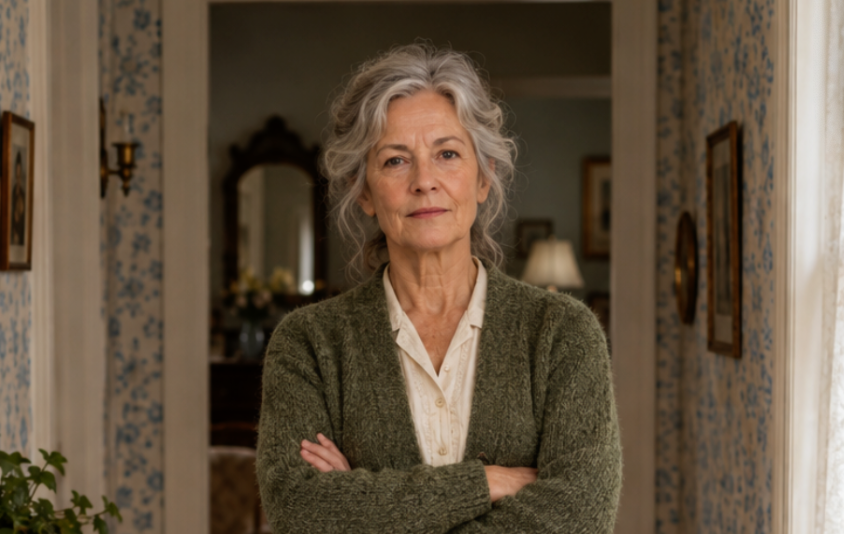
For thirty-seven years, Lyudmila endured it all. Not because she couldn’t leave, but because she truly believed that’s how things were supposed to be. Then one day, she opened her closet, pulled out an old suitcase, and packed it—not with her own things.
Lyudmila put the kettle on and glanced at the clock. It was twenty to seven. Gennady would be home in forty minutes, and by that time, the soup needed to be on the table. Not warm, not hot, but just the way he liked it: ready to eat right away, without having to blow on the spoon.
She had known this for thirty-seven years. Every evening, except for those when he went fishing with Petrovich. But Petrovich passed away the year before last, and the fishing trips came to an end.
There was a cactus on the windowsill in a clay pot. Lyudmila bought it twenty years ago, back when she still got herself things without asking for permission. The cactus survived. Sometimes, Lyudmila thought they were alike.
Gennady Vasilievich Kryukov, sixty-six years old, stood at one meter seventy-eight tall, with broad shoulders that over the years hadn’t really slumped but rather grew heavier somehow. His face was red—especially in the evenings. His eyebrows were thick, nearly white, and met at the bridge of his nose. When he was angry—and that was often—his right eyebrow would twitch. Lyudmila could predict the whole evening by watching that eyebrow.
He never hit her. No. He did something worse.
“What is this slop? Did you even try it before serving?”
Lyudmila stood by the stove, not turning around. The bowl of borscht steamed on the table. The borscht was good—she was sure. Fresh beets, straight from the market.
“Lyudmila, I’m talking to you.”
“I hear you.”
“She hears me—so what?”
He pushed the bowl aside, stood up, and went over to the TV. Within a minute, the sound of a soccer match filled the living room, and the apartment became just as it always was: quiet on the outside, but echoing inside.
She sat down at the table. Tasted the borscht. It was excellent.
She finished the whole bowl, taking her time. For the first time in a long while, she didn’t worry about whether he liked it.
Their daughter Tamara lived in Kaluga. Forty-one years old, two kids, a husband who worked as a programmer, a mortgage, and a corgi dog. Tamara called every Sunday at 11AM on the dot. The call lasted exactly twelve minutes: health, kids, the weather, and, “Mom, you know what Dad’s like.”
Lyudmila had heard that phrase so many times, it turned into background noise for her. Like the hum of a refrigerator. You just get used to it.
“Mom, is he at it again?”
“What do you mean, again?”
“Well, you know what I mean.”
“Everything’s fine, Toma.”
“Mom.”
“I said, everything’s fine.”
Tamara would sigh. Lyudmila could hear the corgi’s nails clicking on the laminate floor in the background. Then her daughter would say “okay” in that way that means nothing is actually okay, but there’s no point in arguing.
And they would both hang up.
After these calls, Lyudmila always went to water the cactus. Not because it needed water—she just had to keep her hands busy.
It all started because of a tooth.
In April, Lyudmila got a bad ache in her lower left molar. For three days, she toughed it out, pressing a salted towel to her cheek. On the fourth day, she told Gennady that she needed to see a dentist.
“And where would the money come from?”
“Well, it’s my pension.”
“Your pension, Lyudmila, is our money. Shared. Don’t you get that?”
She understood. She always did. Her pension: nineteen thousand four hundred rubles. Genady took fifteen thousand “for household expenses,” even though she was the one who managed the household and bought groceries with the remaining four and a half thousand.
“Rinse with baking soda. My mother’s teeth got better on their own.”
“Your mother died at fifty-two, Gena.”
He looked at her. His eyebrow twitched. Ludmila realized she had said too much and turned toward the sink. Her hands automatically picked up the sponge. She started washing an already clean plate.
But inside, something shifted. Small, quiet, like the click of a light switch in an empty room.
The next day, she went to the dentist. Paid three thousand two hundred rubles. From the savings she hid in a tin cookie box on the shelf. There were still eleven thousand left in the box. She had been saving for two years.
The tooth was fixed. Genady never found out.
And Ludmila thought: if he didn’t notice three thousand missing, he probably doesn’t notice that I’m even alive.
May was warm. Ludmila took out her summer shoes from the closet, beige with low heels, and realized they pinched her feet. After a winter of swelling and aching joints at night, she stood in the hallway with a shoe in her hand, thinking that she was sixty-four years old and didn’t own a single pair of shoes she had chosen herself.
Genady bought everything. Not out of generosity. Out of control.
“Why do you need red ones? Are you a clown? Take the black ones.”
“They’re burgundy, Gena.”
“I said black.”
Black. Gray. Beige. In thirty-seven years, not a spot of color. He even chose the kitchen towels himself: white, with gray checks.
She put the shoe back in the closet. Then took it out. Put it back again. And suddenly, to her own surprise, she tossed both shoes into the trash can.
They landed with a thud on top of the potato peelings in the bag. The sound was dull and final.
At the beginning of June, Valentina came to visit. The neighbor from the third floor, seventy-one years old, petite and wiry, with a sharp chin and a voice like a creaky un-oiled door. Valentina had outlived two husbands and remembered neither of them fondly.
“Ludka, why do you look so gray?”
“I’m fine.”
“Sure, you’re fine. Fine like a corpse. Look at those dead eyes. Do you even eat?”
“I eat.”
“What do you eat?”
“Soup.”
“What kind of soup?”
“Pea soup.”
Valentina sat down on the stool, crossed her arms, and looked at her with the kind of gaze women have who know everything about everyone. Not because they snoop, but because they’ve lived enough to see right through you.
“Does he give you any money?”
“Valya, don’t start.”
“I’m not starting. I’m asking.”
Ludmila stayed silent. She set a cup in front of her neighbor. Hot water, a tea bag, a bit of sugar. Valentina didn’t really drink tea bags, but she never refused. It was their ritual.
“My first husband, Tolik, was the same way. Watched every kopeck. ‘I earn the money, so I call the shots,’ he’d say. Then he had a heart attack, and there was no one left to call the shots. You know what I did?”
“What?”
“I bought myself a red dress. The very next day. Wore it to his funeral.”
Ludmila smiled. For the first time in a month.
“Valya, you’re crazy.”
“The crazy ones are those who stay quiet and put up with it for thirty years.”
The tea was getting cold. Outside, boys were kicking a ball around. The sound echoed off the courtyard walls, and suddenly, Lyudmila remembered when Tamara used to play there as a child, with Gennady shouting from their balcony, “Come home! Who do you think I’m talking to?” And the girl would run back, never looking over her shoulder—she knew if she did, it would be worse.
Her fingers gripped the edge of the tablecloth.
The apartment belonged to Lyudmila. It was a fact Gennady preferred to forget, and she preferred not to say out loud.
The one-bedroom apartment on Leningradsky Avenue had come to her from her mother. Her mother passed away in 1998, leaving her thirty-three square meters with a view of the poplar-lined alley and creaky wooden floors that Gennady had never replaced, even though he’d promised since the year 2000.
They lived in Gennady’s two-room apartment. The one-bedroom stood empty. Sometimes, Lyudmila would go there: she’d dust, open the window, sit on her mother’s stool by the window. She just sat there.
Gennady considered that apartment backup—”for a rainy day.” In his opinion, that day hadn’t come yet. Lyudmila thought differently, but didn’t say so.
In June, she went there again. She washed the windows, wiped down the radiators, and hung a new shower curtain in the bathroom: white, with sunflowers. The sunflowers were a striking yellow, almost screaming in their brightness. She stood and looked at them for five minutes.
Then she took out her phone and dialed Tamara—not on a Sunday.
“Mom? What’s wrong?”
“Nothing’s wrong. I just want to ask you something.”
“Mom, you’re scaring me.”
“Toma, if I kick him out, will you judge me?”
Silence. Long, like the corridor at a clinic. Lyudmila could hear her daughter breathing, the corgi rustling somewhere nearby, the ticking of a clock—even though Tamara didn’t seem to own a wall clock.
“Mom, I’ve been waiting fifteen years for you to say that.”
Lyudmila sank onto her mother’s stool. Her legs suddenly felt like jelly, and she braced herself on the wall to keep from sliding down.
“Really?”
“Really. Every Sunday when I call, I wait. I think: maybe today. Maybe today she’ll say it.”
“I thought you didn’t care.”
“Mom, I do care. I’ve never not cared. I just didn’t know how to help if you didn’t want help yourself.”
Lyudmila closed her eyes. The sunflower curtain swayed in the draft. The air smelled of freshly cleaned windows and dust that hadn’t yet settled.
She prepared for two weeks. No fuss, no rush. Like a chef working on a complicated dish: step by step, checking everything carefully.
First step: she called the legal clinic. A free one, run by the district social service center. A woman lawyer, about thirty-five, with a tired voice, explained things simply.
“Is the Leningradsky apartment registered to you? Inherited from your mother?”
“Yes.”
“He’s not officially registered there?”
“No. We live in his two-room apartment.”
“Then you’re the owner and you have the right to do what you want—rent it, sell it, live there. You don’t need his permission.”
“And if he’s against it?”
“He can be against it. But legally, it’s your property.”
Lyudmila hung up and sat for a minute, staring at the wall. The wall was yellow, hadn’t been painted in a long time. An old calendar from two years ago hung there. She hadn’t taken it down because it had a picture of Lake Baikal, and Lyudmila had always dreamed of seeing Lake Baikal.
Second: she went to the bank. She opened a separate account. Her own, just for herself, where Gennady had no access. When the young teller asked her for a ‘security word’, Lyudmila said ‘sunflower’. The teller smiled. Lyudmila smiled back.
Third: she found tenants. A young couple, both teachers, quiet people with a recommendation from Valentina’s granddaughter. Twenty-eight thousand a month. Lease agreement, deposit, everything done properly.
She wasn’t in a rush. She drank tea, ironed laundry, made soup. Gennady didn’t notice anything. In fact, he’d long stopped noticing anything except the TV, his plate, and his own reflection in the hallway mirror he passed by each time, always fixing his collar.
On June twenty-third, Monday, Lyudmila made dinner. Chicken Kiev, potatoes, cucumber salad with dill. Just the way he likes it.
Gennady ate in silence. Then leaned back in his chair.
“Not bad today. See, you can do it when you want.”
She nodded. Cleared the plates. Washed them. Dried her hands with a towel (white, in a gray check pattern). Hung the towel back on its hook.
Then she sat down across from him.
“Gena, we need to talk.”
He looked up. His eyebrow twitched.
“About what?”
“I’m leaving.”
He didn’t understand right away. Looked at her as if she was suddenly speaking another language.
“Where are you going? To the store?”
“No, Gena. I’m going to live in my mother’s apartment. Separately.”
Silence. The fridge hummed. On the other side of the wall, the neighbors’ TV was on—someone was watching the evening news.
“Are you out of your mind?”
“No.”
“Lyudmila, you’re sixty-four. Where will you go? You can’t spend a day without me.”
She folded her hands on the table. Her fingers didn’t tremble. She was surprised by that.
“I’ve lived with you for thirty-seven years, Gena. And for all thirty-seven years, you keep telling me I can’t do anything. I’ve decided to put that to the test.”
“Test what?”
“Whether it’s true or not.”
He stood up. The chair scraped across the linoleum as it slid back.
“Is this Valka’s idea? That old witch?”
“No. It’s my own idea.”
“Your own. In thirty-seven years, you haven’t made a single decision on your own.”
“Exactly. Time to start.”
He stood, bracing his knuckles against the table, looking down at her. His red face turned even redder. But Lyudmila didn’t look away. She watched his brows, the white hairs fused together, the wrinkle between them that got deeper when he was angry, and she thought: I used to be afraid of this. Now I just see an old man who got used to being in charge.
“I won’t allow it.”
“You don’t need to allow anything. And I don’t need your permission. The apartment is mine. Was mine, is mine, will always be mine.”
He sat down again. Slowly, as if someone had taken the spine out of him.
For the next three days, he tried everything. One by one, just like from some manual he’d never read but somehow knew by heart.
On the morning of the second day, he became suddenly kind. He brought her tea in bed. Lyudmila couldn’t remember the last time this happened. Maybe back in ‘89, when she had a forty-degree fever. And even then, she thought it was Tamara who brought the tea—she was fourteen then.
“Here, drink. I was thinking, maybe we should take a vacation? Go to a sanatorium or something.”
“Thanks for the tea, Gena.”
She took a sip. The tea was much too sweet. Three spoonfuls. He had no idea she stopped adding sugar eight years ago.
During the day, he became pitiful.
“Lyuda, how am I supposed to live alone? I’m sixty-six. Who will make soup for me?”
“You’re a grown man. You’ll learn.”
“I don’t know how.”
“I didn’t know either. At twenty-seven, I had no idea, but I learned because I had no choice.”
“That’s different.”
“It’s exactly the same.”
By evening, he became frightening. He didn’t shout. He spoke quietly, and that was so much worse.
“If you leave, I’ll take you out of my will.”
“You don’t even have a will, Gena.”
“I’ll write one.”
“Go ahead. I don’t want your apartment.”
He flinched. That line hit home because his power over her had always rested on two things: his apartment and her fear. The apartment remained. The fear was gone.
On the third day, he stopped speaking. He sat glued to the TV, changing channels without even looking at the screen. Lyudmila was packing her things. Just a few: two dresses, underwear, a warm robe, medicine, her passport, a tin from ‘Yubileynoye’ cookies. And a cactus.
She wrapped the cactus in newspaper and put it in a bag. Carefully, so the spines wouldn’t break.
Gennady saw her carrying the bag with the cactus to the door and said:
“Why take the cactus?”
“It’s mine.”
“It stood there for twenty years, just sitting there.”
“Exactly. Twenty years is enough.”
Her mother’s apartment smelled of cleanliness and a little bit of paint. The tenants hadn’t moved in yet—they would arrive in two weeks. Lyudmila sat on the stool by the window. Outside, the poplar trees rustled just as they had thirty years ago, when her mother was alive and made apple compote.
She placed the cactus on the windowsill. Next to a pot that had “For Lyudochka” written on it in black marker. Her mother labeled all the pots because she kept mixing up the flowers.
The phone rang. It was Tamara.
“Mom, how are you?”
“I’m home, Toma.”
“What do you mean, home?”
“At grandma’s apartment. I moved in.”
A long pause. Then her daughter’s voice returned, holding something Lyudmila had never heard there before. It wasn’t relief. Not joy. Something deeper, like when you finally let out a breath you’ve been holding for too long.
“Mom. Mom, I’ll come this weekend.”
“No need, Toma, it’s far.”
“I want to. I’ll come.”
Lyudmila hung up and cried. Not out of grief, not out of happiness. Just from a simple physical fact: she was sitting in her own apartment, on her own stool, and no one would tell her the soup was cold.
The tenants moved in on July first. A couple, both about thirty, quiet and polite. The woman, Darya, shook Lyudmila’s hand the first time they met and said:
“We’re very tidy. You have nothing to worry about.”
“I’m not worried,” Lyudmila replied. And she realized it was true.
Twenty-eight thousand hit her account on the fifth. Lyudmila opened her banking app (Tamara taught her via video call—explained three times, succeeded on the fourth) and looked at the number. With her pension, that was forty-seven thousand four hundred.
She had never managed that kind of money in her life.
That same day she went to a shoe store. Not the one Gennady always took her to—cheap, with plastic shelves and the smell of glue. A proper store, on the next street over, with a wooden floor and mirrors.
She tried on red low-heeled shoes. Soft leather, comfortable fit. Two thousand eight hundred.
“Are you taking them?” the shop assistant asked.
Lyudmila looked down at her feet in red shoes. Her feet were swollen, with a prominent bunion on her right foot and blue veins showing through the skin. They were not young feet. But they wore red shoes.
“I’ll take them.”
Gennady called every day. For the first week.
“Lyuda, come back. I tried to make borscht and all I got was red water.”
“There are recipes online, Gena.”
“What do you mean, online? I have no idea how to use that stuff.”
“Ask the neighbor.”
“Which neighbor?”
“Any neighbor.”
He’d go silent. Then call back two hours later.
“The washing machine is blinking. What does that mean?”
“It means you need to take out the laundry.”
“What laundry? I didn’t put any in.”
“Then you put it in and forgot. Open the door.”
She gave instructions in a calm, steady voice. No anger, no pleasure. Like a dispatcher who knows the route by heart.
By the second week, his calls became less frequent. In the third week, he called just once and said:
“You think I can’t handle it. But I can.”
“Alright, Gena.”
“I’m actually better off without you. No one’s nagging me.”
“I’m happy for you.”
She hung up and smiled. Because in Gennady’s language, “better off” meant “I’ve been eating packaged dumplings for three days straight and can’t find my second sock.”
August. Lyudmila bought a ticket to Irkutsk. Tamara sent her a link to a guesthouse by Lake Baikal—affordable, with a view of the water. Four thousand per night, breakfast included.
“Mom, are you serious?”
“I’m serious.”
“By yourself?”
“Who else would I go with, Toma?”
“With me. I’ll take vacation time.”
“No need. You have kids, a dog.”
“Mom. I’ve dreamed for thirty years of going somewhere with you—somewhere Dad never wanted to.”
Lyudmila sat on a stool, phone pressed to her ear, staring at a cactus. The cactus seemed a little taller. Or maybe she just imagined it.
“Alright. Let’s go.”
“Really?”
“Really, Toma. Let’s go.”
Valentina heard about Baikal and showed up with a jar of jam.
“Gooseberry. For the trip.”
“Valya, I’m flying. It’s a four-hour flight.”
“So what? Jam is useful everywhere.”
She put the jar on the table. The lid was tied with a red ribbon—crooked, in the old-lady way, but secure.
“Lyudka, I’m proud of you.”
“Oh, come on.”
“No, really. Thirty-seven years you lived with that jerk, and then you got up and left. Do you know what that is?”
“What?”
“That’s courage, Lyudka. Real courage.”
Lyudmila turned to the window. Beyond the glass, poplar trees rustled. Her throat tightened, and she swallowed hard so no one would notice.
Before leaving, she dropped by Gennady’s place to pick up the winter coat she’d forgotten.
He opened the door. He’d lost weight, his shirt was wrinkled, and the apartment smelled of something both fried and burnt.
“Hello, Gena.”
“Hello.”
She walked into the hallway. The mirror, where he always fixed his collar, was smeared with something greasy. The same coats hung on the rack. Her winter coat, burgundy (not red, burgundy—because red wasn’t allowed), was hanging on the end hook.
“I came for my coat.”
“I see.”
She took the coat. He stood in the kitchen doorway, blocking the way.
“Lyuda.”
“Yes?”
“Are you happy?”
He asked quietly, without mocking or prying. Just a simple question. And Lyudmila saw that he genuinely wanted to know. Maybe for the first time in thirty-seven years, he had asked her something where the answer honestly mattered to him.
“I’m calm, Gena. For the first time in a long while.”
He nodded and stepped aside to let her pass.
The hallway smelled of his cologne, the same ‘Shipr’ he’d bought since the eighties. The scent hadn’t changed. Nothing else had, either. But she was different now.
“You’re overcooking the chicken,” she said in the doorway. “Lower the heat and cover it with a lid.”
“I know.”
“No, you don’t. But you’ll learn.”
She closed the door and walked to the elevator. Her jacket smelled like the old apartment, and Lyudmila decided she’d wash it before her trip. Or throw it out. Or give it away. It didn’t matter. What mattered was the decision was hers.
Baikal looked just like it did on the calendar—only bigger. Much bigger. The water was so clear you could see the bottom meters down: rocks, greenish algae, shadows from the clouds.
Tamara stood beside her. Both of them were silent.
The wind blew in from the lake, chilly even in August, and Lyudmila pulled a woolen scarf from her bag. Her hands moved by habit, tying it under her chin. Tamara glanced at her mother and, suddenly, hugged her—tight, strong—like she hadn’t since she was a child.
“Mom, those red shoes look good on you.”
Lyudmila laughed. The sound was strange, hoarse, like someone who hadn’t laughed in a long time. She stood on the shore of Lake Baikal in red shoes, a jar of gooseberry jam in her bag, and thirty-seven years behind her—years that had finally come to an end.
Her phone chimed. A message from Daria: “Lyudmila Petrovna, everything is okay, the bathroom radiator is leaking a little, we called the plumber. Don’t worry.”
She typed back: “Thank you, Dasha. Call if anything comes up.”
Then she put her phone away and looked at the water.
The water was cold and calm. Just like her.
In autumn, Lyudmila signed up for a computer skills course at the library. Not because she didn’t know how—Tamara had taught her the basics. But she wanted to leave the house for things other than groceries.
There were eight people in the group. Six women and two men. All over sixty. The instructor, young, with round glasses and a knitted vest, called everyone by their full name and never rushed anyone.
“Lyudmila Petrovna, click the right mouse button here.”
“And what if I click the left one?”
“Something different will happen.”
“Like what, exactly?”
“Try it and see.”
Lyudmila clicked the left button. Something unexpected popped up. She laughed.
The woman next to her, Faina Arkadyevna, laughed too. She wore big hoop earrings and had a voice like a radio host.
“Yesterday, by accident, I sent my selfie to my husband’s email. My ex-husband’s.”
“And? What did he say?”
“He wrote, ‘Faya, you’ve gotten prettier.’ After fifteen years of silence.”
“Did you reply?”
“I deleted it. Let him think he imagined it.”
Both women laughed, and the instructor smiled at them—because that’s what these courses were really for. Not computers, but people.
In November, Gennady called. His voice was different, quieter, without pressure.
“Lyuda, my blood pressure’s up.”
“Call an ambulance, Gena.”
“I did. They said it’s nothing serious.”
“See?”
“You’re not going to come?”
She fell silent. Outside, a light rain was falling. The cactus on the windowsill stood there as always, unfazed.
“Gena, I’m not going to come every time your blood pressure acts up.”
“I’ll be seventy soon.”
“You’re sixty-six.”
“Well, almost.”
“Not almost. Gena, you have an apartment, you have your pension, you have your hands and feet. You can live on your own. People do.”
“But what if I feel bad?”
“If you feel sick, call an ambulance. If you’re lonely, get a cat.”
He was quiet.
“A cat.”
“A cat. They aren’t pushy. You’ll like it.”
She hung up and walked to the window. Rain traced crooked paths down the glass. Lyudmila ran her finger along the window frame. It was wooden, old, her mother’s. There were knife marks left behind—her mother used to slice bread at the window when the kitchen table was covered in jars of pickles.
Those scratches were the most precious thing in the apartment.
December. Tamara sent a photo: the kids were building a snowman, the corgi running circles around them, her husband holding a carrot for the snowman’s nose.
Lyudmila stared at the photo for a long time. Then she sent 20,000 to her daughter’s card. Just because. For the first time ever, she could send someone money “just because.”
Tamara replied: “Mom, you don’t need to.”
Lyudmila wrote back: “I do.”
Valentina came over with a pie.
“With cabbage. Your favorite.”
“Apple is my favorite, Valya.”
“Really? I’ve thought for thirty years it was cabbage.”
“No, with apple.”
“Alright, next time it’ll be with apple.”
They sat in the kitchen, drinking tea. The pie was delicious, even if it was with cabbage. Outside, snow was falling—the first of the year. Big, slow flakes, just like in Christmas movies.
“Lyudka.”
“What?”
“Will you be alone for New Year’s?”
“Tamara is coming.”
“And after that?”
“After that, I’ll be alone.”
“Come to me.”
“But you always go to bed at ten, Valya.”
“So what? We’ll go to bed at ten. Both of us. It’s better than being alone.”
Lyudmila smiled. The tea was hot. The pie was soft. Snow drifted outside, and she had nowhere she needed to rush.
For New Year’s, Tamara brought a box. Inside were red mittens—thick, wooly, with white snowflakes.
“Mom, these are so you don’t get cold.”
“Toma, I’m sixty-four, not eight.”
“So what? You got cold at eight too.”
Lyudmila put on the mittens. They were soft, a bit big, and inside they smelled of something woolly and warm.
Her daughter stood in the hallway, watching her, and Lyudmila could see Tamara’s eyes were watery, but she didn’t cry—she just stood there, staring.
“What?”
“Nothing. You’re just different.”
“Different how?”
“Alive, Mom. You’re alive.”
Lyudmila pulled the mitten off her right hand, took her daughter’s fingers, and squeezed tight. Hard. Like holding onto something you were afraid you might lose.
There was a cactus on the windowsill. It didn’t bloom. Cactuses rarely flower, only when they want to. But it looked healthy: bright green, sturdy, with a new spine on top.
Lyudmila had noticed it that morning when she was wiping the windowsill. A new spine. Tiny, barely visible. But it was there.
In February, Gennady sent a photo. A cat. Ginger, with a white spot on its nose, sprawled on the sofa.
Caption: “I named him Borscht.”
Lyudmila looked at the picture, then at the cactus, then out the window where March sunlight was beating against the glass—even though it was still only February.
She didn’t reply. Not because she didn’t want to. Sometimes there’s no need to respond. Sometimes, it’s enough to know that life goes on. For everyone. In different ways. But it goes on.
The red shoes were standing by the door. She put them on and stepped outside.