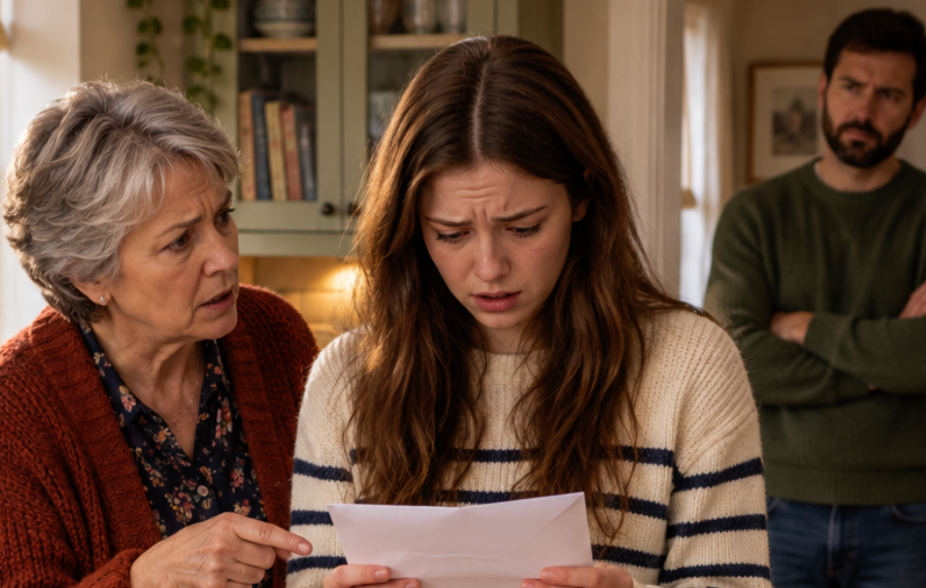
Galina showed up at her daughter-in-law’s birthday with an envelope and a warm smile. But inside, there wasn’t a greeting card. Instead, it was a deed to the apartment they lived in—registered in her mother-in-law’s name.
The cake had been sitting on the table for forty minutes. No one had lit the candles.
Vera traced her finger along the edge of the dish, picked up a smudge of frosting, and wiped her hand on her apron. Thirty-three years old. Not a milestone, not an anniversary. But Rodion said, ‘Mom’s coming, she’s already on her way.’ As if that explained everything.
Galina Petrovna always arrived on time. Never early, never late. Exactly at the appointed hour, wearing a maroon jacket, her hair styled so perfectly not a single strand dared to stray. She was sixty-two but held herself as if she had practiced walking with a book on her head when she was young. Maybe she had.
The doorbell rang—short and sharp. Just once.
“Verochka, happy birthday, dear.”
She handed over the envelope. White, thick, with no writing on it. And she hugged her daughter-in-law the way people do at funerals: tightly, but only for a moment.
Vera took the envelope and immediately sensed there was no card inside. Something firmer. A few sheets of paper, folded in quarters.
“Thank you, Galina Petrovna.”
“Open it later, don’t rush. Where’s my grandson?”
Mitya dashed out of the room and bumped his forehead into his grandma’s stomach. She stroked the back of his head, and her face changed. Softer. As if someone had turned an invisible dial.
Rodion came out of the kitchen with a towel over his shoulder.
“Mom, come in. Want some tea?”
“I do.”
He always asked. She always answered the same way. A ritual that had never failed in eight years.
Vera placed the envelope on the shelf in the hallway, between a stack of mail and a box of keys. She had no intention of opening it in front of everyone. Something about the way Galina handed it over, how quickly she withdrew her hand, made it clear: not now.
They sat at the table. Cake. Tea. Mitya smeared frosting over his cheeks and giggled. Rodion chatted about the renovations at the office, his mother listened and nodded, adding berries from her plate to her grandson’s.
Vera watched them and kept thinking about the envelope.
She couldn’t help herself. It was like an itch in the middle of her back she couldn’t reach. What was in there? Money? Some sentimental handwritten message? Galina Petrovna sometimes wrote real letters, by hand, with an old inky pen she had kept since the nineties. Vera had received one after the wedding. It was about a wife’s duty and about patience. She read it back then, folded it up, and tucked it away in a jewelry box. Never went back to it.
“Verochka, you’re not eating.”
“I’m just lost in thought.”
“About what?”
Vera looked at her mother-in-law. Galina held her teacup with both hands, thumbs on the rim. Her nails were neat, unpolished. She still wore her wedding ring, even though Viktor Sergeevich had passed away four years ago.
“About work, Galina Petrovna. End of the quarter.”
“I understand. Rodia, pour me some, please.”
Rodion got up and took the teapot. Vera noticed the way her mother-in-law watched her son—a long, evaluating glance, not anxious, as if she was tallying something up inside herself.
Mitya went to bed at nine. Galina Petrovna left at half past nine. She hugged Vera at the door, patted her on the shoulder.
“Read the envelope. Don’t put it off.”
And with that, she left. Her heels clicked evenly and sharply down the stairs, like a metronome.
Rodion was washing the dishes. The water hummed as he softly sang something indistinct. Vera went over to the shelf, picked up an envelope, and walked into the bedroom.
She sat down on the bed. The lamp on the nightstand cast a yellow circle of light. Pipes rumbled behind the wall. It was a February evening, the radiators working at full force.
She opened the envelope.
Inside were three sheets of paper. Folded neatly, as if measured with a ruler. The paper felt thick, with watermarks. There was a notary header at the top.
Vera read slowly. The first paragraph. The second. The third.
Then she went back to the beginning and read it again.
A deed of gift. An apartment at the following address: city, street, building, apartment. The very apartment where they had sat at the table an hour ago. Where they had been living for five years. Where Mitka had taken his first steps, and Vera had painted the living room walls because the old color seemed too cold to her.
Donor: Rodion Viktorovich Styopin.
Recipient: Galina Petrovna Styopina.
Date: the day before yesterday.
Rodion’s signature at the bottom. His handwriting. That slanted “S” she would recognize anywhere.
Vera closed her eyes. Then opened them. The letters were still there.
She sat on the bed for about twenty minutes. Maybe more. The sound of water in the kitchen stopped. Rodion was rustling around, then turned on the TV. Quietly, just like he always did when he thought Mitka was already asleep.
Vera put the papers back into the envelope. Her hands were steady. That surprised her. She had expected shaking, tears, at least a dry mouth. But there was nothing. She felt empty and smooth inside, like the bottom of a clean pot.
She walked out into the hallway.
Rodion was sitting on the couch, feet up on the ottoman, remote in hand. A fishing channel on TV. He didn’t even fish.
“Rodya.”
He turned around. Saw the envelope in her hand. And she realized: he knew. He knew exactly what was inside.
His face changed. Just a little. His chin tucked in, like a boy caught doing something he shouldn’t.
“Ver, I wanted to tell you.”
“When?”
“Tomorrow.”
“Tomorrow, Rodya? Your mother brought me a deed of gift for my birthday. For our apartment. In her name. And you were going to tell me tomorrow?”
He turned off the TV. Set the remote on the armrest.
“Please, sit down.”
“I’ll stand.”
Pause. Something clicked in the radiator, then the humming returned. A car passed by outside, its headlights gliding across the ceiling.
“It’s not what you think.”
“Then explain what it is.”
Rodion rubbed the bridge of his nose. He always did that when searching for words. Vera knew every gesture of his. Eight years. That’s a lot.
“Mom asked me. After Dad died, she had problems with his brother. Inheritance, shares—you remember, it dragged on for a year and a half.”
“I remember.”
“She was afraid Vitaly would file for division and that the court would count all property. She asked me to transfer the apartment to her name so that, officially, I wouldn’t have anything they could touch.”
Vera stood in the doorway, watching him. Light from the kitchen shone on her back, and Rodion probably saw just her silhouette.
“When did you do this?”
“Two days ago.”
“When did she ask you?”
“In October.”
October. Four months ago. They went to IKEA together, picking out shelves for Mitka’s room. She’d twisted fabric samples in her hands, and he’d said, ‘Take any you want, this is our home.’
Our home. The one he started signing over to his mother just a month later.
“Why didn’t you tell me?”
“Because you wouldn’t have agreed.”
“And did you ever think about why I wouldn’t have agreed?”
He stayed silent, rubbing the bridge of his nose again. Suddenly, Vera saw him in a way she never wanted to: not weak, but obedient. Like a boy who’s always done whatever his mother asked, and spent his whole life explaining those choices to his wife.
She didn’t go to bed that night. Instead, she sat in the kitchen, drinking glass after glass of water—tea just wouldn’t go down anymore. Cake crumbs still lay on the table. Vera brushed them onto a saucer with her hand.
Her mind was eerily quiet. No shouting, no resentment, no rage. Just something else. Like you’re walking across a bridge and realize it was just drawn in chalk.
She pulled out her phone and dialed the number. Three rings.
“Lena, are you asleep?”
“Not anymore. What happened?”
Lena, her older sister, lived in Tver. She worked as an accountant, kept a cat, and grew tomatoes on her windowsill. Her voice was always calm and steady, like the horizon.
“Rodion signed the apartment over to Galina.”
“Which apartment?”
“Ours. The one we live in.”
Silence.
“Wait. The one you both bought together?”
“That one. With the maternity capital and a mortgage. The one I paid off for three years out of my own pocket.”
Lena went quiet. Vera could hear her sister sit up, the bed creak, the click of a light switch.
“Was he even allowed to?”
“The apartment was in his name. Was.”
“What about the kids’ shares?”
“We were supposed to give them their share after the mortgage was paid off. We didn’t.”
“Vera.”
“I know.”
Another pause. The kind long enough to fit a year’s worth of unsaid words.
“Does Galina know you saw the documents?”
“She gave them to me. For my birthday. In an envelope.”
“She gave them to you?”
“Lena, she gave them to me as a present.”
The silence on the line changed. It wasn’t empty anymore—it was thick, crowded with all the things Lena couldn’t bring herself to say yet.
“Come to me. Bring Mitka and come.”
“Not now.”
“When?”
“I need to figure things out.”
“Figure out what?”
“What to do.”
Morning came gray, like a rain-soaked newspaper. Vera stood by the window, looking out at the yard. The playground, three birch trees, the dumpster. The world hadn’t changed. And for now, neither had she.
Rodion walked out of the bedroom in his underwear and T-shirt. His eyes were red—he probably hadn’t slept either.
“Vera.”
“The kettle’s boiled.”
He poured himself a coffee and sat down at the table. Vera stayed at the window, not turning around.
“I’ll call Mom and ask her to give it back.”
“When?”
“Today.”
“And if she doesn’t?”
He put his mug down and coffee spilled onto the table, leaving a small brown puddle.
“She will.”
“How do you know?”
“Because I’ll ask her.”
Vera turned to him. Slowly.
“You’ve already asked. In October, she asked you to sign the apartment over and you didn’t say no. You didn’t even talk to me about it. You went straight to the notary and signed. And then you kept it from me for four months.”
He stared into his mug.
“I thought I’d sort it all out before you found out.”
“Sort out what? You gave away the apartment, Rodya. Not a garage, not a car. The apartment your son lives in.”
“She’s not going to throw us out.”
“Well, I never planned to live in someone else’s apartment.”
Mitka started crying in the kids’ room. Vera walked out, not waiting for a response.
During the day, she called a lawyer recommended by a colleague from work. The lawyer was a woman with a dry, businesslike tone. Vera introduced herself and briefly explained her situation.
“Have you used your maternity capital?” the lawyer asked.
“Yes,” Vera replied.
“Did you allocate any shares to the children?”
“No.”
“Is the mortgage paid off?”
“Two years ago.”
“Then you have grounds for action. When using maternity capital, you sign an obligation to allocate shares to the children. Your husband broke that obligation. And the notary who handled the deed of gift also made a mistake.”
“Does that mean the deed can be challenged?”
“In court. The deal was made in violation of a minor’s rights. The child’s share should have been allocated before making any transactions with the apartment.”
Vera jotted down words on a napkin: “violation of obligation,” “child’s rights,” “invalid transaction.” The letters seemed to jump around.
“How long will this take?”
“About five to six months. If there’s no appeal.”
“And if there is an appeal?”
“Up to a year.”
Vera put her phone down on the table and stared at the napkin. A whole year. A year living in an apartment that, on paper, belonged to her mother-in-law. A year of conversations and silences, of Mitka’s morning performances and Rodion’s promises.
That evening, Rodion said he’d called his mother.
“Well?”
“She said she’ll keep everything as it is for now—until things are settled with Uncle Vitaly.”
“Until it’s settled? When will that be?”
“She didn’t say.”
Vera washed apples under a stream of cold, February water. The apples were from the bag that Galina Petrovna had brought yesterday with the envelope—red, all the same size, like something out of a picture.
“Rodya, do you understand what you’ve done?”
“I understand.”
“No, you don’t. You gave away your own child’s home—on the first request—without even arguing.”
“I did argue.”
“With whom?”
“With her.”
“And what did she say?”
“That it’s temporary. She promised to sign it back over when everything is sorted out.”
“And you believed her.”
“She’s my mother.”
Vera turned off the water, set an apple on the towel, and looked at her husband in a way she hadn’t for a long time. Not with hurt or anger, but with a kind of exhaustion, something even deeper—like staring at the wall at the end of a hallway.
“I was someone’s daughter too. And my father never once in his life signed a paper that could have left me without a roof over my head.”
He wanted to answer, opened his mouth, then closed it. He stood and walked into the other room.
A week later, Vera filed an application with the prosecutor’s office. Not in court—with the prosecutor. She based it on the violation of the obligation to allocate shares to a minor when using maternity capital.
The lawyer had said: this will be faster.
“The prosecutor’s office will issue an order. Either they honor the obligation voluntarily, or we go to court with the prosecutor’s conclusion. That strengthens your case.”
Vera filled out the form in the prosecutor’s corridor—plastic chair, faint smell of bleach, three people ahead of her. She wrote down Mitka’s name, his birthdate, the apartment address. The letters no longer jumped.
Rodion found out that evening.
“You filed with the prosecutor’s office?”
“Yes.”
“Against me?”
“Against the situation.”
He sat down on a stool in the hallway, not even taking off his boots.
“Why?”
“Because you lied to me for four months. Because the apartment is in your mother’s name. Because Mitka doesn’t have the share he’s entitled to by law. And because I don’t believe in promises anymore.”
“I would have fixed it.”
So when, Rodion? In a year? In five? When will Galina Petrovna finally decide everything with Vitaly is settled?
He stayed silent. His shoes were wet, leaving marks on the linoleum.
“You could have talked to me first.”
“I did. A week ago. You called your mom, and she said, ‘not yet.’ And you went along with it.”
Mitka peeked out of his room.
“Mom, are you two arguing?”
“No, honey. Dad just came home from work, he’s going to get changed.”
Rodion took off his shoes and left for the bathroom. Vera stood in the hallway. The envelope was still on the shelf: white, thick, no inscription.
Galina Petrovna called two days later. Her voice was steady, not a single crack.
“Verochka, I need to talk to you.”
“Come over.”
“Not over the phone. In person.”
“I said, come over.”
She came on Saturday. No apples, no envelope. Wearing the same burgundy jacket but no earrings. Vera noticed immediately. Without earrings, Galina Petrovna looked different. More vulnerable. Or maybe it was all part of the act.
“Tea?”
“No.”
They sat in the kitchen. Mitka was at his developmental class; Rodion had taken him in the morning and hadn’t returned. Must have known his mother would come.
Galina Petrovna placed her hands on the table, fingers intertwined. Her wedding ring caught the light.
“You filed a complaint.”
“Yes.”
“Against my son.”
“For breaking the law.”
“Verochka, this is a family matter.”
“No, Galina Petrovna. This is a legal matter. The apartment was purchased with maternal capital. By law, all family members must have a share. Mine and Mitka’s. But we don’t. Because your son never registered our shares; instead, he transferred the property to you.”
Her mother-in-law didn’t look away. She rarely ever did.
“I explained to Rodion. It’s only temporary.”
“A temporary measure you never thought to tell me about.”
“I did think to. I brought you the documents.”
“On my birthday. In a gift envelope.”
Silence. A crow cawed outside the window. Long and harsh, like an old woman on a bench.
“Why did you do it this way, Galina Petrovna? The envelope, the greeting, the smile—why?”
Her mother-in-law raised one eyebrow. Barely noticeably.
“I just wanted you to know.”
“Know what?”
“That the apartment is mine. Not to threaten, not to scare—just so you’d know. So there would be no confusion between us.”
Vera leaned back in her chair. There it was. Not a gift, not a coincidence—this was a message. The pieces were being set.
“You wanted to show who’s in charge here.”
“I wanted to be honest.”
“If you wanted to be honest, you would have talked to me before you took the apartment. Not after.”
Galina Petrovna stood up and straightened her jacket.
“I see this conversation isn’t going to work.”
“No, it did work, Galina Petrovna. It turned out exactly the way you planned.”
Mother-in-law left. The door closed quietly behind her. No bang, no creak.
The prosecutor’s office replied three weeks later. The order was to correct the violation, allocate shares according to obligations, deadline: thirty days.
Rodion read the document and put it down on the table.
“Well, here it is.”
“What do you mean, ‘here it is’?”
“We have to allocate the shares.”
“First, we need the apartment back.”
“Mom won’t sign the transfer back if I just ask nicely.”
“Then we’ll have to go to court.”
He rubbed the bridge of his nose. It was the third time in this conversation.
“Vera, do you really want to take my mother to court?”
“I want Mitka to have a roof over his head. His own. Legally his. Not a gift from his grandmother—who might change her mind at any time.”
“She won’t change her mind.”
“She’s already changed her mind once. Promised to give it back, and didn’t.”
He stayed silent. For a long time. Vera stood by the stove, warming milk for Mitka. A white foam started to rise, and she pulled the pot off just in time. Years of habit. Her body knew before her mind did.
“I’ll go to the notary, have a talk.”
“With whom?”
“With the one who handled the paperwork.”
“Rodja. The notary completed the deal knowing there was maternity capital in the apartment. He broke the law too. Helping us is not in his interest.”
“Then I’ll find someone else.”
“I already have a lawyer.”
He looked at her. There was something new in that look. Not anger, not hurt. Confusion. Like a person who always thought there was only one door out of a room, and suddenly discovered a second.
“You made up your mind without me.”
“You signed everything without me.”
The foam subsided. The milk cooled. Vera poured it into a cup with a bear on it and took it to Mitka.
The court date was set for April. Vera filed a claim to declare the gift agreement invalid. The reason: violation of a minor’s rights, disposing of property without awarding the mandatory shares.
The lawyer said, “You’ve got a strong case.”
“You can trace the maternity capital. The obligation was signed. Shares weren’t assigned. The notary didn’t check. The court will side with the child.”
“And what if the mother-in-law says she didn’t know?”
“That doesn’t matter. The deal is void on those grounds.”
Vera wrote the word “void” in the margin of her budget notebook, right next to “milk 89 rubles” and “tights for Mitka 320 rubles.”
Rodion became quieter. Not just silent, but really quieter. Like someone who has broken something inside but hasn’t figured out what yet. He came home from work, kissed Mitka, ate dinner. But his eyes looked right through everything.
One evening, he sat down next to Vera on the couch. Close. Their shoulders touched.
“Ver.”
“What?”
“I’m sorry.”
She didn’t turn to him.
“Sorry for exactly what?”
“For not telling you. For signing. For thinking I could handle this without you.”
She stayed silent. In the bedroom, the clock Galina Petrovna had given them as a housewarming gift ticked loudly. Round, with Roman numerals. Vera had wanted to take it down last year. She hadn’t.
“Do you really understand?”
“Now I do.”
“And back then?”
“Back then, I thought I was protecting my mom.”
“And us?”
He took her hand. Vera didn’t pull away.
“I’m an idiot.”
“You’re not an idiot. You’re a son who never learned how to say ‘no’ to his mother.”
He squeezed her fingers.
“I’ll say it. In court, if I have to. I’ll say I signed under pressure.”
“Not under pressure. By request. That’s different.”
“A request you can’t refuse.”
“You could, Rodja. You could’ve refused.”
They sat like that for about ten minutes. In silence. The clock ticked on. Mitka coughed in his sleep.
Galina Petrovna showed up to court in black. Not in mourning, but close. Formal suit, hair pulled back, not a single piece of jewelry except for her wedding ring.
Vera sat beside her lawyer. Rodion was between them. Both literally and figuratively.
The judge read out the circumstances: the apartment, the maternity capital, the obligation, the unassigned shares, the gift agreement.
“Defendant, do you acknowledge that you knew maternity capital funds were used in the purchase of the apartment?”
Galina Petrovna got up.
“No, Your Honor. My son said the apartment belongs entirely to him.”
Vera clenched her teeth. The lawyer placed a hand on her wrist: not now.
“Do you have any proof?”
“My son told me verbally.”
The judge turned to Rodion.
“Plaintiff, do you confirm this?”
He stood up. Looked at his mother. Then at Vera.
“No. Mom knew. I told her during the paperwork. She even recommended the notary herself, the one who, according to her, ‘wouldn’t ask unnecessary questions.'”
The room was small, but the silence felt enormous. Galina Petrovna stared at her son. Her face didn’t flinch. Not a muscle moved.
Vera caught herself counting the tiles on the floor. Gray, beige, gray, beige. Sixteen tiles to the bench.
“The court adds to the case the prosecutor’s report, the obligation to allocate shares, and the registry statement from Rosreestr.”
The lawyer spoke calmly—numbers, dates, statutes. Vera listened but didn’t really hear. She watched her mother-in-law. Her hands. The fingers weren’t intertwined anymore. They rested on her knees, the tips turning white.
The verdict came a month later. The deed of gift was annulled. The apartment was returned to Rodion’s ownership. The court ordered him to allocate shares to his wife and underage son within three months.
Vera read the result standing in the hallway of the courthouse. Her lawyer smiled.
“I told you so.”
“Thank you.”
“You’ll need to have the shares notarized. I can recommend someone.”
“Please do.”
Rodion stood by the window. It was May outside. The birch trees were green. He turned around.
“Mom won’t call me now.”
“She will.”
“How do you know?”
“Because she has a grandson. And a grandson is stronger than resentment.”
He nodded. Not confidently, but the way people nod when they want to believe.
The shares were registered in June. Vera signed and looked at the document. Her name, Mitya’s name, Rodion’s name. Three lines. Three shares. One apartment.
She left the notary’s office and stepped outside. The sun was bright in her eyes. The asphalt smelled like rain from the morning. On the bench opposite, a woman sat with a stroller, eating ice cream.
Vera took out her phone.
“Len.”
“Well?”
“It’s done.”
“All three shares?”
“All three.”
“Thank goodness. Will you come visit me this summer?”
“We’ll come.”
She put away her phone and walked toward the subway. Her heels clacked on the pavement. Not steadily or rhythmically. Just clacking.
Galina Petrovna called in August. Vera saw her name on the screen and didn’t answer. She called back an hour later.
“Verochka.”
“Galina Petrovna.”
“Can Mitya come visit me for the weekend?”
“He can.”
A pause.
“Thank you.”
“You’re welcome.”
She wanted to hang up. But didn’t.
“Galina Petrovna.”
“Yes?”
“Did you know it would turn out this way?”
“What exactly?”
“That I wouldn’t stay silent.”
A long pause. Vera could hear her mother-in-law breathing. Even, calm.
“I hoped you would, but I’m not surprised you didn’t.”
“Why?”
“Because you’re the kind of person who washes someone else’s glass and puts it higher up in the cupboard. That means you know how to finish things.”
The line beeped. Galina Petrovna hung up first.
Vera stood in the hallway. On the shelf, between a stack of mail and a box of keys, was a white envelope. Empty. She had taken the documents out three months ago.
She picked up the envelope and crumpled it in her hand. Thick paper, no writing on it.
I tossed it in the trash can and closed the lid.
Then I went to cook soup. Mitka had asked for it with meatballs.