The car was pure luxury—sleek and jet-black, polished to a mirror finish, with regional license plates. In this area, you hardly ever saw cars like that. If they did roll through, it was usually something folks only glimpsed on TV. Kids would race to the roadside to catch a look at the rare sight. Elderly women would cross themselves as it glided by, while the men gathered near the garages fell silent, watching the car until it disappeared in a cloud of road dust.
Viktor Ivanovich sat comfortably in the back seat. The air conditioner was gently humming, keeping the cabin cool and pleasant. The young driver in a crisp white shirt stayed silent, focused completely on the road ahead. Meanwhile, Viktor stared out the window, trying to match what he saw now with the memories he had carried with him all these years.
Some places looked familiar, but others felt like they belonged to a completely different world.
There used to be a crooked post right here with a faded sign pointing the way. Now, not a trace of it remains. Over there was a gully that he and Anyuta crossed every day going to school. These days, nettles and tall grass have swallowed it up completely. And look, there’s the birch tree where they once sat together, sharing secrets and making plans for the future. The tree is still standing in the same spot, but now its trunk is much thicker, its heavy branches sag with age, and it seems worn out by the years.
And finally, his childhood home came into view.
The car stopped by the gate. The driver got out first, walked around, and opened the rear door. Viktor Ivanovich stepped out slowly, placing his feet on the familiar ground.
Thirty years.
It had been a full thirty years since he last came here.
At seventeen, Viktor left his hometown behind. He went off to college, served in the army, and after his service, started climbing his career ladder—first as a department head, then deputy director, then company leader, and eventually deputy minister. Each promotion felt like another step up a wide staircase, every step opening new doors and fresh opportunities.
In time, he had his own office with a reception area, a secretary who brought him coffee, endless meetings, phone calls, and stacks of documents waiting for his signature.
Viktor married a former model who eventually built a successful business of her own. His daughter settled in London, while his son found a career as a programmer. He had a spacious downtown apartment, a country house by the lake, expensive belongings, and valuable connections. His health sometimes reminded him of his age, but he always had good doctors on hand.
He had gotten almost everything he had ever dreamed of. In fact, life had given him far more than he could have imagined as a young man.
And yet, there was still one thing he could never fix—not with money, status, or the right connections.
He hadn’t come back for his mother’s funeral.
Back then, he had an important meeting with the minister. He couldn’t reschedule and didn’t dare to back out. Instead, Viktor sent an expensive wreath and transferred money to his sister to help organize the funeral. Everything was taken care of properly, with dignity and precision—at least, that’s how it would seem from the outside.
But Viktor himself was not by his mother’s side.
From that moment on, he carried this memory inside him, like a small stone in his heart. It didn’t ache all the time, it didn’t stop him from carrying on with life, and sometimes he could even forget it was there. But whenever he was left alone with his thoughts, the weight would always return.
The gate creaked open with a long, drawn-out sound.
From the yard came the smell of hay, fresh manure, warm milk, and smoke from the chimney. Mixed in with these familiar scents was something else—something barely noticeable, deeply personal, hidden in the furthest corners of his memory.
Viktor froze.
He hadn’t expected simple country smells to stir up his emotions so strongly. For a split second, he felt like a boy again, coming in from outside and waiting to hear his mother’s voice calling from the kitchen.
“Well, come in, Vitya. Why are you standing there?”
The voice was calm, quiet, a little rough with age. There was no joyful excitement or hurt in it. The woman simply called her brother, as if he’d only been gone a few days—not thirty years.
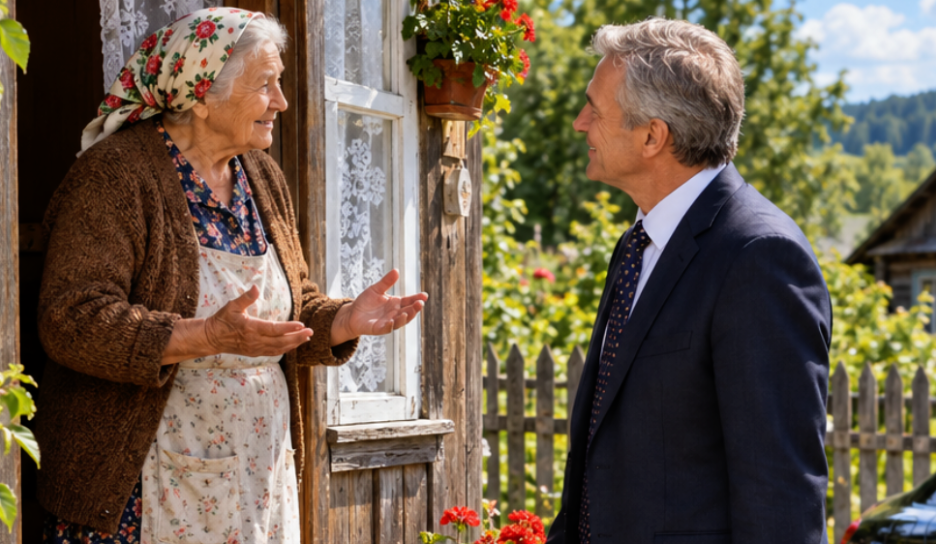
Anna was standing on the porch.
The last time Viktor left home, she was thirty-two. Now she was sixty-two. In those years, she’d lived a whole lifetime, filled with both happiness and many hardships.
Anna had clearly aged. She was fuller now, her hair almost completely white. Deep wrinkles crossed her face like furrows in a long-plowed field. Thick veins stood out on her hands, and her fingers looked strong and worn. She wore rubber boots, a simple dress under an old printed housecoat, and a faded scarf tied on her head.
But her eyes were just the same.
Gray, clear, watchful. That same slightly squinting gaze Viktor remembered from childhood. Just like that, Anna had looked at him when he accidentally broke a jar of jam, when he tried to hide a bad grade, and when he packed to leave for the city for the last time, convinced he had a completely new life ahead.
“Hello, Anyuta,” he said, suddenly noticing his mouth had gone dry.
“Hello, Vitya.”
They hugged, but it was an awkward, careful embrace. The kind shared by people who were once close down to the smallest detail but now had to get used to each other all over again.
His sister smelled of milk, dried herbs, and wood smoke. And then Viktor caught a familiar scent he could never mistake—it was the way their mother had smelled.
His eyes stung unexpectedly, and he quickly turned away.
The house looked almost the same as always. It still had the old family log walls made from pine, those carved window frames, the spacious kitchen, and that big stove right in the middle. But now, thanks to Anna, everything had been tidied up. The old roof shingles had been replaced with shiny metal, the wooden window frames swapped out for plastic, the window trims had a fresh coat of paint, and the porch had gotten a solid renovation.
“Looks like you’ve fixed up the house,” Viktor remarked as he glanced around at the buildings.
“My sons helped me,” Anna replied. “How are things with you? Kids? Wife?”
“Everything’s fine. My daughter is in London, my son works as a programmer. My wife…” He paused for a moment, as if searching for the right words. “My wife runs her own business. She owns a chain of beauty salons.”
“That’s good,” Anna said calmly. “Sounds like everything turned out the way it was supposed to.”
Somehow, Viktor suddenly felt uncomfortable at those simple words. He couldn’t even explain to himself why. Nothing out of the ordinary had happened. He’d mentioned his family, his sister had listened, no one had said anything hurtful. And yet, there was that uneasy feeling inside, something like shame.
He stepped over the threshold.
Inside, the house was clean and cozy. The floors were scrubbed until they shone, embroidered curtains hung at the windows, and a pot of geraniums sat on the windowsill. There was an icon in one corner, and framed photographs hung on the walls.
Viktor moved closer.
In the photos were their mother and father, Anna with her husband, her sons, and grandkids. Among them, Viktor spotted a picture of himself, looking so young, wearing a neat suit and a bright, open smile right after graduating from college.
“That’s me,” he said quietly.
“Yes, that’s you,” Anna confirmed. “Mom put it up there. I just left it as it was.”
Viktor stared at the photograph for a long time.
A nineteen-year-old looked back at him from the photo, full of hope and confidence in himself. That boy didn’t yet know who he’d become years later, what he would gain, and what he would lose along the way. He didn’t know he wouldn’t get to say goodbye to his mother. He couldn’t have guessed that chasing success didn’t necessarily bring happiness.
That evening, they settled in the kitchen.
Anna set the table simply, like at home—not fancy at all. She brought out cabbage soup that had cooked in the stove, slices of black bread, pickled mushrooms, and a carafe filled with homemade moonshine.
Viktor poured himself a little, took a sip, and winced at the strength of the drink. The taste brought back memories of his youth, when he and his friends would sit around the table late into the night, making plans and arguing about what each of them would achieve in life.
“Where’s your husband?” he asked, trying to sound casual. “Nikolai, if I remember right?”
“He passed away,” Anna answered simply. “It’s been ten years already. Heart gave out. He worked at the sawmill, came home, lay down on the couch to rest, and never woke up again.”
“My condolences,” he said.
“Thank you.”
She fell silent for a moment, then lifted her eyes to her brother.
“How are things with your wife?”
“What do you mean?”
“Are you happy together?”
Viktor opened his mouth, instinctively ready with his usual confident tone, but said nothing. Instead, he reached for the carafe and filled his glass again.
“It’s complicated,” he managed to say at last.
“Well, if it’s different for everyone, then it’s not completely happy,” Anna remarked.
“Listen, Anyuta…”
“If you don’t want to talk about it, that’s fine. I was just asking. Sorry.”
Her sister fell silent and turned to the dishes.
Viktor watched her, unable to shake the heavy thought that she was apologizing to him for a simple question. She—a humble village woman who had spent her life working as a milkmaid, widowed, without a college degree, expensive doctors, or a hefty bank account—felt it necessary to say sorry to him.
To him, a man used to people choosing their words carefully before even speaking to him.
That realization made his burden feel even heavier.
They sat in the kitchen until darkness fell. The conversation grew more heartfelt as time passed, though mostly Anna talked while Viktor listened.
She spoke about the village, their neighbors, and how the collective farm had collapsed, leaving people without work for months. She remembered the hard years when they had to jump at any job just to feed the family. Then, slowly, life improved: some started farming, others worked in lumber, and some opened small workshops.
Anna also talked about her sons. One was a logging truck driver, the other a mechanic in the district center. Both had started families, raised children, and did their best not to forget their childhood home.
She already had four grandchildren. They all lived nearby, came over often on weekends, helped around the house, and filled it with the noise Anna sometimes missed since her husband’s passing.
“And what about you?” she suddenly asked after finishing her story about the grandkids. “You came to see me, but you didn’t come to see Mom back then. Why?”
Viktor slowly set his glass on the table.
“I couldn’t.”
“Because of the meeting,” Anna nodded. “I remember. Your secretary called me. Said you were busy approving the republic’s budget. Very important business.”
“Anyuta…”
“I’m not reproaching you, Vitya. I just want to understand.”
She spoke calmly, without anger, and that made each of her words cut deeper than any accusation.
“You’re a big man, you have a position, opportunities, money. I’m just an ordinary milkmaid. Maybe I have less money left at the end of the month than your wife spends on a manicure. But I made it to Mom. I was there when she got really bad. I held her hand as she passed. And she wasn’t afraid, because she knew she had someone by her side. But you didn’t make it. You had a meeting.”
Viktor lowered his head.
The kitchen grew quiet. Only the firewood crackled in the stove, and the wind rustled the tree branches outside the window.
“And how do you live with that now?” Anna asked.
He didn’t answer.
He could have talked about how hard he worked, how important decisions rested on him, how difficult it was to refuse a meeting with the minister. He could have listed his reasons, explained the circumstances, and convinced himself he did what the situation required.
But now, all those explanations sounded pathetic even to his own ears.
Anna looked at him and asked a question that made Viktor feel a chill inside:
“Vitka, are you happy?”
He tried to say something, but couldn’t.
In thirty years, no one had ever asked him a question like that.
That night, Viktor couldn’t fall asleep for a long time. He lay on the old bed that creaked familiarly with every movement and stared up at the ceiling.
In the city, he had everything that people believe marks a successful life: power, money, social status, and the respect of influential people. With a single phone call, any problem began to resolve itself. Some feared him, some envied him, and others quietly hated him behind his back. That was just the way the world he lived in worked, and Viktor had long since learned to ignore the feelings of others.
But none of the people who surrounded him every day had ever once asked, “Vityok, are you happy?”
That wasn’t the kind of question people asked in the city. There, they were interested in careers, incomes, connections, new acquisitions. There, the only question was how successful you were.
But as he now realized, success and happiness were completely different things.
And now, here in the old family home, it was his sister—who had worked on a farm her whole life—who asked him a question he simply couldn’t answer. That scared him more than any audit, any scandal, or official investigation ever had.
He got up from the bed, pulled on his jacket, and stepped out into the yard.
The night was incredibly quiet. Above, the sky stretched out, dark and crowded with stars. You’d never see this in the city; there, the lights from street lamps and signs hid half the sky. But here, the Milky Way flowed across the heavens in a wide silvery stripe, like a river crossing the celestial distance.
Viktor stood still for a long while, breathing in the cool air.
And then, suddenly, he realized something he’d never noticed before.
He was envious.
He envied his own sister—Anna, a simple country woman who, by the standards he was used to, had almost nothing.
She didn’t have an expensive apartment, powerful friends, foreign trips, or the ability to handle business with a single call. She didn’t hold high posts, didn’t attend important receptions, and couldn’t afford many of the things Viktor took for granted.
But she had a home where her sons joyfully came to visit. She had grandchildren who hugged her and called her grandma. She had loved ones with whom she could share happiness and sorrow. And she kept only bright memories of their mother—without the heavy guilt or the weight Viktor had carried all these years.
Anna had this night, the stars above her head, and the familiar scent of hay, milk, and smoke.
She had a real life.
And he had a position.
In the morning, Viktor was preparing to leave.
The black car waited by the gate. The driver was packing a travel bag into the trunk—a bag that had almost nothing in it. Viktor only took what he truly needed. Everything else stayed in the city, where those things still had purpose and he was used to having them.
Here, all of that felt unnecessary.
Anna stepped out onto the porch. She was still wearing an old housecoat, with a faded scarf tied over her head. She looked at her brother with those same clear eyes.
“Come back again,” she said.
“I will.”
“Don’t lie.”
Viktor flinched. Those two words were spoken softly, but he realized in that moment that his sister wasn’t about to accept pretty promises just because they came from someone with status.
“I’ll come,” he repeated, no longer even trying to sound confident.
And then something happened that Viktor never expected from himself.
He started to cry.
For the first time in many years. He stood there by his expensive car, in a flawless suit, gray streaks at his temples, a leather briefcase in hand, and cried openly—without any attempt to hide the tears. They streamed down his cheeks and Viktor didn’t even notice.
Anna walked over and hugged him.
She didn’t ask any questions or try to comfort him with long speeches. She just held her brother close, just like she did when they were kids and he felt like the whole world was against him.
Viktor buried his face in her shoulder and again he smelled the familiar scent of milk, grass, smoke, and their childhood home. Memories came rushing back all at once, and he couldn’t hold them back anymore.
“Forgive me, Anyuta,” he whispered.
“For what?”
“For everything. For Mom. For not coming back all these years. For…”
He couldn’t finish.
“It’s okay,” Anna said quietly. “That’s enough, Vitya. Mom forgave you. Right before she died, she told me, ‘Don’t blame Vitka. He loved in his own way. That’s just the life he had.’ So go home. Go live your life. But try to be happy. Do you hear me? Be happy.”
Viktor pulled away, wiped his face with his hand and headed back to the car.
He got into the back seat. The door closed, the engine started, and the car slowly drove off. Dust rose behind the tires, hung over the road, and slowly settled.
The driver, as always, remained silent.
Viktor looked out the window. The village slowly faded into the distance: familiar houses, old fences, birch trees lining the road, the well at the crossroads. By his family’s home, a small figure in a faded robe remained. Anna stood on the porch, watching her brother leave.
He rode on, reflecting on the years he had lived.
Once upon a time, he left here as a boy, believing he could achieve anything he wanted. And in a way, he really had. He became an important boss, learned how to manage other people’s time, make decisions, and achieve his goals.
Anna, meanwhile, had stayed a simple dairy maid.
They met again after thirty years, and to Viktor’s surprise, he found that he envied her more than he’d ever envied anyone in his life.
Because she had the truth. And all he had was success—which, from the outside, looked perfect.
The car joined a wide highway. Ahead lay the city, his office, more meetings, documents, and phone calls. At home his wife was waiting, always attentive to her looks and her routine. His daughter still lived in London, his son in Moscow. Everything was as it had been, as if nothing had happened.
But something inside Viktor had changed.
Behind him was the little wooden house that smelled of hay and fresh milk. There remained a gray-haired woman who had lived a hard life but somehow managed to keep what he himself had lost without noticing—chasing his career.
And there was still a question left there, one that would not give him peace.
“Vitka, are you happy?”
Viktor Ivanovich glanced out the window again. The road stretched ahead, leading him back to his familiar responsibilities and routine. He knew he would soon put on his professional face, step into his office, and start giving orders.
But now he realized: one day he would have to pause and honestly answer the simple question his sister had asked him.
And maybe, for the first time in his life, he wouldn’t chase after success, but would try to find real happiness.