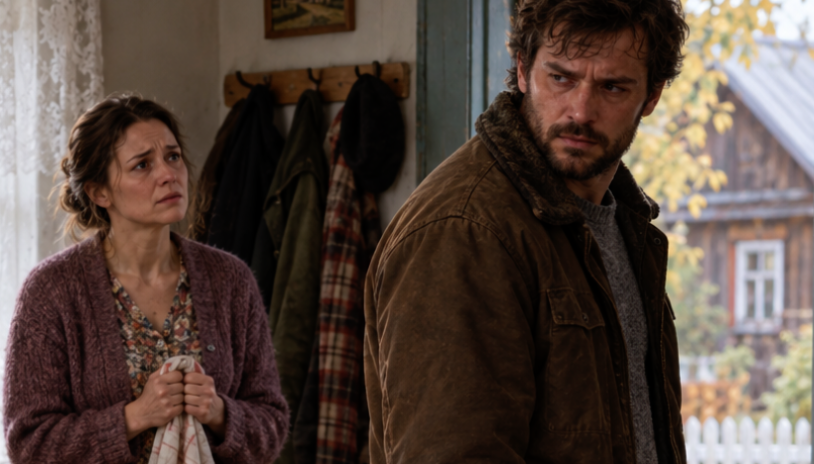
The zipper on the large, dark sports bag made an unpleasant metallic screech. Anatoly yanked the slider all the way to the end, exhaled loudly through his nose, and straightened his shoulders, as if proud of his own determination.
He intentionally left the front door open so that the cold November air would swirl around his legs, emphasizing the finality of his departure. The entryway smelled of sauerkraut, cold river water, and birch firewood—the smoke from which had only recently been drifting out of the stove.
“Well, that’s it, Nadezhda,” Anatoly said, pausing meaningfully as he grabbed the bag by its handles. “For twenty-two years, I’ve put up with your heartless coldness. I’ve had enough! A man only lives once in this world. He needs warmth, care, understanding, to be admired—not your endless sighs and evening reading. I’m leaving for Larisa. She’s a passionate, lonely woman who has longed for male attention. She has a solid house, and she’ll treat me like a real master. You stay here with your flowerpots. Let’s see how long you last when there’s no one to chop the firewood!”
Nadezhda stood by the kitchen partition, leaning her shoulder against the smoothly planed doorframe. In her hands was a clean linen towel she had just used to dry freshly washed glass jars.
Not the slightest emotion showed on her face. Her brown eyes stayed dry, not a single tear appeared on her lashes. She did not sigh, did not reproach her husband, nor did she even move. Nadezhda looked at him calmly and distantly, as if the person before her wasn’t one she’d lived with for over two decades, but a random merchant trying to pawn off stale goods.
“Close the door tightly behind you, Tolya,” she said in an even, calm voice. “The warmth is leaving the house.”
Anatoly was so taken aback he nearly choked on his carefully prepared speech. He had expected tears, hysterical cries, to watch his wife wring her hands in despair. In his imagination, Nadezhda would have run to him, grabbed his jacket, begged him to stay, and lamented the shame he’d bring on the family in front of the whole village. He had even prepared a condescending line: “It’s your own fault you drove me to this!” But his wife’s icy calm wounded his pride much more than any slap in the face ever could.
“So now you’re proud, are you?” he hissed through gritted teeth, swinging the bag onto his shoulder. “Go ahead, play at being independent. We’ll see what you say when the shed door jams or you have to haul water from the well all by yourself with a yoke. You’ll crawl back to Larisa’s fence yet, but by then it’ll be too late!”
He slammed the door with a bang. The sudden blow made the chimes of the old wall clock jingle plaintively. Heavy steps thudded across the wooden walkway, then the gate clapped loudly, and silence settled over the house.
Nadezhda slowly set the towel down on the table, settled onto a stool, rested her hands on her knees, and closed her eyes. Her heart wasn’t racing, and she felt no burning sense of hurt. Instead, there was a strange, mildly frightening, yet incredibly liberating emptiness inside her. It was the feeling you get after a thorough house cleaning, when the dust and stifling junk collected in the farthest corners over many years have finally been swept away.
Twenty-two years. They had married so young. Back then, Anatoly seemed like an attractive and energetic guy—he could always make a crowd laugh and was the center of attention. But living together soon revealed his real nature. The once lively young man’s boldness turned into empty pride, and the cheerful, sociable man, behind closed doors, became eternally dissatisfied, petty, and controlling. Anatoly worked as a mechanic for the local public utility, earning a standard wage, yet he acted as if the weight of the entire district rested on his shoulders.
Every day brought complaints and criticism. The soup wasn’t salted enough, the creases in his shirt weren’t ironed just right, the floorboards creaked, the TV was too loud. He didn’t drink excessively or raise a hand to his wife, but day after day, like a dull plane shaving off shavings, he stripped away everything bright and alive in her soul. Since they had no children, Nadezhda bore the full burden of his irritability, anger, and endless dissatisfaction alone. She managed the village library, tended the garden, kept up with all the housework, and bustled nonstop from morning to night. And all the while, she stayed silent, sincerely believing that a woman’s lot was to be patient and skillfully avoid family conflicts.
Just two houses away lived Larisa—a forty-year-old divorced woman with bleached curls, a loud laugh, and the overly sweet scent of cheap perfume. For about six months, she had been steadily vying for Anatoly’s attention. Sometimes she’d ask him to fix her fence, sometimes to check the lock on her car. And every time he helped her, Larisa made sure the whole street knew just how impressed she was:
“Oh, Tolechka, you’re pure gold, not just any man! How does Nadka not see your worth? She’s such a cold fish!”
Anatoly strutted all the more, proud as a peacock. He believed he was performing a heroic deed by leaving his ‘frosty’ wife for a woman who, in his eyes, could appreciate a real man.
The first week after he left caused quite a stir in the village. Women gathered near the mobile shop, whispering among themselves, peering into Nadezhda’s eyes with sympathy, trying to tell if she cried alone at night. But every day, Nadezhda went to work with her head held high. Her coat was always clean and carefully pressed, and she remained friendly and unflappable.
Without Anatoly around, the house suddenly felt lighter and easier to breathe in. The constant tension and the fear of messing something up—like putting the pan down the wrong way, leaving the remote in the wrong place, or closing the cupboard too loudly—disappeared. Nadezhda cleaned all the windows, got rid of the old rags soaked with motor oil that her husband had piled up on the veranda for years, and for the first time in ages, she calmly brewed herself a cup of mint tea in the evening. She managed to read a whole book without flinching at sudden shouts from the next room.
But for Anatoly, the happiness of starting a new life faded pretty quickly.
Larisa turned out to be not just a spirited woman, but a loud, quarrelsome, and demanding hostess. The very first evening, she put fried potatoes on the table and immediately made it clear: she had no intention of cooking a variety of dishes every day.
“I didn’t hire you as a servant, eagle. If you want to live in comfort, you’d better earn it yourself!”
After just three days, it became clear that the roof on the extension was leaking, the well pump had broken back in the summer, and water had accumulated in the cellar. Anatoly, who was used to stretching out on the couch after his shift and waiting for hot pies, suddenly found himself in the role of a handyman with an endless list of tasks. Larisa nagged him from morning to night, shouted with a market-seller’s voice, counted every penny, and demanded that he buy her a sheepskin coat by winter. She washed his shirts carelessly, tossing them in with the rest of the laundry, and thought that carefully pressed creases in his pants were a pointless whim.
By the end of the third week, Anatoly was walking around the village looking pale and worn out. His jacket looked dirty and wrinkled, and constant heartburn from all the ready-made food wouldn’t leave him alone. His only consolation was the thought that his ex-wife must be having an even harder time.
“It’s okay, Nadya must be miserable over there. She’ll come running back soon,” he kept telling himself, hoping her peace and quiet wouldn’t last long.
On Saturday afternoon, Anatoly went to the store for bread and a box of baking soda. Larisa had ordered him to scrub the soot off the stove, so there was no coming back empty-handed. The road took him past his former home.
Anatoly stopped by a leaning neighbor’s fence, hid behind some acacia bushes whose leaves had already fallen, and gripped the crumpled shopping bag tighter. What he saw next shocked him so much that he stood frozen in place, his mouth wide open in surprise.
Nadezhda’s yard, the one Anatoly had left unattended, looked completely different now. By the shed stood a neatly stacked pile of birch firewood, filling the air with a pleasant, resinous scent. The old, rotten porch steps were gone, replaced by new, wide, and sturdy ones made of smoothly finished larch.
On the porch stood Pavel—a forty-three-year-old craftsman who owned a small sawmill on the edge of the village. He had been widowed for many years and lived a quiet, solitary life, always composed and dignified. The local men respected him for his sound judgment and skilled hands.
Pavel was working with a planer, shaving golden curls of wood from the workbench. Standing next to him was Nadezhda.
Anatoly stared at his wife, unable to believe his eyes. She wore a soft terracotta cardigan that highlighted her slender figure, her chestnut hair tied back with a bright ribbon, cheeks aglow from the cold air. But what struck him most was something else: Nadezhda was laughing! She threw back her head and smiled warmly, offering Pavel a large enamel mug filled with hot tea. Anatoly hadn’t heard her laugh like that in almost fifteen years. The warmth, life, and charm shining in her brown eyes turned his insides upside down with a burning, poisonous envy.
Pavel gently took the mug. For a brief moment, their fingers touched, and the craftsman responded with an open, friendly smile. He looked at Nadezhda with genuine admiration—the kind of feeling Anatoly had never once experienced for his own wife all their years together.
“Well, would you look at that…” Anatoly muttered through clenched teeth, squeezing his fists so hard the bag in his hands crackled. “So that’s how it is?! Not even a month has passed! Already managed to reel a guy in for a free meal!”
He was about to cross the street, launch into a scandal, and announce to the whole village that the house had been built while they were still married. But his feet felt glued to the ground. Pavel was much taller than him, broad-shouldered and strong, and Anatoly was simply too intimidated to start a confrontation with such a man in front of everyone on the street.
For the entire following week, he was eaten up inside by anger and wounded pride. Larisa’s yelling now sounded to him like unbearable dog barking. Everything in this other house irritated him: the sticky oilcloth on the table, the constant smell of burnt onions, the unfamiliar old slippers lying under the bed. More and more, he remembered how calm, clean, and well-fed life had been with Nadezhda. The scent of fresh baking, the gentle clink of dishes, the cozy glow of the desk lamp.
‘What a fool I was to leave,’ the thought kept tormenting him. ‘I let myself get led by her pride. She’s the one to blame, she drove me away. I need to go back. I’ll make it clear that carpenter should stay away from her, forgive her—fine, I’ll do it. Out here, a woman without a man doesn’t stand a chance. She’s only pretending to be happy now, I bet she cries into her pillow at night.’
Everything came to a head on the first Saturday of December.
At the village House of Culture, a newly renovated auditorium was being officially opened with great fanfare. To mark the occasion, there was a festive evening with performances by local artists. The square in front of the building was brightly lit by lanterns, music was playing, and people were streaming in from every neighboring street.
Anatoly showed up alone. Since early morning, Larisa had been arguing with him about the shed he still hadn’t fixed, and then made a show of staying home. She announced that she wouldn’t be seen in such rags. Anatoly stood by the log wall of the village store, hands stuffed in the pockets of his windbreaker. He shifted nervously from foot to foot, scanning the crowd for Nadezhda. He finally decided he’d walk up to her in front of everyone, take her by the hand, and firmly declare, “Alright, Nadya, that’s enough fun. Pack my things, I’m coming back.”
Snow crunched under the tires as Pavel’s sturdy blue pickup pulled up to the brightly lit entrance of the community center.
The car door opened. Pavel climbed out, walked around the truck, and offered his hand to his passenger with a gentleman’s flair.
Nadezhda hopped lightly onto the snow, stepping confidently. At that moment, the voices in the square seemed to quiet on their own for a few seconds.
She looked stunning. Nadezhda wore an elegant, deep emerald wool coat that highlighted her waist, and neat leather boots peeked from beneath the hem. Her chestnut hair fell onto her shoulders in soft, well-groomed waves. Her eyes sparkled, her posture stayed straight and proud, and a gentle, contented smile played on her lips—the smile of a woman who is loved, valued, and cared for. She didn’t just walk through the snow—it seemed as if she glided over the frosty, crunchy surface.
Pavel supported her gently by the elbow, leaning in to tell her something quietly. Nadezhda responded with joyful laughter and lightly touched his shoulder with her gloved hand.
They didn’t just look like a couple in love. To everyone watching, they were clearly two beautiful, mature people who had finally found each other after years of loneliness and emotional coldness.
Anatoly felt as if the ground had disappeared beneath his feet. A heavy lump rose in his throat, making it hard to breathe.
Standing before him was no longer the timid, silent librarian he had, over twenty-two years, carefully turned into an invisible gray shadow. Now she was a stunning woman, vibrant with energy and inner strength. Her amazing beauty, her awakened femininity, had appeared not thanks to Anatoly, but in spite of him. Everything had changed because he left—and made room for a real man.
Blinded by a humiliating, burning rage, Anatoly stepped out from the shadow of the store and blocked their path to the steps of the community center.
“Nadya!” he yelled loudly, his voice rough from emotion.
They stopped. Pavel calmly took a step forward, shielding Nadezhda with his broad shoulder. There was not a hint of aggression in his clear blue eyes, but his steady gaze made it clear he wouldn’t let the bully cross the line. The craftsman’s look expressed nothing but cool mockery and readiness to put the troublemaker in his place.
But Nadezhda gently touched Pavel’s sleeve.
“It’s alright, Pasha.”
She stepped forward slightly and looked straight at her ex-husband.
Anatoly stood before her, his jacket open. Gray tufts of hair stuck up on his balding head, and his flushed face was twisted with rage. Suddenly, the man realized with chilling clarity just how she was looking at him now.
In her brown eyes, there was no hatred and no triumph. There wasn’t even contempt anymore. What remained was total, echoing emptiness. Nadezhda looked at him as indifferently as she would at an old tree stump by the roadside or a gray November snowdrift.
“You… what are you doing, Nadya?” Anatoly stammered in confusion. His voice failed him, breaking into a shaky, high-pitched whimper. “Flirting with the whole village while your husband’s alive? I only came to talk. Maybe I want to come back! Do you hear me? I’m willing to forgive you! Let’s go home!”
Among the curious crowd by the porch, a sly, quiet chuckle broke out. The women exchanged glances and shook their heads in disapproval.
Nadezhda’s face didn’t change at all. She spoke softly, but in the frosty air, every word rang out clear and heavy, like an iron weight hitting the ground:
“I have no husband, Anatoly. My husband died a month ago, the moment the gate closed behind him. To me, you’re a complete stranger now. Step aside and stop embarrassing yourself. We’re heading to the concert.”
She turned to Pavel, took his arm, and without another look back at her ex-husband, walked lightly up the wooden steps toward the brightly lit doors of the cultural center. Pavel held the heavy door for her and glanced back at Anatoly just for a moment, his gaze mixing disgust and pity.
The doors closed. From inside the hall, the sounds of an accordion and loud, cheerful applause flowed out.
Anatoly just stood in the middle of the square under the icy wind. People slowly drifted away, hiding their smirks in raised collars. No one approached him, no one tried to comfort him or offer a friendly pat on the shoulder.
He stood alone in the darkness, fists clenched empty in his pockets, with a chilling realization that his old life was gone for good. The Nadezhda who had put up with him for twenty-two years, forgave him, and warmed him with her kindness, was no more. With his own hands he had thrown away his happiness, trading true gold for a cheap trinket. Now all that remained for him was to trudge along the muddy, dark village road back to a cold, unfamiliar house, where endless reproaches, strange pots and pans, and a bleak, joyless old age waited for him.
Above the snow-covered village, a pure northern moon rose slowly. Its calm, silvery light poured over the white rooftops, and in that silent glow, there was no room left for human arrogance or petty lies.