They’ll deliver it on Saturday, Mom said. Just don’t come before lunch, everything will be moved around here.
I was about to ask what exactly would be delivered, but she was already talking about the bedspread. Light, without any big flowers. The old one wouldn’t fit anymore.
“Mom, what bed?”
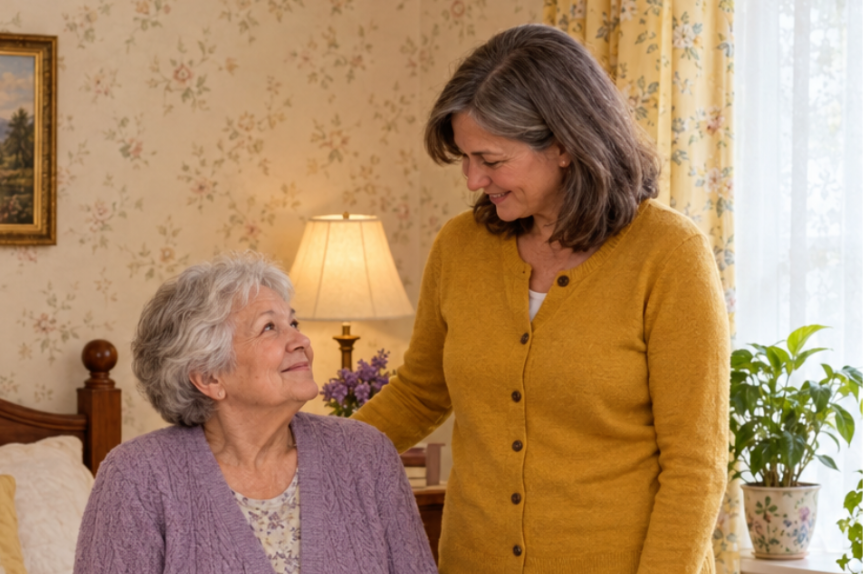
An elderly woman in a lilac sweater sits on the edge of a new, wide bed with a light-colored headboard. Her adult daughter stands nearby in a mustard-colored sweater, listening.
“A new one, Lena. I already told you.”
She’s seventy-eight. Dad is eighty. I’m fifty-five, and my daughter Sofia is twenty-eight. Sonia is renovating her apartment right now: an expensive kitchen, missing sockets, and the constant “We’ll save that for later.” I knew about all of their “laters,” but I hardly knew how many years Mom has been putting off her own comfort.
I first saw the bed in a photo. Wide, with a soft, light headboard. Mom sent me a picture she’d taken in the store and asked if I liked the color. I zoomed in, checked the dimensions, then asked about the price.
After she told me, I felt like I needed to sit down.
“Why do you need such an expensive one?”
Mom was silent.
“It’s comfortable. Your dad and I lay on it, tried it out. We looked at others, too.”
“You could have chosen something simpler.”
“We could have. But we picked this one.”
That’s it. No explanations, no medical certificate, no proof that the old bed had collapsed and was impossible to sleep on. Just two elderly people picking out the bed they want to sleep on.
For some reason, that didn’t sit right with me.
I worked, supported myself, never asked my parents to pay for my things. That’s why, at first, I thought I was being totally selfless. I worry about my elders, to make sure they aren’t left without anything they need. Who else could I possibly worry about?
But almost immediately, Sonia’s new kitchen came to mind. The postponed cabinet, the countertop that she and her husband still couldn’t afford. The image of the new bed was suddenly overlaid with an invisible spreadsheet: all the useful things that money could have gone toward.
“You said you were saving for the future,” I said.
“I am saving.”
“Exactly.”
Mom was silent again.
“My future matters too, Lena.”
I blushed, even though we were talking on the phone and she couldn’t see me. I immediately wanted to protest: Don’t make me out to be someone already dividing up the inheritance. I didn’t say anything like that out loud. But in my mind, Sonia’s countertop was much clearer than Mom’s headboard.
“And what about Dad?”
“Dad helped pick it out too. Want me to put him on the phone?”
I refused. But later in the evening, I called Dad myself anyway.
He was happy, started telling me how they went to the store. The salesman showed them several options, they weren’t in a rush, they ate nearby, then came back to compare. I listened, waiting for the part where it would turn out that Mom got carried away and Dad just didn’t want to argue.
That part never came.
“I like it too,” he said. “There’s more space. We’ve wanted to replace the old one for a long time.”
“Why didn’t you say anything?”
“We mentioned that we needed to. You said, it would do for now.”
I remembered—last year, Mom didn’t complain about being sick or something breaking. She just mentioned the bed was narrow; they were used to it, but now and then, they’d disturb each other when turning over. I suggested they try different blankets instead. Much cheaper than changing everything.
Mom bought a blanket. I felt like I’d helped solve the problem.
“Will you still have money left after this?” I asked dad.
“Yes, we will,” he replied. “We’ve done the math. That’s not all the money we have.”
He didn’t go into detail about their savings in different places. Just said they’d accounted for ongoing expenses, and there was a reserve left. I held back from asking to see the calculation. Dad has always been good with numbers, and turning eighty didn’t suddenly make him someone who buys the first thing he sees and forgets about the future.
Dad sent another photo from the store. Mom was sitting on the bed they’d picked, her coat next to her. She had that look she usually gets when picking out something lovely for one of us—only this time, she was choosing for herself.
“We also had lunch nearby,” Dad told me. “She ordered something she’d always wanted to try. Didn’t like it, but now she knows.”
I’d already heard about lunch, but he happily told the story again. For me, the whole trip had turned into one questionable number, but for them, it was a full day. They browsed, got tired, sat down, and then went home. Dad explained how Mom first picked a cold gray color, then found another shade. She grabbed his phone and laughed that he never remembers anything: they only liked the gray in the pictures.
As I listened, I suddenly felt a pang of childish resentment. They’d enjoyed themselves without me. Didn’t wait until I had a free Saturday, didn’t ask me to drive, didn’t let me choose a store that worked for me. Instead, they organized everything the way they wanted. I knew I should be glad—they’d done it for themselves. But instead, I wanted to reclaim my role by disagreeing.
After we hung up, I still searched online for similar options. Found one cheaper. Started messaging Mom, pointing out there was an almost identical one, just with a different headboard. I gathered a few photos, zoomed in, compared details. A daughter could put that much effort into picking something out for her parents—if they had asked her.
They hadn’t asked.
I put my phone down and called Sonya. I led with the news that grandma and grandpa had bought a bed with money I thought was completely unnecessary to spend.
“Why unnecessary?” my daughter asked.
“Well, it’s a big bed. You should have seen it. I thought they’d help you with the kitchen.”
Sonya went silent.
“Did they promise to?”
“Not specifically with the kitchen. They just said, you know, for the future.”
“Mom. I never asked them.”
I sat down on the edge of my own couch. Sonya explained that she and her husband decide for themselves what to buy now and what to save for. Yes, they can’t afford everything at once. No, she never expected grandma to finish the kitchen for them.
“If you already told them something about me, please explain,” Sonya added. “I don’t want them thinking I’m upset about it.”
It started to feel especially uncomfortable. Not only was I counting someone else’s money, but I tried to cover it up by pretending it was for my daughter’s needs. Sonya didn’t even know she had been made the main reason her grandmother had to give up a comfortable bed.
I still hadn’t called Mom. I deleted the photos I had prepared for her, without sending them. I spent the evening doing my usual routine, but each time I walked past my bedroom, I noticed how many things I had chosen just because I liked them.
The lamp by my bed wasn’t the cheapest option. The comfy armchair could easily have been swapped for a simple stool, if I was only thinking about what’s necessary. I had no intention of listing off diagnoses to justify every purchase. I didn’t understand right away why my mom would need such an explanation, but when I finally did, I felt ashamed.
It was as though I’d confined her to a small set of essentials: groceries, medicine, warm boots if the old ones were really falling apart. Everything else could wait. Not because she didn’t deserve more—I would have objected to anyone saying that. But in my mind, the big plans were all about me and Sonya, while my parents were supposed to just carefully stretch what they had in the present.
On Friday, Mom called to check if I’d be coming after lunch. I said I would. Then I blurted out:
“I was going to send you some photos of other beds. I’m not going to anymore.”
“Alright,” Mom replied.
She didn’t ask why I’d changed my mind. So I added on my own:
“I decided for you what you should spend money on. And I dragged Sonya into it. She doesn’t expect anything from you, Mom. That was all me.”
Mom was silent for a long time. Then she said:
“I just wanted to show you which one we picked. Not ask for permission.”
“I understand.”
“You probably get it now.”
There was hurt in her voice. I hadn’t asked her to have it all done by Saturday, just so I could visit in a good mood. Instead, I asked if she needed any help with anything specific. Mom told me delivery and assembly were already arranged, and someone would help remove the old bed. But later, she’d need help checking how the new bedspread looked, because it was hard for her to spread it out on her own.
“We’ll take a look,” I replied.
On Saturday, I arrived after lunch. There was a roll of packaging by the door, and the hallway smelled like new furniture. Dad was walking around in his socks, looking for the glasses he’d left by his mug. Mom, calling from the bedroom, was asking him to come see where the bedside lamp fit best now.
The bed was even wider than I’d imagined from the photo. The room is small, so we had to put the small table in a different spot. My parents had discussed in advance where the walkway would stay open, then double-checked after it was set up. They weren’t about to squeeze past sideways just to get a nice photo.
I asked Mom where I should put my bag. She showed me the chair, then straightened the edge of the bedspread.
“So, what do you think?”
I still felt that old urge: maybe something different, less bright, more practical? But I looked at Mom, at her fingers smoothing the soft fabric.
“It’s beautiful. Do you like it?”
“I do.”
She kept it simple. She sat on the edge and tried getting up to see if it was easy from that side. Dad explained he’d keep his slippers next to the nightstand instead of under the bed, since he always ends up searching for them. I listened to their conversation about slippers and the night light, and for the first time, I stopped seeing this new purchase as something that had devoured Sonya’s hypothetical kitchen. It became just another part of their ordinary evening, morning, day—moments that continue perfectly well whether or not I’m involved.
We spread out the bedspread together. On one corner, the edge kept flipping over, and Mom laughed, saying we should have checked which side was up before starting. I helped her turn it around. There was no lecturing or fuss, just two women mixing up a brand-new item they’d never made before.
Afterward, we had tea. Dad talked about the delivery, and Mom described the saleswoman who patiently let them compare options. I wasn’t looking for signs that they’d been pushed into buying anything. If they’d actually run into a problem, we could have dealt with it then. But for now, they just shared how they made their choice.
As I was leaving, I asked if they needed new sheets for the bigger size. Mom told me she’d already picked up one and would buy another later. I offered to give her one as a gift if she wanted. She thought about it, picked a color, and asked to see the fabric first.
I liked that. Not buying something to suit my own taste as a way to make up for not controlling the whole bed situation, but choosing exactly what we’d agreed on together.
In the morning, Mom sent me a photo of the unmade bed. Turns out, that very first night, Dad put his glasses where the old nightstand used to be, and then ended up searching for them on the new side. Both of them wandered around the bed until they finally spotted the case tucked behind a pillow.
I laughed out loud. I immediately pictured myself asking if it all felt too strange now, and whether the change was worth it. But I didn’t. A new thing almost always calls for a few new little routines. That didn’t make it a mistake or some perfect solution to every problem at home.
Mom wrote that they’d move the lamp a little closer in the evening. I said if they needed help holding it in place, just call me. She replied they’d manage on their own, and would send another photo once it was done.
Sonya called her grandparents on Sunday too. Then she texted me: Grandma’s happy, Grandpa says now there’s no need to argue over the edge of the bed anymore. She even added a laughing emoji. I told her yes, I’d seen that.
She kept working on her kitchen without making a big family drama about it. One day she asked me to help pick out handles for the cabinets. I went with her—we debated over the colors, and I didn’t agree with all her choices. But I could help with what I had to offer now: my time, attention, and a gift I could afford myself. Not Mom’s stash, already mentally passed on to someone else.
We picked out the sheet together. Mom wanted to feel the fabric, so we met up at the store the following week. I arrived early, got a few options ready, and almost set everything up so all she had to do was say yes.
When she arrived, she put away her phone where she’d saved example photos. She asked where to start. Mom looked around, found something she wanted to touch, then something else. The first fabric felt too slippery to her; the second one was nicer.
The saleswoman asked me what size we needed. I turned to my mom—she knew for sure. She pulled out a piece of paper where Dad had written down the measurements. The woman took it and double-checked a few things with her directly. I stood by, looking over the colors. There was no dramatic moment where my mom got her voice back. She just answered questions about her purchase.
We picked a calm, warm shade. They promised to deliver the sheet in the size we needed later, and Mom said she’d wait. I didn’t suggest taking something else right away, even though it looked almost the same to me. We decided I’d pick it up and bring it by when it arrived.
We left the store and stopped by the display next door. There were cups—some plain, some with patterns. I checked the time; I still had things to do. At first I wanted to hurry things up, but then just told Mom how long I could stay. She nodded, chose what to look at, and a few minutes later, we moved on. I didn’t have to spend the whole day with her, and she didn’t have to skip window shopping just because I was busy.
By the bus stop, Mom asked why I hadn’t replaced the sagging cushion on my couch myself. I was ready to brush it off: it’s still fine, I’m used to it. Then I said I’d take a look. She didn’t pull out her phone to show me different cushions. She got on the arriving bus, waved to me through the window.
A couple of weeks later, I brought the sheet to my parents. Mom unfolded it, felt the fabric, said it was just right. Dad poked his head in to ask if we were changing the sheets now, because he was planning to have a nap after lunch.
“We’re not,” Mom replied. “We’ll have time later.”
Dad went into the bedroom and closed the door. Mom and I stayed in the kitchen. She asked about Sonya and I told her about her little hands, then about my job. She listened, every so often straightening the edge of the new sheet’s packaging.
I wanted to tell her she deserved a nice bed. I even opened my mouth, then stopped. It would sound as if her daughter’s approval finally made the purchase a deserved reward for all those years.
“Is the bedspread too light?” I asked instead.
Mom gave me a squinty look.
“Lena.”
I laughed.
“Okay, got it. If you like it, that’s all that matters.”
She smiled too. She invited me to see how the color changes by the window in daylight, but we remembered Dad was resting. So we stayed in the kitchen. The wide bed could wait—there was absolutely no need to show it off again right then.