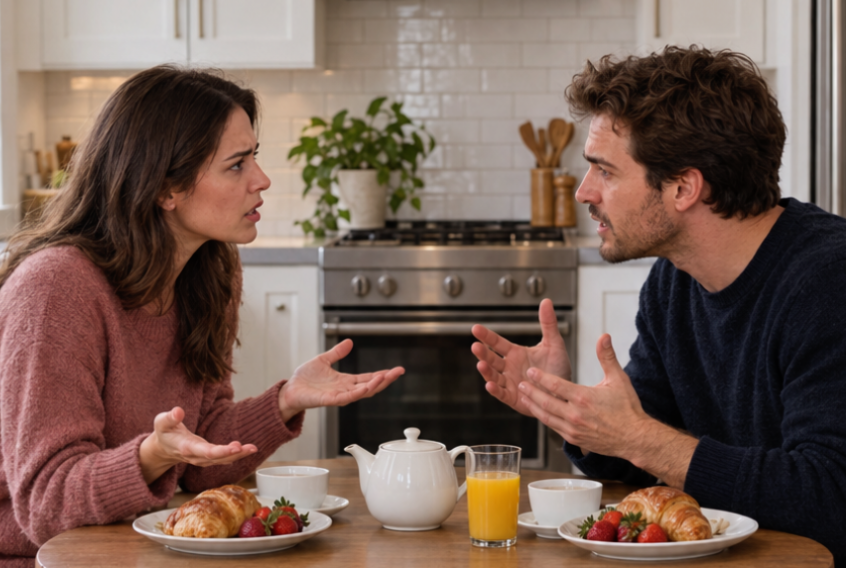
“Are you serious right now?” Dima asked, as if he wasn’t sure he’d heard correctly.
Her husband froze with a spoon in his hand. The spoon hovered over the bowl, sour cream slowly dripping in thick drops back into the borscht.
Karina looked him squarely in the eyes. She didn’t look away. She didn’t lower her lashes. She didn’t try to soften her tone. She just stared—calm, tired, and resolute.
“Absolutely serious.”
Silence fell over the kitchen. Only the fridge was humming, and somewhere a branch tapped against the window.
Dmitry slowly put down his spoon.
“So you mean you’re not going to cook anything for my mom at all anymore?”
“I will not cook for your mom.” Karina raised her voice slightly to make each word clear. “No borscht, no cutlets, no casseroles, no dried fruit compote, not even just ‘potatoes with onion, the way I like it.’ Nothing. If she wants to eat, she can come and have whatever’s been made for our family. Or you can cook for her yourself. It’s your choice.”
Dima opened his mouth, closed it, then opened it again.
“Karin… you do understand that she…”
“I understand perfectly that she’s a pensioner, lives alone, it’s hard for her to stand at the stove, she has high blood pressure, joint pain, her memory isn’t what it used to be.” Karina’s voice was steady, almost as if she was reading off a shopping list. “And I’ve understood all of this for the past seven years. Seven. Years. That’s why I’ve been cooking her meals for two or three days in advance. I’d carry containers across town. Wash her pots. Listen to her complaints that it was ‘too salty,’ ‘not enough pepper,’ ‘the meat’s tough,’ ‘the potatoes fell apart.’ I endured it. But today I realized I just don’t want to anymore.”
She turned to the sink and started washing the cutting board she’d just used for chopping onions. Her movements were precise, mechanical.
Dmitry stared at her back.
“So what exactly happened today?” he finally asked. “Everything seemed fine yesterday.”
Karina turned off the water. She dried her hands on the towel and turned to face him.
“Today she called at eleven in the morning. Said that ‘yesterday’s stew is gone,’ even though I’d brought enough on Friday for three full days. She said she ‘really wanted cabbage rolls,’ but ‘not the kind with half rice, but the real ones, just cabbage and meat.’ And then she added: ‘You’re free today anyway, so you’ll stop by after work?’”
Karina paused.
“I told her today wouldn’t work. She said, ‘How could that be? I just made you pastries last week.’ I reminded her those pastries were for her own birthday and she just gave us leftovers. She got offended. She said, ‘In my day, daughters-in-law didn’t keep count of how many times a week they brought food to their mother-in-law.’ And she hung up.”
Dima said nothing.
“And then you called,” Karina went on. “And the first thing you asked was: ‘Did Mom like the cabbage rolls?’ Because she’d already complained to you. And you didn’t even ask why I hadn’t made them. You just assumed I’d forgotten again or couldn’t be bothered.”
She looked at her husband very intently.
It was in that moment I finally understood. I realized, once and for all, that you see this as normal. That you think it’s my duty. And that if I don’t stop this endless routine now, it will never end.
Dmitry rubbed his temples.
“Karin… you know how she is. If you refuse, she’ll start getting sick, crying, calling me at work five times a day, then complaining to the neighbors…”
“I know,” Karina nodded. “That’s why I haven’t refused for seven years. But now I am. If she gets sick and cries, it will be really unpleasant. But that’s her choice now. Not mine.”
She picked up her phone, opened her notes, and scrolled through.
“In the past three months, I cooked and delivered one hundred eighty-six portions of food to her. One hundred. Eighty. Six. That’s about two portions a day. No days off. Sometimes three. I kept count because I wanted to understand why I always feel like I never have time for us or for the kids.”
Dima looked at her like she had suddenly started speaking a foreign language.
“You kept count?”
“Yes, I did. Because if you don’t keep track, you start to believe that ‘everybody does it’ and lose your mind.”
She put her phone away in her pocket.
“That’s it, Dim. The topic is closed. I’m no longer the personal chef. If you want your mom to eat well, take responsibility yourself. Or hire someone to come and cook for her. I’m even willing to pay part of the cost. But I’m done.”
Dmitry was silent for a long time. Then he asked quietly:
“What if I say this makes me uncomfortable?”
Karina gave a slight, bitter smile.
“And did I enjoy these past seven years?”
He lowered his gaze.
“I… I’ll talk to her.”
“Go ahead,” Karina agreed. “Just don’t ask me to do it ‘just occasionally.’ Because ‘occasionally’ always turns into ‘every day.’ I’ve been through this before.”
She walked over to the stove and turned down the heat under the pot.
“Dinner will be ready in ten minutes. Sit down before it gets cold.”
Dima sat down, but didn’t eat. He just stared at his plate.
And for the first time in many years, Karina realized she didn’t feel that usual heaviness in her chest when she finished making dinner. For once, she felt calm.
She had no idea that in three days, this calm would turn into a completely different conversation. And for the first time in his life, Dima would cook at the stove—not because he ‘needed to help Mom,’ but because he’d realize: he had no other choice.
But that would come later.
For now, she just set the table and called the kids.
Three days passed in a strange, tense silence.
Dima never brought up that evening. Karina stayed quiet too. Their conversations were just about practical things: who would pick up their son from practice, what to buy at the store, what time to go to bed. It was as if a thin but very strong film had formed between them—not to be torn, not to be broken by words.
His mother called every day. At first, she called Dima. Then, when he stopped answering at work, she started calling Karina. Karina didn’t answer. She just declined the calls and sent back a brief message: “Dima is busy, call him later.” After the third such reply, Tamara Ivanovna stopped calling her completely.
On the fourth day, Dima came home from work earlier than usual, carrying two big supermarket bags. Karina was unloading the dishwasher at that moment.
“I bought groceries,” he said instead of a greeting. “Mom asked… well, I decided I’m going to cook myself.”
Karina slowly stood up straight and looked at the bags. Inside, she could see a head of cabbage, ground meat, carrots, onions, and a can of tomato paste.
“Stuffed cabbage rolls?” she asked quietly.
Dima nodded without looking at her.
“She’s been eating buckwheat with canned stew for three days. Says she just doesn’t have an appetite. I… I can’t listen to that every night.”
Karina didn’t respond. She just stepped aside and nodded toward the stove.
“The pots are clean. The cutting board’s over there. It’s better to defrost the meat in the microwave, but not for too long or it’ll start to cook.”
Dima took off his jacket and rolled up his sleeves. His movements were awkward, like someone who hadn’t really handled a knife in a long time.
Karina sat down at the table with a cup of tea and started watching.
First, he spent a long time figuring out how to separate the cabbage leaves. Then he boiled water in a huge pot and burned his fingers trying to pull the leaves out with a slotted spoon. Then he quietly cursed when the ground meat stuck to the bottom of the pan. Then he chopped onions and carrots into uneven pieces, and tears ran down his cheeks—maybe from the onion, or maybe from something else.
After an hour and a half, the kitchen smelled like burnt oil, raw onions, and something faintly resembling tomato sauce. On the table sat a pot filled with cabbage rolls of all different sizes: some wrapped too tightly, others falling apart, and the top layer had completely slid to the side.
Dima wiped the sweat from his forehead with his sleeve.
“Well… looks like it worked, sort of.”
Karina walked over and peered into the pot. She silently took a fork and tried one.
“Needs more salt. And there’s barely any rice. But for a first try—it’s okay.”
Dima watched her, waiting for her reaction.
“You always said making cabbage rolls was a long and messy job.”
“I did,” Karina agreed. “Because it really is a long, messy job. Especially when you’re making them for two houses at once.”
He lowered his head.
“I thought… well, that it was just food. That you liked cooking.”
“I like cooking for us. For the kids. For you.” She put down the fork. “But when it becomes a duty, when you’re expected to show up every day with plastic containers like some food delivery driver—the love for it ends. All that’s left is exhaustion.”
Dima was silent for a long time. Then he asked, almost in a whisper:
“What if I say that I understand?”
Karina looked at him closely.
“To understand means you take it to heart. Not just stand by the stove once and expect me to say, ‘It’s all forgiven, let’s go back to how things were.’”
He nodded. Slowly, heavily.
“I’ll take this to her tonight. And tomorrow… tomorrow, you and I will talk properly. No shouting. No blaming. Just talk.”
Karina didn’t answer right away. She finished her tea and set her mug in the sink.
“Okay. But on one condition.”
“What condition?”
When you talk to her, don’t make excuses for me. Don’t say ‘Karina is tired,’ ‘Karina is busy,’ or ‘Karina decided this.’ Be honest: say, ‘Karina and I have decided we won’t be doing takeout meals anymore. If you want, come join us for dinner. Or I’ll cook myself whenever I can.’ She needs to know this is our decision together.
Dima looked at her for a long moment. Then he nodded.
Agreed.
He gathered up the pot, wrapped it in a bag, and put on his jacket. At the doorway, he turned back.
Karina… thank you for not leaving.
For the first time in days, she gave a real smile—just a little one.
I never thought about leaving. I just stopped staying silent.
The door closed. Karina was left alone in the kitchen.
She walked over to the stove and turned off the forgotten burner. Then she opened the window to let in the cold evening air. The smell of burnt oil mixed with the scent of wet leaves and distant smoke from someone’s fire.
She stood there for about ten minutes. Just breathing.
Then she heard the elevator door slam in the hallway. And a few seconds later, the doorbell rang.
Karina startled. She walked to the peephole.
On the landing stood Tamara Ivanovna. Old coat, scarf, an empty bag slung over her shoulder. Her face was pale, lips pressed tightly together.
Karina opened the door.
Good evening, Tamara Ivanovna.
Her mother-in-law looked up at her from below. Her eyes were red.
Dima just left. He said the cabbage rolls didn’t turn out well. And that from now on…—her voice trembled—no one will be bringing food anymore.
Karina stayed silent. She waited.
I came to ask…—Tamara Ivanovna swallowed—Is it really you who doesn’t want this? Or was it Dima’s idea?
Karina took a deep breath.
It was our decision. Because I’m tired of being a free kitchen. And Dima finally realized it’s not fair to place it all on me.
Her mother-in-law looked down at her worn-out shoes.
I thought… back in our day, it was expected. The daughter-in-law should…
A lot was different back then, Karina interrupted softly. Things have changed. If cooking alone is hard for you, you’re welcome to come for dinner. We’d be happy to have you. But I won’t be delivering food in containers anymore. Never again.
Tamara Ivanovna stood in silence for a long time. Then she nodded—short and sharp.
I understand.
She turned and walked toward the elevator. Her steps were slow and shuffling.
Karina closed the door. She leaned against it.
Something in her chest let go. Not all the way. But enough so she could breathe a little easier.
She knew this was just the beginning. Tamara Ivanovna would still get upset, call Dima in tears, complain to the neighbors. Dima would lose his temper and say, “just once, come on.” And more than once, Karina would feel like giving in and making a big pot of soup ‘just because’.
But today she took her first real step.
And there was no taking that step back.
She went to the kids’ room to check if they were asleep. Then she returned to the kitchen and started washing the dishes from the failed cabbage rolls.
An hour later, Dima came home—carrying the empty pot and looking exhausted. She simply poured him some tea. No questions. No blame.
They sat down at the table. And for the first time in a long while, they had a real conversation.
But that part will come in the third chapter.
The door closed behind Dima for the third time that evening—this time he came back from Tamara Ivanovna’s apartment without the pot, his face heavy and his hair soaked from the rain. Karina sat curled up on the kitchen bench, scrolling through her phone, but really, she was just waiting.
He took off his jacket, hung it on the hook, and stood in the hallway as if he couldn’t quite make himself walk in.
“Well?” she asked quietly, not looking up.
Dima made his way into the kitchen and sat down across from her. He placed his hands palm down on the table—as if to show he wasn’t hiding anything.
“She cried,” he said. “At first quietly, then louder. She said she feels like nobody cares about her anymore. That back in her day, children never abandoned their mothers. That if dad were still alive, he would never allow this…”
Karina stayed silent, tracing her finger around the rim of her mug.
“I let her talk it out,” Dima went on. “Then I told her nobody is abandoning her. That we love her. That our door is always open. But that making meals every single day is not something we can keep doing. That I can visit her two or three times a week to talk, to keep her company, to go shopping for her. I’m even willing to learn how to make something simple. But every day? No. And bringing over containers of food every day? Also no.”
He paused and looked at Karina.
“She asked, ‘What did Karina say?’ I told her, ‘Karina said the same thing. We decided this together.’”
Karina finally looked up at him.
“And how did she take it?”
“She was hurt at first. Said I’m just doing what you want now. Then she went quiet. Sat there a long time, staring out the window. And then suddenly she asked, ‘Dima, can you really learn to make borscht? The kind Karina used to make, with garlic and sour cream?’”
Karina couldn’t help but smile—just the corner of her mouth.
“And what did you say?”
“I said I’d try. But I warned her it’d probably turn out worse. She nodded. She said, ‘Worse doesn’t matter. The important thing is my son made it.’ And… she hugged me. As tight as when I was a kid. She hasn’t hugged me like that in years.”
Dima rubbed his neck—right where the muscles always tensed up after a tough conversation.
“Then she went to the fridge herself, took out yesterday’s buckwheat, reheated it, and ate while I was there. She said, ‘See? I’m not starving. I’m just used to you both taking care of me.’ Then she added, ‘Tell Karina I’m not angry with her. But don’t think I’ll be coming over to your place for dinner every day now. I don’t want to be a burden.’”
Karina was quiet for a long time. Then she got up, went to the stove, and filled the kettle with water. She set it to boil.
“Tomorrow is Sunday,” she said. “Let’s invite her for lunch. Not a pity invite, but just lunch. All together. The kids adore her. Let her see we’re not shutting her out—we’re just changing the rules.”
Dima nodded.
“I’ll call her in the morning. Tell her to come by at one.”
The kettle started boiling. Karina poured hot water into the teapot. The air filled with the scent of black tea and bergamot—the very one Tamara Ivanovna always called ‘fancy tea.’
“But what if she starts again…” Dima began.
So when the moment comes, just say: “Mom, we’ve already talked about this.” Calmly—no shouting. And if she keeps pushing, we’ll simply get up from the table and go to the kitchen to do the dishes. Together. She’ll either join us, or she’ll understand there’s no point in continuing.
Dima looked at her with a new expression—it was a mix of respect and surprise.
“Have you always been this… strong-willed?”
Karina shrugged.
“No. I used to be accommodating. But people who go out of their way to please everyone end up breaking at some point. I just didn’t want to break.”
They finished their tea in silence. Then Dima got up, walked over behind her, and wrapped his arms around her shoulders. Not tightly—just resting his chin on the top of her head.
“I’m sorry it’s been so long since I’ve seen you.”
“Well, you’re here now,” she replied. “That’s what matters.”
The next morning, Tamara Ivanovna arrived right at one o’clock. In her hands—a small box of store-bought pastries and a bag of apples from her own garden.
The kids ran to her shouting, “Grandma!” She smiled—not quite naturally, but genuinely. She sat down at the table and looked at Karina.
“Good afternoon, Karina.”
“Good afternoon, Tamara Ivanovna.”
Lunch went by peacefully. They talked about school, about the weather, about how November was coming and it was time to change the tires. No one mentioned containers, stuffed cabbage rolls, or past grievances.
When it was time to see her off, Tamara Ivanovna lingered in the hallway. She approached Karina.
“I was thinking…” she began softly. “Maybe you could teach me to make that borscht? The one with the garlic. I want to try it myself. And if it doesn’t work out—Dima can help.”
Karina looked her in the eyes. She didn’t see demands or reproach—just a real, honest request.
“Of course,” she replied. “Come over Saturday afternoon. I was actually planning to make some. We’ll sit together, and I’ll show you all the little tricks.”
Tamara Ivanovna nodded. Her lips trembled.
“Thank you.”
She gave Karina a hug—brief, awkward, but warm. Then she turned to Dima.
“And you, son, grab the bag. And don’t forget to give the apples to the kids.”
The door closed.
Karina stood in the hallway, listening to the elevator descend. Then she turned to Dima.
“Well, chef. Ready to learn how to make borscht?”
He smiled—the first easy, guilt-free smile he’d had in days.
“Ready. Just so you know—if mine turns out worse than yours, please don’t scold me.”
“I won’t,” she promised. “The most important thing is that you make it yourself. Whenever you want. And for whoever you want.”
They headed back to the kitchen. The kids were already sorting through the apples. Outside, a November rain was quietly falling.
And finally, Karina felt calm inside. Not empty. Not in pain. Just peaceful. And it was the most right feeling she had experienced in seven years.
f