The final rays of September sun drifted softly across the kitchen, glinting off a copper basin used for making jam. The air was heavy with the sweet, spicy perfume of a cinnamon apple pie, still warm from the oven. Marina wiped her hands on her apron and surveyed the table with quiet pride. Everything was ready: soup steaming, fresh bread sliced, and that golden pie sitting at the center like a reward. It was her small Sunday miracle—one calm patch of life after a punishing week.
“Kiril! Alexey! Food’s ready!” she called toward the living room, where a football match echoed from the TV.
Sixteen-year-old Kirill came running first, smelling of fresh air and that bright, careless joy only teenagers carry. He’d just gotten back from walking around with friends.
“Whoa—pie! Mom, you’re the best!” he reached for it immediately, but Marina smiled and lightly smacked his hand.
“Soup first, bandit. Where’s your father?”
“Coming,” Alexey answered as he stepped out of the living room—her Lyosha. He looked worn out, but pleased. He walked up behind her, wrapped his arms around her waist, and kissed her neck.
“It smells like my childhood,” he murmured. “Mom used to bake like this.”
They sat down and slipped into an easy conversation: weekend plans, Kirill’s school, and the vacation they’d postponed year after year. Marina caught herself thinking how precious these ordinary, peaceful moments were. She and Alexey had been together for twenty years—fifteen married—and only now did it feel like things were finally steady. The mortgage still weighed on them, of course, but they were holding their ground. They both worked relentlessly.
“So next week we go check out that camp for Kirill?” Alexey asked, chasing his soup with a piece of bread. “His break is coming up and we still haven’t decided.”
“Absolutely!” Kirill lit up. “Their robotics program is insane. You can’t even imagine!”
Marina smiled at the fire in her son’s eyes. This was why she did everything—why she pushed through exhaustion. For that light.
The calm shattered when Alexey’s phone rang—sharp, persistent. It lay on the table, and the screen blazed with one word: Mom.
Alexey exhaled. The tired kindness on his face tightened into tension. He set down his spoon.
“One second,” he said, and left the table for the hallway.
Marina and Kirill exchanged a look. Lidia Petrovna—Marina’s mother-in-law—rarely kept calls short these days, and “pleasant” wasn’t a word that applied anymore. Things had always been strained, but lately they’d turned outright ugly. Every time Alexey spoke to his parents, he came back smelling of stress like smoke.
From the hallway, Marina heard Alexey’s clipped fragments:
“Yes, Mom, we’re eating… No, not right now… What happened?… Mom, calm down, talk clearly… What loan?”
The word loan hung in the kitchen like a storm cloud. Marina felt her fingers go cold. She lowered her spoon. Kirill stopped chewing, staring at the doorway.
A minute later Alexey returned. His face had gone gray, his eyes avoiding hers. He sat down like someone had dropped a heavy sack onto his shoulders.
“It’s Mom,” he said hoarsely. “She says we have to come over. Right now. Something’s wrong.”
“What kind of wrong, Dad?” Kirill asked. “Is Grandpa okay?”
“I don’t know, Kir.” Alexey rubbed his face. “It’s about money. They’re both yelling—can’t make sense of it. They want me there immediately.”
“Now?” Marina looked at the barely touched pie, at her half-finished soup. “Lyosh, it’s Sunday evening. Can’t it wait until tomorrow? Maybe they just got into another fight.”
“She says it can’t.” Alexey lifted his eyes, and Marina saw not just fatigue—she saw genuine fear. “She said… she said, ‘If you don’t come, I won’t calm down. This is about us surviving.’”
A lump rose in Marina’s throat. About us surviving sounded melodramatic—and ominous. Every instinct in her screamed not to go. Nothing good ever followed a summons like this. But she could see the state her husband was in.
“Fine,” she gave in, pulling off her apron. “We’ll go. Quickly. Kirill, you stay home, okay? Finish eating and do your homework.”
Fifteen minutes later they drove in silence through the darkening streets of their sleepy residential district. Alexey didn’t speak, gripping the wheel so hard his knuckles whitened. Marina watched the passing lights blur by and felt anxiety clamp tighter and tighter around her heart.
They pulled up to the five-story building where Alexey’s parents lived. Even on the stairwell they could hear muffled—but furious—voices. Alexey took a deep breath and rang the bell.
The door swung open almost instantly, as if someone had been waiting with a hand on the handle.
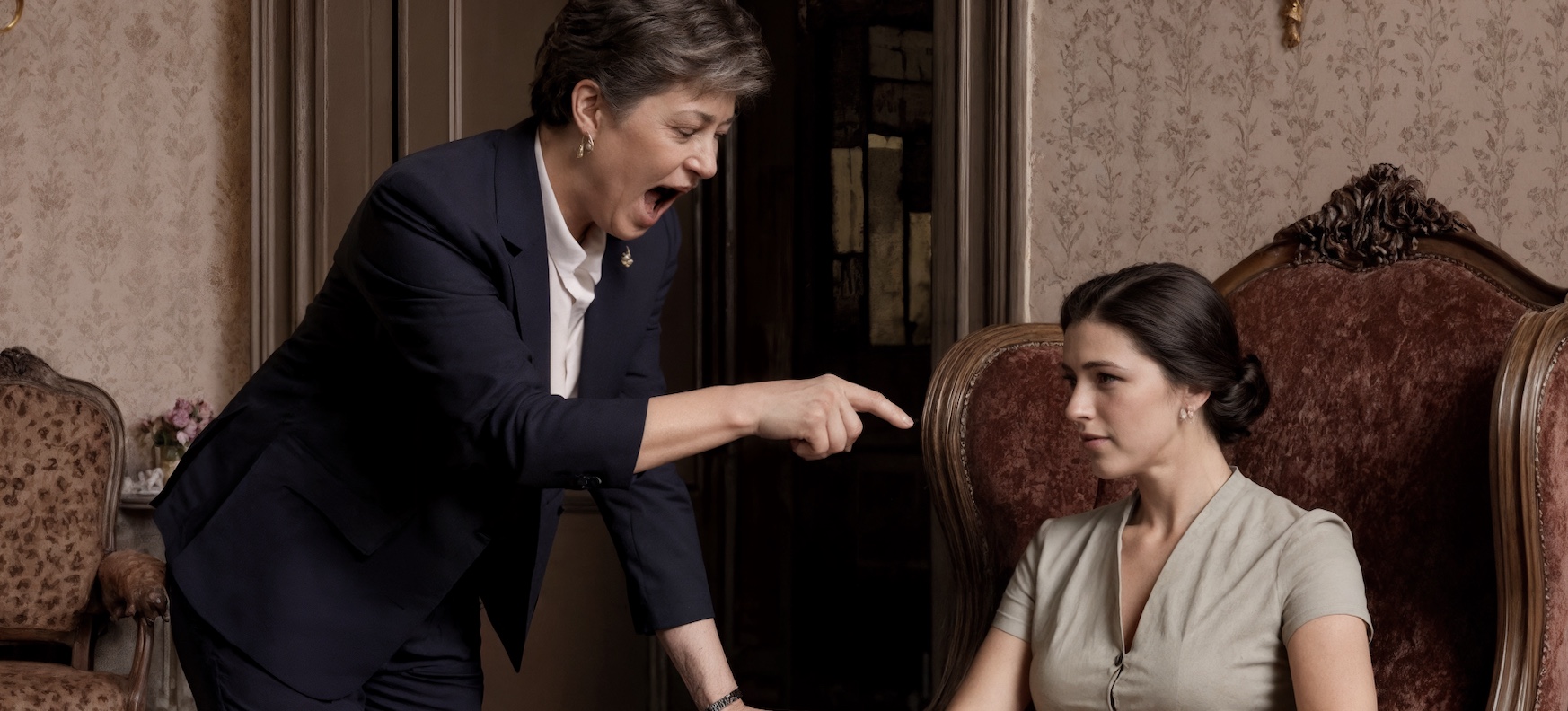
Lidia Petrovna stood there like a sentry of the apocalypse, her face twisted in rage, eyes blazing. She ignored her own son completely and fixed her stare on Marina.
“Well, look who showed up—our generous benefactor!” Her voice was raw from screaming. “So tell me! How do you not have money? And how are we supposed to pay off the loans? We were counting on you!”
She fired it all out in one breath, stabbing a finger toward Marina. Behind her, in the dim hallway, Victor Ivanovich—Alexey’s father—hovered like a frightened shadow.
Marina froze on the threshold. She felt the blood drain from her face; a high ring filled her ears. The cozy world of her Sunday evening—apples, cinnamon, warmth—collapsed in an instant under the force of that furious, unfair assault. She looked at Alexey, waiting—hoping—he would speak up, defend her. But he lowered his eyes like a guilty schoolboy.
That was how it began.
Marina stood pressed against the doorframe, as if the wood could hold her upright. Time felt slowed. She could physically feel her mother-in-law’s heavy, hateful stare. The words “We were counting on you!” hung in the hallway, thick and sticky like tar.
Alexey finally moved. He stepped forward, trying to shield his wife.
“Mom, calm down. Why are you yelling? Let’s talk like adults.”
“Adults?” Lidia Petrovna snorted, but she backed away to let them in. “When you want your money to matter, suddenly we’re all ‘adults.’ Meanwhile we’re losing our minds here and you’re sitting around eating pie!”
The apartment greeted them with familiar scents—lavender sachets from the closet, a faint old-house smell. But today something else tainted it: fear and disorder. Unread newspapers were piled in the entryway. Dust filmed the mirror.
In the living room, beneath the icons, Victor Ivanovich sat on the couch. He looked ten years older than he had a week ago. Gray stubble covered his hollow cheeks. His hands trembled slightly on his knees. He didn’t look up—just stared at one spot on the rug.
“Dad… what happened?” Alexey asked quietly, sitting beside him.
Lidia Petrovna didn’t let her husband answer. She planted herself in the center of the room like a prosecutor, arms crossed.
“What happened? Ask your clever wife why she’s leaving us to drown! We’re old—should we just go die, then?”
“Lida, enough,” Victor Ivanovich rumbled, but his voice was barely a whisper.
“Shut up!” she snapped. “This is your doing, so you keep quiet. Now listen—my grown, smart children. Your father,” she emphasized the word with venom, “decided he was going to be a businessman. He poured in all our savings—and then borrowed more—into one ‘super profitable’ project. Promised us mountains of gold.”
Marina moved slowly to the chair by the window and sat down. She felt like a foreigner in hostile territory. Her heart thumped up in her throat.
“What project?” Alexey asked, forcing calm.
“What does it matter?” Lidia Petrovna shrieked. “It was a pyramid scheme! A scam for idiots! It all collapsed. And the people he borrowed from aren’t waiting politely. Now they call us ten times a day. They’ve already shown up here—asked the neighbors about us. The whole street knows! Shame on us!”
She slapped her palm down on a stack of papers. Printed contracts, calculations—numbers that looked like threats, especially in the line labeled Total Debt.
“Look! Admire your father’s genius! And here’s the best part—those… those people say if we don’t start paying, they’ll sue and take our apartment! Our only home! Do you want us out on the street?”
“Mom, what does any of this have to do with Marina?” Alexey said, pain edging his voice. “Why did you attack her the second she walked in?”
“Because it does!” Lidia Petrovna turned on Marina, eyes narrowed. “You’ve got everything! A place—even if it’s mortgaged, it’s yours. A car. And you—” she jabbed a finger at Marina, “—you got promoted, you earn well, everyone knows it! And we’re here living off my pension. You have to help. We’re family!”
She pronounced family like an oath, heavy with drama. Marina listened and almost couldn’t believe what she was hearing. This woman had never treated her like family—never—had sabotaged her at every step. Now she used that word like a weapon.
The room felt airless. Marina looked at Alexey, begging him with her eyes to stop this madness. But he sat hunched, staring at his father. Victor Ivanovich chewed his lip, fingers fidgeting at the edge of his jacket.
“Lidia Petrovna,” Marina said at last—quietly, but clearly. Her voice trembled, yet she forced it steady. “I’m sorry you’re in this situation. Truly. But I don’t understand one thing. Why did you decide it’s my direct responsibility to solve your financial problems?”
A dead silence fell. Even the wall clock seemed to stop. Lidia Petrovna stared as if Marina had started speaking an alien language. She had expected tears, excuses—anything but a cold, logical question.
Alexey lifted his head. His eyes darted between his mother and his wife. His face showed horror that gentle, usually accommodating Marina had dared to push back.
Lidia Petrovna recovered first. Her face twisted again with rage.
“Oh, so that’s it?” she hissed. “So you’re a stranger, then? Fine. Watch yourself, Marina. Life has a way of spinning the wheel. We’ll see how you sing when disaster hits your house.”
It sounded like a curse.
Marina stood. She couldn’t breathe in that room another second. The air was poisoned with hatred and greed.
“Lyosha, I’m leaving,” she told her husband, not looking at him. “I need to check on Kirill.”
She turned and walked out, not reacting to her mother-in-law’s renewed screams—now aimed at Alexey: “See? See what kind of wife you married? Leaving us to drown!”
Marina stepped into the stairwell and shut the door behind her. She pressed her forehead to the cold glass of the window and closed her eyes, trying to silence the roar in her ears.
She knew this was only the beginning. Worse was coming.
And the hardest blow, she felt it in her bones, wouldn’t come from her mother-in-law at all.
It would come from her husband.
Marina didn’t remember how she got to the car or how she drove away. Alexey’s pale, lost face floated in front of her like an afterimage. And in her ears, his voice—still silent, still not defending her—rang louder than any scream.
When she entered their apartment, she heard the normal, peaceful sounds of home—Kirill playing on his computer. He turned at her footsteps.
“Mom? Why are you back so fast? Where’s Dad?”
“Dad… will come soon,” Marina forced out, taking off her coat. Her hands shook. “Grandma and Grandpa have some problems. Adult problems.”
“Again?” Kirill sighed—and in his voice there was a tired understanding that squeezed Marina’s heart. Kids always feel the tension. “Okay. I finished almost all my homework.”
“Good job,” Marina said, and walked to the kitchen.
The warmth of the evening was ruined beyond repair. The pie sat untouched on the table, like a postcard from happiness—something that had existed only a few hours earlier. Marina began clearing the table automatically, but her movements were sharp, uneven. A plate slipped from her hands and shattered on the floor.
At that exact moment, a key turned in the lock.
Alexey came in. He looked wrecked. His steps were heavy.
“Hey, Dad!” Kirill called from his room.
“Hi, son,” Alexey answered, his voice raspy with exhaustion.
He walked into the kitchen, saw Marina picking up the broken pieces, and stopped in the doorway. The silence between them was thick, sticky—like tar.
“Kiril, go to your room,” Alexey said quietly. “Mom and I need to talk.”
When their son’s door closed, Marina straightened, set the dustpan aside, and looked at him.
“Well?” she asked. “What exactly do we need to talk about, Lyosh? About how your mother blamed me for everything under the sun? Or about why you stood there like a statue and didn’t say a single word?”
“Marina, don’t start the second I walk in,” Alexey dropped into a chair. “You know what state they’re in. Mom’s hysterical, Dad’s barely conscious. They’re desperate.”
“And I’m thrilled?” Marina’s voice shook, but she kept it low so Kirill wouldn’t hear. “Did you hear what she said? ‘How do you not have money?’ Me. And where were you? Why did you keep quiet? Why did she come for me first?”
Alexey covered his face with his hands, then dragged his palms down hard.
“I wasn’t quiet! I tried to calm her down! And you—why did you snap back? They’re my parents. We can’t just abandon them!”
“We?” Marina took a step closer. She wanted to shake him awake. “Is it you who gave them hope? Is it you who hinted we’d ‘figure something out’? On my back? Without asking me?”
Alexey looked away.
That one gesture said more than a hundred words.
A cold wave ran down Marina’s spine—betrayal, clean and sharp.
“Lyosh,” she whispered. “You know what that money was for. Kirill’s education. That robotics camp he dreams about. Our vacation we’ve postponed for five years. We cut ourselves back to save. And now you want to toss it all in the trash because of your father’s gamble?”
“What am I supposed to do?” Alexey suddenly shouted, springing up. His restraint cracked. “Tell me, since you’re so smart! Let them take their apartment? Let them spend old age bouncing between rented rooms? They’re my parents!”
“And that’s your son!” Marina shot back, pointing toward Kirill’s room. “That’s your family. Are you ready—because your parents are paying for their own mistakes—to ruin our child’s future? To take away his chance? To drown our marriage in their debt?”
Soft footsteps sounded behind the door. It opened slightly.
Kirill stood there, pale and frightened.
“Dad… Mom…” he said quietly. “Is it true my camp is canceled because of Grandpa’s debts?”
The question hung in the air—sharp and merciless like a blade.
Alexey stared at his son. And slowly, awareness spread across his face. He finally understood: his silent agreement with his mother wasn’t about “money” in the abstract anymore. It had already struck the most precious thing in the room—his child’s hopes.
He couldn’t answer.
He just lowered his head.
Marina saw something else in his eyes—not only confusion, but a terrifying split inside him. And she understood: the fight was only beginning.
And her hardest battle wouldn’t be with the shameless mother-in-law.
It would be with her own husband—who, at the worst possible moment, had stood on the wrong side of the barricade.
Three days passed. Three days of heavy, crushing silence in the apartment. Alexey left for work early, came home late. They spoke only in household fragments when Kirill was around. The air was packed with unspoken accusations and raw hurt.
Marina’s phone stayed quiet—her mother-in-law must have realized the frontal attack hadn’t worked and switched strategies. The quiet felt more threatening than screaming.
On Thursday evening, as Marina tried to focus on cooking, someone rang the doorbell—insistent, two long presses. Marina’s heart dropped unpleasantly. Only one person rang like that.
“Who could that be?” Alexey muttered, walking out of the room.
Marina froze at the stove, listening.
She recognized the voice instantly—loud, confident, casual in that overly familiar way.
“Lyokh! Hey, brother! Long time! What are you doing standing there—let us in!”
Igor, Alexey’s younger brother, strode into the kitchen like he owned the space. He was Alexey’s opposite in every way—bright clothes, an expensive phone in his hand, pricey cologne trailing after him. Alexey followed behind, shoulders slumped.
“Marish, hey!” Igor flashed a wide smile, but his eyes were cold, measuring. “Having dinner? We’ll only take a minute. Business.”
“What kind of business, Igor?” Marina asked without turning from the stove. Goosebumps ran down her back.
“Family business,” Igor said, dropping into a chair and nudging a plate aside. “Heard Mom and Dad are in deep trouble. Happens to old folks. We’ve got to help.”
“Help?” Marina repeated, turning to face him. “How?”
“Oh, I’ve already thought it through!” Igor snapped his fingers as if he’d invented electricity. “The problem is the interest. Those… lenders have insane interest. But you and Lyokha—everything’s official: white salaries, clean credit history. Right? Right.
“So you take a normal consumer loan—good amount. Bank interest is way lower. You use it to pay off Mom and Dad’s debts, and then you just pay the bank monthly like normal people, without all that drama. Everybody wins!”
Marina stared, genuinely stunned by the cynicism.
“So,” she said slowly, “your brilliant plan is for us to take on your parents’ debts. To climb into new loans.”
“Not debt—restructuring,” Igor corrected cheerfully. “Look at you, big words. Same idea. It’s easier for you. Gives them air. They’re old, it’s hard.”
Alexey finally lifted his eyes to his brother.
“Igor, what about you?” he asked quietly. “You have your own little company. You could help. Lend money.”
Igor laughed—short and dry.
“Lyokh, come on. I’ve got business, turnover, everything’s invested. Pull cash out, I lose. But you’re wage earners—steady. Easier for you. And besides…” he glanced at Marina with meaning, “I heard Marina’s career is taking off. Manager now, right? Salary must be good. Helping family is sacred.”
Heat flashed behind Marina’s eyes.
“SACRED?” Her voice went low and dangerous. “Where were you when your parents dumped their savings into that gamble? You, the genius businessman—did you warn them? Stop them? Or were you hoping for your cut of the ‘mountains of gold’ too?”
Igor’s smile vanished. His eyes narrowed.
“Not your business. I don’t judge them. Right now we’re talking help.”
“We’re talking about dumping their mess on us!” Marina slammed her palm onto the counter. “You aren’t offering to help—you’re offering to drag us into a pit so we can pay for their stupidity for years. And what about our plans? Kirill’s education?”
“Oh, the kid can wait,” Igor waved it off. “Not like you’re sending him to some conservatory.”
That one sentence was enough.
Marina saw Alexey flinch. For him, Kirill was sacred.
“Igor,” Alexey stood up. His voice—for the first time in days—came out firm. “Enough. Your plan isn’t a solution. It makes it worse.”
“So you’re just abandoning the old people like monsters?” Igor hissed, rising too. “Fine. I’ll tell Mom. Your precious son and his greedy wife—no help from them!”
He spun on his heel and left without a goodbye. The front door slammed like a gunshot.
Marina and Alexey stood in the heavy silence, on opposite sides of the kitchen. The barricade between them had grown taller—but for the first time, Marina saw a flicker in Alexey’s eyes: not confusion, but understanding.
Understanding that his family didn’t see them as loved ones.
They saw them as a wallet.
After Igor’s visit, silence ruled the apartment completely. Alexey disappeared into the bedroom, closing the door too hard. Marina stayed in the kitchen, staring at dinner gone cold. His brother’s suggestion floated in the room like poison: Take a loan… restructure…
She understood then—emotion wouldn’t win this. Her mother-in-law used guilt. Igor used arrogance and fake logic. Marina needed a different language.
Facts.
The law.
The next morning, after sending Kirill to school and waiting for Alexey to leave for work, Marina called her friend Olga—a lawyer at a large firm.
“Olya, I need your help urgently,” Marina said. “Not as a friend. As a professional. I need a consultation.”
An hour later Marina sat in Olga’s neat, glass-walled office, the city moving outside like a distant movie. Here it was quiet, smelling of coffee and old paper.
“Tell me everything,” Olga said, setting down her pen.
Marina explained—messy, emotional, jumping between details: her father-in-law’s debt, her mother-in-law’s demands, Igor’s “brilliant” plan.
Olga listened without interrupting, only occasionally jotting notes. When Marina finished, Olga leaned back.
“Okay. Breathe,” she said. “First and most important: your in-laws’ debts are their personal responsibility. You, Alexey, your minor son—none of you are legally responsible for them.”
Marina clung to each word like a life raft.
“That means,” Olga continued, “if they don’t pay, collection can only target their property. Their apartment, their assets. Not your apartment, not your salaries, not your accounts. Absolutely not. That’s prohibited.”
“But they’re saying they’ll come and take their home…” Marina started.
“That’s fear tactics,” Olga cut in calmly. “And also—there’s a crucial detail. In general, a creditor can’t seize a person’s only home. There are exceptions, like if it’s a mortgage collateral. But your in-laws don’t have a mortgage, right?”
“No,” Marina exhaled. “Their apartment is fully theirs.”
“Good. Then even if someone sues and wins, they won’t be able to take the apartment as an ‘easy trophy.’ They might be able to put restrictions on selling it, but the idea that they can just throw them out is—at minimum—not as simple as your mother-in-law is shouting. The key is: your family’s property is protected.”
“What if they call us? Threaten us?” Marina asked.
“Common tactic,” Olga nodded. “But you’re not a party to their contracts. You can demand they stop contacting you. There are legal ways to document that. I’ll draft you a template statement.”
Olga slid a sheet of paper across the desk with bullet points.
“Remember this,” she said. “If you take a loan in your names, it becomes your obligation. Purely voluntary. And in this situation, it would be a massive mistake. Your job is to protect your child, your home, and yourself. The law is on your side.”
Marina took the paper. It wasn’t just paper. It was a shield.
When she stepped outside into the crisp autumn air, she realized she was breathing properly for the first time in days. Their life—Kirill’s plans, their future—was not a bargaining chip in other people’s reckless schemes.
She pulled out her phone and called Alexey.
“Lyosha,” she said, and her voice surprised even her—steady, calm. “Meet me at your parents’ place. In an hour. We need to talk. This will be the deciding conversation.”
Alexey was waiting outside his parents’ building, smoking one cigarette after another. When he saw Marina, he tossed the butt and crushed it under his heel.
“Marin… maybe we shouldn’t,” he said tiredly. “They’ll scream again. Another scandal…”
“There will only be a scandal if they refuse to listen to reason,” Marina answered firmly, gripping the folder Olga had given her. “But this conversation has to happen. For us.”
She walked into the building without letting him argue. Alexey sighed and followed.
Lidia Petrovna opened the door, face already geared for war—then paused in surprise seeing them together.
“Well? Come in then,” she grunted, stepping aside.
Victor Ivanovich sat in the living room where he always sat. He looked even more crushed than last time. The same papers lay on the table, now joined by bank envelopes.
“So?” Lidia Petrovna began immediately, without offering them a seat. “Did you finally decide? Did you bring money?”
“Mom,” Alexey said quietly but firmly, “sit down. We’re going to talk calmly.”
They sat.
Marina placed the folder on her knees and looked Lidia Petrovna straight in the eyes.
“Lidia Petrovna. Victor Ivanovich. Alexey and I discussed everything. And we’re going to offer you the only realistic options you have.”
“Options?” her mother-in-law scoffed. “There’s one option—give us money!”
“We don’t have the money you want,” Marina said, clear and flat. “We have our own obligations—our mortgage, our son’s education. We cannot and will not take away Kirill’s future to pay for someone else’s mistakes.”
“Someone else’s?” Lidia Petrovna shrieked. “Is my son ‘someone else’ to you?”
Alexey raised a hand.
‘“Mom. Stop. Let Marina finish.”
His voice wasn’t loud—but it carried a firmness that made his mother blink, stunned. Marina felt something shift in her chest. For the first time in weeks, he was standing with her.
Marina opened the folder.
“First,” she said, “you have a dacha. It’s property. You can sell it and cover a large portion of the debt.”
“My dacha?” Lidia Petrovna exploded. “My dacha? That I sweat blood for? No. I’m not giving up my dacha!”
“Then the second option,” Marina continued, unshaken. “You and Victor Ivanovich go to the bank—or to whoever you owe—and request a restructuring plan. Payment schedule based on your pension income.”
“They’ll eat us alive!” Lidia Petrovna waved her hand.
“And we won’t go negotiate for you,” Alexey added. “These are your debts, Mom. You’re adults. You need to deal with them.”
At that moment Igor appeared in the doorway.
“Oh, a family meeting without me?” he smirked. “What genius plan is the clever wife selling today? Sell the dacha? March the old folks through banks?”
Marina turned to him.
“Igor,” she said evenly, “what are you offering? Besides dumping everything on us? Do you have money to help? Or are you only good at advice—using other people’s hands to pull your chestnuts from the fire?”
Igor flushed, thrown off.
Lidia Petrovna lunged into her final attack, stepping close, finger shaking inches from Marina’s face.
“I knew it! From the beginning I knew you’d destroy our family! Selfish snake! You drove a wedge between a son and his mother!”
Marina rose slowly. She was taller. And her calmness looked like strength.
“No,” Marina said. “You’re the one thinking only of yourself. You want to fix your problems by sacrificing our family—by sacrificing your grandson’s future. And family isn’t only you.”
She looked at Alexey.
He stood up and stepped beside her.
“Mom,” he said—and his voice trembled, but he pushed through. “My family is Marina and Kirill. That’s our son. You are my parents, and I love you. But you have to solve your problems yourselves. We can help with advice, with support—yes. But not with money we don’t have. And not by destroying our child’s future.”
Silence filled the room. Somewhere behind the wall, a neighbor turned on the TV.
Lidia Petrovna stared at her son like he’d stabbed her. In her eyes was grief—and a dark realization.
She had lost.
She didn’t answer. She turned and walked into the kitchen without a word.
Marina took Alexey’s hand. His palm was cold and damp—but he didn’t pull away.
They left the apartment without saying goodbye.
The battle had been won.
But the war for their family had just moved into a new, harsher stage.
The silence that followed was different. Not the suffocating, ominous kind—but fragile, hard-earned. Paid for.
The first days were the worst. No calls. No visits. Neither Lidia Petrovna nor Igor. That quiet was more frightening than shouting. Alexey seemed haunted, checking his phone constantly as if waiting for an explosion. Marina understood: he was waiting for punishment—for “betraying” his mother.
A week later, one evening, he finally cracked. Staring into his tea, he asked in a small voice:
“Maybe we should still help them. Just a little. Just so Mom…”
“So Mom what?” Marina interrupted gently. “Stops freezing you out? Forgives you for choosing your wife and son? Lyosh, that’s blackmail. If we give them even a coin now, they’ll smell weakness—and they’ll push until there’s nothing left.”
“But they’re selling the dacha,” Alexey whispered. “Dad called… today. He says Mom won’t get out of bed. She cries all day. It really is hard for them.”
“It is hard,” Marina agreed. “But they’re adults. They made the choice to gamble. Now they live with the consequences. We offered them solutions. They chose the dacha. It’s bitter—but it’s the right choice.”
She came behind him and hugged his shoulders. He was tight as a wire.
“We didn’t abandon them,” she said softly. “We protected our family. Otherwise that debt pit would swallow everyone—them, us, and Kirill’s future. Do you want that?”
Alexey shook his head.
“No,” he breathed. “I don’t.”
He reached for her hand and squeezed it. For the first time in weeks, his touch wasn’t pleading. It was grateful.
The turning point came two weeks later.
On Saturday morning, the doorbell rang. Marina and Alexey looked at each other—same question in both pairs of eyes. But it was Kirill standing there, phone in his hand, excited and confused.
“Grandma… Lidia Petrovna,” he corrected himself, “called me. She congratulated me on my grades. My teacher apparently called her.”
Marina and Alexey froze.
It was the first step—tiny, cautious, but real. From his mother.
“And what did you say?” Alexey asked.
“I said thanks,” Kirill shrugged. “Asked how they’re doing. She said everything’s fine, they’re selling the dacha. Her voice was… normal. Not angry.”
Alexey closed his eyes and breathed out long and slow. The rock of guilt inside him shifted.
And then they made a decision—one that felt like freedom.
“Kiril, pack your things,” Marina said, and her voice held a joy she hadn’t heard in herself for months. “We’re going to see that camp. Today.”
“Seriously?” Kirill’s eyes flared bright.
They went. They toured the buildings, the labs, spoke to instructors. Kirill sprinted ahead, his face glowing. Alexey watched him, and his old, gentle smile finally returned. He took Marina’s hand.
“I’m sorry,” he said quietly. “For everything. For being weak.”
“I forgive you,” Marina answered. “But let’s agree on something. Never again. Our family is a fortress. And we protect it together.”
“Agreed,” he said, squeezing her fingers.
They signed the camp contract.
They came home late—tired, happy, united again.
Six months passed. Life eased into a new, calmer rhythm. Things with Alexey’s parents stayed cool, but no longer openly hostile. Lidia Petrovna called Kirill sometimes. Marina didn’t forbid it. She understood: losing the dacha and losing the battle had forced the old woman to rethink things in her own way. Bitter medicine, but it worked.
Marina and Alexey finally bought tickets to the sea—first time in five years. The night before they left, their apartment hummed with pleasant chaos. They packed, laughed, made plans.
Then Alexey’s phone rang.
It lay on the nightstand, screen glowing with one name:
Igor.
Alexey looked at Marina. There was no fear now. No confusion. Only tired readiness.
He answered.
“Yes, Igor. Hi.”
Marina couldn’t hear Igor’s words, but Alexey’s face told the story. His brows lifted slowly; a crooked, exhausted smile tugged at his mouth. He listened for a full minute without interrupting.
“I see,” he said at last. “Problems. You need money. Urgently.”
There was not a drop of surprise in his voice. Only bitter inevitability.
“Let me guess,” Alexey went on, glancing at Marina. She gave a small nod—permission to say whatever he needed to say. “Your new ‘super profitable’ scheme crashed, and now you want us to ‘save’ you again. Take a loan. Hand over our last breath.”
‘
He paused, listening to excuses.
“You know,” Alexey said finally, “I’ll tell you what it took me half a year to learn. Nobody owes anybody anything. Not us to you, not you to us. Your problems are your problems. Deal with them yourself.”
Igor’s voice rose, sharper. A few words pierced through the speaker: “…brother…”, “…just this once…”, “…your wife’s a—”
Alexey’s face turned to stone.
“That’s enough,” he said. “Listen carefully. My wife is my choice. My family. And I protect my family—from everyone. Including you. Don’t call again with requests like this. It’s pointless.”
He ended the call and lowered the phone. Silence settled, broken only by the steady ticking of the clock.
Kirill stared at his father with open admiration.
“Dad… that was like a movie,” he whispered.
Alexey sank onto the couch and rubbed his face. But when he looked up at Marina, there was no torment left in his eyes. Just exhaustion—and enormous relief.
“That’s it,” he said simply. “Topic closed.”
Marina sat beside him and took his hand. She looked at him and didn’t see the lost boy his mother used to bully. She saw a grown man who had finally chosen his priorities—and found the strength to say no.
“Never again,” she repeated softly—their pact.
“Never,” he confirmed. “Our fortress. Our rules.”
He wrapped an arm around her, and they sat that way for a moment, listening to Kirill humming while he packed his suitcase. Outside, the sun went down, painting the room in warm gold. Inside, it smelled like peace.
And like the future.
They didn’t gloat. They didn’t ask what happened to Igor’s latest scheme. It didn’t matter anymore. What mattered was that they survived. They walked through the fire of family pressure, manipulation, and guilt, and came out not broken—but closer.
Alexey looked at the packed suitcases, at his son’s bright face, at his wife—who had been stronger in their hardest moment and had found the wisdom not to crush him, but to help him stand straight.
“Tomorrow,” he said, and hope returned to his voice, “we go to the sea.”
Marina smiled and leaned into his shoulder. They had paid a high price for their calm. But now they understood: it was worth it.
And the lesson was simple:
Family boundaries must be defended—and those boundaries begin exactly where other people’s ambitions and debts end.