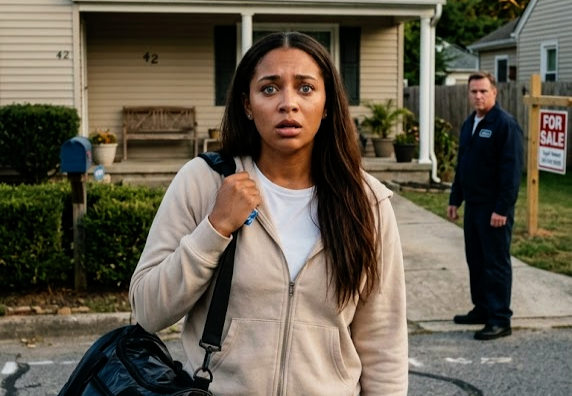
The drive from university to Bakersfield is usually a four-hour meditation on the future. I had spent the trip thinking about my midterms and the looming shadow of law school applications. But as I pulled onto my street, the future vanished, replaced by a neon-orange “For Sale” sign hammered into the lawn like a stake through a heart.
My name is Jasmine Rojas, and on that Tuesday of spring break, I became a ghost in my own life. The house was a hollow shell. The curtains—the ones my mother had spent weeks sewing—were gone. The windows stared back at me like empty eye sockets. And there, on the porch, sat three black garbage bags. They looked like unwanted guests waiting for a bus that would never come.
I tore into the nearest bag. My life spilled out: a dog-eared copy of The Great Gatsby, a thick wool sweater I’d forgotten I owned, and a collection of high school debate trophies.
“Your father said you should have called first,” my Uncle Thomas said when I finally reached him. His voice was thin, vibrating with the discomfort of a man who knew he was participating in a betrayal. “They moved last week. Didn’t they tell you?”
“No,” I whispered. The word felt like a stone in my throat. “They didn’t tell me anything.”
When I called my father, the line didn’t even ring twice. He picked up with a flat, clinical “Hello?” as if I were a telemarketer.
“Dad, I’m at the house. It’s empty. Why is my stuff on the porch?”
There was a pause, a brief moment where I expected an apology, an explanation, or even a joke. Instead, I got the verbal equivalent of a door slamming. “We moved. You’re an adult now, Jasmine. Deal with it.”
The line went dead. I tried my mother. Straight to voicemail. My brother, Gabriel? Silence. Just like that, the “family first” religion they had preached since we immigrated from Mexico had been converted into a cult of one. I had spent years being the “perfect” daughter—maintaining a 3.9 GPA, sending a portion of my scholarship money home every month, and staying out of trouble. Apparently, my reward for being low-maintenance was being discarded.
That night, I checked into a motel that smelled of stale cigarettes and cheap bleach. I laid my salvaged possessions out on the scratchy bedspread. A broken picture frame showed us at the beach three years ago. We were all smiling. Looking at it now, I realized that family is often just a collection of people holding their breath, waiting for the right moment to exhale.
I made a decision that night. If they wanted to erase me, I would become something indelible.
I spent the rest of spring break on the couch of my mentor, Professor Wilkins. She didn’t offer platitudes; she offered a key to her guest room and a connection to Riverton Law Partners. “Channel that anger into advocacy,” she told me over tea. “The best lawyers are the ones who know exactly what it feels like to have the law fail them.”
I threw myself into a summer internship. While my peers were at the beach, I was in the intake office at Riverton, listening to families who had been evicted with ten minutes’ notice or students who had been scammed by predatory landlords. I realized that my story wasn’t unique—it was just a different flavor of a systemic poison.
That’s how the Safe Space Initiative was born. It started as a proposal for a university grant: a legal advocacy group dedicated to helping students and low-income families navigate housing crises. When I won the $25,000 seed grant, I didn’t call my parents. When I rented a small office space, I didn’t send them a photo. I blocked every number associated with my past.
But the silence didn’t last. After six months of radio silence, the calls began.
“Jasmine, your mother is worried. Call us.” “This silent treatment is childish.” “We’re your family.”
I saved the voicemails, a digital museum of hypocrisy. One year after that day on the porch, I had logged 247 frantic calls. They weren’t calls of apology; they were calls of expectation. They wanted their “responsible” daughter back, now that she was making a name for herself.
The truth, however, was far uglier than a simple family feud. Two months before my final presentation for the Watkins Foundation—a grant that would provide $300,000 to take Safe Space city-wide—I received a call from Mrs. Hernandez, my old neighbor.
“Jasmine, someone broke into your old house,” she said. “The police found an envelope. It was from a law firm in Mexico regarding your grandmother’s estate.”
My grandmother had passed away years ago, leaving behind what we thought was a modest plot of land. I asked Mrs. Hernandez to open the letter. As she read, my world tilted. The “modest plot” had been developed into resort condominiums. My share of the inheritance, finalized just one month before my parents moved, was over $400,000.
They hadn’t moved because of financial hardship. They hadn’t moved because they were “embarrassed” by debt. They had moved because they knew I was coming into money, and they wanted to isolate me or hide the fact that they had been my legal guardians when the notice arrived. They had hoped I would simply disappear so they wouldn’t have to share the legacy.
The day of the Watkins Foundation presentation arrived. I was in the middle of explaining our impact data to a board of eight philanthropists when the door opened. A foundation assistant looked panicked. “Ms. Rojas, there are people here… they claim it’s a family emergency.”
I knew exactly who it was. My parents had seen the press coverage of the grant finalists. They knew this was my moment.
“Tell them I’ll speak with them after,” I said, my voice steady enough to surprise even myself. “This presentation is the only emergency in this room.”
When I finally walked out of that boardroom an hour later, they were waiting in the lobby. My mother looked older, her face a map of manufactured grief. My father stood with his arms crossed, still trying to project the authority he had forfeited a year ago.
“Jasmine,” my mother cried, stepping forward. “We’ve been trying to reach you. We made a mistake. We were in trouble—”
“I know about the inheritance,” I interrupted.
The silence that followed was heavy. My father’s eyes shifted. The “financial trouble” lie died in his throat.
“You knew I had that money coming,” I said, looking them both in the eye. “And you still put my life in garbage bags. You didn’t leave because you were poor; you left because you were greedy. You wanted to see if I could survive on my own so you wouldn’t feel guilty about taking what was mine.”
“We’re your parents,” my father growled, his pride finally breaking. “We raised you. We sacrificed everything!”
“And then you charged me for it,” I countered. “You sold the house and the daughter in the same transaction. I’m done paying that debt.”
I walked away from them in that lobby and didn’t look back. Two days later, the Watkins Foundation awarded the Safe Space Initiative the full grant, plus an extra $50,000 for “operational excellence.”
I used a portion of my inheritance to establish a permanent office and hire two full-time attorneys. The rest went into a trust for Gabriel—not because I forgave my parents, but because he was a victim of their cycle, too.
Sometimes, people tell me that “blood is thicker than water.” I usually tell them they’re misquoting the proverb. The full version is: “The blood of the covenant is thicker than the water of the womb.” I didn’t find my family in that empty house in Bakersfield. I found them in Professor Wilkins, in my colleagues at Riverton, and in the faces of the people we save from the streets every day. My belongings may have started in a garbage bag, but my future is built on a foundation they can never touch.