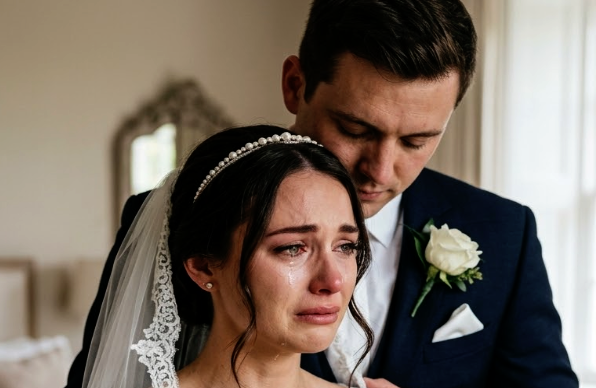
The silence of a garden filled with empty chairs is a specific kind of sound. It is not the absence of noise, but rather the heavy, echoing presence of what should have been there: the rustle of silk, the low murmur of expectant guests, the collective intake of breath when the music begins. On June 14th, 2026, in a small salt marsh venue near Mystic, Connecticut, that silence was an indictment.
I am Adeline Pharaoh, and for twenty-eight years, I lived under the impression that family was a foundation. I was wrong. In the Pharaoh household, family was not a foundation; it was a hierarchy, and I was perpetually at the bottom of the ledger. To understand why my father, Richard Pharaoh, chose finger sandwiches at a country club over his daughter’s wedding vows, you have to understand the currency of our family. My father spent three decades as a branch manager in Hartford. He was a man of “respectable” standing, which is often code for a man whose ego is tied entirely to the perception of his neighbors. My mother, Diane, mirrored this, curating our lives in Glastonbury like a museum exhibit of upper-middle-class stability. Hydrangeas, white shutters, and an unspoken rule that we never discussed anything “unpleasant.”
Then there was Colette. My older sister didn’t just marry Brett Whitfield; she married into a dynasty of Fairfield County real estate. In my parents’ eyes, Colette hadn’t just found a husband; she had secured a patron. Brett paid the mortgage on the Glastonbury house. Brett funded the Viking range in the kitchen. Brett provided the supplementary credit card that allowed my mother to shop without checking the balance. In the Pharaoh family, loyalty wasn’t earned through love; it was purchased through dividends.
I, conversely, was the “artist.” I freelanced as an illustrator for children’s books, living in a studio in New Haven where the scent of turpentine and old wood was the only perfume I could afford. My life was built on the ephemeral beauty of line and shadow, things my father couldn’t quantify on a balance sheet. When I met Marcus Delaney, a contemporary realist painter who saw the world in hues of ochre and deep indigo, my family saw not a soulmate, but another liability.
The Conflict of Calendars
The invitation to my wedding was sent six months in advance. June 14th. A date I’d chosen for the specific quality of the light in Mystic during the late afternoon. My father had promised, with a hollow, rehearsed sincerity, to walk me down the aisle.
“June 14th. Let me check the calendar,” he’d said initially. Not congratulations. Not I’m so happy for you. Just a logistical check, as if I were a dentist appointment.
Six weeks before the date, the “Great Shift” occurred. Colette announced her baby shower. It wasn’t just on the same weekend; it was the same day, the same hour, three towns away in Greenwich. The laws of physics made it impossible to attend both. The laws of the Pharaoh family made it mandatory to choose Colette.
“You can have a wedding anytime, Addie. This is my first baby,” Colette had told me, her voice dripping with a saccharine condescension that made my skin crawl. She wasn’t just scheduling a party; she was performing a stress test on our family’s loyalties. And one by one, the Pharaohs failed.
Aunt Patricia, the cousins, the family friends—they all fell in line. They were tethered to Brett’s wealth, and Colette knew it. She made individual, “surgical” phone calls, as my best friend Rachel later discovered. She told my mother it would be an “embarrassment” to the Whitfields if the Pharaoh side didn’t show up. She told my father I was “used to being disappointed.”
The Seven Who Stayed
The morning of June 14th was a study in crystalline blue. I stood in my bedroom, Rachel applying “hospital-grade” mascara to my lashes, when my phone buzzed. It was my father.
“Adeline, honey… with the drive and the shower… we just can’t make it to Mystic by three.”
The silence that followed was the sound of twenty-eight years of hope finally evaporating. “You promised, Dad,” I said. My voice didn’t shake. It was the cold, hard tone of someone who had finally seen the bottom of the well.
“Don’t make this harder than it has to be,” he replied.
When I arrived at the venue, the forty-two white chairs Marcus had arranged were gleaming in the sun. Seven people were sitting in them. Rachel, two of our art school friends, two college acquaintances, and Harold Brenton—our sixty-seven-year-old landlord from New Haven.
Thirty-five chairs held nothing but sprigs of lavender and the weight of absent ghosts.
As the string quartet began Pachelbel’s Canon, I stood at the edge of the grass, alone. I was prepared to walk myself down that aisle. I was prepared to let the empty chairs be my only witnesses. But then, I felt a presence beside me.
Harold Brenton, wearing a navy three-piece suit that smelled of cedar and old books, offered his arm. “I believe I’m overdressed for a garden party,” he whispered, his eyes steady and kind. “But if you’d let an old man have the honor… someone who actually values you should be by your side.”
I took his arm. We walked. I didn’t look at the empty chairs. I looked at Marcus, who was standing under the arch he had built with his own hands, his eyes red with a mixture of fury and love. The ceremony lasted twelve minutes. It was the most honest twelve minutes of my life. What I didn’t know as we danced on the grass that night to a portable speaker, eating pizza from a local shop, was that Harold Brenton was not just a landlord. He was the former owner of the Brenton Gallery in Chelsea, a man who had represented artists now hanging in the Met. He had been quietly watching Marcus work in our studio for a year, waiting to see if the talent was matched by character.
While my family was in Greenwich, toastings to Colette’s “miracle” baby with champagne paid for by Brett’s real estate empire, Harold was already orchestrating our future. He had sent Marcus’s portfolio to Victor Ashland, one of the most prestigious private collectors in the world.
Two weeks after the wedding, the world changed. Not in a slow, gradual way, but with the force of a tidal wave. Victor Ashland purchased Marcus’s first piece for $85,000. He then offered a $450,000 commission for a series of twelve paintings.
The centerpiece of that series would be titled June 14th. It was a large-scale oil painting of our wedding garden. It depicted the seven guests in luminous, warm detail, while the thirty-five empty chairs were rendered in a chilling, ethereal light, looking like tombstones on a manicured lawn.
The 417 Messages
In July, Marcus and I were invited to spend our honeymoon on Victor Ashland’s 180-foot yacht, the Meridian, in Monaco. It was a professional thank-you, a way for Marcus to immerse himself in the world of high-stakes art.
I am not a person who seeks revenge. But there is a particular kind of justice in the truth. On our last night in Monaco, as the sun dipped below the Mediterranean, I posted a single photo on Instagram. No filters, no long captions. Just Marcus and me at the bow of the yacht, the Monaco skyline behind us, with the caption: Honeymoon with my husband. Grateful for the people who showed up.
I woke up to 417 notifications.
The same family that couldn’t find the time to drive ninety minutes to Mystic suddenly had all the time in the world to call, text, and DM. My father called twenty-three times. My mother sent nine texts asking about the “boat.” Brett Whitfield—the golden boy—sent a message asking if Marcus needed “real estate investment advice.”
They didn’t miss me. They missed the proximity to the success they hadn’t predicted. The irony of the Pharaoh family is that they hitched their wagon to a falling star. Within months of our return, Brett’s real estate company filed for Chapter 11 bankruptcy. The “mercenary loyalty” my family had shown Colette began to fray. The mortgage payments stopped. The credit cards were declined.
My father called me in October, his voice sounding like dry parchment. “Adeline… we might lose the house. Is there any way you and Marcus…?”
I let the silence hang for a long time. I wanted him to feel the weight of an empty chair.
“Dad,” I said eventually, “I’m not a backup plan. I’m your daughter. You treated me like I was optional until I became an asset. I will help you find a smaller place, and I will make sure you’re fed, but the Glastonbury house is a monument to a life you couldn’t afford and a family you didn’t value. Let it go.” Today, Marcus and I live in a cottage in Westport. We have a garden where I grow the same lavender that sat on those empty chairs in Mystic. Harold comes for dinner every Sunday. He is the grandfather I never had, the man who saw us when we were invisible.
Marcus’s exhibition at the Caldwell Gallery was a triumph. The New York Times called June 14th “a devastating exploration of familial absence.” When my father saw the article, he reportedly didn’t speak for three days. He finally came to our door with a yellowed certificate from twelve years ago—an art award I’d won in high school that he’d found in the attic. He’d finally framed it.
I let him stay for coffee. I didn’t offer him a place on a pedestal, but I offered him a seat at the table.
People often ask about forgiveness. I tell them that forgiveness isn’t about forgetting the empty chairs; it’s about realizing you don’t need them filled by people who don’t want to be there. We built our own family from the seven who stayed.
Self-respect is the quietest, most potent form of revenge. You don’t have to shout. You don’t have to scream. You just have to stop setting yourself on fire to keep people warm who wouldn’t even hand you a glass of water in a desert.