The silence of high-end success is rarely peaceful; more often, it is heavy, like the atmosphere before a catastrophic storm. At sixty-eight years old, I sat within that silence, the owner of a brand-new $58 million fortune and a lifetime of accumulated weariness. I had spent forty years building Callahan Logistics from a singular, oil-stained truck into a global powerhouse. I remembered the grit of it—the way the diesel fumes seemed to seep into my skin, the sleepless nights spent calculating fuel margins on napkins, and the callouses that never quite faded.
Now, the grease was replaced by the scent of expensive lilies and the soft clink of Christofle silver. To celebrate the sale of my life’s work, I took my only son, Kevin, and his wife, Brenda, to the city’s most prestigious restaurant. It was a place where the waiters moved like shadows and the menu didn’t bother with prices. Across the starched white linen, they looked like the perfect family. But as a man who had spent decades reading logistics and human nature, I could see the cracks in their performance. Their smiles were too wide, their toasts too frequent, and their eyes were fixed not on me, but on the invisible vault they believed I had just become.
“Fifty-eight million, Dad,” Kevin said, his voice a low whistle of simulated awe. He swirled a vintage Bordeaux that cost more than my first month’s rent. “It’s a testament to everything you’ve sacrificed. A true legacy for the family.”
Brenda reached out, her fingers—manicured to a razor’s edge—resting briefly on my hand. “You’ve worked so hard, Jack. Now, it’s our turn to take care of you. You don’t have to worry about a thing ever again.”
The phrase ‘take care of you’ echoed in the hollows of my chest. It didn’t sound like a promise of comfort; it sounded like a closing argument. My late wife, Alicia, had warned me years ago. She had a way of seeing through people that I lacked in my personal life. “Jack,” she’d say, watching Kevin demand a new car or a debt payoff, “he doesn’t love the father; he loves the bank.” At the time, I’d dismissed it as motherly worry. Now, sitting in the glow of the chandelier, I felt the cold weight of her prophecy. The turning point occurred during the intermezzo. Kevin and Brenda rose to dance, a slow, practiced sway near the grand piano. They were the image of grace, the golden couple of the Callahan name. I stayed at the table, sipping my cranberry juice—a concession to my cardiologist’s warnings about my aging heart.
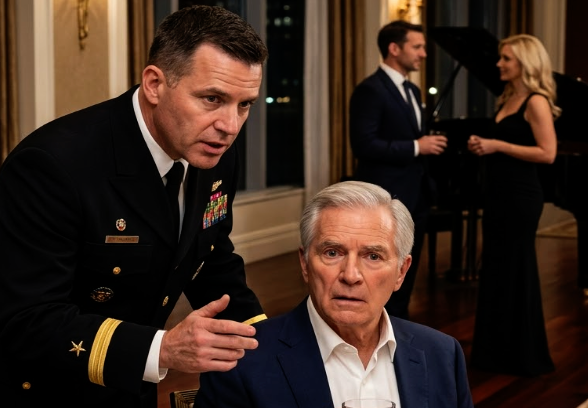
That was when Marcus approached. He was a security guard I’d seen around the club for years, a man with the ramrod posture of a career soldier and eyes that held the weary wisdom of someone who has seen the worst of humanity in the dark. He leaned in, his voice a barely audible rumble.
“Mr. Callahan,” he whispered, his eyes scanning the room with professional detachment. “I don’t mean to intrude, sir, but I was standing by the service bar. I saw your son when he returned to the table while you were in the restroom. He thought he was shielded by the floral arrangement. Sir… I saw him pour something from a small vial into your glass.”
The world didn’t shatter; it froze. The music, the murmurs of the elite, the distant city traffic—it all vanished into a vacuum. I looked down at my glass. The deep, ruby-red liquid, which I had chosen for my health, now looked like a pool of arterial blood. Marcus didn’t wait for a reaction. He gave a sharp, respectful nod and vanished back into the shadows.
I didn’t scream. I didn’t flip the table. Decades of high-stakes negotiations had taught me that the person who reacts first usually loses. Instead, a chilling clarity settled over me. I connected the dots: Kevin’s constant questions about my will, his subtle inquiries into my heart medication, and his frustration when I mentioned I intended to live another twenty years. The $58 million wasn’t a celebration for him; it was a deadline.
When they returned to the table, flushed and laughing, I put on the greatest performance of my life. I feigned a sudden, sharp pain in my abdomen, clutching my chest with a groan that felt all too real.
“Jack! What is it?” Brenda cried, her voice reaching a pitch of theatrical concern.
“My stomach,” I rasped, my voice thin. “The rich food… I need to get home. I’ve already called a car.”
“Let us take you,” Kevin insisted, his hand firm on my arm. His touch felt like a brand of ice.
“No,” I said, with a finality that brooked no argument. “I just need to lie down. Stay, enjoy your dinner. It’s my treat.”
As I rose, I “accidentally” knocked over the cranberry juice. It saturated the white cloth, a dark, spreading stain. While they called for a waiter, I used a thick linen napkin to “clean” my trousers, soaking up the liquid and shoving the damp cloth deep into my coat pocket. Fifteen minutes later, I was in a silent Uber, clutching that napkin—the physical proof of my son’s attempt to erase me from the world. I didn’t go home. Home was a museum of lies. Instead, I went to a 24-hour diagnostic lab, the kind that serves the city’s elite with total discretion. I handed over the plastic-bagged napkin and a credit card that didn’t care about the price.
“Full toxicology,” I told the technician. “Priority one. I need to know every molecule in this cloth by dawn.”
While the machines whirred, I sat in a neon-lit diner a block away, drinking bitter black coffee. At 4:00 AM, the email arrived.
Substance detected: Metoprolol tartrate. > Concentration: 2500 mg. > Clinical Note: Standard dose is 25-100 mg. For a patient with pre-existing cardiac conditions, this concentration would likely induce acute myocardial infarction within two hours.
It was the perfect murder. A heart attack in an old man with a history of heart trouble. No struggle, no visible trauma. Just a grieving son and a $58 million inheritance. The sheer, calculated coldness of it was a psychic wound that I knew would never truly heal.
I didn’t call the police. To do so would be to surrender my legacy to the tabloids. ‘Logistics Mogul Murdered by Son’ would be the headline that defined the Callahan name forever. Alicia’s memory would be dragged through a public trial. No, this required a different kind of justice. It required a surgical removal of their presence from my life.
I called Cynthia Walsh. She was the daughter of my late business partner, a woman who possessed a mind like a razor and a loyalty that was absolute. We met in her 40th-floor office as the sun began to bleed over the horizon.
“He finally did it,” she whispered, her face hardening as she read the report. “What do you want, Jack? Prison?”
“Prison is too simple,” I replied. I looked out over the city I had helped build. “I want to dismantle the world he thinks he’s about to inherit. I want him to realize that when he poured that vial into my glass, he didn’t just kill his father—he killed his future.” Over the next week, Cynthia’s team of investigators—former feds and forensic accountants—stripped Kevin and Brenda’s lives down to the bone. While I played the part of the frail, recovering father, feeding Kevin lies about a “family trust” I was drafting, the reports poured in.
The first report revealed a financial nightmare. Kevin and Brenda weren’t just living beyond their means; they were living in a hallucination. They had $2.3 million in unsecured debt. They were three months behind on the mortgages for their mansion and the leases on their luxury SUVs. They had taken high-interest personal loans from “private lenders”—the kind of people who don’t use lawyers to collect. They were drowning, and my death was the only life jacket they had left.
The second report was the one that broke my heart.
Investigators found that Brenda had been contacting high-end art galleries in New York and London. She had been surreptitiously photographing Alicia’s private art collection—pieces my wife had spent forty years curating, each one a memory of a specific moment in our marriage. Brenda was telling galleries that I was “on my way out” and that she was the sole heir, looking to liquidate the collection “discreetly” the moment I passed.
They were selling my wife’s soul before I was even in the ground.
The final piece of evidence was the most chilling. Cynthia’s team discovered a forged Medical Power of Attorney document Kevin had filed at my hospital months ago. It gave him full access to my records. His search history on burner phones included terms like: “how to fake a natural death,” “lethal dose of metoprolol,” and “will an autopsy detect beta-blockers.”
This wasn’t a crime of passion. It was a business plan. Kevin had mapped my heart’s vulnerabilities like a supply chain route, looking for the most efficient way to shut down the operation.
The final meeting took place in Cynthia’s boardroom. The room was a cathedral of mahogany and glass, designed to make people feel small. Kevin and Brenda arrived in high spirits, dressed in designer silk and smelling of success. They believed they were there to sign the papers for the $58 million Callahan Family Trust.
“Dad, you look so much better!” Kevin beamed, attempting another hollow hug.
I sat at the head of the table, silent. Cynthia sat to my right, five thick blue folders stacked before her like the components of a bomb.
“Before we sign anything,” Cynthia began, her voice as sharp as a scalpel, “we need to review the supporting documentation.”
She slid the first folder across the table. The toxicology report. Kevin’s smile didn’t just fade; it disintegrated.
She slid the second folder. The financial ruin. The debt. The looming foreclosures. Brenda’s face turned the color of ash.
She slid the third. The art gallery transcripts. The betrayal of Alicia’s memory.
She slid the fourth. The forged power of attorney and the search history. The blueprints for murder.
The silence in the room was absolute. It was the silence of a vacuum. Kevin looked at me, and for the first time in his life, he saw not a bank, but the man who had built an empire from a single truck. He saw the iron that had survived forty years of industry.
“There will be no trust, Kevin,” I said. My voice was low, devoid of the anger they expected. Anger is for those who still have hope. This was merely a statement of fact.
Cynthia delivered the final blow. “The $58 million has been moved into an irrevocable charitable trust: The Alicia Callahan Foundation. It will fund young artists and animal sanctuaries—the only things your mother truly loved. The paperwork was finalized yesterday. You will never see a single penny of it.”
I leaned forward, looking into the eyes of the stranger I had raised.
“You have two choices,” I told them. “Option one: Cynthia calls the District Attorney. We have the vial, the toxicology, the forged documents, and the search history. You will be arrested before you leave this building. You will be charged with conspiracy to commit murder. You will spend the rest of your lives in a cage.”
I let the word ‘cage’ hang in the air.
“Option two: You sign a total relinquishment of any claim to the Callahan name and estate. You hand over the keys to the house and the cars, which are already being repossessed. You take one suitcase each and you walk out of this office. You will never contact me again. I will not press charges, but this evidence will remain in a vault. If you ever come near me, it goes to the police.”
Brenda was sobbing now, a jagged, ugly sound. Kevin didn’t make a sound. He simply reached for the pen. His hand shook so violently he could barely form the letters. He signed away his inheritance, his home, and his father in three seconds of scratching ink. It has been three months since that day.
I am currently standing in a small, sunlight-drenched gallery in the heart of the city. The walls are covered in the work of twenty-somethings who have talent but no means—until now. The Alicia Callahan Foundation just held its first gala. I didn’t see any $5,000 suits or hear any talk of logistics. I saw a young man from the docks stand in front of a canvas he’d painted and weep because someone finally believed in his vision.
I realized then that a legacy isn’t something you leave to someone; it’s something you leave in the world. By taking away the money my son hadn’t earned, I gave him the only thing he actually needed: the necessity of character. Whether he builds a new life or vanishes into the shadows is up to him. I am no longer his architect.
As for me, I am no longer the man with the $58 million burden. I am the man who turned poison into paint. I am the man who finally listened to his wife’s wisdom. And as I look at a vibrant abstract piece that reminds me of Alicia’s laugh, I realize that for the first time in sixty-eight years, I am finally at peace.