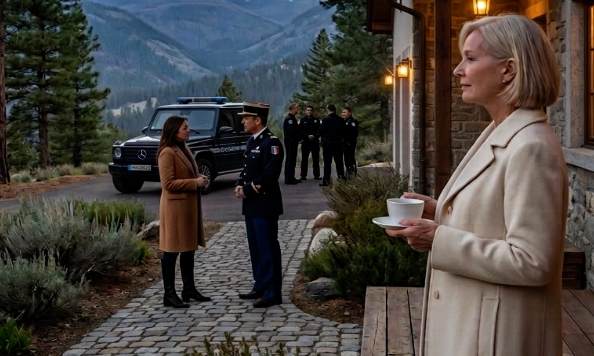
The security alarm shattered the porcelain stillness of the mountain air at exactly five in the morning. It was a sharp, clinical tone—the kind of sound designed to trigger the primitive “fight or flight” response—but in the master bedroom of the Harland cabin, it met only a calculated, weary silence. I did not jump. I did not experience the sudden spike of adrenaline that usually accompanies a pre-dawn intrusion. Instead, I simply opened my eyes and watched the faint, charcoal-gray light of a Colorado dawn filter through the heavy wooden beams of the ceiling.
My phone buzzed on the nightstand with an insistent, rhythmic vibration. I reached for it with a steady hand, my fingers wrapping around the cool glass.
“Mrs. Harland?” The voice was brittle, belonging to young Mike, the security guard I had hired three weeks prior. He was a local boy, more used to deterring curious bears than predatory family members. “I’m so sorry to wake you, but your daughter-in-law… she just pulled up to the gate. She’s got a professional moving truck with her. Three men. She’s waving a stack of papers and telling me she owns the property now. She’s demanding I open the gates or she’ll have me fired.”
I let the words settle, feeling their weight without giving them any power. My tea sat cold on the bedside table, a half-finished cup of Earl Grey from the night before when I had sat up reviewing the latest files from my attorney.
“Let her in, Mike,” I said, my voice projecting a calmness I had spent thirty years perfecting as a high school biology teacher. “But make sure she signs the visitor log. Full name, time of arrival, and the stated purpose of her visit. Have her write it down in her own hand.”
There was a long, confused pause on the other end. “Are you sure, ma’am? She’s saying you don’t live here anymore. She looks… she looks very certain.”
“I am sure, Mike. Let the theater begin.”
I ended the call and sat up, pulling my heavy wool robe around my shoulders. Outside, the low, guttural rumble of a diesel engine began to echo up the winding gravel driveway. Tires crunched. Doors slammed with the finality of a judge’s gavel. And then, there was the voice—sharp, silver-tongued, and radiating an unearned victory. Melissa.
I walked to the window and pulled the curtain back just a fraction. Below, the moving truck was parked at an arrogant angle, blocking the path to my garden shed. Melissa stood there, wrapped in a cream-colored wool coat that cost more than my first car, her hair pulled back into a sleek, aggressive ponytail. She was gesturing toward the front door, directing the three movers like a general commanding a small, reluctant army.
She thought I was gone. She thought the rumors she had planted, the documents she had forged, and the gaslighting she had orchestrated had finally reached their crescendo. She thought she was stepping into an empty shell of a house. She had no idea that I had been preparing for this specific 5:00 a.m. arrival since the moment I first saw her eyes wander toward the deed to this house six months ago. To understand the audacity of Melissa’s arrival, one must understand the ecosystem of the Harland family. For thirty years, I taught biology in Denver, educating teenagers on the delicate balance of life, the ruthlessness of natural selection, and the importance of observation. When I retired, I moved permanently to the cabin I had purchased a decade earlier—a two-bedroom refuge tucked into the pines, where the only drama was the changing of the seasons.
I was content. I was solitary, but not lonely. My only child, Daniel, was my pride. A tech consultant with a heart of gold but a catastrophic blind spot when it came to the motivations of others, Daniel had always been a “nester.” He saw the best in people, a trait that made him a wonderful son but a vulnerable target.
When he introduced me to Melissa, my “teacher’s intuition”—a finely tuned radar for deception—immediately pinged. She was a portfolio manager for private clients, a woman who spoke in the language of “asset optimization” and “legacy planning.”
During our first dinner at the cabin, she didn’t look at the wildflowers I’d picked; she looked at the crown molding. She didn’t ask about my career; she asked about the “appreciation of mountain real estate since the pandemic.”
“You’re so lucky to have a place like this, Helen,” she had said, her voice dripping with a sweetness that felt chemically engineered.
“I’m not lucky, Melissa,” I replied. “I’m disciplined. There’s a difference.”
The shift began shortly after their wedding. Daniel’s weekly calls became monthly. When we did speak, his vocabulary had changed. He began using phrases like “medical alert systems,” “diminishing returns on property upkeep,” and “the burden of isolation.” It was clear that Melissa was whispering in his ear, painting a portrait of me as a frail, declining woman who was one slipped rug away from disaster. The first physical evidence of the grift appeared in July. A leather folder was “helpfully” left on my kitchen table during one of Melissa’s unannounced visits. It contained “Estate Consolidation Forms” for something called the Harland Family LLC.
The Red Flag: The documents essentially granted the LLC (managed by Melissa) the power to “oversee” my real estate assets to ensure “tax efficiency.” In reality, it was a slow-motion theft of my autonomy.
When I refused to sign, the tactics changed. Melissa began a clandestine campaign of character assassination in my small town. She told the post office clerks I was “getting forgetful.” She told my neighbor, Margaret, that I’d left the stove on three times in a week. She was building a narrative of incompetence so that when she eventually moved to take the house, no one would question her “mercy.” I am a woman of science; I believe in data, evidence, and preparation. I did not confront Melissa with my suspicions. Instead, I contacted Ruth Bennett, a legal shark who specialized in elder financial exploitation.
We met in a dimly lit office in Denver, the “Harland Family LLC” papers spread between us like a map of a battlefield. Ruth’s assessment was blunt: Melissa was attempting a “Quiet Seizure.”
“She’s laying the groundwork for a competency hearing,” Ruth explained, her eyes sharp behind silver-rimmed glasses. “If she can prove you’re a danger to yourself, she can use those LLC papers—which I suspect she’ll eventually forge your name on—to take control of the deed.”
We didn’t just defend; we counter-attacked.
The Revocable Living Trust: We transferred the property into a trust where I was the sole trustee. This made the “Harland Family LLC” legally irrelevant.
The Quiet Title Action: Ruth filed a sealed court order that effectively “locked” the deed. Any attempt to file a new deed would trigger an immediate fraud alert to the District Attorney.
The Surveillance Network: I didn’t just hire a guard. I installed six discrete, high-definition cameras throughout the house—hidden in smoke detectors and bookshelf ornaments. I needed Melissa’s intent captured in high definition.
The “trap” was set two days ago. I told Daniel I was going to visit an old friend in Boulder for a week. I made sure Melissa overheard the conversation. I knew she couldn’t resist an empty house. It was the perfect opportunity for her to “staged” the final transition.
Through the cameras on my tablet, I watched her break in yesterday. I watched her use a key she had stolen from my garden shed. I recorded her walking through my living room, touching my belongings with the cold gaze of a liquidator.
“This is going to sell for a fortune,” she had whispered to herself, standing in the center of my kitchen. “She’ll be much more comfortable in a managed care facility.”
That recording was the final nail. It proved intent, unauthorized entry, and premeditated fraud. Which brings us back to five in the morning.
I walked down the stairs, the wood cool beneath my feet. I could hear the movers in the hallway, their heavy boots thumping against the pine floors. Melissa was in the living room, her back to me, pointing at my antique roll-top desk.
“That goes first,” she commanded. “Careful with the edges.”
“Actually,” I said, my voice cutting through the room like a cold front, “I’d prefer if the desk stayed exactly where it is.”
Melissa spun around. The blood drained from her face so quickly I thought she might actually faint. Her mouth opened, but for the first time since I’d known her, no polished lies came out.
“Helen? You… you’re supposed to be in Boulder.”
“I decided the mountain air was better for my ‘declining memory,’” I said, taking a slow, deliberate sip of my tea.
She recovered quickly—the predatory instinct was strong in her. She reached into her bag and pulled out a stack of papers. “It doesn’t matter that you’re here. I have the signed deed, Helen. The Harland Family LLC is the legal owner of this property as of yesterday. I have a moving crew and a legal right to clear this house. You’ve been deemed unable to manage your affairs.”
I didn’t argue. I didn’t raise my voice. I simply looked at the lead mover. “Sir, I suggest you stop what you’re doing. You are currently participating in a felony trespass and attempted grand larceny.”
The man looked at Melissa, then at me. “She showed us a deed, ma’am.”
“A forged one,” I clarified.
At that moment, the front door opened. It wasn’t more movers. It was the County Sheriff and my attorney, Ruth Bennett.
“Melissa Harland?” The Sheriff stepped forward, his badge glinting in the morning light. “We have a warrant for your arrest on charges of identity theft, criminal forgery, and elder financial exploitation. We also have twenty-four hours of high-definition footage of you entering this home without authorization and discussing the illegal sale of this property.”
Ruth stepped forward, her briefcase clicking open. “The deed you’re holding, Melissa, is a legal fiction. This property was moved into a protected trust weeks ago. The notary seal you used on those ‘signed’ documents? We’ve already confirmed with the Secretary of State that the registration number is fraudulent. You didn’t just steal from your mother-in-law; you committed multiple counts of state-level fraud.”
Melissa looked around the room, her eyes darting like a trapped animal. The radiant, victorious woman from the driveway was gone. In her place was a small, desperate grifter who had underestimated a biology teacher’s ability to observe a parasite. The movers left within ten minutes, apologizing profusely as they literally ran back to their truck. Melissa was escorted out in handcuffs, her cream-colored coat looking stark and ridiculous against the black plastic of the restraints.
The silence that followed was different from the silence of the morning. It was a clean silence.
Daniel arrived two hours later. I had sent him the videos the night before, but he hadn’t seen them until he woke up. He sat at my kitchen table, his head in his hands, the weight of his own naivety finally crashing down on him.
“I’m so sorry, Mom,” he whispered. “I thought… she made it sound like you were failing. She made it sound like I was being a bad son if I didn’t help her ‘manage’ things.”
“She was a predator, Daniel,” I said, placing a hand on his shoulder. “They specialize in making you feel like the hero of a story you don’t realize is a tragedy. But you’re not the one who forged the papers. You’re not the one who broke in.” Melissa’s legal troubles were only beginning. The investigation into the “Harland Family LLC” revealed that she had attempted similar maneuvers with two of her private clients—elderly men with no families to protect them. She had been a parasite for years; I was simply the first host who had a background in science and a very good lawyer.
The Final Outcomes:
Legal: Melissa was sentenced to four years for grand larceny and fraud, with a permanent disbarment from the financial sector.
The House: The cabin remains in the trust, protected and silent once more.
The Family: Daniel and I are rebuilding. It is a slow process, like a forest recovering after a fire, but the soil is richer now.
I still sit on my porch every morning at 5:00 a.m. I no longer need the alarm, and I no longer need the guard. I watch the sun rise over the peaks, and I drink my tea. I am seventy years old, my memory is perfect, and I know exactly who owns this place.
I do.