“The Locket in the Rain”
Rain hammered the glass door of the little jewelry shop, turning the whole street outside into a blur of blue-gray light and moving shadows.
Inside, everything was warm and amber.
Soft lamps glowed over the glass cases.
Gold chains shimmered under clean display lights.
The shop felt small, still, protected.
Then the door burst open.
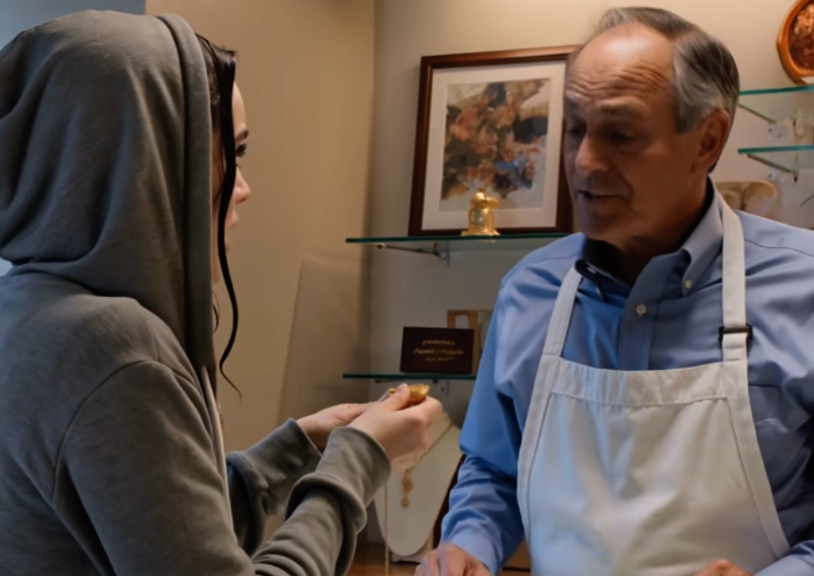
A young woman stepped in from the storm, soaked through, breathing hard, dark hair wet against her face.
Her gray hoodie clung to her shoulders.
Her jeans were ripped.
Her hands shook as she held a gold necklace with a locket close to her chest.
She looked like someone running out of time.
Behind the counter stood the jeweler — older, quiet, careful, the kind of man who had spent years pretending that routine could protect him from surprises.
She held the necklace out.
“How much for this necklace?”
He took it without much interest.
Examined the chain.
The clasp.
The gold.
His voice stayed flat.
“Fifty dollars. No more.”
The woman answered too fast.
Too desperate.
“Okay. Deal.”
That made him pause.
No bargaining.
No hesitation.
Just need.
He turned the locket in his fingers and opened it.
Inside was an old black-and-white photo.
A younger man.
A little girl.
And beneath them, engraved in tiny letters:
For my little Clara.
The jeweler’s whole body went still.
His face changed so fast it looked like the years hit him all at once.
Because Clara was his daughter.
The daughter who disappeared eighteen years ago.
The daughter everyone told him had drowned during a storm, even though no body was ever found.
The young woman saw his expression and turned instantly toward the door.
The jeweler rushed out from behind the counter and blocked her path.
Not angry.
Panicked.
His voice broke for the first time.
“Wait. That was my daughter’s.”
The woman froze with her hand on the door.
Rain thundered outside.
She didn’t turn around at first.
Then, very slowly, she looked back at him with tears mixed into the rain on her face and whispered:
“She said you wouldn’t recognize me.”
For one long second, neither of them moved.
The rain kept pounding the glass.
The warm shop lights reflected in the locket between them.
And the jeweler stared at the young woman like the past had just walked back in wearing wet clothes and a stranger’s face.
She looked exhausted.
Scared.
Cornered.
But now that he really looked at her, he saw it.
Not just in the eyes.
Not just in the shape of her mouth.
In the tiny mole near her jaw.
The same place Clara had one.
His voice came out rough.
“Who are you?”
The woman’s hand trembled on the doorknob.
Then she answered:
“I’m her daughter.”
The shop went silent.
Not because the rain stopped.
Because the meaning landed too hard.
His missing child had not died.
She had lived long enough to have a daughter.
He took one slow step forward.
“Where is Clara?”
The young woman shut her eyes for a second, like even hearing the name hurt.
“She’s alive,” she whispered.
“But not for long.”
That sentence shattered whatever distance remained.
Years ago, Clara had not drowned.
She had been taken.
Not by strangers — by her own mother’s family, who believed the jeweler was too poor, too ordinary, too shameful to keep a child tied to their name. They sent Clara away, changed records, buried the truth, and told him a storm had taken her instead. By the time Clara was old enough to search, she had already been taught to believe he never wanted her back.
But she searched anyway.
Too late to come herself.
So she sent her daughter with the one thing no lie could erase: the locket.
The young woman looked down at it and said, voice breaking:
“She needed medicine. I had nothing left.”
That was why she tried to sell it.
Not because it meant nothing.
Because it was the last thing that still meant everything.
The jeweler reached out, not for the locket this time, but for her shaking hand.
And for the first time since she entered the shop, she didn’t pull away.
Then she said the line that broke him completely:
“She told me… if you cried when you saw it, then I found my real grandfather.”
And suddenly the little jewelry shop was no longer just a place to pawn gold on a rainy night.
It was the place where a dead story ended
and a buried family found its way back into the light.