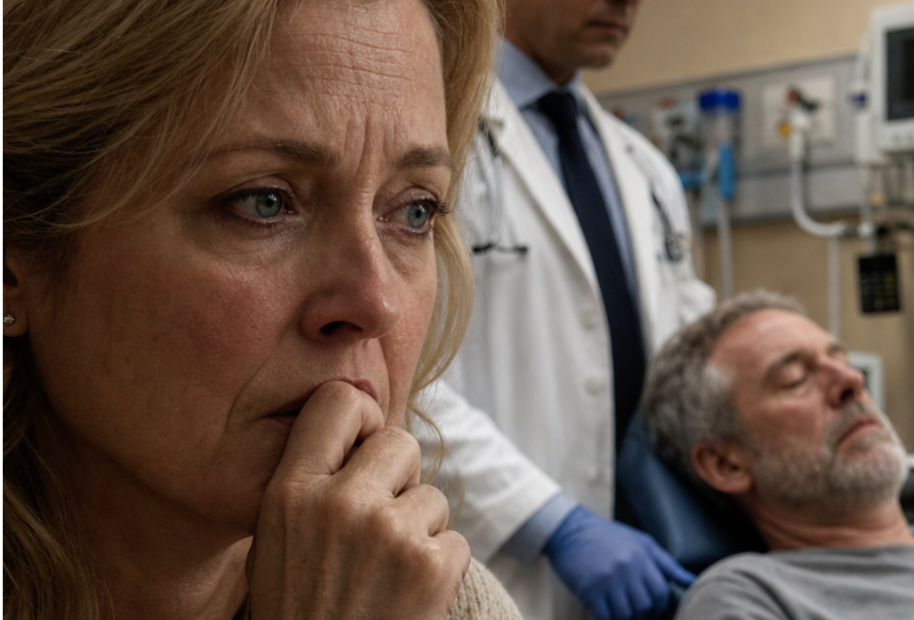
The smell of camphor and stale sweat had seeped so deeply into the apartment walls that neither long hours of airing the place out nor expensive air fresheners could get rid of it. Vera Pavlovna hated that heavy odor, but even more than that, she despised her own helplessness against it.
“Vera!” The voice from the bedroom sounded demanding, with that special shrill note people have when they are convinced of their sacred right to command. “Have you gone deaf in there?”
The towel slipped from her hands and fell softly to the floor, but Vera did not even curse.
She took a deep breath, trying to calm her pounding heart, and hurried into her husband’s room, straightening her house dress as she went.
Igor lay on the wide orthopedic bed, surrounded by pillows like an Eastern padishah at rest. His legs, covered with a scratchy wool blanket, were stretched out stiffly and looked completely lifeless.
“I’m here, Igorek,” she said quietly, approaching the head of the bed. “What happened?”
“The pillow slipped,” he grimaced in suffering, as though enduring unbearable torture. “It’s uncomfortable, Vera. You know I have poor circulation. I can’t have anything pressing on my neck.”
Vera obediently bent over, lifted her husband’s heavy head with a familiar movement, and fluffed the pillow. Igor did not even try to help, pressing his full weight onto her tired hands. Six months earlier, he had been suddenly seized up at their dacha, and since then their life had turned into this endless marathon.
Back then, the doctors at the district hospital had shaken their heads for a long time, talking about a complicated case and pinched nerves that “don’t show up on scans, but the clinical picture is obvious.”
Vera, who had worked as a chief accountant, quit her job the same day without a second thought. How could she think about quarterly reports when the person she had lived with for thirty-five years had turned into a helpless invalid?
“Water,” Igor muttered without opening his eyes and without thanking her.
She rushed to the kitchen, filled a glass, and immediately returned, afraid of displeasing him. He took one tiny sip and demonstratively grimaced, pushing his wife’s hand away.
“It’s warm. I asked for cool water. Do you want me to throw up?” He dramatically fell back onto the pillows. “You do everything to torment me. Taking care of me is a burden to you. I can see it.”
This was his favorite record, the one he put on every time Vera allowed herself even a minute of rest. You want me dead. I’m in your way. Put me in a nursing home and live in peace. Vera felt guilt wrapping around her throat like a sticky cobweb, not letting her object.
And, in truth, sometimes she was so tired she simply wanted to walk out into the street and never come back. To wash his heavy body, listen to his endless whims, run to the market for special cottage cheese because the store-bought kind tasted sour to him.
“Why are you saying such things, Igorek?” Vera carefully stroked his shoulder. “You are my husband. In sorrow and in joy, remember?”
“All right, enough lyricism,” he cut her off rudely. “Lenochka, the masseuse, is coming today, so prepare clean sheets. And go shopping. There’s no need for you to sit here.”
“In this weather?” Vera asked, confused, looking at the gray clouds outside the window. “It looks like a downpour is coming.”
“Vera!” He opened his eyes, and there was not a drop of helplessness in them. “Lenochka said I need complete peace during the session. Your presence stresses me out. I’m ashamed of my weakness in front of you!”
Vera understood. Of course, a man would feel ashamed that his wife saw another woman kneading his atrophied muscles.
Lenochka, a young, rosy-cheeked nurse from a private clinic, came three times a week and cost a lot of money. But Igor assured Vera that after her sessions, he could at least feel tingling in his toes, and that gave them hope.
She put on her old raincoat, took an umbrella, and left the apartment, feeling like a stranger in her own home. She was sixty, but in moments like this she felt like a very old woman whose life was already over.
A week later, Vera felt a strange and frightening discomfort. At first, she blamed the itching and burning on nerves or on the new laundry detergent she used to wash her husband’s bedding. But the symptoms grew worse, unpleasant sensations appeared, and it became impossible to ignore.
Burning with shame, she made an appointment at the women’s clinic, choosing a time when there would be as few people as possible. Sitting in the corridor, wrapped in her scarf and hiding her eyes from the young girls, was unbearably humiliating. The examination room had a persistent medical smell mixed with the aroma of cheap coffee.
The doctor, a heavyset man with a rumpled face and tired eyes, silently took swabs and told her to wait for the rapid test results. Those twenty minutes felt longer to Vera than the entire last six months at her husband’s bedside. In her mind, she went through the places where she could have picked up an infection: public transport, the clinic, someone else’s bathroom?
When she was called back in, the doctor was already writing something quickly in her chart, not even looking at his patient. Then he raised his eyes over his glasses, and that look was assessing, heavy, and unpleasant.
“Sit down, dear,” he said, putting aside his pen. “The situation, to put it plainly, is rather delicate.”
“What is it, inflammation?” Vera’s voice trembled. “Did I catch a chill somewhere?”
The doctor snorted and pushed toward her a sheet of results covered with Latin terms and bold plus signs.
“Inflammation, yes, but a very specific kind. In the most active phase, plus an accompanying bouquet.”
Vera froze, feeling the air in the room turn thick, like jelly.
“This is a mistake,” she whispered with bloodless lips. “This simply cannot be.”
“Tests are stubborn things,” the doctor cut her off indifferently, grimacing with disgust. “Where did you manage to pick up such filth at your age?”
Vera’s cheeks flared as if she had been slapped across the face.
“Doctor, how dare you! I have been married for thirty-five years. I am a decent woman!”
“We’re all decent until we see the certificate,” he said, taking up his pen again and writing a prescription. “Your partner must be treated as well. Otherwise you’ll keep passing the infection back and forth forever.”
“I have no partners!” Vera cried out, her voice breaking into a shriek. “My husband is almost completely paralyzed. He hasn’t gotten out of bed in six months. I feed him with a spoon! Once a year he tries to perform his marital duty. Somehow.”
The doctor stopped writing and looked at her now not with disgust, but with some sharp, professional irony.
“Paralyzed, you say?” He tapped his pen on the table. “Well then, the wind must have blown it in, or the Holy Spirit did it, since you’re so pure.”
He leaned forward, his face too close, violating every personal boundary.
“Listen to me, Vera Pavlovna. You can’t fool biology, no matter how hard you try. This infection is not transmitted through everyday contact: not through towels, not through handshakes, only through direct contact.”
Vera shook her head, refusing to believe it, but the world around her had already begun to collapse.
“If you are clean,” the doctor pronounced harshly, “then your ‘paralyzed’ husband isn’t as immobile as you think. Or someone is jumping into his bed while you’re emptying his bedpan.”
Vera left the clinic with no memory of how she had gone down the stairs and ended up outside.
In her hands, she was painfully clutching the crumpled prescription, and in her ears rang like an alarm bell: “Not as immobile as you think.” She sank onto a wet bench in the small park, not noticing the cold.
Images appeared before her eyes: Igor demanding that she close the door more tightly. Igor sending her out of the house during the visits of “masseuse” Lenochka, supposedly because he was embarrassed. Rosy, sturdy Lenochka with her strong hands, and that strange, sweetish smell in the bedroom after she left.
The scattered details Vera had once dismissed now came together into one ugly and perfectly clear picture. Inside her, where pity and care had once lived, a cold, calculating rage began to rise. She stood up, shook off her raincoat, and headed decisively to the pharmacy, and then to the hardware store.
She returned home after dark, when the windows of the neighboring buildings glowed with a cozy yellow light.
The apartment smelled of medicine and that same sweet, cheap perfume Lenochka used. Before, Vera had paid no attention to it, but now the smell hit her nose like ammonia.
“Where the hell have you been?” came the familiar shout from the bedroom. “I’m hungry, the bedpan hasn’t been taken away since lunch, have you decided to let me rot alive?”
Vera entered the room. Igor lay in the same martyr’s pose, rolling his eyes toward the ceiling in suffering. On the nightstand stood an empty mug, though Vera clearly remembered not leaving him anything to drink before she went out.
“Forgive me, Igorek,” Vera said, her voice even, almost too calm. “The line at the pharmacy was enormous. I was getting you new vitamins.”
“What vitamins? I don’t need anything except peace and normal human care!” he barked.
She went to the kitchen, prepared dinner, and fed him, trying not to look into her husband’s shifting eyes. Every movement he made, every swallow now seemed false, theatrical, like something in a bad play. She saw the muscles in his “paralyzed” legs tense when he got himself more comfortable, bracing his heels against the mattress.
“I’m very tired today, Igor,” she said, clearing the dishes. “My head is splitting. I’ll take medicine and go to bed early. Don’t wake me.”
“About time,” he muttered, turning toward the wall. “Close the door properly and turn off your phone so it doesn’t beep in my ear.”
Vera went to her room, slammed the door loudly, and deliberately clicked off the light. She made the bed, fluffed the pillow, but did not lie down. Instead, she sat in the armchair in the corner, where she could not be seen from the door, and became all ears.
Time dragged slowly, thickly, like molasses dripping from a spoon. Midnight, one in the morning — the sounds of the city outside quieted, giving way to nighttime stillness. But there was no peace in the apartment. Here, a tense expectation reigned, ready to explode at any moment.
At half past one, a floorboard in the hallway treacherously creaked. Vera held her breath, digging her fingers into the armrests of the chair. The rustling repeated, then she heard quiet but confident steps — not the shuffle of a sick man, but the stride of a healthy one.
The lock on the front door clicked, letting someone inside.
“Well, where are you, my tiger?” came Lenochka’s playful whisper. “Is your Cerberus asleep?”
“Asleep, the bitch. I told her to take a double dose,” Igor answered in a low, vigorous voice, without the slightest trace of illness. “Come in, kitty. The cognac is in the bar. I’ll get it now.”
Vera stood up, feeling everything inside her tighten into a taut, springy knot. She waited until the clink of glasses sounded from the kitchen and the distinctive pop of a cork followed. When cheerful female laughter came from the kitchen, Vera walked into the hallway.
The kitchen light was bright, cutting into her eyes after the darkness of the bedroom. The door was slightly open, and Vera, without ceremony, kicked it wide.
What she saw made her freeze on the threshold, though she had been ready for anything. Her “paralyzed” husband was standing in the middle of the kitchen on two strong legs and dancing. In one hand, he held an uncorked bottle of expensive cognac; with the other, he embraced “masseuse” Lenochka by the waist. She was dressed only in a short robe.
At the sight of Vera, Lenochka squealed and jumped toward the refrigerator, covering herself with her hands. Igor froze. The bottle slipped from his fingers and struck the floor with a crash. Cognac spread across the linoleum in a brown puddle, instantly filling the small kitchen with the sharp smell of alcohol.
“Verochka…” Igor croaked, and his face instantly turned an earthy gray.
He instinctively grabbed the edge of the table and bent his knees, pitifully trying to portray a sudden attack.
“My legs… my legs started working… it’s a miracle…”
“A miracle, then?” Vera stepped over the threshold, right into the puddle of cognac. “Stand up straight.”
“Vera, you don’t understand. It’s a shock therapy method! Lena developed a new system…” he bleated.
“I said stand up straight!” she roared so loudly that Lenochka pressed herself against the refrigerator door.
Igor straightened up, standing before his wife in a stretched-out undershirt and boxer shorts, with his sagging belly. He looked pathetic, ridiculous, and nauseatingly disgusting in his lie.
Vera shifted her heavy gaze to her husband’s mistress.
“And you, sweetheart, get dressed, and in one minute I don’t want even your smell left here.”
“I… my things are in the bedroom…” the girl babbled, trembling all over.
“I don’t care. Get out as you are, in that robe.” Vera took a step forward.
Lenochka squeaked, grabbed her purse from the windowsill, and dashed into the hallway, nearly knocking Vera off her feet. The front door slammed, and Igor was left alone with his “nurse.” He shifted from foot to foot, hiding his eyes like a naughty schoolboy.
And Vera looked at him and saw before her not a husband, but a parasite who had been drinking away her life for six months.
“Vera, come on, let’s talk calmly,” he whined, switching on his usual victim tone again. “The devil tempted me. A man wanted some affection. You were always busy caring for me. And my legs… well, yes, they got better. I wanted to surprise you for our anniversary.”
“The surprise was a success,” Vera nodded and pulled a crumpled piece of paper from the pocket of her robe.
She threw the prescription in his face, and the paper fluttered down onto the wet floor.
“What is this?” he asked, glancing sideways.
“That is your diagnosis, Igorek. And mine too. Fresh, active gonorrhea, which I apparently managed to catch at sixty.”
Igor turned so red it seemed steam would start coming out of his ears.
“This… this is a mistake… the hospital must have had dirty instruments…”
“Shut up,” Vera said tiredly but firmly. “Just shut up. You have five minutes to get dressed and get out of my apartment.”
“You have no right!” he shrieked. “Where am I supposed to go at night? I’m a sick man!”
“You’re a healthy stallion, Igor. You were just standing and dancing. And this apartment belonged to my parents. You are nobody here, remember?”
“I’m not going anywhere. Call the police, sue me!” He tried to take on a threatening pose.
Vera smirked, and that smirk frightened him more than shouting.
“The police? Fine. I’ll tell them you faked disability to receive benefits, and that is fraud. And I’ll tell your entire ‘fishing club’ how you made your wife empty your bedpan while you entertained yourself with girls.”
Igor turned completely pale. He valued his reputation among his friends more than his honor.
“You witch,” he hissed, backing toward the door. “What a vile creature you are, Vera. I suffered for six months…”
“Your time has started,” she said, demonstratively looking at the wall clock.
Igor rushed into the bedroom, and Vera heard him feverishly rattling drawers, throwing things into a bag. Four minutes later, he ran into the hallway, his trousers inside out and his jacket hanging open.
“You’ll regret this!” he shouted from the threshold, spraying saliva. “You’ll come crawling back. Who needs you, old woman?”
“The keys,” Vera said, simply holding out her palm.
With hatred, he hurled the keychain onto the floor, cursed, and ran out onto the stair landing. Vera calmly picked up the keys, locked the door with two turns, and put the chain on. Then she returned to the kitchen, took a rag — Igor’s favorite T-shirt from the back of a chair — and threw it into the puddle of cognac.
Epilogue
The next day, Vera called a locksmith and had the locks changed to more reliable ones. Then she called a disinfection service and ordered a full treatment of the apartment, explaining to the dispatcher that she needed to get rid of parasites. She did not cry. Her tears had dried up yesterday, leaving behind only a sterile clarity of perception.
The orthopedic bed was taken away by evening. A group of young men bought it for their sick grandmother.
When the furniture was carried out, an unfamiliar emptiness appeared in the bedroom, but it did not frighten her. It promised freedom. Her cross had lain there, her thirty-five-year marriage and her naïve illusions, and now all of it had disappeared.
Vera opened the window wide, letting in the cold autumn air that smelled of wet leaves.
She approached the mirror. A tired woman with dark circles under her eyes looked back at her, but there was no longer the anguish of a cornered animal in that gaze.
Igor called many times: first with threats, then with drunken pleas, but Vera simply added his number to the blacklist. She had already filed for divorce online, attaching a scanned copy of the certificate from the clinic as the only necessary and exhaustive explanation.
That evening, she brewed herself fresh thyme tea — strong and fragrant, exactly the way she liked it. She poured the drink into the elegant porcelain cup her husband had always forbidden her to use, afraid she would break it.
There was not a sound in the apartment, but that silence no longer pressed on her shoulders. It embraced and soothed her.
Vera took a sip, feeling warmth spread through her body, and looked at the empty corner where her husband’s hated ficus had once stood. Tomorrow she would buy a palm tree for that spot — or maybe even get a dog. After all, now there would be enough oxygen in this home for two.