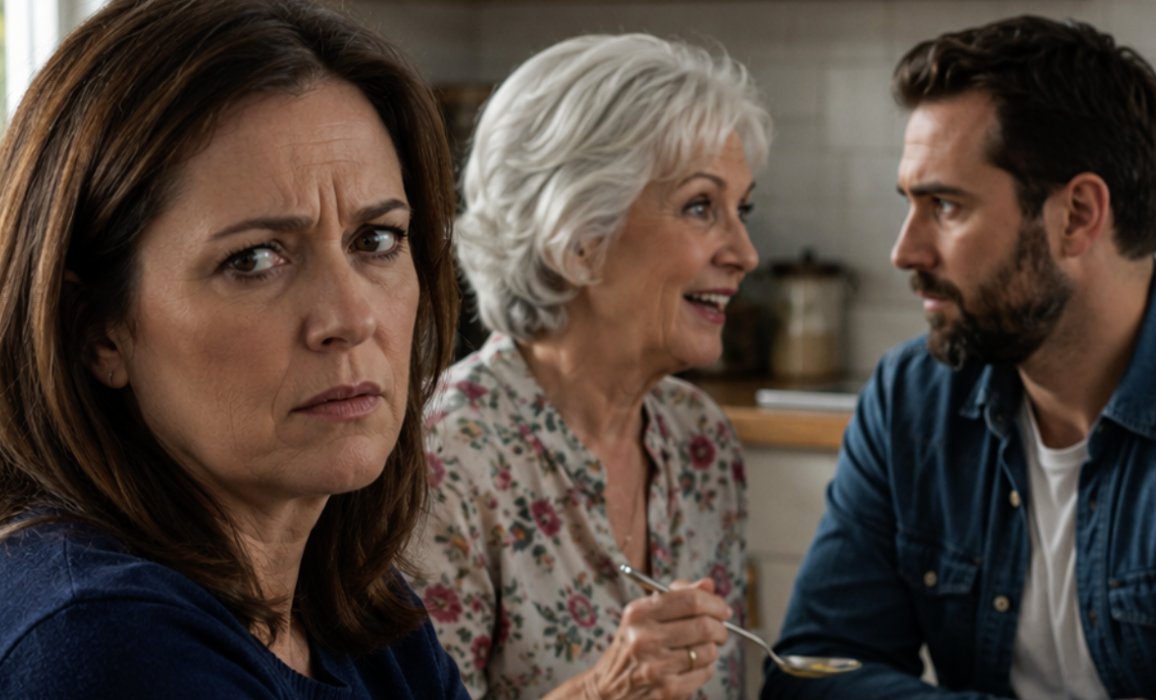
Svetlana set her cup of coffee on the windowsill and looked out at the rain. Drops slid down the glass like tears she refused to let herself shed. October had been especially nasty that year: gray, damp, depressing. Just like her life over the past six months.
“Svetа, are you listening to me?” Andrey asked irritably.
The woman turned around. Her husband was standing in the kitchen doorway, holding some papers. Behind him, she could see the familiar figure of her mother-in-law. Galina Petrovna, as always, had found a reason to drop by “just for a minute.”
“I’m listening,” Svetlana replied dryly.
“Mom is right. It’s time for us, as adults, to switch to a separate budget. Everyone is responsible for themselves.”
Svetlana gave a barely noticeable smirk.
Adults. Yes, of course. Especially adult was the man who, at thirty-five, still consulted his mommy about every little thing.
“And how exactly do you imagine that working?” his wife asked, pretending to study the papers in his hands carefully.
Galina Petrovna could not hold back.
“Svetochka, dear, millions of couples live like that in the modern world! Everyone earns their own money, and everyone spends their own money. No claims against each other. Andrey earns seventy thousand a month, you earn fifty. It’s perfectly fair to split the expenses in half.”
“Mom thinks it will be better for our relationship,” Andrey added, avoiding his wife’s direct gaze. “Fewer reasons to argue.”
Svetlana nodded, trying to stay calm. But inside, something snapped.
She remembered how three years earlier, when Andrey had been unemployed for six months after being laid off, she had carried all the expenses alone. Back then, no one suggested a separate budget. She remembered how, a year ago, she had paid for expensive medication for his mother when her hypertension flared up. Back then, everyone had also been in favor of one common pot.
“All right,” she said. “Let’s try it.”
Andrey had clearly expected objections and had even prepared himself for a scandal. Her calm agreement confused him.
“Seriously? So you’re not against it?”
“Why should I be against fairness?” Svetlana took the papers from his hands and quickly scanned them. A list of expenses, divided exactly in half. Utilities, groceries, gasoline, internet… Everything looked reasonable.
Galina Petrovna beamed.
“You see, Andryusha! Sveta is a smart girl, she understands. Some wives immediately start with, ‘But what about family, what about love?’ Nonsense! Love is love, but money should be separate!”
Svetlana silently nodded, mentally writing down every word her mother-in-law said in her inner ledger of grievances.
The woman continued preaching about the advantages of a separate budget, using some American families as examples and explaining how “civilized” it was.
“And one more thing,” Andrey added, encouraged by his easy victory. “I’ll be having dinner at Mom’s. She cooks every day anyway. It’s more convenient; my office is very close to her place. So you’ll be spending more on groceries.”
“Logical,” Svetlana agreed.
When her mother-in-law left and Andrey went to his room “to work” — which meant playing tanks online — the woman remained alone in the kitchen.
She slowly finished her cold coffee and took out a calculator. It was time to do some arithmetic.
First, she wrote down all the family expenses from the past six months. The amount was impressive: utilities, groceries, household chemicals, medicine, clothing, gifts for relatives, trips to the cinema and cafés… Then she divided everything into two columns: “husband” and “wife.”
By midnight, Svetlana had finished the calculations. The result turned out to be even more interesting than she had expected.
Andrey really did spend less on the family. Much less.
It turned out that, despite their officially declared equality of income, the real expenses were distributed at roughly a one-to-three ratio — and not in her favor.
The woman stood up from the table, stretched her stiff neck, and smiled.
Fine. A separate budget it is. Let’s see how ready Andrey is for financial equality.
The next day, her husband went to work in a cheerful mood.
By morning, her mother-in-law had already managed to call three times: to discuss the “new family arrangements” and praise her son for his “manly decision.”
Svetlana listened to her husband’s phone conversations with his mother and kept catching herself wondering: when exactly had she stopped respecting him? A month ago? Six months ago? Or had it happened gradually, quietly, eating away at everything like rust?
Her day at the agency went as usual: clients, layouts, endless edits and approvals. But Svetlana worked with a new kind of drive. As if some mechanism inside her, long idle, had suddenly switched on.
In the evening, she stopped by the supermarket and bought groceries for exactly one person: bread, milk, yogurt, oatmeal, a few vegetables. Everything in the cart looked rather sad — like a hermit’s ration. But at least it was her ration.
Andrey was not home. As promised, he had stayed for dinner at his mother’s.
Svetlana ate alone, watched a series, and went to bed. Strangely enough, the loneliness did not oppress her. On the contrary, she felt a sense of inner freedom she had not had in a very long time.
A week passed like that.
Andrey reliably had dinner at Galina Petrovna’s, came home late, and was endlessly pleased with himself. Sometimes he told Svetlana how delicious his mother’s cutlets or borscht had been, clearly hinting that she could learn some culinary skills from her mother-in-law. But the woman only nodded, put on an understanding expression, and continued eating from her modest supplies.
That weekend, Andrey went to his friends’ country house.
“Sometimes we need to take a break from each other,” her husband explained, obviously quoting his mother’s advice.
Svetlana did not object. She spent Saturday and Sunday at the computer, sorting through family documents and bills from the past year.
The picture was becoming clearer. And sadder.
On Monday morning, the first warning bell rang. Andrey discovered they had run out of coffee.
“Sveta, could you buy coffee? I’m running late for work.”
“Coffee is not listed under common expenses,” she replied, slowly spreading butter on her single piece of toast. “Everyone buys what they drink.”
Her husband was silent for a moment, apparently expecting a trick or a joke. But Svetlana looked completely serious.
“Fine,” he muttered. “I’ll buy it myself.”
By the middle of the second week, it became clear that the experiment was starting to crack. Andrey began casting sideways glances at the refrigerator, where the usual delicacies somehow failed to appear. The expensive yogurts, red fish, and good cheeses were gone. Instead, his wife’s ascetic supplies lay there, fitting on one shelf.
“Where’s the sausage?” her husband asked on Thursday evening, peering into the refrigerator in search of something edible.
“At the store,” Svetlana replied without looking up from her laptop.
“What do you mean?”
“I mean, if you want sausage, go and buy it. I don’t eat sausage.”
That was true. She really had not bought sausage for several weeks, preferring healthier food. But before, she had bought it for her husband.
Andrey grumbled something and slammed the refrigerator door. That evening, he went to his mother’s again.
And on Friday, the utility bills arrived.
Svetlana deliberately did not pay for the apartment right away, although she usually did it the same day the bills arrived. Instead, she waited until Andrey saw the receipts in the mailbox and brought them home with an important look on his face.
“The utility bills came,” her husband announced as he entered the apartment. “About eight thousand.”
“All right,” Svetlana nodded. “Your half is four thousand. Will you transfer it to my card or give it to me in cash?”
Andrey froze for a moment. Apparently, in his picture of the world, a separate budget applied mostly to Svetlana’s expenses, but not to his own obligations.
“Uh… yes, of course. I’ll transfer it tomorrow. I don’t have enough on my card right now.”
“No problem. Just remember that if we delay the payment by more than a month, penalties will start accumulating.”
The next day, no transfer came. Nor the day after. And on Wednesday, Andrey casually asked as if nothing had happened:
“Sveta, the internet is acting up. Did you forget to pay for it?”
The woman looked up from the documents she was working on at the kitchen table.
“You’re paying for the internet. It’s listed in our expense sheet.”
“It is? Oh, right…” He clearly did not remember what was written there. “Then I’ll pay tomorrow.”
But her husband did not pay for the internet either. Just as he did not pay for the phone, garbage collection, or the intercom.
By the end of the week, Svetlana realized that her husband simply did not take the new rules seriously. In his mind, nothing was supposed to change radically. Except that his wife now had no right to ask what he spent his money on.
On Saturday morning, Andrey was getting ready to go play football with his friends when he discovered that the car’s tank was practically empty.
“Sveta, give me money for gas,” he asked, as usual.
“I don’t have any money,” his wife replied dryly.
“What do you mean you don’t? You got paid last week.”
“I did. And I spent it on my own needs. Food, clothes, cosmetics. Gasoline is your expense category.”
Andrey stood there blinking in confusion, clearly not understanding what was happening.
In their year and a half of married life, his wife had never once refused him money. More than that, she often gave it to him even when he did not ask: slipping it into his jacket pocket before he left for work or transferring money to his card “just in case.”
“Are you serious?” he asked again.
“Have I ever joked about money?”
That was true. Svetlana had always treated finances very responsibly. That was exactly why their family had never had debts or overdue payments.
“But we’re spouses…” Andrey started.
“Spouses who keep a separate budget,” his wife reminded him. “That’s what you wanted. Your mother thinks this approach is very modern and fair. Don’t forget that.”
The mention of his mother had a magical effect on the man. Andrey could not admit that his mother’s idea had turned out badly, so he said nothing and left.
That evening, her husband returned in a bad mood. Apparently, an unpleasant conversation had taken place over dinner at Galina Petrovna’s, because she called Svetlana around nine.
“Svetochka, dear, Andryusha says you’ve become terribly greedy. This is no good! Refusing your husband money for gas!”
“Galina Petrovna,” Svetlana replied calmly, “the idea of a separate budget was yours, remember? You said yourself that everyone should be responsible for themselves.”
“Well, yes, but within reason! You can’t take things to the point of absurdity.”
“And where is the line between reasonable and absurd? Please explain it to me.”
Galina Petrovna clearly had not expected that question. She hesitated, mumbled something about feminine wisdom and family compromises, and then quickly ended the conversation.
And on Monday, something happened that Andrey had not expected at all.
Their hot water was shut off. Not in the whole building, only in their apartment. Her husband discovered it in the morning when he got into the shower and immediately panicked.
“Sveta! What’s wrong with the water? Why is it cold?”
“Probably shut off for nonpayment,” she replied calmly, preparing oatmeal for herself.
“What do you mean, nonpayment? You were supposed to pay!”
“Me?” Svetlana pretended to be surprised. “Why was I supposed to pay your half? Two weeks ago, you promised to transfer the money for utilities, but you never did.”
Andrey stood there for several seconds with his mouth open. Then he quickly grabbed his phone and began frantically calculating something. The debt really was substantial, and they could have had the hot water turned off for nonpayment.
“But I didn’t know it was that urgent!” the man justified himself, getting dressed quickly. “You should have warned me!”
“Andrey, you’re thirty-five years old. You’re an adult man who decided to keep a separate budget. Keep track of your own obligations.”
Her husband ran off to work unwashed and angry.
And Svetlana calmly finished her breakfast and went to the gym, where she took a shower after her workout. She had bought a fitness-center membership the previous month but had never found time to use it before. Now she had time. Especially in the evenings, when Andrey had dinner at his mother’s.
By evening, the hot water was turned back on. Apparently, her husband had borrowed money somewhere and urgently paid the debt.
But the unpleasant aftertaste remained. He walked around gloomy and constantly seemed to be thinking about something.
A few days later, her husband decided to have a serious conversation. Svetlana was just getting ready to meet a friend when Andrey blocked her way.
“We need to talk,” he said irritably.
“I’m listening. Just make it quick. Someone’s waiting for me.”
“What are you doing? This isn’t life, it’s some kind of accounting! We’re spouses, not business partners.”
Svetlana carefully adjusted the handbag on her shoulder.
“You wanted a separate budget. You and your mother thought it would be fair. I’m simply following your rules.”
“But you understand that’s not what I meant!”
“Then what did you mean?” she asked with sincere interest. “Explain it to me.”
Andrey hesitated. It was difficult to explain what exactly he had meant without admitting his own dishonesty. Because what he had meant was very simple: his wife should not control his spending, but she should continue paying the lion’s share of family expenses and providing his comfort.
“Well… you understand,” her husband mumbled uncertainly. “Let’s go back to how things were.”
“No,” Svetlana objected firmly. “Everything suits me. It’s very honest and fair. Everyone is responsible for themselves, as your mother said.”
“Forget about my mother!” Andrey flared up. “This isn’t about her!”
“Oh, so it isn’t about your mother?” Svetlana smiled, and there was something in that smile that made him uneasy. “Interesting. And here I thought all our family decisions were made by her.”
Her husband wanted to object, but the words stuck in his throat. Because it was true, and they both knew it.
“I’m late,” his wife said and headed for the door. “If you want to change something in our family arrangement, let’s discuss it tomorrow. In a civilized, adult way. Without your mother.”
The last phrase sounded like a slap in the face.
The next day, Andrey came home from work even gloomier. He did not go to his mother’s for dinner, which was significant in itself. Instead, he sat across from Svetlana and tried to begin a serious conversation.
“Listen, let’s find a compromise,” he began. “I understand that I was wrong. Maybe we can try something halfway between a shared budget and a separate one? At least try.”
Svetlana looked at him attentively. For the first time in a long while, her husband was talking to her as an equal, not as a convenient attachment to his own life.
“Let’s just work it out like normal people!” Andrey continued, unable to hide his irritation. “Did you at least pay for the electricity this month?”
The woman smiled indulgently.
“I did,” she said, rising from the table. “I’ll bring the documents now.”
She went into the hallway and took a thick envelope from her handbag, which she had prepared in advance. Inside was a stack of papers: printed bank transfers, receipts, statements, and one special document.
“Here, take it,” his wife said, handing him the envelope. “My half of the utility payments for this month. And something else.”
The man smugly took the envelope. But when he pulled out the papers and began reading, the expression on his face changed rapidly.
The first document was a receipt for electricity. The second was a detailed calculation of all their family expenses over the past year. The third was a notice that she had filed for divorce.
“What is this?” he muttered, turning pale.
“This is the result of our separate-budget experiment,” Svetlana explained calmly. “A very instructive result.”
Andrey finished looking over the calculations and raised confused eyes to her.
“Sveta, come on… Let’s go back to how things were!” her husband set the papers aside and tried to take her hand. “I understand that I was wrong. Let’s put all our money together again, like before.”
“Really?” Svetlana did not pull her hand away, but there was no particular warmth in her voice either. “And are you ready for that?”
“Of course! More than that, I’m ready to give you my salary, except for a little pocket money. You’ll manage the family budget. You’re better at it.”
Svetlana studied his face carefully. Andrey looked sincere, even somewhat frightened by the prospect of divorce.
“And what about your mother?” she asked. “She was the one who initiated the separate budget in our family.”
“Forget about Mom!” Andrey waved his hand. “This is our family, we should decide for ourselves. The main thing is that you handle all these… household matters. Utilities, groceries, bills. I don’t understand any of it, you know that. And I’ll honestly hand over the money.”
“All of your salary?” Svetlana clarified.
“Well… almost all of it!” Andrey hesitated. “There’s just one thing. Mom wants to renovate the country house, and I promised to help her. Over the course of this year, I’ll be giving her half of my income. But it’s temporary! A year at most, maybe a little longer.”
Svetlana slowly withdrew her hand.
“Half of your income?” she asked very quietly.
“Well, yes. Thirty thousand a month. The rest is all yours. And it really is temporary, Sveta, believe me.”
“When did you start giving her half your salary?”
“A month ago,” Andrey admitted, lowering his eyes. “But I thought that with a separate budget, it wouldn’t be a problem…”
Svetlana leaned back in her chair. Suddenly, everything fell into place. The whole story with the separate budget, Galina Petrovna’s sudden concern about their finances, her persistent advice to her son…
“I see,” she said. “Now I understand why your mother started this whole performance with separate expenses.”
“What are you talking about?”
“She planned to pull thirty thousand a month out of you. And she understood that with a common budget, I would object. That’s why she came up with this scheme. Let everyone spend their own money however they want! Don’t you understand that?”
“Sveta, don’t exaggerate…”
“I’m not exaggerating!” She stood up and went to the window. “Your mother is a very smart woman. She calculated everything several moves ahead.”
“But it’s temporary!”
“Nothing is more permanent than temporary. Have you heard that expression? And the saddest thing,” Svetlana continued, “is that you’re ready to give me control over the budget not because you respect my abilities, but because you don’t want to take responsibility. You don’t want to think about bills, plan expenses, or make decisions. It’s easier for you to dump everything on your wife.”
“But you’re better at it…”
“I am. But I’m tired of being the only adult in this family, Andrey. Tired of making decisions for two people and carrying responsibility for two people.”
She took the envelope with the documents from the table.
“My answer is no. I don’t want to go back to my old life. I don’t want to be your mother number two, the one who decides everything, controls everything, and pays for everything while you entertain yourself and hand out money left and right.”
“Sveta, please…”
“The divorce will be finalized in a month,” she said firmly. “You have two weeks to find somewhere to live. You can move in with your mother. I’m sure she’ll be happy. And then she’ll be able to spend not half of your salary on renovating the country house, but all of it.”
Andrey stood in the middle of the kitchen, staring blankly at one spot. Svetlana felt something like pity for him. But not regret.
“This is unfair,” he said quietly.
“On the contrary,” Svetlana replied. “This is exactly fairness. You’re getting precisely what you chose: freedom from responsibility and the chance to live the way your mother wants.”
A month later, the divorce was finalized.
Andrey really did move in with Galina Petrovna, who welcomed him with open arms and renovation plans not only for the country house, but also for the city apartment.
Svetlana stayed in her own apartment and, for the first time in a long while, felt that her life belonged only to her.
Justice had prevailed.
Everyone got exactly what they deserved.