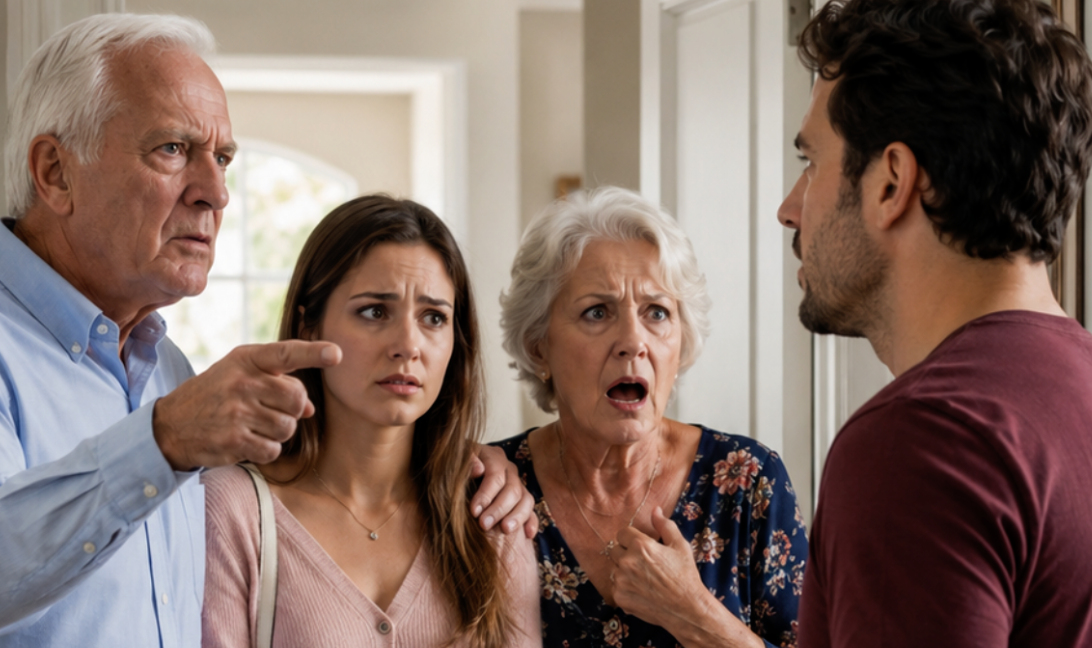
I bought this apartment for my granddaughter. And who are you here — a parasite?” Grandpa asked one question and threw her husband and his mother out.
“Where did you put the cufflinks?”
Mikhail stood in the bedroom doorway, clutching an empty velvet box. Elena turned away from the window.
“What cufflinks?”
“The silver ones, with the engraving. They were lying on the dresser. Mom saw them yesterday.”
Zhanna Petrovna appeared behind her son, arms crossed over her chest. Her robe was new — bought on the second day after she arrived, when she had called the studio apartment “an uncomfortable den.”
“I didn’t touch anything.”
“Then who did?” Mikhail stepped closer. “It definitely wasn’t us.”
“Maybe they fell? Behind the dresser or…”
“We checked,” Zhanna Petrovna interrupted, her voice quiet and enveloping. “Elena, dear, I understand that where you come from, at the port, things are done differently. But if you took something, just say so. Misha won’t scold you.”
“I didn’t take anything!”
“Then where are they?” Zhanna Petrovna came right up to her. “Or do you think we’re blind?”
A lump rose in Elena’s throat. For four months she had kept silent when her mother-in-law threw away her grandmother’s carved tray, calling it “village junk.” She had kept silent when Mikhail agreed with his mother about everything. She had kept silent when they called her “the port girl” and criticized her every move.
“Apologize to Mom,” Mikhail narrowed his eyes. “She’s upset. Those cufflinks belonged to my father.”
“What am I supposed to apologize for? I didn’t take them!”
“So you won’t apologize?”
He turned and left. Zhanna Petrovna lingered, looking Elena up and down — slowly, appraisingly.
“Girl, you’ll still come to understand how lucky you are. Another mother would never have forgiven her son for marrying a daughter-in-law like you.”
Elena took out her phone and dialed her grandfather’s number.
Semyon Ivanovich arrived on Saturday, around lunchtime. He carried a woven basket, and he smelled of salt and the sea. Elena opened the door. Grandpa looked into her eyes and immediately understood everything.
“Holding up?”
She nodded. He came in, hung his jacket on the hook without asking — naturally, like the owner of the place. Mikhail’s voice came from the living room:
“Who’s there?”
He stepped into the hallway, saw Grandpa, and grimaced.
“What are you doing here?”
Semyon Ivanovich set the basket by the wall and straightened up. Broad shoulders, working hands, a heavy gaze.
“I came for my granddaughter.”
“This is our apartment!” Mikhail stepped forward, puffing out his chest. “Get out! You port people only know how to steal!”
Grandpa slowly turned his head and looked at him for a long time without blinking. Then he shifted his gaze to Zhanna Petrovna, who had frozen in the living room doorway.
“I bought this apartment for my granddaughter. Sold my boat, sold my land.” His voice was even, never rising. “And who are you here — a parasite?”
Mikhail opened his mouth, but Grandpa had already walked past him into the bathroom. He crouched beside the riser pipe, found the main valve, and turned it counterclockwise three times. The water roared, then fell silent.
“What are you doing?!” Zhanna Petrovna rushed toward him, but Grandpa was already standing up, brushing off his knees.
“Everything is registered in my name. I pay for it, so I shut it off.” He walked back into the hallway and picked up his jacket. “I’m giving you twenty-four hours. Move out, and I’ll turn it back on. If not, sit here like this.”
“This is illegal! I’ll call the police!”
“Go ahead. Tell them how you’re living in someone else’s apartment and accusing the owner of being a thief.” Grandpa nodded to Elena. “Pack your things. Take only what’s yours.”
Elena went into the bedroom and took out a bag. Her hands were not shaking. She folded her clothes slowly, not turning around at the shouting from the living room, where Mikhail was yelling something and Zhanna Petrovna was demanding they call a lawyer.
When she came out with the bag, Grandpa was standing by the door, waiting.
“Let’s go.”
“Stop!” Zhanna Petrovna blocked their path. “You can’t just take her and leave! Mikhail, say something!”
“Mom is right,” Mikhail stepped toward Elena. “You’ll stay here and apologize. Or I’ll sue you for…”
“For what?” Grandpa turned to him. “For living in her own apartment? The gift deed is in her name. You can check it right now.”
“What gift deed?! We’re family, we bought this apartment together…”
“You bought nothing. I bought it. I gave it to her.” Grandpa opened the door. “That’s it. Conversation over.”
They went out. Behind them came a crash — Mikhail had apparently slammed his fist into the wall. Zhanna Petrovna shouted something about ingratitude and disgrace.
In the car, Grandpa started the engine and looked at his granddaughter.
“Will you file for divorce yourself?”
“Myself.”
“Good. The apartment is yours, everything is clean on paper. Let them sue if they want.” He pulled away from the curb. “And those cufflinks, I bet his mother has them in her bag. So you’d walk around feeling guilty.”
Elena remained silent, looking out the window. The city floated past, unfamiliar and indifferent. But inside her, something loosened and let go. For the first time in four months, she could breathe deeply.
The divorce went quickly. Mikhail did not appear at the hearing; he sent the documents by mail. The apartment remained Elena’s — the gift deed was impossible to dispute. Zhanna Petrovna called three times, demanding compensation, but Elena declined the calls.
A month later, Zhanna Petrovna called again. Her voice was different — not demanding, but almost pleading.
“Elena, this isn’t right. We were family.”
“We were.”
“Maybe we could meet? Talk normally?”
“There’s nothing to talk about.”
“Do you even know what’s happening with us?! Tamara came! My sister! Now she…”
Elena muted the phone and set it on the table. She remembered Tamara — a large woman with a hard stare, a former prison guard. She had seen her once at Mikhail’s birthday. Back then, Zhanna Petrovna had fawned over her, even though she was usually the one who bossed everyone around.
A week later, Elena accidentally ran into Mikhail near a shopping center. He was coming out with two heavy bags, hunched over and aged. When he saw her, he froze and looked away.
“How are things?” Elena asked more out of habit than curiosity.
“Fine,” he jerked his shoulder and adjusted his grip on the bags. “Tamara came. To us. Now she lives with us.”
“For long?”
“I don’t know. She…” He faltered and looked off to the side. “She changed everything there. Says that since she’s the eldest in the family, she’s in charge. Mom is in the kitchen from morning on, cooking for everyone. Tamara made a schedule: who gets up when, who does what. Yesterday I was five minutes late for dinner — she threw my plate into the sink. Said if I can’t appreciate labor, I can eat later, cold.”
Elena imagined the scene: Zhanna Petrovna at the stove, without her manicure, wearing an apron. Tamara in an armchair with a newspaper, like a guard in a watchtower. Mikhail, who no longer dared to object.
“And moving out?”
“She won’t allow it. Says family should stay together. Under control.” He lifted his eyes, and there was something almost pleading in them. “Lena, maybe you could… well, talk to your grandfather? Ask him to turn the water back on? We’ll move out, honest.”
“You already moved out. Four months ago.”
He nodded and clenched his jaw.
“Yes. You’re right.”
He walked on, bent under the weight of the bags. Elena watched him go and felt neither pity nor anger. Just emptiness. Karma does not arrive with a court order. It comes with a suitcase and stays to live.
In spring, Grandpa came again — this time with blackberry seedlings. He set the box of green shoots in the hallway and went into the kitchen. Elena took out her grandmother’s carved tray — the very one she had secretly pulled out of the trash. Now it hung on the wall in the most visible place.
She brewed black tea, sliced bread, and brought out honey. Grandpa sat down, leaned back in his chair, and looked around the apartment.
“It’s good here. Quiet.”
“Quiet,” she agreed.
They drank tea in silence. Outside the window, poplar branches swayed, already showing their first buds. Grandpa took a second slice of bread and spread honey on it.
“Have you seen Mikhail?”
“I have. By chance.”
“And how is he?”
“Tamara lives with them. She’s in charge. Zhanna Petrovna is in the kitchen now, and Mikhail walks the line.”
Grandpa smirked and finished his tea.
“Then everything is right. Everyone got what was coming to them.”
He stood, walked to the window, and stayed there for a while, looking out at the street. Then he turned around.
“I didn’t sell my boat for nothing. My Volna. I sailed her for twenty years, but I don’t regret it.” He looked at Elena. “Some things are worth more than any boat.”
She came up to him and hugged him. He smelled of the sea and of something reliable — something that would not leave and would not betray.
“Thank you, Grandpa.”
“Plant the seedlings. Blackberries are hardy — water them, and they’ll spread.”
When he left, Elena returned to the kitchen and sat by the window. The apartment was filled with silence — not empty silence, but thick, lived-in silence. The kind in which one could breathe.
She remembered how four months earlier she had washed these windows before the wedding, rejoicing over every inch. Back then, she had not known what it had cost her grandfather.
She had not known that he had chosen between the sea and her — and had chosen her.
Now she knew.
Elena opened the small window. Spring air burst into the room — cold, smelling of melting snow. She breathed in deeply and closed her eyes.
Mikhail was probably washing dishes now according to Tamara’s schedule. Zhanna Petrovna was peeling potatoes for dinner, afraid to argue with her older sister. They had received what they had handed out to others. Only doubled.
Elena opened her eyes and looked at the box of seedlings. Tomorrow she would buy soil and pots and plant the blackberries on the balcony. She would water them and wait. Grandpa had said blackberries were like people — give them freedom, don’t suffocate them, and they will spread and bear fruit.
She poured herself water from the tap — the same one Grandpa had shut off six months earlier. The water flowed evenly, calmly. Everything in this apartment was hers now. The water, the air, the silence.
Elena drank slowly and set the glass down. She went into the room and lay on the bed. Outside the window, the city hummed, entrance doors slammed, someone laughed in the street. Life went on. Her life. Without permission, without accusations, without strangers in her own home.
As she was falling asleep, she thought that Grandpa had sold his boat and had never once said he regretted it. Maybe because some things are more important than everything else. More important than the sea, more important than money, more important than the past.
She smiled into the darkness.
And those cufflinks were probably still lying in Zhanna Petrovna’s bag. Somewhere in an apartment under Tamara’s supervision, among cleaning schedules and lists of duties. Let them lie there. It was no longer her story.
I bought this apartment for my granddaughter. And who are you here — a parasite?” Grandpa asked one question and threw her husband and his mother out.
“Where did you put the cufflinks?”
Mikhail stood in the bedroom doorway, clutching an empty velvet box. Elena turned away from the window.
“What cufflinks?”
“The silver ones, with the engraving. They were lying on the dresser. Mom saw them yesterday.”
Zhanna Petrovna appeared behind her son, arms crossed over her chest. Her robe was new — bought on the second day after she arrived, when she had called the studio apartment “an uncomfortable den.”
“I didn’t touch anything.”
“Then who did?” Mikhail stepped closer. “It definitely wasn’t us.”
“Maybe they fell? Behind the dresser or…”
“We checked,” Zhanna Petrovna interrupted, her voice quiet and enveloping. “Elena, dear, I understand that where you come from, at the port, things are done differently. But if you took something, just say so. Misha won’t scold you.”
“I didn’t take anything!”
“Then where are they?” Zhanna Petrovna came right up to her. “Or do you think we’re blind?”
A lump rose in Elena’s throat. For four months she had kept silent when her mother-in-law threw away her grandmother’s carved tray, calling it “village junk.” She had kept silent when Mikhail agreed with his mother about everything. She had kept silent when they called her “the port girl” and criticized her every move.
“Apologize to Mom,” Mikhail narrowed his eyes. “She’s upset. Those cufflinks belonged to my father.”
“What am I supposed to apologize for? I didn’t take them!”
“So you won’t apologize?”
He turned and left. Zhanna Petrovna lingered, looking Elena up and down — slowly, appraisingly.
“Girl, you’ll still come to understand how lucky you are. Another mother would never have forgiven her son for marrying a daughter-in-law like you.”
Elena took out her phone and dialed her grandfather’s number.
Semyon Ivanovich arrived on Saturday, around lunchtime. He carried a woven basket, and he smelled of salt and the sea. Elena opened the door. Grandpa looked into her eyes and immediately understood everything.
“Holding up?”
She nodded. He came in, hung his jacket on the hook without asking — naturally, like the owner of the place. Mikhail’s voice came from the living room:
“Who’s there?”
He stepped into the hallway, saw Grandpa, and grimaced.
“What are you doing here?”
Semyon Ivanovich set the basket by the wall and straightened up. Broad shoulders, working hands, a heavy gaze.
“I came for my granddaughter.”
“This is our apartment!” Mikhail stepped forward, puffing out his chest. “Get out! You port people only know how to steal!”
Grandpa slowly turned his head and looked at him for a long time without blinking. Then he shifted his gaze to Zhanna Petrovna, who had frozen in the living room doorway.
“I bought this apartment for my granddaughter. Sold my boat, sold my land.” His voice was even, never rising. “And who are you here — a parasite?”
Mikhail opened his mouth, but Grandpa had already walked past him into the bathroom. He crouched beside the riser pipe, found the main valve, and turned it counterclockwise three times. The water roared, then fell silent.
“What are you doing?!” Zhanna Petrovna rushed toward him, but Grandpa was already standing up, brushing off his knees.
“Everything is registered in my name. I pay for it, so I shut it off.” He walked back into the hallway and picked up his jacket. “I’m giving you twenty-four hours. Move out, and I’ll turn it back on. If not, sit here like this.”
“This is illegal! I’ll call the police!”
“Go ahead. Tell them how you’re living in someone else’s apartment and accusing the owner of being a thief.” Grandpa nodded to Elena. “Pack your things. Take only what’s yours.”
Elena went into the bedroom and took out a bag. Her hands were not shaking. She folded her clothes slowly, not turning around at the shouting from the living room, where Mikhail was yelling something and Zhanna Petrovna was demanding they call a lawyer.
When she came out with the bag, Grandpa was standing by the door, waiting.
“Let’s go.”
“Stop!” Zhanna Petrovna blocked their path. “You can’t just take her and leave! Mikhail, say something!”
“Mom is right,” Mikhail stepped toward Elena. “You’ll stay here and apologize. Or I’ll sue you for…”
“For what?” Grandpa turned to him. “For living in her own apartment? The gift deed is in her name. You can check it right now.”
“What gift deed?! We’re family, we bought this apartment together…”
“You bought nothing. I bought it. I gave it to her.” Grandpa opened the door. “That’s it. Conversation over.”
They went out. Behind them came a crash — Mikhail had apparently slammed his fist into the wall. Zhanna Petrovna shouted something about ingratitude and disgrace.
In the car, Grandpa started the engine and looked at his granddaughter.
“Will you file for divorce yourself?”
“Myself.”
“Good. The apartment is yours, everything is clean on paper. Let them sue if they want.” He pulled away from the curb. “And those cufflinks, I bet his mother has them in her bag. So you’d walk around feeling guilty.”
Elena remained silent, looking out the window. The city floated past, unfamiliar and indifferent. But inside her, something loosened and let go. For the first time in four months, she could breathe deeply.
The divorce went quickly. Mikhail did not appear at the hearing; he sent the documents by mail. The apartment remained Elena’s — the gift deed was impossible to dispute. Zhanna Petrovna called three times, demanding compensation, but Elena declined the calls.
A month later, Zhanna Petrovna called again. Her voice was different — not demanding, but almost pleading.
“Elena, this isn’t right. We were family.”
“We were.”
“Maybe we could meet? Talk normally?”
“There’s nothing to talk about.”
“Do you even know what’s happening with us?! Tamara came! My sister! Now she…”
Elena muted the phone and set it on the table. She remembered Tamara — a large woman with a hard stare, a former prison guard. She had seen her once at Mikhail’s birthday. Back then, Zhanna Petrovna had fawned over her, even though she was usually the one who bossed everyone around.
A week later, Elena accidentally ran into Mikhail near a shopping center. He was coming out with two heavy bags, hunched over and aged. When he saw her, he froze and looked away.
“How are things?” Elena asked more out of habit than curiosity.
“Fine,” he jerked his shoulder and adjusted his grip on the bags. “Tamara came. To us. Now she lives with us.”
“For long?”
“I don’t know. She…” He faltered and looked off to the side. “She changed everything there. Says that since she’s the eldest in the family, she’s in charge. Mom is in the kitchen from morning on, cooking for everyone. Tamara made a schedule: who gets up when, who does what. Yesterday I was five minutes late for dinner — she threw my plate into the sink. Said if I can’t appreciate labor, I can eat later, cold.”
Elena imagined the scene: Zhanna Petrovna at the stove, without her manicure, wearing an apron. Tamara in an armchair with a newspaper, like a guard in a watchtower. Mikhail, who no longer dared to object.
“And moving out?”
“She won’t allow it. Says family should stay together. Under control.” He lifted his eyes, and there was something almost pleading in them. “Lena, maybe you could… well, talk to your grandfather? Ask him to turn the water back on? We’ll move out, honest.”
“You already moved out. Four months ago.”
He nodded and clenched his jaw.
“Yes. You’re right.”
He walked on, bent under the weight of the bags. Elena watched him go and felt neither pity nor anger. Just emptiness. Karma does not arrive with a court order. It comes with a suitcase and stays to live.
In spring, Grandpa came again — this time with blackberry seedlings. He set the box of green shoots in the hallway and went into the kitchen. Elena took out her grandmother’s carved tray — the very one she had secretly pulled out of the trash. Now it hung on the wall in the most visible place.
She brewed black tea, sliced bread, and brought out honey. Grandpa sat down, leaned back in his chair, and looked around the apartment.
“It’s good here. Quiet.”
“Quiet,” she agreed.
They drank tea in silence. Outside the window, poplar branches swayed, already showing their first buds. Grandpa took a second slice of bread and spread honey on it.
“Have you seen Mikhail?”
“I have. By chance.”
“And how is he?”
“Tamara lives with them. She’s in charge. Zhanna Petrovna is in the kitchen now, and Mikhail walks the line.”
Grandpa smirked and finished his tea.
“Then everything is right. Everyone got what was coming to them.”
He stood, walked to the window, and stayed there for a while, looking out at the street. Then he turned around.
“I didn’t sell my boat for nothing. My Volna. I sailed her for twenty years, but I don’t regret it.” He looked at Elena. “Some things are worth more than any boat.”
She came up to him and hugged him. He smelled of the sea and of something reliable — something that would not leave and would not betray.
“Thank you, Grandpa.”
“Plant the seedlings. Blackberries are hardy — water them, and they’ll spread.”
When he left, Elena returned to the kitchen and sat by the window. The apartment was filled with silence — not empty silence, but thick, lived-in silence. The kind in which one could breathe.
She remembered how four months earlier she had washed these windows before the wedding, rejoicing over every inch. Back then, she had not known what it had cost her grandfather.
She had not known that he had chosen between the sea and her — and had chosen her.
Now she knew.
Elena opened the small window. Spring air burst into the room — cold, smelling of melting snow. She breathed in deeply and closed her eyes.
Mikhail was probably washing dishes now according to Tamara’s schedule. Zhanna Petrovna was peeling potatoes for dinner, afraid to argue with her older sister. They had received what they had handed out to others. Only doubled.
Elena opened her eyes and looked at the box of seedlings. Tomorrow she would buy soil and pots and plant the blackberries on the balcony. She would water them and wait. Grandpa had said blackberries were like people — give them freedom, don’t suffocate them, and they will spread and bear fruit.
She poured herself water from the tap — the same one Grandpa had shut off six months earlier. The water flowed evenly, calmly. Everything in this apartment was hers now. The water, the air, the silence.
Elena drank slowly and set the glass down. She went into the room and lay on the bed. Outside the window, the city hummed, entrance doors slammed, someone laughed in the street. Life went on. Her life. Without permission, without accusations, without strangers in her own home.
As she was falling asleep, she thought that Grandpa had sold his boat and had never once said he regretted it. Maybe because some things are more important than everything else. More important than the sea, more important than money, more important than the past.
She smiled into the darkness.
And those cufflinks were probably still lying in Zhanna Petrovna’s bag. Somewhere in an apartment under Tamara’s supervision, among cleaning schedules and lists of duties. Let them lie there. It was no longer her story.