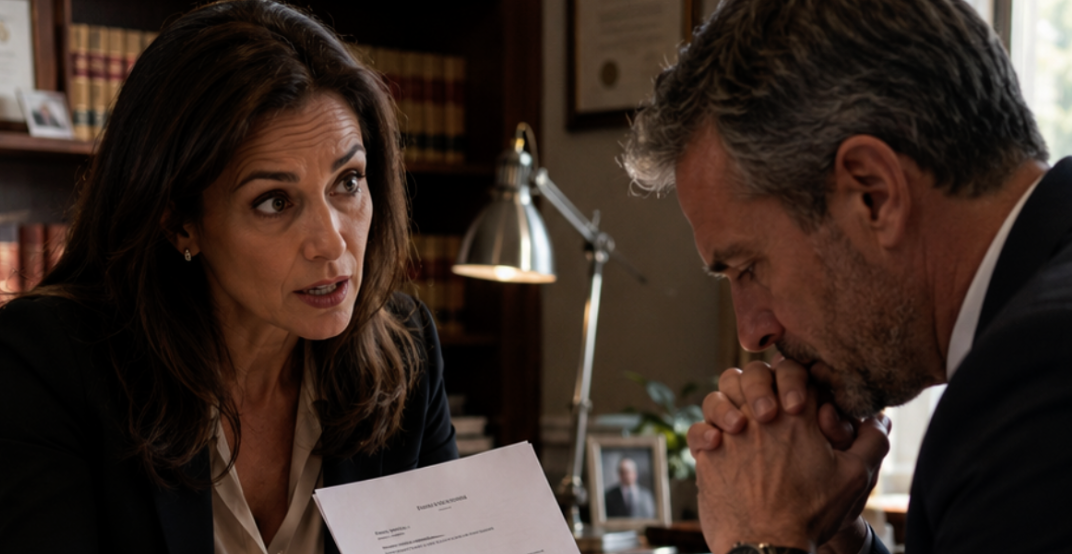
Vitaly placed the folder on the kitchen table, between the saltshaker and Polinka’s math notebook.
“Sign it, please. Just a formality.”
I was standing by the stove, stirring the stew. The wooden spoon knocked against the edge of the pot, and I turned around.
The folder was blue, plastic, the kind they sell in stationery shops for forty rubles. Nothing special. Vitaly had already taken off his jacket, hung it on the hook, and was now standing in the doorway, leaning his shoulder against the frame. He was rubbing the bridge of his nose. He always did that when he wanted to seem calm.
“What papers are these?”
“For the apartment. The bank needs them for refinancing. I told you, we’re switching to a lower rate.”
He had told me. Something about the rate, about the monthly payment going down by four thousand. I remembered that conversation. It had been about two weeks earlier, on a Sunday morning. Polinka was watching cartoons, Vitaly was drinking coffee and scrolling through something on his phone. I had nodded. Four thousand a month. Forty-eight thousand a year. It sounded reasonable.
“I can’t right now, my hands are oily.”
“It’ll only take a minute. Two signatures.”
I turned off the burner. Wiped my hands on the towel, the white one with embroidered cherries that my mother had given me for March eighth. The towel had already begun to turn gray from washing. I walked over to the table.
I opened the folder.
There were nine pages. Thick paper, tiny print. I saw the words “notarial consent,” “joint ownership regime,” “marriage contract.” And the name of the notary in the upper right corner. Tkacheva V. R.
“Vitaly, there’s a lot here.”
“It’s a standard package. The bank gives this to everyone. I already signed my part.”
He came closer. I smelled his cologne, woody, with a bitter note of something. He had not used cologne on weekdays before. Only on weekends, if we were going somewhere. I had noticed it a month earlier, but back then I thought: well, the man has started taking care of himself. That’s a good thing.
“Here and here.” He pointed at two places marked with yellow sticky notes. “I’ll sit with Polinka while you do it.”
And he went into the room. A second later, our daughter’s voice rang out from there:
“Dad, look what kind of dinosaur I have!”
Then came his laugh. Somehow unnatural, as if he had exhaled and remembered that he was supposed to laugh.
I sat down at the table.
My fingers automatically turned my wedding ring. A habit I had not been able to get rid of in twelve years. You turn it when you think. You turn it when you’re nervous. You turn it for no reason at all, simply because it is there.
I began to read.
The print was tiny, size ten, maybe even nine. Legal language. “Party One transfers,” “the undersigned expresses consent,” “loses the right of claim.” The words swam before my eyes, catching onto each other like freight train cars. I am an accountant. I work with documents every day. But these documents were not about debit and credit. They were about something else.
I reread the third page twice. Then the fourth.
Something did not feel right. Not a specific phrase, not a specific clause. A feeling. Like when you walk into an apartment and sense that something is out of place. Has the chair been moved? Is the window open? You cannot understand. But your gut feels it.
I closed the folder.
“Vitaly, I’ll look at it tomorrow with a clear head. I’m tired.”
Silence from the room. Then:
“All right. Just do it by Thursday. The bank is waiting.”
“Okay.”
I put the folder into the kitchen table drawer, under a stack of Polinka’s drawings. On top lay a drawing of our family: three little people with huge heads, a red dog we did not have, and a house with a blue roof. Polinka always drew a dog, even though we had explained to her a hundred times that it was difficult in an apartment.
The evening went on as usual. Dinner. The stew, which had burned a little while I was reading the papers. Polinka picked at it with her fork and talked about Arina from her class, who had brought a hamster to school. Vitaly nodded and looked at his phone. Then we put our daughter to bed. We read her a book. One page from me, one page from him. That had been our routine since she was three.
When Polinka fell asleep, Vitaly lay down on the sofa and turned on football. I went to the bathroom.
I turned on the water and stood there, gripping the sink with both hands. I looked at my face in the mirror. Dark circles under my eyes, one loose strand of hair. Thirty-eight years old. Twelve of those years I had spent with this man. I had given birth to his daughter. Together we had taken out a mortgage, together we had chosen the bathroom tiles, these very tiles, turquoise, the ones I had wanted and he had thought were too bright. I had insisted.
The water ran, and I stood there.
In the morning I did nothing. I took Polinka to school and went to work. Our office is on Leningradskaya Street, second floor, three rooms. I sit by the window. Outside the window there is a parking lot and a poplar tree that covers everything in fluff during the summer.
All day I thought about the folder. Not about what was written in it, because I had not really understood it. I thought about how Vitaly had stood in the doorway. About the cologne on a weekday. About “two signatures, one minute.” About the yellow sticky notes carefully placed in the right spots.
When you love a person for twelve years, you get used to trusting them. Trust is like a wall. You do not notice it while it stands. And when a crack appears, you do not notice that at first either. You simply feel a cold draft.
At lunch I called Natasha. We had been friends since university. She worked in insurance and understood paperwork better than I did.
“Natasha, do you know a lawyer? A normal one, not too expensive.”
“What happened?”
“Nothing. I need someone to look over some documents.”
“For the apartment?”
“Yes.”
She was silent for a moment. Natasha always goes silent before saying something important. As if she is weighing her words on internal scales.
“There is one. Svetlana Igorevna, on Pervomayskaya. I went to her when Genka and I were dividing the car. She’s a tough woman, but competent. Want me to send you her number?”
“Send it.”
I called that same day. I made an appointment for Thursday at ten in the morning. I asked for time off work and said I had a clinic appointment. I said nothing to Vitaly. And that “said nothing” made me feel sick. I used to tell him everything. Always. Even foolish little things. But this time I kept silent, and that silence was like a stone I had put in my pocket. Small, but I could feel it.
On Wednesday evening Vitaly asked:
“Did you sign?”
“Tomorrow. I wanted to find my glasses. The print is too small without them.”
“Ah, right.”
And that was all. He did not insist. He was not nervous. Or rather, he was nervous, but not like a person being let down. Like a person waiting. Patiently, calculatingly. He was washing the dishes, and I looked at his back. Broad, in a checkered shirt. A familiar back. For twelve years I had fallen asleep beside it.
Thursday.
The morning was gray. October, fine rain, the kind where you think you do not need an umbrella, but after five minutes your jacket is dark with water. I got out of the metro at Pervomayskaya and walked two blocks. A yellow-brick office building, third floor. On the door was a sign: “Makhova S. I., Legal Services.” The letter “M” had partly peeled off and hung crookedly.
I went in.
The hallway smelled of coffee and something papery, dry, like a library. A calendar from last year hung on the wall. A voice came from the office:
“It’s open.”
Svetlana Igorevna turned out to be a short woman with a gray bob haircut. Glasses on a chain rested on her chest. Her hands were dry and small, with short nails and no polish. She did not smile, did not offer tea. She simply nodded at the chair.
“Sit down. What did you bring?”
The chair was leather and cold. I took the folder out of my bag, the same blue plastic one. I put it on the desk. Svetlana Igorevna put on her glasses and opened it.
Silence.
I listened to the ticking of the clock on the wall. Big, round, with a white face. The second hand moved in jerks, as if it were hard for it. Tick. Tick. Tick. Outside, a tram passed, and the windows trembled slightly.
Svetlana Igorevna read. She turned the pages carefully, one by one, like cards in solitaire. Sometimes she went back to the previous page. Once, she took off her glasses, rubbed the bridge of her nose, and put them back on. She paused on the seventh page.
I twisted my ring.
“Your husband gave you this to sign?”
“Yes.”
“What did he say it was?”
“Mortgage refinancing. The bank requested it.”
She looked at me over her glasses. Her gaze was not sympathetic, not angry. Professional. Like a surgeon deciding where to cut.
“Elena, there are three documents in this folder. I will now explain what each of them means. Listen and do not rush to react. Agreed?”
I nodded. My palms had gone wet, and I wiped them on my jeans.
“The first document. A marriage contract. It is drafted properly, I would say custom-made. The essence is this: the apartment at 23 Komsomolskaya Street, apartment 41, is transferred from joint marital property into the personal property of your husband, Zharikov Vitaly Olegovich. Completely. Without compensation.”
I opened my mouth. Closed it.
“Wait. That is not all.”
“The second document. A notarial consent for the sale of the indicated apartment. You give your consent for your husband to sell the apartment on any terms, at his own discretion, without further notice to you. Without specifying a minimum price. Complete freedom of action. No time limit.”
The clock ticked. The tram thundered past again. Or maybe it was the same one, going back.
“The third document. A statement waiving your right to a mandatory share in the event of divorce. By signing this, you lose the right to claim the apartment during divorce as well. Even if the marriage contract is challenged, this document works as insurance. For him, not for you.”
Svetlana Igorevna folded the pages back into the folder. Evenly, edge to edge. She placed her hands on the desk.
“This has nothing to do with refinancing. No bank requires a marriage contract to lower an interest rate. You are being deceived.”
I sat there. The chair no longer felt cold. I did not feel anything at all. As if someone had taken all the contents out of me and left only a shell sitting on a leather chair in an office on Pervomayskaya.
“Elena. Do you hear me?”
“Yes. I hear you.”
“Questions?”
I looked at my hands. The ring shone. Gold, smooth, without stones. We had bought them together on Arbat, in a small shop where the saleswoman called us “lovebirds.” I was twenty-six. Vitaly was twenty-nine. Back then he had carried me in his arms from the shop to the metro, and I had laughed, and passersby had turned around to look.
“How much is the apartment worth?”
“A market valuation would need to be ordered separately. But the area is good, third floor, and the size, if I am reading correctly, is sixty-two square meters. At current prices, somewhere around eight and a half million. Maybe nine.”
“Half is mine?”
“Half is yours. The apartment was bought during marriage, the mortgage is in both your names. You have equal rights. Unless you sign this.”
She tapped the folder with her finger. Her nail clicked against the plastic.
“Tell me honestly. Does he want to sell the apartment and leave?”
Svetlana Igorevna was silent for a moment. She was not one of those people who say unnecessary things.
“I do not know what your husband wants. I know what these documents allow. They allow him to sell your shared apartment, take all the money, and leave you and the child with nothing. Legally, if you sign.”
I stood up. My legs would not obey me, and I grabbed the back of the chair. Svetlana Igorevna did not jerk forward or reach out. She waited.
“How much do I owe you for the consultation?”
“Two thousand. But sit down for another minute.”
I sat down.
“Do not sign anything. Nothing at all that he gives you until you show it to me. If he starts pressuring you, say you lost the folder. Or that you were busy. Stall for time. And open a separate account, if you do not already have one. Transfer at least part of your salary there. Quietly, without announcements.”
“Do you think it will come to divorce?”
“I think a person who prepares documents like these does not do it out of curiosity.”
I went outside. The rain had stopped, but the asphalt was wet and shone like polished stone. Puddles reflected the gray sky and orange streetlights. Two teenagers rode past on scooters, one shouted something to the other, and the sound dissolved in the air.
I stood on the steps and held the blue folder in my hands.
Nine pages. Twelve years of marriage. Sixty-two square meters. Nine million rubles. And “sign it, please, just a formality.”
My feet carried me on their own. I walked down Pervomayskaya, past the pharmacy, past Pyaterochka, past a playground with a yellow slide. A woman was pushing a stroller on the playground. Back and forth, back and forth. Monotonously, habitually. I looked at her and thought: do you know what your husband has signed? Do you know what is lying in his desk drawer?
Then I pulled myself back. Not everyone is like that. Not everyone.
But mine turned out to be.
I went into the coffee shop on the corner. Ordered black coffee, bitter. I hate black bitter coffee, but I wanted bitterness. I wanted the taste in my mouth to match what was inside me.
The coffee burned my lips. Good.
I took out my phone. Opened the messenger. My chat with Vitaly. His last message: “Buy 3.2% milk for Polinka’s porridge.” Ordinary. Normal. As if nothing was happening. As if he had not slipped me documents that would leave me without a home.
I scrolled up. Here he wrote: “I’ll be late, meeting.” That was three weeks ago, Wednesday. And here: “I love you.” That was in August, when we went to his mother’s place in Kaluga. Polinka had run around the garden collecting apples. Vitaly had grilled kebabs and smiled. And he had texted me “I love you,” even though I was standing three meters away from him. I had laughed and shown him the screen. He only shrugged, as if to say, what is wrong with that?
“Well, I like writing it to you.”
My throat tightened. Not from the coffee.
I sat in the coffee shop for forty minutes. During that time, I managed to replay everything in my head. The cologne. The late nights at work that had become more frequent since September. The new password on his phone, which he had changed “just because, for safety.” And the smile, that very smile with which he had brought the folder. Kind. Calm. Caring. I remembered that smile, and I felt sick.
I went out. Called work and said I would stay on sick leave for the rest of the day. Then I came home.
The apartment was empty. Polinka was at school, after-school care until four. Vitaly was at work. I stood in the hallway, and the apartment, our apartment, looked back at me. The turquoise bathroom tiles I had chosen. The wallpaper in the bedroom that we had hung together, arguing and laughing. Polinka’s drawings on the refrigerator. The bookshelf, half my books, half his. And in the kitchen, in the table drawer, under the drawing with the red dog, lay nine pages that turned all of it into zero.
I opened the drawer. Took out the drawing. Three little people, a dog, a house with a blue roof.
Polinka.
Nine years old. Third grade. A math test the day after tomorrow. She is afraid of fractions. I had promised to practice with her in the evening. And here I was, standing with her drawing in my hands, thinking not about fractions. Not about porridge. Not about the hamster that Arina had brought to school.
I was thinking: where would we go if he sold the apartment?
To my mother’s one-room flat on the outskirts, where the ceilings are 2.3 meters high and the elevator has not worked since last winter? Rent a corner somewhere on my accountant’s salary, forty-seven thousand, minus tax, minus after-school care, minus food?
I put the drawing back. Closed the drawer.
And at that moment, something switched inside me. I do not know how to describe it. As if water that had been slowly rising to the edge finally overflowed. Quietly, without a splash. It simply began to flow.
I stopped being afraid.
That does not mean it became easy. But the fear left, and in its place there was something hard. Like bone. Like that same wall, only now it was mine.
I called Svetlana Igorevna.
“What needs to be done to protect my share?”
“Come tomorrow. I’ll prepare a plan.”
“Good.”
Then I picked up Polinka from after-school care. We walked home through the park. She jumped in puddles in her yellow rubber boots and told me that Arina’s hamster was named General. I laughed. Truly laughed. And at the same time, inside me, work was going on, quiet and invisible, like tree roots breaking asphalt.
That evening Vitaly came home at seven. Took off his jacket. The cologne, now familiar. He looked into the kitchen.
“So, did you sign?”
I was standing by the stove. Buckwheat with cutlets. Polinka’s notebook lay on the table, open to a word problem about trains. “A train left point A for point B at a speed of…”
“Sit down, Vitaly. We need to talk.”
He sat down. Rubbed the bridge of his nose. Smiled. That same smile.
“I showed the documents to a lawyer.”
The smile did not disappear. It froze. Like a puddle at night: ice on top, water still underneath.
“Why?” His voice was even.
“Because this is not refinancing. And you know that.”
Silence. The buckwheat bubbled on the stove. From Polinka’s room came the sound of a cartoon. Luntik, I think. Or The Fixies. I could not tell.
“Elena, you misunderstood.”
“Did I misunderstand the marriage contract that makes the apartment yours? Or the consent to sell it without notifying me? Or the waiver of my share in a divorce? What exactly did I misunderstand? Explain it to me.”
He leaned back in the chair. Crossed his arms over his chest. I knew that pose. Defense. Deaf, silent, familiar.
“Who put you up to this? Natasha?”
“It doesn’t matter who. What matters is what is in those papers.”
“It was an option. A preliminary one. I would have explained everything.”
“When? After I signed?”
He stood up. Walked around the kitchen. Three steps one way, three steps back. The kitchen was small, eight square meters.
“You don’t trust me.”
And that was where I almost broke. Because that phrase hits precisely. In twelve years, trust had become a habit, a reflex, something automatic. Like breathing. And when someone says, “You don’t trust me,” everything inside you flinches. You want to say, “No, of course I trust you, forgive me.” You want to rewind, forget the lawyer, forget the folder, close your eyes.
But I looked at the notebook. At the word problem about trains.
And I understood that the train had already left point A. It could not be stopped.
“Vitaly. I trusted you. For twelve years. And you slipped me documents that would leave me without an apartment. Without anything. With a child. And you called it a formality.”
“I did not want it that way.”
“How did you want it?”
He was silent.
I turned off the stove. Took the pot off and set it on a trivet. My movements were calm. My hands did not tremble. I was surprised myself.
“Who prepared the documents?”
“What difference does it make?”
“Vitaly. Who?”
“A lawyer. Someone I know. He said it would be easier if…” He stopped.
“If what?”
And then he sat down. Not on a chair, but on his haunches, leaning his back against the cabinet. As if his legs had given out. He rubbed his face with his palms. For a long time, hard. When he lowered his hands, his face was red.
“I want to leave. I need to leave. But I didn’t know how to say it. And I thought that if I settled the apartment first, then it would be easier. The conversation would be shorter. No court, no division. We would just separate.”
“Just like that. You take the apartment. I take what? The towel with the cherries?”
He lifted his head.
“I would have given you money.”
“How much? Out of nine million? One million? Two? Because I would have signed and not known the price?”
He did not answer.
From Polinka’s room came:
“Mom, I’m hungry!”
“Coming, sweetheart. Five minutes.”
I turned back to Vitaly. He was still crouching there by the cabinet. Big, broad-shouldered, with receding hair at the temples. My husband. Twelve years.
“You want to leave? Leave. But we will divide the apartment according to the law. Through court, through valuation, through everything that is required. I have a lawyer. You apparently do too. Polinka will stay with me. And four and a half million will stay with me too. Or the apartment, if the court decides so.”
“Elena…”
“I’m not finished. Tomorrow you will take your things. Or the day after tomorrow, I don’t care. You can live with your lawyer friend. Or with whoever the weekday cologne is for. I don’t care. But I will keep these documents. The lawyer made copies. If you try to do anything with the apartment without my consent, I will know. And the court will know.”
He looked up at me from below.
“You’ve changed.”
“No. I read the small print.”
He went into the room. I fed Polinka. Buckwheat, cutlet, dried-fruit compote. She ate and talked about fractions, about how three-fourths is bigger than two-fourths, and how now she understood because Marina Sergeevna had drawn a pizza on the board.
I listened, nodded, and thought that three-fourths really was bigger than two-fourths. And that half of the apartment, my half, was not “a formality.”
Vitaly left on Saturday. He packed two suitcases and a sports bag. Polinka was at my mother’s. I had taken her there the day before on purpose, so she would not see.
He stood in the hallway, in his jacket, keys in his hand.
“Leave the second set.”
He placed the keys on the little cabinet. Next to the vase with dried stalks in it. Polinka had collected them in the park in autumn.
“I’ll call Polina.”
“Of course. She is your daughter.”
He opened his mouth as if he wanted to add something. He did not. He left. The door closed softly. He did not even slam it.
I stood in the hallway and listened as his footsteps moved away down the stairs. Our entrance echoed, with high ceilings, an old Stalin-era building. The footsteps sounded for a long time. Then the door downstairs slammed.
Silence.
I looked at my hand. The ring. Gold, smooth, without stones. Arbat, twenty-six years old, “lovebirds,” laughter, arms.
I took it off. Slowly, as if my fingers had forgotten how. I placed it on the little cabinet, beside his keys and Polinka’s dried stalks.
Then I went to the kitchen and put the kettle on.
The tea was hot and sweet. Two spoons of sugar, just as I like it. Outside the window, snow was falling, the first of the year, tiny and uncertain. It melted before reaching the ground.
On Monday I will go to Svetlana Igorevna. I will file for division of property. I will take my half. Or the whole apartment, if the court decides the child needs housing. I will pay the mortgage. I will work. In the evenings, I will solve fractions with Polinka and read her a book before bed, both pages now mine.
And the blue plastic folder, the one for forty rubles, I put on the top shelf of the wardrobe. I did not throw it away. Let it stay there. As a reminder that small print must be read.
Always.
Even if your hands are oily.
Even if you have loved someone for twelve years.
Even if he says, “It’s just a formality,” and smiles in a way that makes you want to believe him.
Especially then.