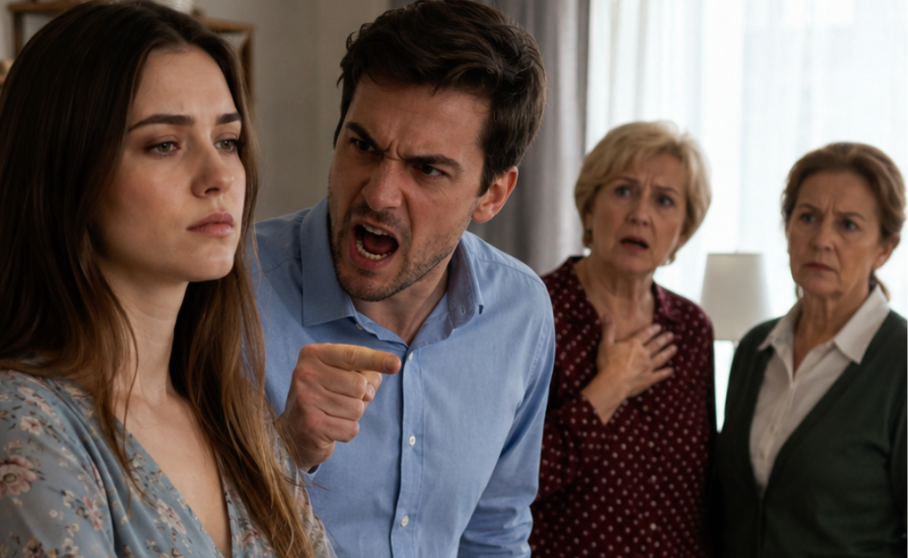
“I don’t care about your ‘buts’!” Artyom’s voice was so loud that the neighbor’s cat behind the wall stopped meowing. “Do you even understand what I’m talking about or not?!”
Lena stood by the kitchen table and looked at her husband. Calmly. Too calmly — and that was exactly what infuriated him.
Artyom wasn’t an evil man. No, really. It was just that something had gone wrong that morning: first a traffic jam on the Garden Ring, then a call from his mother — long, suffocating, full of pauses and sighs — and now he was standing in the kitchen, yelling at his wife, even though she actually had nothing to do with it.
Or did she?
Lena poured herself some water, took a sip, and set the glass down.
“Artyom,” she said quietly, “you’ve been shouting for about ten minutes. Tell me normally: what does your mother want?”
He fell silent. Rubbed his forehead.
“She wants a dacha.”
The story had begun three weeks earlier, when Tamara Vikentyevna — Artyom’s mother, a sixty-two-year-old woman with a halo of dyed hair and the look of someone used to getting her way — called her son and announced that she had “found an option.”
A plot in the Moscow region, forty sotkas, an old little house that “could be fixed up.” The price was four million.
“Mom, I don’t have four million,” Artyom said.
“Well, Lena does,” his mother replied, and she said it so simply and matter-of-factly that he couldn’t even find an answer.
Lena did not find out about that conversation right away. Artyom hesitated somehow, postponed the discussion, then postponed it again. Meanwhile, Tamara Vikentyevna wasted no time — she had already told her friends about the dacha. Lyudmila, Rita, and Zoya. They approved: “Excellent idea, we’ll come visit, relax, fresh air, garden beds…”
Lena learned all of this by chance — when she stopped by her mother-in-law’s place to pick up some documents and found this entire “council of friends” sitting at the table with tea and a printout of the listing.
“Lena, sweetheart!” Tamara Vikentyevna rose to meet her with a smile that made something unpleasant prick inside Lena. “How good that you stopped by. We were just discussing…”
Lena took the documents. Smiled politely. Left.
And thought about it the whole way home.
Lena worked as an accountant in a small logistics company. Quiet, unnoticeable work — exactly the kind no one talks about at family dinners. Not fashionable, not loud. But stable.
For ten years she had been saving money. Not for anything specific — just saving, because that was what her mother had taught her: “You must always have a cushion. Your own. Only yours.” She did not waste money on nonsense, did not take out loans, did not buy fur coats that were “once in a lifetime.” Every month, a percentage went aside. Year after year.
Artyom knew she had savings. But he did not know how much. It was her personal matter, and he respected that. He used to respect it.
When he finally told her everything — about his mother’s call, about the four million, about how “well, she’s alone, she needs somewhere to rest” — Lena listened silently. Then she got up and walked around the room. Artyom followed her with his eyes.
“She wants a dacha,” Lena finally said. “For herself and her friends.”
“Well… yes. She says it’s an investment, that later it will belong to us…”
“Artyom.” Lena stopped. “I will not give money for this.”
“Len…”
“Wait. Let me speak.” She spoke evenly, without shouting, and for some reason that sounded weightier than any scandal. “My savings were built up over years. And I am not obligated to share them with anyone. Anyone at all.”
Artyom opened his mouth. Closed it.
Behind the wall, the cat started howling again.
Tamara Vikentyevna found out about it that same evening — Artyom called her himself, because he was incapable of keeping quiet. He spoke gently, evasively, as best he could: “Lena isn’t ready right now…,” “We need time to think…”
But his mother heard what was between the lines.
She hung up and sat in the kitchen for a long time. Her friends were already waiting for an answer — Lyudmila had written in the messenger: “Well, did you agree?” Rita sent a little dacha-house emoji. Zoya sent a link to garden furniture.
Tamara Vikentyevna stared at her phone screen and felt something in her plan begin to crack.
She had thought it would be simple. A son loves his mother — that was a fact. Her son’s wife was richer than she seemed — she had understood that long ago, from little details: from the way Lena never complained about money, from how calmly she paid for dinners, from the expensive but discreet handbag she had been carrying for three years and that had not looked cheaper with time. Women did not buy bags like that on credit.
So there was money. That meant she could ask.
But something had gone wrong.
Something in Lena — that quiet firmness, that calm gaze — did not fit the script.
Tamara Vikentyevna got up and went to the window. The city rumbled below, cars passed by, someone laughed near the entrance. Life went on as usual — but suddenly she had the feeling that she had failed to account for something. Some detail. An important one.
She began recalling everything she knew about her daughter-in-law.
Meanwhile, Lena was sitting in the bedroom she shared with Artyom, staring at the ceiling.
Artyom had gone into the living room — silently, without slamming the door, and that was a good sign. He knew how to be angry loudly, but he only kept quiet when he was thinking.
Let him think.
She picked up her phone, opened her banking app. Looked at the numbers. Put the phone away.
It was not about the money — or rather, not only about the money. It was about the fact that Tamara Vikentyevna had not even called her personally. Had not asked. Had not talked to her. She had simply informed her son that “Lena has it” — as if Lena were not a person, but a line in the family budget.
Lena remembered that.
Tomorrow she planned to go into the city center — she had a meeting with the company’s accountant, then needed to stop by the MFC for her own matters. An ordinary day. Life moved forward.
But something told her that the dacha story was only beginning.
And that Tamara Vikentyevna was not the kind of person who gave up after the first “no.”
Tamara Vikentyevna called the next day. Not her son — Lena.
That alone was unusual. In five years of marriage, her mother-in-law had called her daughter-in-law maybe ten times at most, and each time strictly on business: to clarify the time, to pass something through Artyom, to congratulate her on her birthday — dryly, businesslike, exactly as many words as necessary.
Lena saw the name on the screen and hesitated slightly before answering.
“Lena, hello. Do you have a minute?”
Her voice was soft. Almost affectionate. That was what put Lena on guard.
“Yes, I’m listening.”
“I was thinking… Maybe we could meet? Talk calmly, without the men.” Tamara Vikentyevna laughed — lightly, familiarly, as though they were friends. “I’ll be near your place, I can stop by.”
Lena looked at the clock. She was just about to leave for the MFC.
“Today won’t work. I’m busy.”
A pause.
“Well, all right,” her mother-in-law said, still just as softly. “Another time.”
She hung up first.
“Another time” came two days later — and without a call.
Lena opened the door and saw Tamara Vikentyevna on the threshold. With pies in a container and the smile of a person who had simply come by, as family.
“Is Artyom home?” her mother-in-law asked, already stepping inside.
“No, he’s at work.”
“Oh, well, that’s fine. I came to see both of you, but since he isn’t here, we’ll sit and chat.”
She was already taking off her shoes in the hallway. Already walking into the kitchen. Already placing the container on the table.
Lena closed the door and simply stood in the hallway for several seconds, watching her go.
Over tea, Tamara Vikentyevna talked a lot and about nothing — the weather, the neighbor who had renovated and “made such a mess, it’s just awful,” the fact that Artyom had loved exactly these cabbage pies when he was a child. Lena listened, nodded, drank tea.
Then her mother-in-law sighed — as though she had only just remembered something insignificant.
“Len, so have you thought about the dacha?”
Lena set down her mug.
“Tamara Vikentyevna, I’ve already stated my opinion.”
“Yes, yes, I understand.” Her mother-in-law waved her hand. “But you understand me too. I’m not asking for a gift — it will be shared. Family property. Artyom has grown up, you’ll have children — where will you take them in the summer? Keep them stuck in the city?”
“We don’t have children yet.”
“Yet!” Tamara Vikentyevna raised a finger. “Exactly — yet. And the dacha will already be there. I’m thinking about the future, Lena. About your future.”
Lena looked at her. Calmly. Studying her.
Her mother-in-law smiled — openly, maternally, and there was something so practiced in that smile that it became a little unsettling.
“I will not give money for a dacha,” Lena said evenly. “That is my final decision.”
Tamara Vikentyevna removed the smile. Not sharply — smoothly, like changing a slide in a presentation.
“So family means nothing to you,” she said quietly.
“Excuse me?”
“I said, family is when people help each other. When they don’t count every penny.” She stood up and began gathering her things. “I thought you were different.”
She left, leaving the container of pies on the table.
Artyom came home at eight. Lena told him everything — briefly, without unnecessary details. He listened, looking at the table.
“She shouldn’t have come like that,” he finally said.
“Yes.”
“I’ll talk to her.”
“Artyom.” Lena waited until he looked at her. “I don’t want you to ‘talk to her.’ I want you to understand for yourself: what she is doing is pressure. She didn’t come here for tea.”
He was silent for a moment.
“I understand.”
“Really?”
“Len…”
“All right.” She stood up. “Talk to her.”
Artyom had the conversation with his mother by phone, in the hallway, in a low voice. Lena did not listen — she went into the room, picked up a book, and did not read it.
Twenty minutes later he came in.
“She’s offended.”
“I figured.”
“She says you’re humiliating her.”
Lena lowered the book.
“Artyom, I simply said no.”
“I know.” He sat down beside her and rubbed his face with his hands. “She knows how to… turn things around like that.”
That was honest. And Lena was grateful to him for that honesty.
But she already felt it — this was not the end. Tamara Vikentyevna was not one of those who stopped. She would regroup, come up with a new approach, involve whoever she needed. Lyudmila and Rita, some mutual acquaintance, some old story from the past that could be presented at the right angle.
Lena knew people like that. She had grown up beside one such person — and had learned to recognize the type from the very first remarks.
Three days later, Lyudmila called — her mother-in-law’s friend, whom Lena had seen maybe a couple of times at family celebrations.
“Lenochka, this is Lyudmila Sergeyevna, do you remember me?”
Lena remembered. A large woman with a loud laugh and a habit of placing her hand on the other person’s shoulder a little longer than necessary.
“I remember. Hello.”
“I’m calling because… Tamara is very upset. She told me about your situation. Don’t be angry with her — she’s a simple, direct person, but she has a heart of gold…”
Lena listened. Lyudmila spoke for another three minutes — about Tamara’s golden heart, about how she had given her whole life to her son, about loneliness and a well-deserved rest.
“Lyudmila Sergeyevna,” Lena interrupted, “are you calling at Tamara Vikentyevna’s request?”
A one-second pause.
“Well… she’s upset, so I…”
“I understand. Thank you for calling.”
She hung up and stared out the window for a long time.
So, now the friends were involved. Now there was already a whole delegation.
Lena smiled faintly — almost without humor. Now it had become truly interesting.
She picked up her phone and dialed her mother’s number. Her mother answered after the second ring.
“Mom, do you have time to talk?”
“For you, always. What happened?”
“Nothing yet.” Lena paused. “But I think something will soon.”
Her mother listened to everything silently — that was her signature quality: not interrupting, not gasping, not inserting sympathetic “oh my goodness” between phrases. She simply listened until the person had said everything to the end.
“I see,” she finally said. “And what do you want to do?”
“I don’t know yet. I want to understand how you see it from the outside.”
“From the outside, I see this,” her mother said evenly, without emotion, like an experienced accountant dictating figures in a report. “A woman wants you to pay for her desire. When you refused, she began building pressure. She involved her circle. This is not the first attempt and it won’t be the last. The next one will come through Artyom, and it will be heavier.”
“I know.”
“Then why are you calling?”
Lena was silent.
“Probably so I won’t feel like a bad person.”
Her mother laughed softly.
“Lena. You said ‘no’ to someone else’s desire at your own expense. That does not make you a bad person. It makes you an adult.”
They talked a little more — about her mother, about her vegetable garden, about the neighbor who had finally fixed the fence. An ordinary conversation. Lena hung up and felt that breathing had become a little easier.
The next two weeks were quiet — suspiciously quiet, the way it is before a thunderstorm, when the birds fall silent before the clouds appear.
Tamara Vikentyevna did not call. Lyudmila did not call. Artyom walked around a little tense, but he held himself together — he did not pressure her, did not hint, and in the mornings he made coffee for two and placed a mug on her side of the table.
Lena noticed that and appreciated it.
Then a message came. Not to Artyom — to her, in a messenger, from an unknown number.
“Lena, this is Zoya, Tamara’s friend. I understand it’s none of my business, but Tamara is feeling very unwell because of this whole situation. Her blood pressure has gone up. Maybe you can still find some way out?”
Lena reread the message twice. Then she wrote briefly:
“Hello, Zoya. Thank you for your concern. I will not change my decision. I wish Tamara Vikentyevna good health.”
She sent it. Put the phone away.
Blood pressure. She had no doubt that the pressure was real — Tamara Vikentyevna was an emotional woman. But Lena had long ago learned not to put an equals sign between “a person feels bad” and “a person gets what they want.”
Artyom found out about Zoya’s message that same evening — Lena showed him the correspondence herself.
He read silently. His face changed — not sharply, not theatrically, but slowly, the way the sky changes toward evening: it did not become lighter.
“She organized this,” he said. He did not ask — he stated it.
“Most likely.”
“Len, I…” He stopped. Started again: “I grew up with this. I don’t always see where care ends and something else begins. Do you understand?”
“I understand.”
“But I see it. Now I see it.”
She looked at him. A tired person who was honestly trying to understand what he had grown into since childhood. That was harder than simply taking someone’s side, and she understood that.
“Good,” she said. “Then you talk to her. Yourself. Tell her that both of us, together, are closing this topic. Not just me — us.”
He nodded.
The conversation took place on Sunday — Artyom went to his mother alone, without Lena. He came back two hours later, silently took off his shoes in the hallway, went into the kitchen, and poured himself some water.
“Well?” Lena asked.
“She cried.” He set down the glass. “She said I had chosen my wife against my mother. That she was alone. That in old age she would have nowhere to rest.”
“And you?”
“And I said that no one was abandoning her. That we would help — as we had helped before. But four million of someone else’s money for a dacha for her friends was not help for his mother; it was something else.”
Lena was silent.
“She fell silent after that,” Artyom added. “For a long time. Then she said, ‘Go.’”
“That is her right.”
“I know.” He looked at Lena. “She’ll call. Not now, but she’ll call. She gets over things once she realizes it won’t work.”
“All right.”
“Len.” He paused. “I’m sorry I shouted then. At the beginning.”
She smiled slightly.
“You scared the neighbor’s cat.”
“He started it.”
Tamara Vikentyevna called ten days later. Her voice was normal — without tears and without affection, simply the voice of an elderly woman calling her son on a Sunday.
They talked about the weather, about the neighbor’s peonies blooming, about some TV series her mother-in-law watched in the evenings. Not a word about the dacha.
At the end, Artyom handed the phone to Lena — simply said, “Mom, here’s Lena, say hello to her.”
“Hello, Lena,” Tamara Vikentyevna said after a pause.
“Hello, Tamara Vikentyevna.”
That was all. But it was something.
That evening, Lena opened her banking app — with the habitual motion of someone opening a window before going to sleep. She looked at the numbers.
The money was still there. Every last kopeck.
She put away the phone and suddenly thought that her mother had been right: savings were not just money. They were years of decisions, years of saying “no” to everything unnecessary, years of quiet discipline that no one knew about and no one praised.
To give that away at the first pressure would mean giving away not money. It would mean giving away a part of herself. Something she would not get back later.
Behind the wall, the neighbor’s cat started up again — long and for no reason at all.
Lena listened and, for some reason, smiled.
Life went on.
The dacha appeared after all.
Not through Lena — through an advertisement on Avito, a gardening association forty kilometers from the city, six sotkas, and a little house the size of a decent hallway. Tamara Vikentyevna bought it herself — she sold an old fur coat, added her savings, and borrowed fifty thousand from Lyudmila.
Artyom found out about it in June, by chance, when his mother mentioned “seedlings.”
“Wait. You bought a dacha?”
“I did,” Tamara Vikentyevna said calmly.
“When?”
“In April. Why I kept quiet, I don’t know. I suppose I was ashamed.”
Artyom did not immediately find an answer. He told Lena that evening, and she was silent for a long time, looking out the window.
“So she could do it,” she finally said. Without triumph. Simply as a fact.
“She could.”
They were silent together.
“Take her there in the summer,” Lena said. “She earned it.”
Artyom looked at his wife. Something inside him shifted — not loudly, not visibly, the way earth shifts deep below the surface.
“You don’t have to say that.”
“I know.” Lena stood up and walked past him into the kitchen. “That’s why I’m saying it.”
In August, they all came together — Artyom, Lena, Tamara Vikentyevna and, of course, Lyudmila and Rita. The little house turned out to be small, crooked, smelling of old wood and someone else’s life. But the currants were good.
Lena sat on the shaky porch with a mug of tea and watched as her mother-in-law drove Artyom back and forth between the garden beds with a watering can — in a commanding voice, habitually, completely happy.
Tamara Vikentyevna turned around and caught her daughter-in-law’s eye. She hesitated.
“Is the tea hot?” she asked.
“Hot,” Lena answered.
That turned out to be enough.