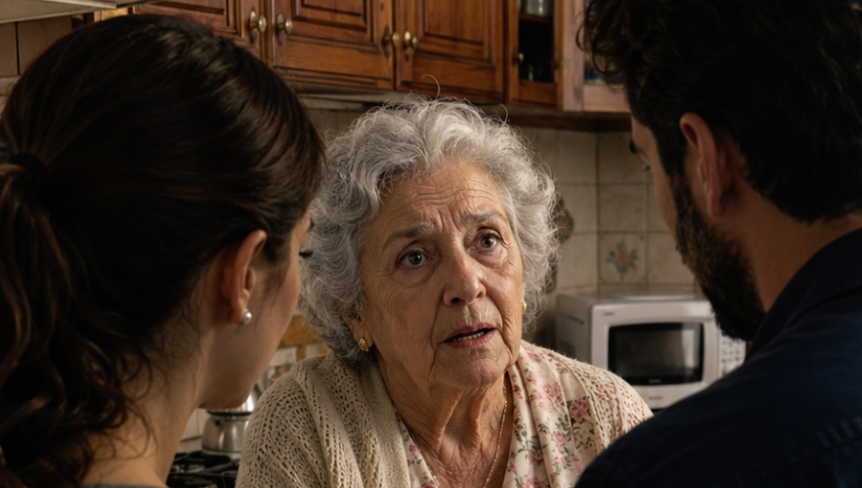
Andrey was spreading butter on a piece of bread when the phone rang. The screen lit up with “Mom,” and he felt the familiar tightness in his chest.
“Andryusha,” his mother’s voice sounded plaintive, with that particular tone that always meant a request was coming. “My joints are aching terribly. I can’t manage the cleaning on my own. Come tomorrow with Lena — let her scrub the bathroom properly, and you can wash the floors for me.”
Lena, sitting across from him with a cup of coffee, raised her eyebrows. Two-year-old Maxim was smearing porridge across the table, happily babbling.
“And where’s Katya?” Andrey slowly put down the knife. “She’s supposed to be looking after you, isn’t she? Remember what you said?”
There was a pause. Through the receiver, only the ticking of the old clock in his mother’s apartment could be heard.
“What are you saying?” his mother’s voice became surprised and wounded. “Katyusha is far away, she has her own life. And you’re my son, you’re obligated…”
“Mom,” Andrey caught his wife’s eyes, “I need to think. I’ll call you back.”
He hung up. Lena silently stood up to clear the table, while Maxim kept laughing, unaware of adult problems.
After the call, Andrey sat in the kitchen for a long time. The cup of cold tea remained in his hands — he kept turning it, staring at nothing. In the room behind the wall, Lena was putting Maxim to bed, and the apartment was quiet.
He remembered the hospital room, that very day when his father could barely speak.
“Look after your mother and Katya…” he wheezed, barely moving his lips.
Andrey nodded. Back then, there had simply been no time to argue or even think.
At first, he really did try. Every weekend, he went to his mother’s place. He fixed the faucet, bought groceries, drove her to the dacha. At that time, Katya had just split up with some man — she said she had no money and asked for help. He transferred fifteen thousand to her almost without asking questions.
His mother greeted him not with gratitude, but with complaints.
“Well, finally. The tiles in the bathroom have been barely holding on for ages. Why did it take you so long to come?” she would wipe her hands on her apron and immediately add, “Katya called yesterday, crying. She doesn’t have enough money.”
And she always mentioned the neighbor:
“Svetlana’s son comes by every day. And what about me? Only on Sundays — and even that depends.”
At first, Lena tried to be polite and helped around the house — washed dishes, dusted. But his mother always found something to criticize.
“You wiped the mirror badly. And the floor is still dirty. Katya would have scrubbed everything properly by now.”
After several visits like that, Lena said that from then on, Andrey could go alone. He didn’t argue.
And then the most unpleasant thing happened. Grandma’s apartment — a three-room place on Molodezhnaya Street — had always been considered family property. His mother used to say, “I’ll divide it between you fairly.” Then came silence. And suddenly, the news: everything had been transferred to Katya.
“She’s nearby. She promised she would look after me,” his mother said without raising her eyes.
Andrey said nothing. He simply walked out and left. Everything inside him tightened, but he didn’t argue. At home, he only nodded silently to Lena. There was nothing to explain — she understood everything anyway.
Now he sat in that same kitchen, with that same cup in his hands, thinking:
At what point had everything gone wrong? When had “look after her” turned into “I carry everything alone”? And how had it happened that for being “obligated,” he was not even owed a thank you?
That evening, he sat in the nursery, rocking Maxim in his arms. The same thoughts kept spinning in his head: no matter how hard you try, it is never enough. Not fast enough, not good enough. And everything is always wrong.
The boy was breathing softly against his shoulder, trustingly pressed close. Andrey stroked his son’s back and imagined: Maxim would grow up, start his own family — and what, would he himself demand the same “sacrifices” from him? Compare his daughter-in-law to someone else, reproach her, manipulate them with health, duty, and resentment?
“Never,” he said almost in a whisper.
In the kitchen, Lena was washing the dishes after dinner. Ever since his mother had last called her “useless,” Lena had simply stopped asking about visits. They had both pretended nothing had happened.
Andrey came out with the child in his arms.
“Len,” he began calmly, “I’m not going to run to my mother at her first call anymore.”
Lena turned around, not quite believing what she had heard.
“I’m really tired,” he continued. “Tired of feeling guilty all the time. Tired of constantly proving something — to her, to Katya, to myself. Katya got the apartment? Fine. Then let her take care of her. I’ve done my part. From now on — no. I’m no longer in debt.”
He spoke calmly. Not with resentment, not with anger. Just as it was.
“I want a normal life. For us. For Max. Without scandals, resentment, manipulation. I don’t want him growing up in this…”
He didn’t finish. He didn’t need to.
Lena turned off the water. She came over and hugged them. She simply pressed herself close, saying nothing.
“That’s it,” Andrey said. “Enough. From now on, I live for my own family.”
Maxim whimpered, and his father gently held him closer. And at that moment, the house suddenly became truly peaceful.
Two weeks passed — no calls, no messages. Andrey even began to think that his mother had actually heard him. Or at least understood that pressure would no longer work.
Saturday morning went on as usual. Maxim was playing on the carpet with building blocks, and Andrey was helping him build a tower.
Then the phone rang. Mom.
Andrey looked at the screen, sighed, and answered.
“Hello.”
“Andryush,” his mother’s voice was cheerful, as if nothing had happened. “My place is simply awful right now. Come with Lena, help me clean up. I really can’t manage anymore.”
Andrey didn’t raise his head, continuing to stack one block on another.
“Mom, you made the decision yourself. The apartment belongs to Katya now — let her help.”
A pause.
“What Katya?” There was clear confusion in her voice, almost offense. “She’s in Yekaterinburg. Pregnant, by the way. Terrible morning sickness, life is hard for her. She rented out the apartment and is now crammed in at her mother-in-law’s. She has no time for me at all right now.”
Maxim joyfully knocked down the tower, and the blocks scattered across the carpet.
“Well, if she rented it out,” Andrey said calmly, “then let her use the rent money to hire a cleaning service. A cleaner will do everything in two hours.”
“What?” his mother immediately raised her voice. “So strangers can rummage through my things?! Are you out of your mind? You have no heart! My hands don’t bend, my knees hurt, and you abandoned me like I’m useless…”
Andrey looked at his wife, then at his son, who was already gathering the blocks into a little pile again.
“Mom, I can’t talk right now. I’ll call later.”
He ended the call without waiting for an answer and immediately turned off the sound. He placed the phone face down.
Lena stood in the kitchen preparing dinner, but her thoughts were far away. “Does she really think everything will just be forgotten?” kept spinning in her head. As if there had been no scandals, no reproaches, no scene with the apartment. As if it were normal to call, ask for help, and pretend everything was just like before.
The kitchen was quiet. Maxim sat in his high chair, with puree on his nose and under his chin. Andrey was feeding him with a spoon — patiently, carefully. From time to time, he brought a napkin to his cheek, smiled, and murmured something softly to his son.
The phone rang again. The screen showed “Katya.”
“Andrey, what are you doing?” his sister started immediately. “Mom is in tears! You’re a grown man — how can you behave like this? She’s hurt, she’s upset! You’re her son! What are you doing?”
“Katya,” Andrey’s voice was calmer than ever, “don’t call me anymore. We’ve decided everything.”
And he pressed “end call.” For a second, he thought — then turned the phone off completely.
Lena turned around. She looked at him silently, without questions. He was sitting with Maxim in his arms, and in that moment he seemed different. Not tired, not irritated — calm. Steady. Real.
The boy reached toward him with his little hands, babbling and laughing. Andrey hugged him tighter and kissed the top of his head.
“That’s it,” he said quietly. “Enough. No one will shout in our home anymore.”
Six months passed.
Maxim was already running confidently. Lena sat nearby on the carpet, watching her son.
The door slammed — Andrey had come home from work. Before he even managed to take off his jacket, he walked over and picked up his son. Maxim, glowing with joy, clapped his hands and suddenly said clearly:
“Papa!”
Andrey froze for a second, as if he couldn’t believe it.
“Did you hear that?” he turned to Lena. “He said ‘Papa’! Did you hear?”
“I heard,” Lena smiled. “Loudly and with expression.”
He laughed and spun around the room with his son, gently tossing him upward. Maxim squealed with delight.
Lena smiled as she watched them. There was a lightness in the house that had been missing before. Warm food on the stove, a clean floor, no tension in the air. Suddenly Lena caught herself thinking: this is how it should be. Normal. Simple. Without constant anxiety.
Six months without calls full of reproaches. Without sudden demands, manipulation, hints about “duty to family.” Only rare neutral messages from Katya — no more than a couple of lines. From his mother — silence. No admissions, no apologies, no threats. She had simply disappeared.
Recently, a neighbor on the stairwell had asked:
“So the grandmother doesn’t see her grandson?”
Lena shrugged.
“She doesn’t. She’s busy.”
She didn’t explain further.
That evening, while putting her son to bed, Lena held him close and thought: “I will never treat you the way your grandmother treats your father. I will never demand sacrifices, never set conditions, never turn love into a commodity.”
Andrey quietly entered the room. He embraced them both — Lena was still holding their son in her arms.
“Do you regret it?” she asked softly, without lifting her head.
He didn’t answer right away. He only held them a little tighter.
“Not for a second,” he said. “We did the right thing.”
Behind the wall, someone was arguing again — muffled voices, a quarrel against the sound of a television. But in their home it was quiet. Without tension, without a showy idyll — simply peaceful.
A real life of their own.
Two years passed.
Maxim raced around the apartment with a toy car in his hands, imitating a loud engine. Across the floor were tracks made of pillows and books, and on the sofa was a pile of ironed children’s clothes. Lena was folding things, adjusting her belly: her due date was approaching, and soon there would be one more little person in the house.
Then the phone rang.
The screen showed “Mom.”
Before, that would have immediately made his pulse jump. Now — nothing. Just a call.
Andrey looked at the screen for a couple of seconds, then answered.
“Hello.”
“Andryusha… There’s something wrong with the bathroom again… The plumber promised to come and didn’t. I don’t even know who to call anymore…” Her voice was tired, even confused. No reproaches, no accusations. Just exhaustion.
Andrey nodded, as if to himself.
“Mom, call a service. These things are solved in five minutes now. Type ‘plumber,’ the city, and choose one with reviews. Okay?”
“Well… all right…” the voice on the other end sounded dull.
He pressed “end call” and put the phone down. A simple “no” that no longer needed explanation.
Meanwhile, Maxim poked Lena’s belly with his finger.
“There? Baby?”
“Yes,” Lena confirmed, smiling. “Soon your little brother or sister will be here.”
She stroked her son’s head, then her belly. Everything was in its place.