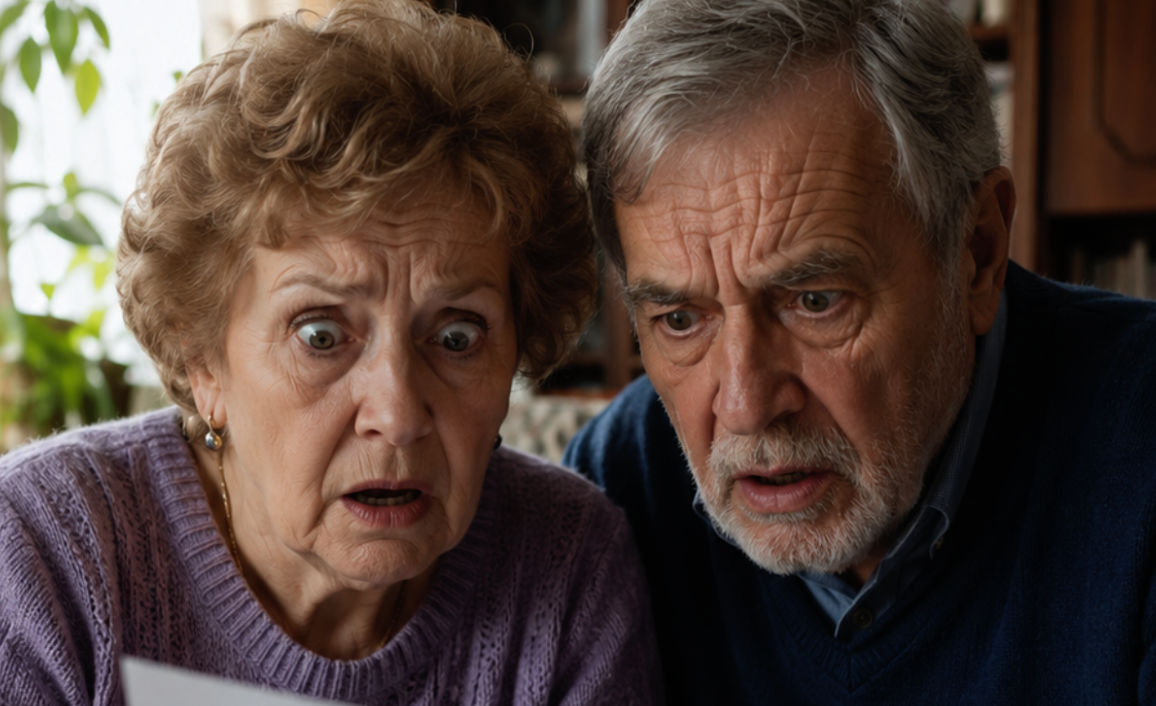
Nina, are you going through my papers again?” Gennady entered the room so quietly that I flinched.
“I’m looking for my glasses,” I said, without lifting my eyes from the desk.
“Your glasses are in the bedroom. I saw them this morning. Go.”
His voice was even. I knew that voice well — it appeared whenever he wanted me to shut up and leave. Usually, I left. For fifteen years, I had developed that habit: hear that voice — and go. But this time, I did not move.
On the edge of the desk lay a stack of papers held together with a paper clip. On top was a sheet with a large heading: “Agreement for the Sale and Purchase of a Land Plot.” And just below it — my surname. Belyakova Nina Sergeyevna. And a signature. Only it was not mine.
I had never signed anything like that. For a second, I even thought I had mistaken the surname — that this was someone else’s contract, someone else’s papers, someone else’s story. But no. Belyakova Nina Sergeyevna. That was me. And the dacha on Sosnovaya Street was mine. And the signature was not mine.
“What is this?” I asked.
“None of your business. I said, go.”
I picked up the papers from the desk before he managed to step toward me.
Things had been different between us in different years. Gennady was five years older than me — he was sixty-three, I was fifty-eight. We met when he had just left his first marriage, and I had already been living alone for ten years after my divorce. I thought he was mature, serious, reliable. Maybe he was, for the first three years. Then things changed. First came the tone. Then the habit of deciding for both of us. Then the habit of not talking at all.
The dacha in the Moscow region had come to me from my father. Forty minutes from the city, six hundred square meters of land, an old house with an apple tree by the fence. I went there every summer, planted tomatoes, made jam. Gennady did not like going there — he said it was far and boring. But as soon as I registered the dacha in my name after my father’s death, he began asking how much plots like that were worth now, whether I was thinking of selling it, why I needed all that trouble. I answered briefly: I was not thinking of selling. He would fall silent. Then, a few months later, he would start again.
I was not planning to sell. The dacha was mine — the only thing I had that was personally mine. The apartment where Gennady and I lived belonged to him; he had bought it before our marriage. Everything there was his: the furniture he had chosen himself, the order he imposed, the voice that filled the space. But at the dacha, I planted tomatoes and made jam, and there everything was mine.
I unfolded the papers right in front of him.
The agreement had been drawn up three weeks earlier. Seller: Belyakova Nina Sergeyevna. Buyer: a certain Roman Dmitrievich Artyukhov. Price: three million four hundred thousand rubles. In the line marked “seller’s signature,” there was something vaguely resembling the letter “N” with a loop — a loop that had never existed in my signature. I sign clearly, without flourishes — I always have, ever since Soviet times, when I worked in accounting.
“Gennady,” I said very calmly, “did you sell my dacha?”
“I’m handling this matter. The money will go to the family.”
“You forged my signature.”
“I didn’t forge anything. I simply prepared a preliminary agreement. It doesn’t mean anything yet. Calm down.”
“Preliminary” — he pronounced the word confidently, as if it explained everything. I looked at the paper again. At the top, it said “Agreement for the Sale and Purchase,” not “preliminary.” And the date: May twenty-third. Exactly twenty-three days ago.
I placed the agreement back on the desk, but I did not let go of it.
“Where is the money?” I asked.
“What money?”
“The three million four hundred thousand. Has Artyukhov already paid?”
“These are my negotiations, Nina. You don’t understand how this works.”
I understood enough. In fifteen years, I had learned a thing or two about how Gennady worked. When he wanted to hide something, he said I did not understand. When he wanted me to agree, he said it was in the family’s interest. When he wanted me to be silent, his voice became even, just like now.
“Give me the paper,” he said, holding out his hand.
I stepped back.
“No.”
He looked at me. Something new appeared in his eyes — not anger, but something like confusion. He had not expected me not to leave.
“Nina, don’t turn this into a story.”
“I’m not turning it into one. I’m reading it.”
I walked out with the papers in my hand.
I went down the corridor thinking of only one thing: that I was holding in my hands an agreement for the sale of my property. An agreement that Gennady had drawn up, signed with someone else’s hand, and had already received money for. And all of it had happened over twenty-three days, while I lived beside him and suspected nothing.
In the bedroom, I found my glasses — they were exactly where he had said they were, on the nightstand. I put them on and read the agreement again from beginning to end. Three pages. A detailed description of the plot: cadastral number, area, address. Everything was accurate. The price written both in words and figures. The transfer deadline: June fifteenth. In other words, today.
The buyer was obligated to pay an advance of eight hundred seventy thousand rubles within three days of signing. The agreement was dated May twenty-third. Three days meant May twenty-sixth. Today was June fifteenth. The advance should have been paid long ago.
I folded the agreement, placed it on the bed, and simply sat there for a minute. Silently. Without panic. Inside, there was a strange feeling — not fear, but almost the opposite. Clarity. As if something that had long been pressing quietly from the side had finally received a name and a shape.
I thought: fifteen years. For fifteen years, I thought I knew this man. That his habits, his tone, his decisions were simply his character — something one could get used to. It turned out that his character was only the outer layer. And underneath it was this. A paper with someone else’s signature and my surname.
I stood up, took the agreement, and returned to the study.
“Is the advance already in the account?” I asked directly from the doorway.
Gennady was standing by the window. He turned around slowly.
“You have no right to interfere in my financial affairs.”
“This is my dacha, Gennady. I have every right to anything connected with it.”
“We’re married. It’s jointly acquired property.”
“No. The dacha was inherited. It is my personal property. You know that. We both know that.”
He was silent for a moment. Then he did something I did not expect: he sat down in the armchair and crossed his arms. As if he were preparing for negotiations. Not an explanation — negotiations.
“Eight hundred seventy thousand has already arrived. In my account. I wanted to talk to you later, when everything settled down.”
“Later.” I repeated the word. “When the dacha had already passed to Artyukhov.”
“Nina, we could have…”
“Where is the money now?”
“On the card.”
“Were you ever going to tell me about this?”
He did not answer right away. The pause was too long.
“Gennady. Were you going to tell me about this?”
“I planned to discuss it with you before the deal was fully completed.”
That meant no. He planned to receive three million four hundred thousand rubles and then present me with a fait accompli. Or not tell me at all — simply move the money somewhere and explain later, when the dacha already belonged to someone else and it would be too late to change anything. He had calculated it. The same way he had calculated everything else over the past fifteen years.
“Where was the money supposed to go?”
Another pause.
“For family needs.”
“What specific needs?”
“Nina…”
“What family needs, Gennady?”
He turned away toward the window.
“Katya got into a difficult situation.”
Katya was his daughter from his first marriage. She was thirty-one, lived in another city, and in all fifteen years of my marriage to Gennady, she had never once come to visit us. But when she needed money, she called — and Gennady always answered. Three years ago, he gave her two hundred forty thousand rubles. He said he had taken it from his bonus. I believed him then and asked nothing. Standing there now in that study with the agreement in my hands, I thought about those two hundred forty thousand. I wondered whose money it had been. And I wondered how many more times I had believed without asking.
“How much did you want to give her?”
There was fatigue in his eyes. Not shame — the fatigue of a person caught doing something he considered right and almost finished.
“Eight hundred. From the advance. The rest would be ours.”
“From the advance for my dacha. Which you sold without my consent. Placing someone else’s signature under my surname.”
“Nina, enough. This is not the final agreement yet.”
“This is a sale and purchase agreement. There is a signature on it. Not my signature.”
He stood up.
“You’re overreacting. I’ll call Artyukhov and tell him we need a pause. I’ll settle everything.”
“You won’t settle anything anymore.”
I took the agreement and left. This time, for good.
Valentina lived two buildings away. We had been friends for thirty years, since our old job, from the days when we both ran around to negotiations with invoices and acceptance acts and knew each other better than any husband. She opened the door immediately and looked at my face.
“Come in. I’ll put the kettle on.”
“Wait with the tea. Look at this.”
I placed the agreement on her kitchen table. She took the papers in both hands and read slowly, without rushing. She turned the page. Then she went back once more to the line with the signature. After that, she raised her eyes to me over her glasses.
“Is this your signature?”
“No.”
“Did you give him a power of attorney? Ever, for anything connected with this plot?”
“Never. Not once in my life.”
She placed the agreement on the table and covered it with her palm, as though she wanted to pin it down.
“Nina. This is a criminal offense.”
“I know.”
“Forgery of a document. Property fraud. This is not a misunderstanding, not ‘he didn’t think.’ Did he understand what he was doing?”
“He understood. He was just sure I wouldn’t find the agreement in time. Or that I would find it — and keep quiet.”
“You kept quiet for fifteen years?”
“Sometimes. But not now.”
Valentina looked at me for a long moment. Then she nodded quietly, as if answering some question of her own that she had been asking herself for a long time.
Valentina stood up and put the kettle on the stove — just to keep her hands busy.
“What do you want to do?”
“I want to keep the dacha,” I said. “And I want his name not to appear in a single document connected to my property.”
“Then listen. First, a notary — to record the agreement and the signature. Then the police. Exactly in that order. Change it, and you’ll ruin things.”
“All right.”
“I can go with you tomorrow.”
“No need. I can handle it.”
She looked at me carefully. Then slowly nodded — the way people nod when they believe you, not just when they agree.
“I know you can. I’m just saying: if you need me, I’m here. Anytime.”
The next morning, I was at the notary’s office at nine. I took the agreement, my certificate of ownership for the plot, and my passport. The notary — a calm, attentive woman of about forty — studied the papers without rushing. Then she set them aside and began asking questions.
“Did you sign this agreement?”
“No.”
“Did you give anyone a notarized power of attorney to dispose of this property?”
“Never.”
“Are you aware that an advance payment under this agreement was transferred?”
“My husband told me about it yesterday. The amount is eight hundred seventy thousand rubles.”
The notary explained: a dacha received by inheritance is not jointly acquired marital property, even during marriage. The husband had no right either to sell it or to sign any agreements on my behalf without a notarized power of attorney. What I was holding in my hands was legally void from the moment it was created — as if that sheet of paper had never existed. However, that did not remove the risk of claims from the buyer, who had already transferred money and had the right to demand its return.
“You need a handwriting examination,” she said. “It will confirm the discrepancy in the signature. And at the same time, a police report. Without both steps, this situation will not be closed.”
“Is the buyer acting in good faith?” I asked.
“That will be determined by the investigation. Your task now is to record the fact of forgery before the transaction is registered.”
“How soon?”
“The transfer deadline in the agreement is June fifteenth.” She looked at the page. “Today is June fifteenth. Better right now.”
I looked at the clock. Ten in the morning.
Gennady called at eleven while I was walking to the police station.
“Nina, where are you?”
“Running errands.”
“Artyukhov is demanding an answer. Either the plot, or the return of the advance with a penalty.”
“That is his right.”
“Nina, if we don’t complete the deal, I’ll have to return double. According to the deposit terms — more than a million.”
“You will. Not me. You signed it.”
“Your surname is there!”
“But not my signature. That is a big difference.”
“What are you doing?”
“Solving the problem,” I said, and put the phone away.
I spent almost two hours at the police station. I wrote a detailed statement: the date the agreement had been drawn up, the amount, the cadastral number of the plot, the circumstances under which I discovered it, information about my husband. I wrote carefully, took my time, reread every paragraph. The investigator — a man of about fifty with an attentive gaze — asked specific questions and nothing unnecessary. He took a copy of the agreement, asked for the original certificate of ownership, and wrote down the notary’s details. He explained that filing the report automatically blocked the registration of the transfer of ownership in Rosreestr. That meant the transaction could not be completed until the report was withdrawn or reviewed.
“Does your husband know you’re here?” he asked.
“No.”
“He’ll find out soon.”
“Let him,” I said.
Valentina was waiting for me near the entrance with two shopping bags. She looked at me the way people look when they want to make sure someone is all right.
“Well?”
“I filed the report. The notary entered the agreement into the register of suspicious transactions. Artyukhov will receive an official notice.”
“Gennady is home. He called me, asking where you were.”
“What did you say?”
“That I didn’t know.” She paused. “Nina, are you sure?”
“I’m sure.”
“This is a big step.”
“He took it first. Three weeks ago, when he put someone else’s signature under my surname.”
Gennady was waiting for me in the corridor. When I opened the door, he began speaking immediately — quickly, with prepared words.
“Nina, let’s talk normally. I didn’t want to hurt you. I thought I would sort everything out myself and tell you when it was ready. The money would have gone to the family anyway.”
“When would it have been ‘ready’? When the dacha had already passed to Artyukhov?”
“We would have talked before that.”
“Gennady. You put someone else’s signature under my surname. You received eight hundred seventy thousand rubles for my property. Without my knowledge. This is not a paperwork mistake. It was a choice.”
“It’s a technical matter. You don’t understand how such transactions are arranged.”
“I understand enough. And now I’m explaining it to an investigator.”
He fell silent. He looked at me for a long time — no longer with fatigue, but with something else. Perhaps only now did he truly understand that I would not leave the room because of his voice.
“You’ve already been there,” he said quietly. He did not ask — he stated it.
“Yes.”
“Nina… Do you understand what this means? I’ll have to return double. Under the terms of the agreement — one million seven hundred forty thousand rubles.”
“That is your problem, not mine.”
“Where am I supposed to get that kind of money?”
“You found eight hundred seventy thousand when you planned to sell my dacha. You’ll find it now too.”
I walked past him into the room. From the top shelf, I took down a travel bag. I opened the drawer and began packing things carefully, without haste. A warm sweater. Documents. A charger. The photograph of my father at the dacha, which had hung above my desk for a long time — I took it down and packed it too.
Gennady stood in the doorway.
“Nina, you’re not really leaving.”
I did not answer. I continued packing.
“We can solve this differently. I’ll return the money to Artyukhov. We’ll close the story.”
“The report has been filed. It cannot be closed anymore.”
“You could try to withdraw it.”
“No.”
“Nina…” His voice became quieter. “I really was thinking about the family. Katya is alone, she has a child, debts. I didn’t know how to ask you.”
I zipped up the bag. I took the certificate of ownership for the dacha — it had always been with me, not with him — and placed it in the inner pocket beside my passport.
“When you don’t know how to ask, you ask,” I said. “You don’t sign.”
“Nina…”
“The lawyer will contact you this week. Answer directly. It is in your own interest.”
“Nina, where are you going now?”
“To my sister’s.”
“Nina, that’s not a solution. You can’t just leave.”
“Look carefully,” I said. “I already am leaving.”
I put on my jacket, took the bag — heavy, real — and the keys to the dacha.
“Family is not something one person decides alone. Behind someone’s back. Without the knowledge of the person beside them. With someone else’s signature under my surname.”
And I left.
At my sister’s, it was quiet. A small apartment, a separate room, no unnecessary questions. My sister poured tea, placed a plate of sandwiches on the table — I had not eaten since morning and only now realized it. Then she sat across from me and said only, “You did the right thing.” She added nothing else — no advice, no questions, no cautious remarks about how everything needed to be weighed carefully. Just: you did the right thing. I was more grateful to her for that than for anything else.
I slept deeply — for the first time in a long while. Not because everything had been resolved, but because I finally knew what I was going to do next.
The notary’s call caught me at breakfast. She spoke briefly, point by point. The handwriting examination had confirmed that the signature did not match the samples provided from banking documents. The agreement was officially recognized as legally void. Registration of the transfer of ownership in Rosreestr had been blocked. Artyukhov had been officially notified that the transaction could not be completed. Gennady had received a demand to return the advance — eight hundred seventy thousand rubles — as the party who had drawn up the void document. The investigator had accepted the case for proceedings.
I thanked her and hung up.
Then I called the gardening association and told them I would be coming today, asking them to open the gate.
The dacha greeted me with silence. I unlocked the gate and walked across the plot. The apple tree by the fence was already blooming — I had not even noticed when it had happened. The tomato seedlings stood on the windowsill, a little stretched out from the time I had been away, but alive, strong. I had planted them in April, coming specially for one day while Gennady was in the city. I carried the trays outside and began planting them in the garden bed. The soil after the rain was soft, my hands worked steadily, and my head was clear.
For fifteen years, I had thought peace meant not being disturbed. It turned out that peace meant holding my own documents in my own hands.
I reached the end of the garden bed, straightened up, and looked at the plot. Six hundred square meters, an old house, an apple tree by the fence. Mine.
Then I returned to the house, took out my phone, and called the lawyer to clarify the next steps in the case.
Your own signature is the only signature that matters.